

Table of Contents
Picture two boarding passes. One is for Seattle to Vancouver, a hop of 127 miles (205 km) with an estimated flight time of an hour and 10 minutes. The other is Los Angeles to Honolulu: 2,553 miles (4,108 km), most of it over open Pacific, and about six hours in the air.
The short hop is the international flight. The ocean crossing is domestic, and nobody will ask to see your passport.
Yet it is the Honolulu flight that takes more preparation. “International” is a word about borders, and most of what changes behind the scenes of a flight has little to do with borders. Here is what actually changes, and what decides each piece.
What Is the Difference Between Domestic and International Flights?
A domestic flight starts and ends in the same country, and an international flight crosses a border. For passengers, that border brings passports, customs and immigration, a passenger manifest sent to the government, an earlier check-in cutoff and different tarmac-delay rules.
For the airline, the border is only one of three lines that matter. The FAA sorts airline flying by whether it leaves the 48 contiguous states, which puts Hawaii on the international side of the fuel rules. And distance from the nearest shoreline decides the life vests, the life rafts and, for twin-engine jets, a special approval called ETOPS.
The answer in one line
Customs cares whether a flight crosses a border. The FAA’s fuel rules care whether it leaves the 48 contiguous states. The safety equipment cares how far it gets from shore. A flight to Hawaii is domestic on the first count and ocean-grade on the other two.
Here is how each difference lines up, and which of the three lines decides it.
| What changes | Typical domestic flight | Typical international flight | Decided by |
|---|---|---|---|
| Passport, customs and immigration | Not needed | Required, sometimes cleared before departure | The border |
| Check-in cutoff (United) | 45 minutes | 60 minutes, up to 90 at some airports | The border |
| Tarmac delay limit at US airports | 3 hours | 4 hours | The border |
| Fuel reserves | Destination, alternate, plus 45 minutes | Adds 10% of flight time and a 30-minute hold | Leaving the 48 contiguous states |
| Life vests and life rafts | Required beyond 50 nautical miles from shore | Same rule | Distance from shore |
| Twin-engine ETOPS approval | Needed beyond 60 minutes from an adequate airport | Same rule | Distance from airports |
| Pilot duty limits | Part 117 | Part 117 | Length of the duty day |
| Leftover galley food | Ordinary trash, except flights from Hawaii and US territories | Incinerated or sterilized under inspection | Ports outside the US and Canada |
The border decides the paperwork
Everything a passenger notices about an international flight comes from the border line. For a flight into the United States, the airline must send US Customs and Border Protection a manifest with each traveler’s name, date of birth, citizenship and passport details.
The deadline is tight. A batch manifest has to reach CBP no later than 30 minutes before the aircraft is secured for departure, or passengers can be cleared one at a time up to the moment it is.
Check-in closes earlier too. Since June 2025, United’s cutoff has been 45 minutes before departure for most domestic flights and an hour for international ones, stretching to 75 minutes at Paris and Dubai and 90 minutes at Toronto and Lagos. It is one of the hard deadlines that decide how early to get to the airport.
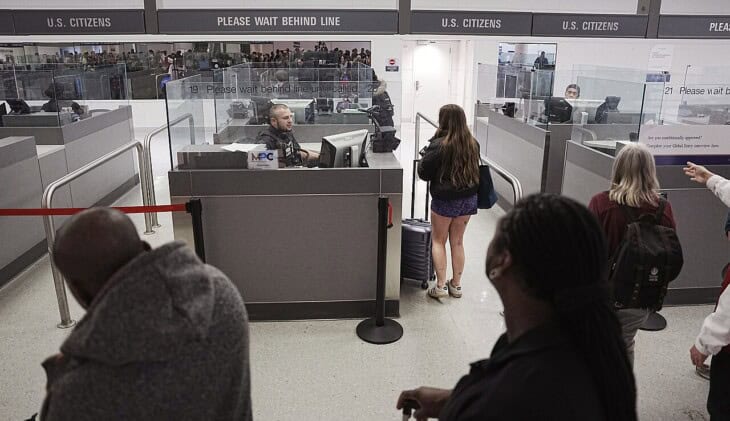
The consumer rules split along the same line. At a US airport, an airline must give passengers on a domestic flight the chance to get off before a tarmac delay passes three hours, and on an international flight before it passes four. Food and water are due by the two-hour mark on both.
Then there is the exception that moves the border itself. At 16 airports in six countries, US officers clear passengers through customs and immigration before they board: Dublin and Shannon in Ireland, Aruba, Bermuda, Abu Dhabi, Nassau and ten airports in Canada.
Passengers on those flights skip CBP and TSA inspection on arrival and go straight to a connection or out of the airport, CBP says. Vancouver is on the list, so the return flight to Seattle ends with no customs line at all.
The FAA draws its line around the 48 states
The FAA does not split airline flying into domestic and international. Its definitions, in 14 CFR 110.2, split scheduled flying into domestic operations and flag operations, and the line between them is not the national border.
A domestic operation stays within the 48 contiguous states and DC, or entirely within a single state or territory. A flag operation runs between Hawaii, Alaska or a US territory and any point outside it, or between the 48 states and anywhere beyond them.
So Los Angeles to Honolulu is a flag operation, while Honolulu to Hilo, which never leaves the state, is domestic. The rule bends the other way too: the FAA can specifically authorize flights from the 48 states to a named point outside them under domestic rules.
The difference shows up in the fuel tanks. A domestic operation must carry enough fuel to reach its destination, fly on to the most distant alternate airport, and then fly 45 more minutes at normal cruise.
A flag operation outside the 48 states must carry fuel to its destination plus an extra 10% of the total flight time, then enough to reach the alternate, then 30 minutes of holding at 1,500 feet above it. On a six-hour crossing to Honolulu, that 10% alone is 36 minutes of extra flying.
Where no alternate airport is named, the flag rule instead demands at least two hours of fuel at normal cruise after reaching the destination. These are legal floors, the starting point for the fuel decision a dispatcher makes before every flight, not the final number.
The ocean decides the life vests
Now look under your seat. FAA rules define an extended overwater operation as a flight more than 50 nautical miles from the nearest shoreline, and it makes no difference which country the flight is going to.
On those flights, every occupant needs a life preserver with a survivor locator light. The aircraft also needs enough life rafts for everyone, a pyrotechnic signaling device for each raft and a survival-type emergency locator transmitter.
Closer to shore, the rules ask for less: any flight over water needs a life preserver or an approved flotation means for each occupant. On some airliners that flotation means is the seat cushion, though the NTSB has noted that some newer cushions are too thin to float, so those aircraft carry life vests instead.
Seattle to Vancouver is only 110 nautical miles end to end and never gets near the 50-nautical-mile mark. Los Angeles to Honolulu spends hours far beyond it, so the domestic flight is the one that needs the full overwater kit.
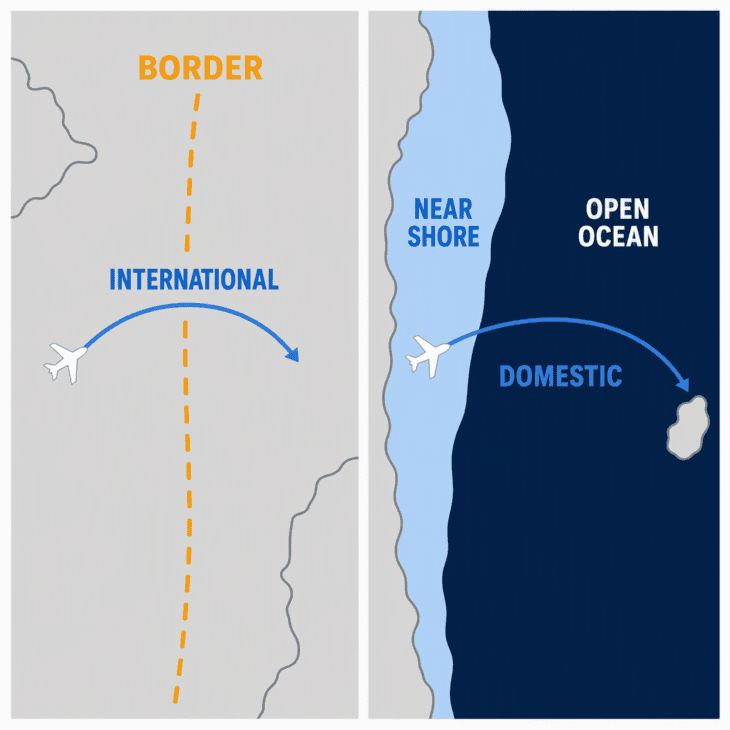
Twin-engine jets face one more distance rule. A US airline may not fly a two-engine airplane on a route with any point more than 60 minutes’ flying time from an adequate airport without FAA approval under the extended operations rules known as ETOPS. The rule makes no exception for domestic flights.
Hawaii is the textbook case. Southwest could not start flying its 737s to the islands until the FAA approved its ETOPS operation on February 27, 2019, after a process that included validation flights with FAA officials on board.
The approval covers individual aircraft, not just the airline. Southwest told Simple Flying in February 2025 that 138 of its jets were ETOPS certified, 28 737-800s and 110 737 MAX 8s, with the MAX 8 rated to fly up to 180 minutes from a diversion airport.
Domestic, but built for the ocean
A Los Angeles to Honolulu flight needs no passport. On a twin-engine jet it still needs ETOPS approval, a life preserver with a locator light for every occupant, life rafts, and flag-operation fuel reserves. The international hop from Seattle to Vancouver needs a passport, but it never goes far enough from shore or from an airport to need the overwater kit or ETOPS.
Long flights, not borders, change the crew and the galley
Pilot duty limits are the change people most often assume follows the border, and they do not. Part 117, the FAA’s flight and duty rule, covers domestic, flag and supplemental passenger flying alike.
What changes the crew is the length of the duty day. A flight too long for a standard crew gets an augmented crew with extra pilots, under its own table of limits in the same rule. It is the same rulebook behind the crew rest rules that can cancel your flight.
The galley is where the border matters in the strangest way. Leftover food, and the trash that touched it, from an aircraft that has been in any port outside the United States and Canada in the previous two years is regulated garbage under USDA rules.
It must stay in tight, covered, leak-proof containers on board, then leave the aircraft under an inspector’s supervision for incineration, sterilization or grinding into an approved sewage system. Sterilization, in the regulation’s words, means cooking the garbage at an internal temperature of 212°F (100°C) for 30 minutes.
Canada is written into the rule as an exception. Hawaii is written into it the other way: flights from Hawaii and US territories to the mainland fall under the garbage rules, even though on your ticket they are domestic.
The myth: international means long-haul
The myth
International flights are the long, demanding ones and domestic flights are the simple ones. In fact the longest flights in the US are domestic, and an international flight can be a 127-mile hop.
The picture of an international flight as a long-haul, widebody event does not survive a look at the map. Every one of the 50 routes on our ranking of the longest flights in the United States, updated September 14, 2026, starts or ends in Hawaii or Alaska.
The top 16 all touch Hawaii, led by Boston to Honolulu at 5,087 miles (8,186 km). Those routes are domestic for customs purposes, and they are exactly the flying that the flag fuel rules, the overwater rules and ETOPS cover.
Meanwhile the Seattle to Vancouver hop crosses a border in about an hour and 10 minutes. It needs a passport, a manifest and, on the way back, a preclearance check in Vancouver, but no life rafts and no ETOPS approval.
So the next time a departures board says “international,” read it as a statement about your paperwork. The border decides whether you meet a customs officer, and not much else.
The map decides the fuel, the ocean decides the life vests, and the length of the day decides the crew. By those measures, the six-hour domestic flight to Honolulu has far more in common with a flight to Tokyo than the hop to Vancouver does.
Sources and references used for research and fact-checking.
- Legal Information Institute, Cornell Law School, 14 CFR 110.2: Definitions (domestic, flag and supplemental operation)
- Legal Information Institute, Cornell Law School, 14 CFR 121.639: Fuel supply, all domestic operations
- Legal Information Institute, Cornell Law School, 14 CFR 121.645: Fuel supply, turbine-engine powered airplanes other than turbo propeller, flag and supplemental operations
- Legal Information Institute, Cornell Law School, 14 CFR 1.1: General definitions
- Legal Information Institute, Cornell Law School, 14 CFR 121.339: Emergency equipment for extended over-water operations
- Legal Information Institute, Cornell Law School, 14 CFR 121.340: Emergency flotation means
- Legal Information Institute, Cornell Law School, 14 CFR 121.161: Airplane limitations, type of route
- Legal Information Institute, Cornell Law School, 14 CFR 117.1: Applicability
- Legal Information Institute, Cornell Law School, 14 CFR 117.17: Flight duty period, augmented flightcrew
- Legal Information Institute, Cornell Law School, 14 CFR 259.4: Contingency plans for lengthy tarmac delays
- Legal Information Institute, Cornell Law School, 19 CFR 122.49a: Electronic manifest requirement for passengers onboard commercial aircraft arriving in the United States
- Legal Information Institute, Cornell Law School, 7 CFR 330.400: Regulation of certain garbage
- Legal Information Institute, Cornell Law School, 7 CFR 330.401: Garbage generated onboard any means of conveyance
- U.S. Customs and Border Protection, Preclearance
- NBC Chicago, United Airlines check-in cutoff time just changed: here's how early you now need to check in
- NTSB Safety Compass, Three Minutes Could Save Your Life
- The Points Guy, Southwest Can Officially Fly to Hawaii, Tickets Will Be Announced in Coming Days
- The Points Guy, Southwest Gets Partial ETOPS Certification
- FlightGlobal, FAA grants Southwest approval for Hawaii flights
- Simple Flying, Why Aren't All Southwest Airlines Boeing 737 MAX 8s ETOPS Certified?
Get the Newsletter
The latest aviation news and stories sent to your inbox.
About the Author

Tim is the owner and lead editor of AeroCorner since 2019, overseeing aviation content covering aircraft, airlines, airports, and the broader aviation industry. Through years of researching, writing, editing, and publishing aviation-focused content, he has developed extensive practical knowledge of commercial aviation and air travel. Based in Asia and a frequent traveler himself, Tim also brings firsthand passenger experience to AeroCorner’s coverage. Outside of publishing, he has also explored aviation firsthand through hands-on flight training in New Zealand.