

Table of Contents
It depends on the airline, and the answer is now more often no than yes. Delta and Alaska Airlines ban inflatable footrests and foot hammocks outright, while Southwest still allows an inflatable footrest at a window seat as long as it is put away for taxi, takeoff and landing.
Abroad the split is just as sharp. Emirates and Air New Zealand do not allow these devices to be used at all, while Qantas, Etihad and Virgin Australia allow them with conditions. Foot hammocks that hang from the tray table are the one device almost no airline allows.
We read the current policy pages of 20 airlines in November 2026. The table below sums them up, and the sections after it give each airline’s exact conditions.
AeroCorner may earn a commission from qualifying purchases made through Amazon links on this page, at no extra cost to you.
| Airline | Inflatable footrest | Foot hammock | Kids’ bed box or seat extender |
|---|---|---|---|
| Delta | Banned | Banned | Inflatable beds banned |
| Alaska | Banned (large inflatables) | Banned | Allowed with conditions |
| Southwest | Window seat only | Foot slings allowed in flight | Window seat only |
| United, American, JetBlue | No published policy found | No published policy found | No published policy found |
| Air Canada | Not addressed | Hammock seats banned | BedBox-type beds allowed |
| WestJet | Not addressed | Baby hammocks banned | Not addressed |
| British Airways | Approved models only | Banned | Approved models only |
| KLM | Leg-rest extension allowed (child’s own seat) | Banned (nothing attached) | Allowed |
| Air France | Not addressed for adults | Not addressed | Banned |
| Emirates | Banned | Banned | Banned |
| Qatar Airways | Certified and pre-approved only | Certified and pre-approved only | Banned (BedBox, Fly-Tot named) |
| Etihad | Allowed (not attached) | Banned (nothing attached) | Allowed |
| Singapore Airlines | Child’s cushion allowed | Banned | Beds allowed, extenders banned |
| Cathay Pacific | Not named | Banned | BedBox allowed |
| Qantas | Inflatable cubes allowed | Banned | Hard-shell bed boxes banned |
| Virgin Australia | Allowed | Banned (nothing attached) | Allowed |
| Air New Zealand | Banned | Banned | Banned |
| ANA | Child’s bed allowed | Banned | Allowed |
The rule every airline shares
Even the airlines that allow footrests make you pack them away for taxi, takeoff and landing, and most do the same whenever the seat belt sign is on. A device that blocks the aisle, attaches to the seat in front, or sits in an exit row is out everywhere.
Why Airlines Restrict Footrests at All
We found no FAA rule written specifically for footrests or leg-rest devices. Each airline sets its own policy, inside general cabin rules that every footrest has to fit around.
The first is 14 CFR 121.311, which requires everyone on board to sit in an approved seat with the belt fastened during movement on the ground, takeoff and landing. That is why even permissive airlines want the footrest stowed for those phases.
The second is evacuation. Under 14 CFR 121.310, the passageways to the main exits must be unobstructed and at least 20 inches (51 cm) wide. An inflated cube in the footwell, or a child stretched across a bed box, is something passengers would have to climb over in an emergency.
The third is the seat itself. Devices that hang from the tray table or hook onto the seat in front put load on parts not designed for it, and can stop the person ahead from reclining. That is the reason most airlines give for banning foot hammocks.
Inflatable Footrest Rules at US Airlines
Delta: banned
Delta’s carry-on page lists “Inflatable devices (wedges, cubes, beds)” and “Foot hammocks and slings” as specifically prohibited. It also bans anything that attaches to the aircraft, blocks the footwell, or extends into another customer’s seating area.
What Delta does allow are comfort items that fit carry-on size limits and can be quickly collapsed and stored under the seat. A small travel pillow passes; an inflated footrest cube does not.
Alaska Airlines: large inflatables banned
Alaska states that “Large inflatable items such as footrests and travel mattresses are not allowed,” and lists foot hammocks as a prohibited example. Other travel products may be used only if they do not hang from or attach to the seat.
Any allowed device must not affect another passenger’s aisle access, recline or tray table. It must be stowed for taxi, takeoff and landing, and you must still be able to fasten your seat belt with it in place.
Southwest: allowed at a window seat
Southwest is the most permissive of the US airlines we checked. Its help page lists inflatable footrests, Flyaway beds, seat extenders and infant hammocks that attach to the seatback as items that may be used in window seats only, stowed for taxi, takeoff and landing.
Foot slings can be used in any seat during the flight, but must also be stowed for taxi, takeoff and landing. Devices that attach to the aircraft wall or block the recline of a seat are not permitted.
United, American and JetBlue: no published policy
We found no published footrest or foot hammock policy on the United, American or JetBlue websites. That does not mean the devices are welcome: the crew can still ask you to put anything away that blocks the aisle or the row.
On these airlines, ask the reservations team before you fly, and pack the footrest so you can stow it in seconds if asked.
Air Canada and WestJet
Air Canada’s children’s page bans hammock-type seats such as Fly LegsUp and Flyebaby. Infant beds similar to the Flyaway Kids Bed or BedBox can be used for comfort, but they cannot block the aisle and must be stowed whenever the seat belt sign is on.
Air Canada adds that child restraint devices are not permitted in its Signature Class cabin, with some exceptions. Its pages do not address adult inflatable footrests.
WestJet’s car seat page bans baby hammocks such as the FlyeBaby. We found no WestJet policy on footrests or bed boxes.
European and Middle Eastern Airlines
British Airways: approved models only
British Airways publishes a list of approved comfort devices: Plane Pal, the Flyaway Kids Plane Bed, JetKids BedBox, Travel Snug and Kooshy Kids Kushion. “Other similar items are not permitted,” and nothing may be attached to the seat, tray table or armrests.
Plane Pal and BedBox are not allowed in Club World or First, in an emergency exit row, or on an aisle seat. BedBox is also barred from bulkhead rows and cannot be used during turbulence.
KLM and Air France: opposite answers
KLM lets you bring an inflight bed or leg-rest extension if you book a seat for your child. It must not be attached to the seat and cannot be used during takeoff and landing.
Air France, KLM’s sister airline, goes the other way. It bans any equipment designed for children to sleep horizontally, including an inflatable mattress placed in front of the seat.
Emirates, Qatar Airways and Etihad
Emirates does not allow leg rests or any seat-extension device to be used on board, naming BedBox, Fly Legs-up, Fly-Tot, Plane Pal and Sky Rest. You may carry them only if they stay in the overhead locker for the whole flight.
Qatar Airways says the Cozigo, Fly-Tot and BedBox are not aviation certified and may not be used. A device approved by an aviation authority can be used only after the airline grants pre-approval.
Etihad is the outlier in the Gulf. It permits most travel accessories, including JetKids BedBox, Plane Pal and Fly Tot, as long as they are stowed for takeoff and landing and nothing attaches to the seat.
Asia-Pacific Airlines
Qantas: inflatable cubes are now allowed
Qantas has reversed its old ban. “Inflatable cubes can now be used onboard,” its family travel page says, and they are the only comfort devices it currently approves, so hard-shell bed boxes and leg hammocks stay at home.
The conditions are detailed. Cubes are allowed in Economy and Premium Economy only, never in exit or bulkhead rows, and only in window or middle seats on widebodies and window seats on narrowbodies.
The cube must be inflated by hand, not with a battery pump, with its quick-release valve facing the aisle. A family’s block of seats can use up to two, and they are packed away whenever the seat belt sign is on.
Virgin Australia and Air New Zealand
Virgin Australia allows Plane Pal, Fly Tot and JetKids BedBox. The device can be set up only once the seat belt sign is off, must be stowed for taxi, takeoff and landing, and an inflatable one must have its valve facing the aisle.
Air New Zealand bans them all: inflatable footrests, leg hammocks, Fly Tot, Plane Pal, BedBox ride-on cases and Fly LegsUp. Its answer for lying flat in economy is a paid one, the Skynest economy bunk beds.
Singapore Airlines, Cathay Pacific and ANA
Singapore Airlines does not allow seat extenders or foot hammocks. If your child has their own paid seat, you can bring an inflatable flight cushion or convertible bed, up to 45 inches (115 cm) in total dimensions, used at a window or center-section middle seat and never in an exit row.
Cathay Pacific accepts devices like the JetKids BedBox that do not affect the seat or other passengers, in seats where they cause no obstruction, such as a window seat. It names Fly LegsUp and the Flyebaby hammock as devices it does not accept.
ANA allows portable children’s beds such as the JetKids BedBox or Fly-Tot, as a general rule at a window or center-section seat. Hammock types are not available, and the beds cannot be used during taxi, takeoff, landing or with the seat belt sign on.
Inflatable Footrest vs Foot Hammock: Why the Rules Differ
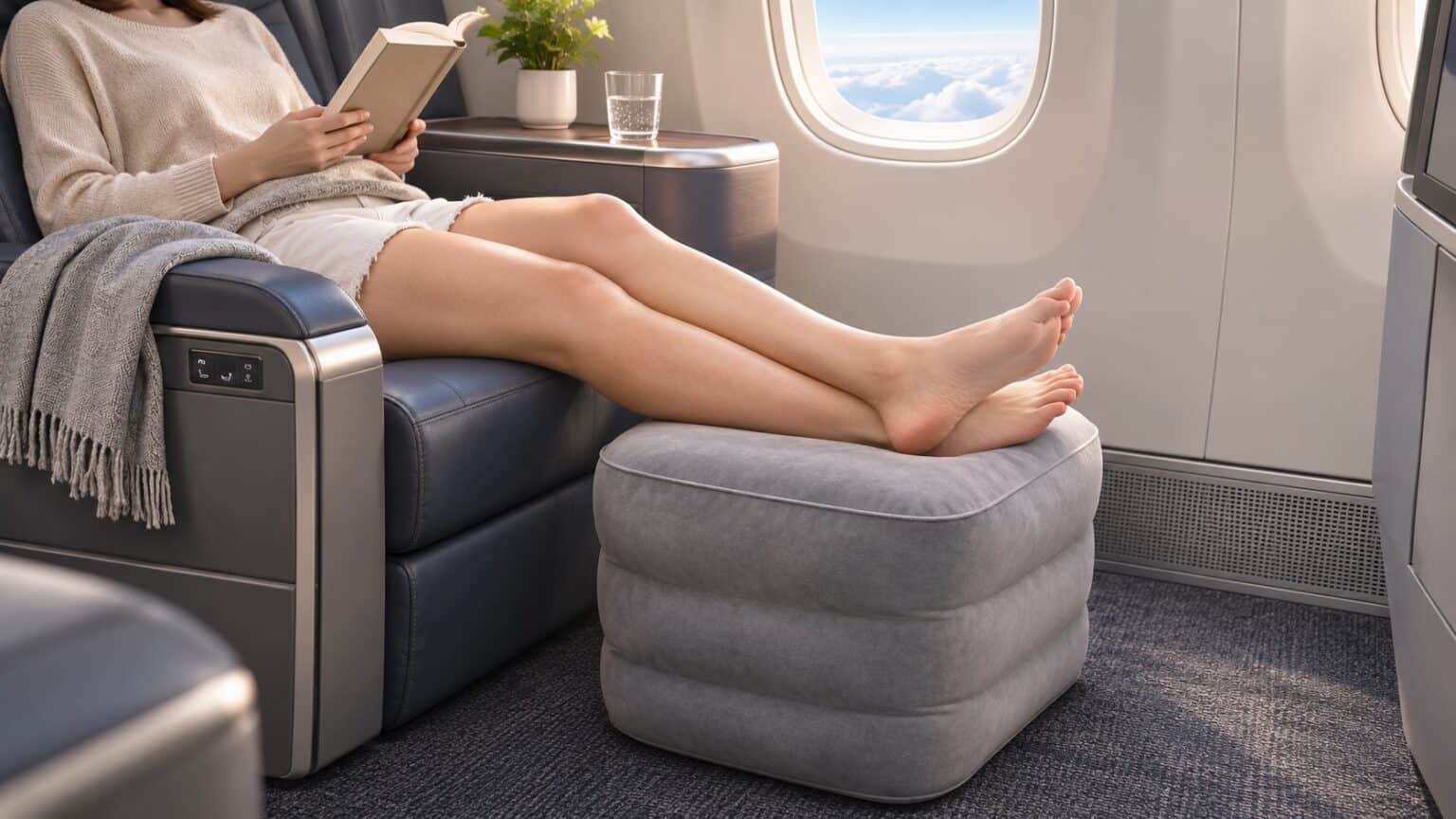
An inflatable footrest is a small air cushion, often with separately inflated chambers, that sits on the floor in front of your seat. Because it only rests on the floor, airlines such as Southwest, Etihad, Virgin Australia and Qantas allow it with conditions.

A foot hammock is a padded sling hung by straps from the tray table arm of the seat in front. That attachment is exactly what Delta, Alaska, British Airways, Etihad and others prohibit, which is why a hammock is banned on far more airlines than a floor cushion.
Hammocks also fail at a bulkhead seat, where there is no tray table on a seatback to hang them from. If you want one device that works on the most airlines, a floor-standing inflatable is the safer buy.
[amazon box=”B074T9CP81″]
Kids’ Bed Boxes and Seat Extenders
Seat extenders and bed boxes fill the gap between a child’s seat and the seat in front, turning an economy seat into a small bed. The JetKids BedBox is a ride-on suitcase that doubles as the platform; Plane Pal and Fly Tot are inflatable.
These are the devices where airlines disagree most. British Airways, Etihad, Virgin Australia, Cathay Pacific and ANA accept BedBox, while Emirates, Qatar Airways, Air New Zealand and Qantas do not.

None of these is a child restraint. During taxi, takeoff and landing, the child has to be back in the seat with the belt fastened, or in an approved car seat, so the bed has to come apart quickly. For age rules on flying with infants, see when a baby can fly.
How to Use a Footrest Without Being Told to Put It Away
Check your airline’s own policy page before you pack, not a forum post. Policies change: Qantas went from a ban to approving inflatable cubes, and Delta names cubes and hammocks as prohibited.
Book a window seat. It is the one seat almost every permissive airline accepts, from Southwest to Qantas, because your footrest blocks nobody’s path to the aisle.
Avoid exit rows and bulkhead rows, and wait until the seat belt sign goes off before setting up. Inflate it by hand or by mouth, since Qantas bans battery pumps, and point the valve toward the aisle so it deflates fast.
If a crew member asks you to stow it, do so. The final say on board is theirs, whatever the policy page says.
If a footrest is banned on your airline, other tricks still help on a long flight: get up and walk when the sign is off, and pack the rest of your comfort kit from our long flight essentials list. It also helps to know what a long flight does to your body.
FAQ
Sources and references used for research and fact-checking.
- Delta Air Lines, Carry-on baggage: comfort items and personal devices
- Alaska Airlines, Guidelines for travel accessories
- Southwest Airlines, Can I use items like an infant hammock or Knee Defender onboard?
- Air Canada, Travelling with children: child restraint devices
- WestJet, Car seats and child restraint systems
- British Airways, Family travel: seating and approved comfort devices
- KLM, Travelling with children
- Air France, Traveling with children
- Emirates, Before you fly: health, leg rests and seat-extension devices
- Qatar Airways, Trade portal: children and infants
- Etihad Airways, Help: travel companions and travel accessories
- Singapore Airlines, Travelling with children
- Cathay Pacific, Children's sleeping devices
- Qantas, Flying with infants and children: comfort devices
- Virgin Australia, Travelling with children: guest comfort devices
- Air New Zealand, Items not allowed on your flight
- Air New Zealand, Travelling with children
- ANA, Expectant mothers and children
- eCFR, 14 CFR 121.311, Seats, safety belts, and shoulder harnesses
- eCFR, 14 CFR 121.310, Additional emergency equipment
Get the Newsletter
The latest aviation news and stories sent to your inbox.
About the Author

Tim is the owner and lead editor of AeroCorner since 2019, overseeing aviation content covering aircraft, airlines, airports, and the broader aviation industry. Through years of researching, writing, editing, and publishing aviation-focused content, he has developed extensive practical knowledge of commercial aviation and air travel. Based in Asia and a frequent traveler himself, Tim also brings firsthand passenger experience to AeroCorner’s coverage. Outside of publishing, he has also explored aviation firsthand through hands-on flight training in New Zealand.