

Table of Contents
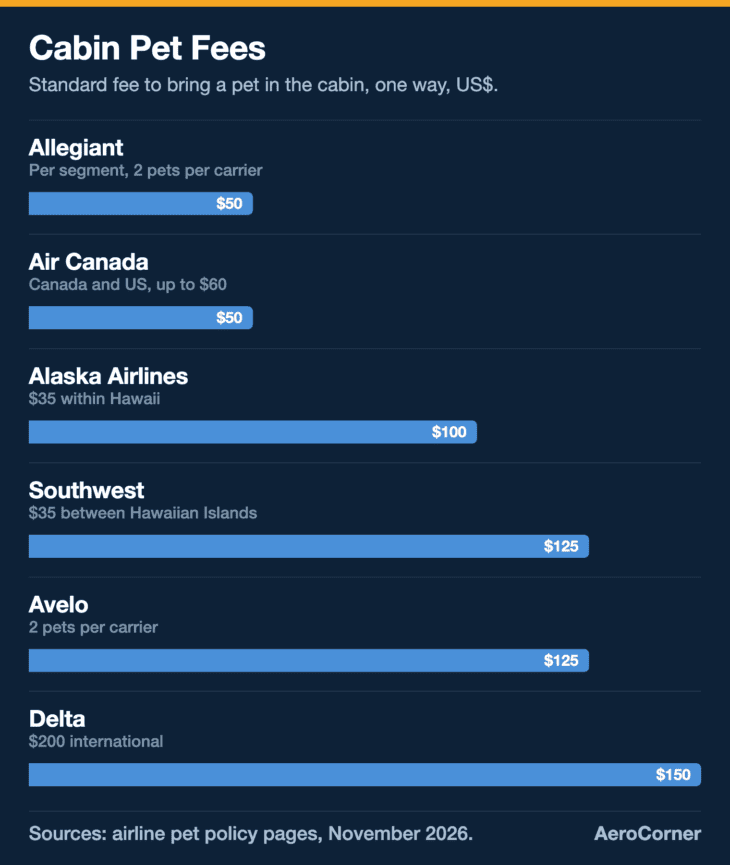
Alaska Airlines is the best airline for flying with pets in 2026. It charges $100 each way for a small pet in the cabin, $35 on flights wholly within Hawaii, and it is the only US airline in this ranking that still takes a bigger dog as checked baggage: up to 150 pounds (68 kg) of dog and kennel combined, for $200 each way.
We ranked seven airlines by their own published pet policies as of November 2026, read on each airline’s site: the cabin fee, how many pets one traveler can bring, and what happens to a pet too big for the seat in front of you. The fees below are one way, per carrier, and they change, so treat each as a dated figure.
| Rank | Airline | Cabin fee, one way | Pets per carrier | Bigger pets |
|---|---|---|---|---|
| 1 | Alaska Airlines and Hawaiian | $100 ($35 within Hawaii) | Not specified | Baggage compartment, up to 150 lb, $200 |
| 2 | Air Canada | $50 to $60 (Canada and US) | 1 per passenger | Baggage compartment, $105 to $120.75 |
| 3 | Allegiant | $50 per segment | Up to 2 | None |
| 4 | Southwest | $125 ($35 between Hawaiian Islands) | Up to 2 | None |
| 5 | Avelo | $125 | Up to 2 | None |
| 6 | JetBlue | Set at booking | 1 (2 pets need 2 seats) | None |
| 7 | Delta | $150 ($200 international) | 1 | None listed for travelers |
How this ranking works
Every airline here was judged on what it publishes, not on reviews. The cabin fee counts most, then how many pets one traveler can bring, then whether a pet too big for an under-seat carrier can fly at all. A cheap fee with no route to your destination is worth nothing, so network size breaks ties. Fees are one way, per carrier, as listed in November 2026.
1. Alaska Airlines and Hawaiian Airlines
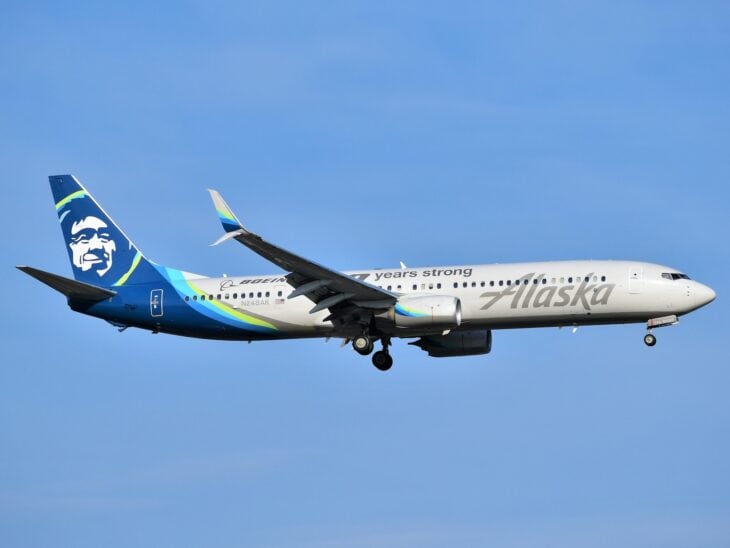

Alaska and Hawaiian now run one pet policy, published on a single page titled “Pets in Cabin – Alaska Airlines and Hawaiian Airlines.” Small dogs fly in the cabin for $100 per carrier each way, or $35 when the trip is wholly within Hawaii, in a soft-sided carrier no larger than 17 x 11 x 9.5 inches.
What puts Alaska first is the second option. Dogs and kennels weighing up to a combined 150 pounds (68 kg) can ride in the temperature-controlled baggage compartment while the owner sits upstairs, for $200 each way per kennel.
That matters because no other US airline on this list offers it, a gap covered in our guide to what really happens to a dog in the cargo hold. The catch: a pet in Alaska’s baggage compartment is not transferred to another airline, so a connection to a partner means claiming and rechecking it yourself.
The military discount nobody mentions
Alaska offers discounted pet rates for travel within Alaska or Hawaii, and for active-duty US military and their dependents traveling on orders. For a family moving bases with a large dog, that discount applies to the 150-pound baggage compartment option, the one route on this list for a big pet.
2. Air Canada
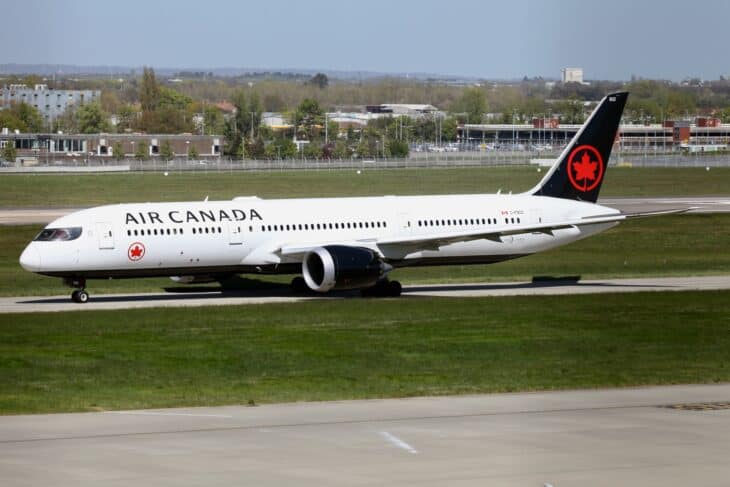
Air Canada charges $50 to $60 one way (in Canadian or US dollars) for a cat or small dog in the cabin within Canada and between Canada and the US, rising to $100 to $120 on other international flights, plus taxes of up to 18%. On most of its jets the carrier must fit 16 x 17 x 8 inches, and since June 1, 2025 it must be soft-sided.
Like Alaska, it also takes cats and dogs in the baggage compartment, for $105 to $120.75 one way within Canada and to the US. Snub-nosed (brachycephalic) dog breeds cannot travel there, and flights to and from Hawaii accept no pets in the cabin or the hold.
The limits are worth reading closely. Only one pet is allowed per passenger, and pets cannot sit in Premium Economy, exit rows or bulkhead rows. For anyone flying between the US and Canada, though, no airline on this list charges less for a cabin pet.
3. Allegiant
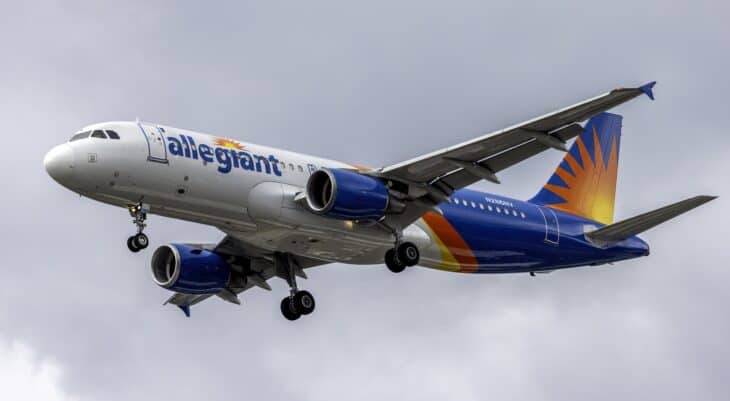

Allegiant has the lowest flat cabin pet fee of any US airline we checked: $50 per segment, per carrier. Two pets can share one carrier, which makes it the cheapest way in the US to fly two small pets.
The carrier can be soft-sided up to 18 x 12 x 11 inches or hard-sided up to 17 x 11 x 10.5 inches, and pets must be at least eight weeks old. Each paid traveler gets one carrier, and it counts toward the two carry-on items Allegiant allows.
Allegiant ranks below Air Canada because of reach. It does not carry animals in the cargo bin, and its pet policy covers travel within the 48 contiguous states, with the airline warning that international destinations and US territories do not accept all pets.
4. Southwest Airlines
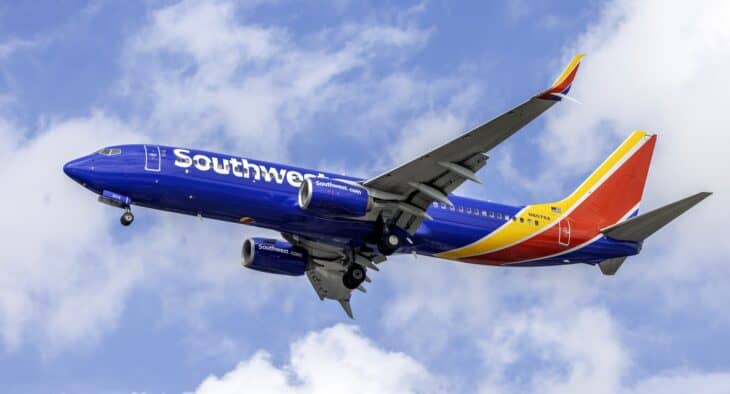

Southwest welcomes small, vaccinated cats and dogs in the cabin on domestic flights for $125 per carrier each way on the US mainland, and $35 between the Hawaiian Islands. Like Allegiant, it lets two small pets of the same species share one carrier.
Each ticketed customer may bring one carrier, which counts as the carry-on or personal item. Pets cannot be booked online, so owners call to reserve one of the limited spaces on each flight.
Southwest carries no pets in the cargo compartment at all. That caps it at fourth: a large US network at a mid-range fee, with nothing for a dog that will not fit under a seat.
5. Avelo Airlines
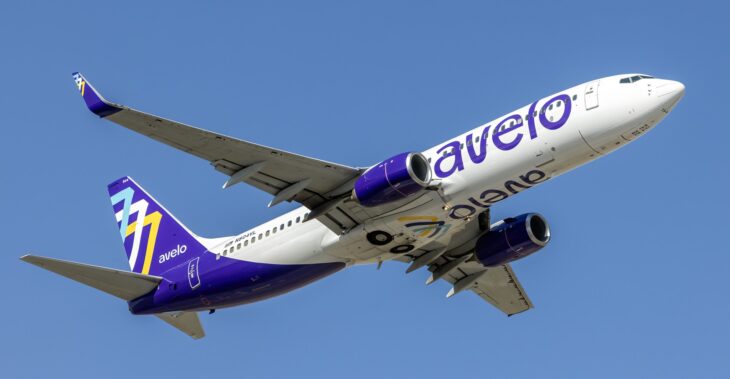

Avelo charges $125 each way per pet carrier, and each carrier can hold up to two small cats, dogs, rabbits or birds. It is the only airline on this list that names rabbits.
Hard-sided carriers can be no larger than 17 x 13 x 9 inches, and Avelo allows up to eight pet carriers on a scheduled flight. It does not take pets in the cargo bin.
6. JetBlue
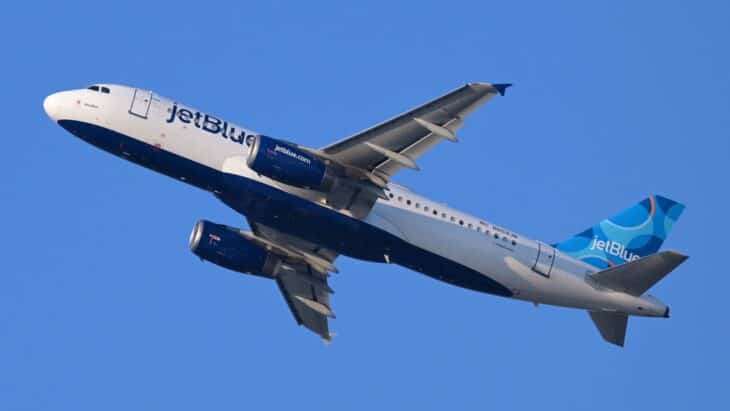

JetBlue accepts only small dogs and cats, in a carrier no larger than 17 x 12.5 x 8.5 inches. Its help page allows two pets per traveler, each in its own carrier, but the second pet requires buying a second seat and paying a second pet fee.
That second-seat rule is the closest thing on a big US airline to buying your pet a seat, though the pet still rides in a carrier. JetBlue’s contract of carriage, revised April 17, 2026, caps the cabin at six pets per flight and takes no animals as checked baggage.
It ranks sixth because neither its pet page nor its contract prints the fee, which is charged when you book. Pet owners also cannot sit in Mint, exit rows or bulkhead seats.
7. Delta Air Lines
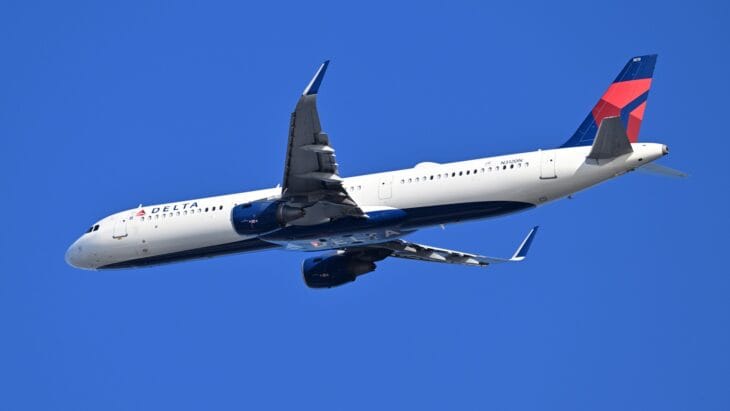

Delta is the most expensive airline on this list for a cabin pet. Tickets issued on or after April 8, 2025 pay $150 each way within the US, Canada, Puerto Rico and the US Virgin Islands, up from $95, and $200 on international flights.
It does take small dogs, cats and household birds, and it recommends a soft-sided kennel of 18 x 11 x 11 inches. Space is first come, first served: two pets in Delta First and four in the main cabin on domestic flights, and none at all in Delta One or Delta Premium Select, so a pet rules out a seat on the best business class airlines list at Delta.
The route list is the real problem. Delta allows no pet travel on flights to Hawaii and no cabin pets to or from the United Kingdom, Australia, New Zealand, Iceland, Jamaica or Barbados, among others.
For big dogs: the only cabin options
No scheduled US airline on this list lets a large dog ride in the cabin outside a carrier. Two services built for exactly that sit outside the ranking because they are not ordinary airlines.
BARK Air sells dog-first shared charters, flown by a licensed US charter carrier rather than its own aircraft. In spring 2026 it listed Madrid to New York at $8,750 and New York to Lisbon at $11,250, each ticket covering one person and up to two dogs with a combined weight of 50 pounds (23 kg) or less, and a flight only goes once enough seats sell.
ITA Airways launched Large Dog On Board on August 3, 2026, on selected domestic routes in Italy. One dog up to 66 pounds (30 kg) can fly in Business Class, or up to 33 pounds (15 kg) in Economy, with a maximum of two large dogs per flight, booked through customer support at least four days ahead.
For a big dog on a private aircraft, the rules are different again: see our guide to bringing a pet on a private jet.
What about United, American and Frontier?
They are left out on purpose. We rank only on figures we could read on an airline’s own pet page or contract in November 2026, and these three blocked or did not print their current pet fees when we checked. Frontier’s own FAQ, updated September 2026, does confirm it takes no pets in the cargo hold and allows only service dogs on international flights. Check each airline’s pet page before you book.
Before you book: the rules that apply on every airline
Every airline here limits pets per flight, so book the pet the moment you book yourself. Southwest and Alaska both require you to contact the airline to reserve the space, and JetBlue takes payment when the reservation is made.
Coming back into the US with a dog adds a federal step. Since August 1, 2024, the CDC requires every dog entering the country to appear healthy, be at least six months old, be microchipped and travel with a CDC Dog Import Form receipt.
Air Canada, Delta and JetBlue all bar pets from exit and bulkhead rows, because there is no under-seat space in front of those seats. If you want a quieter cabin for the trip, our ranking of the best economy class airlines covers which seats and carriers are worth paying for.
FAQ
Sources and references used for research and fact-checking.
- Alaska Airlines, Pets in Cabin - Alaska Airlines and Hawaiian Airlines
- Alaska Airlines Newsroom, International Dog Day 2026
- Air Canada, Travelling with pets
- Allegiant Air, Traveling with Pets
- Southwest Airlines, Pet Policy
- Southwest Airlines, Optional travel charges
- Avelo Airlines, Pet Policy
- JetBlue, Traveling with Pets
- JetBlue, Contract of Carriage, revision 101 (April 17, 2026)
- Delta Air Lines, Pet Travel Overview
- Frontier Airlines, Do you allow pets on the plane?
- BARK Air, Shared Charters
- Aviacionaldia, ITA Airways launches service allowing dogs up to 30 kg in passenger cabin on domestic flights
- Centers for Disease Control and Prevention, CDC Announces Updated Dog Importation Regulation
Get the Newsletter
The latest aviation news and stories sent to your inbox.
About the Author

Tim is the owner and lead editor of AeroCorner since 2019, overseeing aviation content covering aircraft, airlines, airports, and the broader aviation industry. Through years of researching, writing, editing, and publishing aviation-focused content, he has developed extensive practical knowledge of commercial aviation and air travel. Based in Asia and a frequent traveler himself, Tim also brings firsthand passenger experience to AeroCorner’s coverage. Outside of publishing, he has also explored aviation firsthand through hands-on flight training in New Zealand.