

Table of Contents
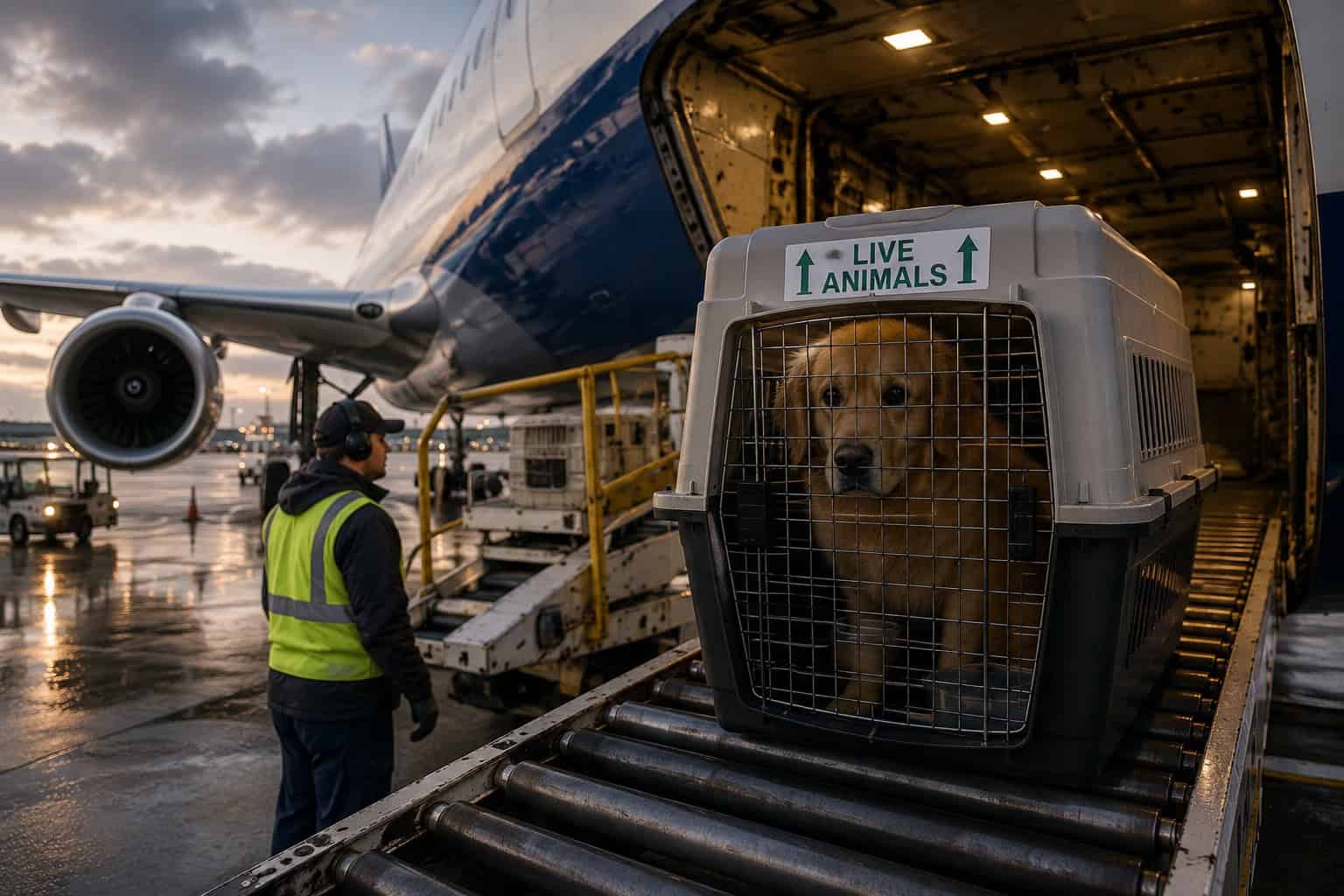
The handover happens at a counter most passengers never use. You sign a form, an agent checks the zip ties on the crate door, and then your dog rolls away on a belt and disappears behind a set of rubber flaps.
For the next several hours you have no idea what is happening to your dog, and the internet is full of people telling you it is a freezing, unpressurized box. That version is wrong, but the reassuring version people offer instead is also wrong.
The honest answer is more specific and more useful: the flight itself is the safest part of the journey, the ground is where the risk lives, and for most Americans the option has quietly been taken away anyway. Here is what actually happens below the floor, what the numbers say, and how to decide between cabin and cargo.
The short answer
Dogs do not ride in the general baggage bin. They travel in a designated compartment that is pressurized to the same cabin altitude you are breathing, heated, and ventilated, because US law does not allow anything else.
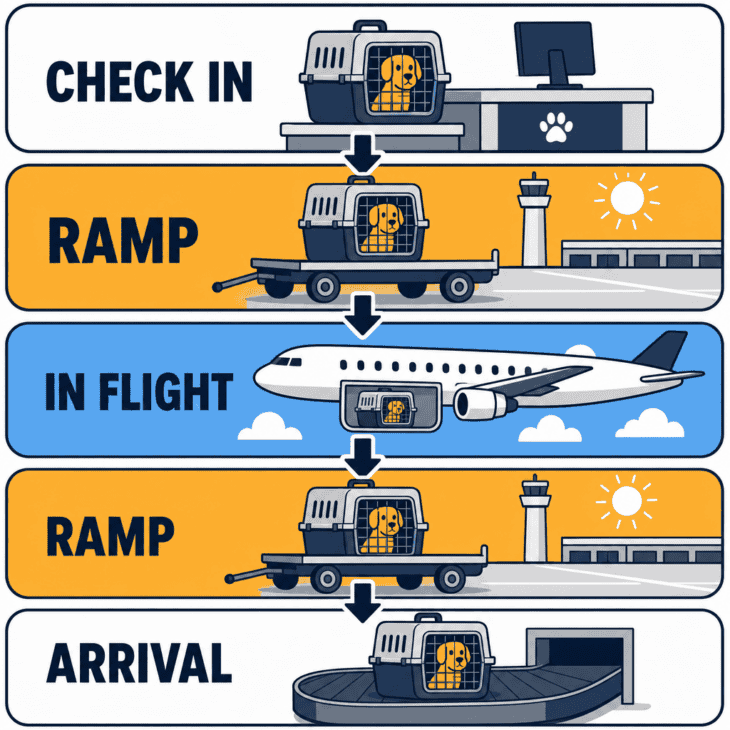
What that compartment cannot control is the hour before pushback and the hour after landing, when the crate is sitting on a baggage cart in whatever weather the ramp happens to have. That exposure, plus the breed of dog inside the crate, explains most of what goes wrong.
The answer at a glance
The hold your dog flies in is pressurized, heated and ventilated to the same standard as the cabin, and federal rules require it. The real hazards are ground time in extreme heat or cold, and flat-faced breeds whose airways cannot cope with stress. That is why airlines police the weather and the breed list far harder than they police the flight itself.
What the hold is actually like below the floor
An airliner’s fuselage is a single sealed tube. The cargo compartments below the floor sit inside that same pressure vessel, so they hold the same cabin altitude you do, usually the equivalent of around 6,000 to 8,000 feet (1,800 to 2,400 m).
Your dog is breathing the air you are breathing, at the pressure you are breathing it. If you want the mechanics, we have covered why airplanes are pressurized in detail.
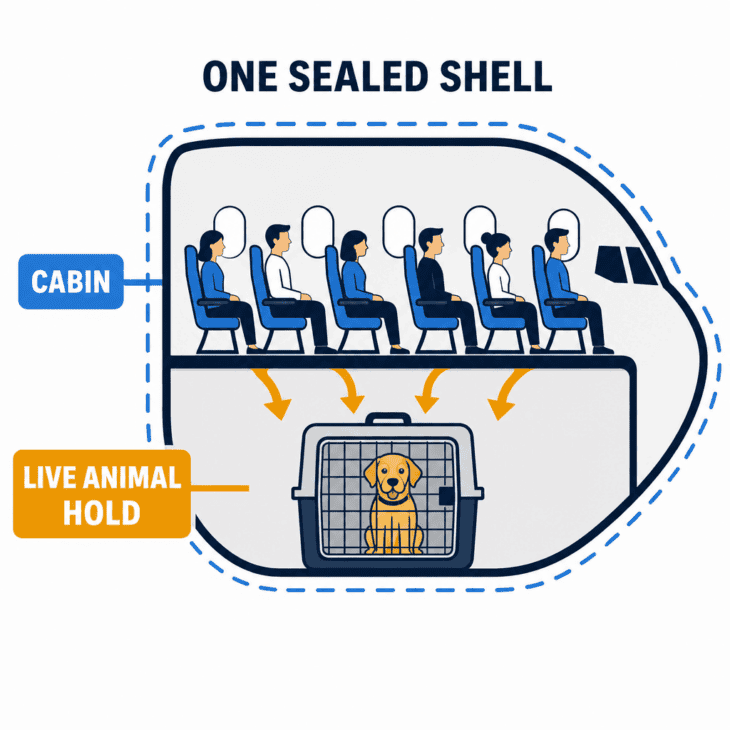
Heat is a separate system from pressure, and this is where compartments differ. Not every hold on every aircraft is heated to a livable temperature, which is exactly why airlines nominate one specific compartment for live animals and load them nowhere else.
On a Boeing 737 that compartment is typically warmed by recirculated cabin air, helped along by waste heat drifting back from the electronics bay behind the nose gear. On widebodies the bulk compartment at the rear is the usual live-animal bin, with its own heating that can be set well above the temperature of the containerized holds forward of it.
Federal regulations under the Animal Welfare Act set the floor. The animal cargo space must be heated or cooled as needed, ventilated for normal breathing, and pressurized whenever the aircraft is airborne above 8,000 feet.
Temperature around the crate must not sit above 85°F (29.5°C) or below 45°F (7.2°C) for more than four hours. No more than 45 minutes of that can happen while the animal is being moved to or from the aircraft.
The compartment is dark and it is loud, which sounds worse than it is. Most dogs settle in a dim, enclosed, steadily humming space far better than they would in a bright cabin full of strangers.
Two things about that space are worth knowing before you agree to it. Nobody can open the door in flight to check on your dog, so the rules only require observation at loading and unloading when the compartment is inaccessible, and the flight crew is told an animal is aboard specifically so they can act if the heating misbehaves.
The numbers airlines are legally required to publish
This is the rare corner of aviation where you do not have to guess. Since 2015, every US carrier operating an aircraft with more than 60 seats has had to report to the Department of Transportation every animal lost, injured or killed in its care, and to file a year-end count of how many animals it carried.
In calendar year 2024, US airlines reported carrying 161,335 animals. Across all of them there were 12 incidents: eight deaths, four injuries and no animals lost.
2025 was better still. Airlines reported eight incidents for the year, three of them deaths, spread across Alaska, American, Delta and United.
Roughly one incident per 13,000 animals
The 12 reported incidents in 2024 came out of 161,335 animals flown, which works out to about one incident for every 13,000 animals carried, and one death for every 20,000. The denominator is the part people never see quoted: an individual pet death is a news story precisely because it is rare.
Two caveats keep this honest. The reporting covers US carriers only, so a connection onto a foreign airline is not in these figures, and the count captures deaths in the airline’s care rather than a dog that falls ill days later.
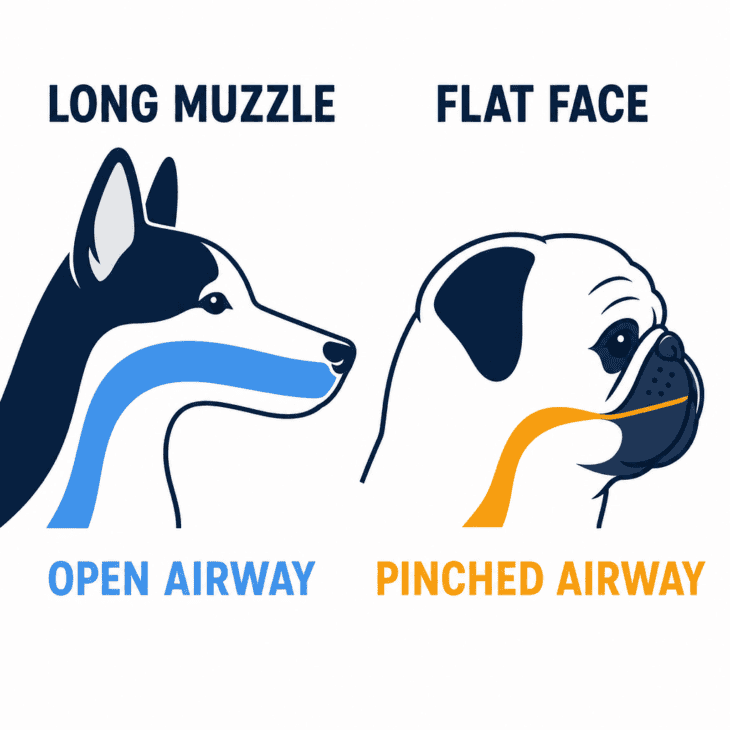
The other caveat matters more, because it changes who the risk applies to. Roughly half of documented dog deaths in air transport have involved brachycephalic breeds, the flat-faced dogs whose airways are already compromised at sea level. The average risk figure is not your risk figure if you own a bulldog.
The rules that will stop your dog from flying at all
Airlines have concluded the same thing the incident reports show, and they have written it into policy rather than leaving it to owners. The result is a set of gates your dog has to clear before the crate goes anywhere near an aircraft.
The first gate is the thermometer. Alaska Airlines, for example, may refuse a pet in the baggage compartment if the current or forecast temperature at departure, connection or arrival is below 20°F (-7°C) or above 85°F (29.5°C). Note that it is every point on the itinerary, not just the two ends, and that a forecast is enough to stop the booking.
Delta and American go further and simply close the window: both apply a blanket seasonal embargo on animals in the hold from roughly May 15 to September 15. Snub-nosed breeds that are accepted at all usually face a lower ceiling still, commonly around 75°F (24°C).
The second gate is the breed list, and for flat-faced dogs it is now mostly a wall. American will not carry brachycephalic dogs or cats or their mixes as checked pets or as cargo at all, and Alaska bars them from the baggage compartment.
Bulldogs, French bulldogs, pugs, boxers, Boston terriers, shih tzus and Persian cats appear on version after version of these lists.
The third gate is the crate. Beyond the usual rigid, escape-proof kennel with attached bowls, powerful breeds such as pit bull terriers, cane corsos, dogo argentinos and presa canarios are frequently required to travel in an IATA CR82 container: reinforced, with no structural plastic and a clamping door, and considerably more expensive than a standard kennel.
The myth: "the cargo hold is freezing and unpressurized"
It is neither. The live-animal compartment shares the aircraft’s pressure vessel and is heated, and federal rules forbid the temperatures people imagine. The genuine danger is concentrated at the two ends of the trip, on a baggage cart in August heat or a January cold snap, and in breeds that were already struggling to breathe before anyone bought a ticket.
Why most Americans cannot do this anymore
Here is the part that surprises people who last flew a dog a decade ago. For the general public, checking a dog like a suitcase has almost vanished from mainline US aviation.
The turning point was 2018. United had recorded 18 animal deaths in 2017, about three-quarters of the industry total, then in March 2018 a flight attendant instructed a passenger to stow a French bulldog puppy in an overhead bin and the dog died. Within days United suspended its PetSafe cargo program, and by May it had banned dozens of breeds outright.
2015
Reporting expands. DOT requires carriers to report incidents for pets flown in cabin and as cargo, and to publish annual totals of animals carried.
March 2018
United suspends PetSafe. After 18 animal deaths in 2017, two dogs loaded onto the wrong flights and a puppy that died in an overhead bin, United halts its cargo pet program and reviews it.
May 2018
The breed lists arrive. United bars dozens of snub-nosed and strong-jawed breeds from the hold. Other carriers tighten their own lists over the following years.
2026
Checked pets are now the exception. Delta, United and American restrict pets in the hold to active-duty US military and State Department personnel on orders, routing everyone else to cargo divisions or specialist shippers.
The practical picture in 2026 looks like this.
| Airline | Dog in the cabin | Dog in the hold, general public |
|---|---|---|
| Alaska | Yes, in an under-seat carrier | Yes, as checked baggage, weather and breed permitting |
| Delta | Yes, in an under-seat carrier | No. Checked pets limited to military and State Department orders; otherwise Delta Cargo |
| United | Yes, in an under-seat carrier | No. PetSafe restricted to military and State Department orders |
| American | Yes, in an under-seat carrier | No. Checked pets limited to military and State Department orders; otherwise the airline’s cargo pet service |
| Southwest, JetBlue | Yes, in an under-seat carrier | No hold service at all |
Read the table again and the shape of the problem appears. Every one of these airlines will fly a small dog in the cabin, and almost none of them will fly a large one for an ordinary passenger.
Cabin or cargo: how to actually decide
For most owners the decision is made by a tape measure rather than a philosophy. If your dog and its carrier fit under the seat in front of you, typically meaning a total of about 20 pounds (9 kg) or less, the cabin is the obvious answer and it is also the cheaper one.
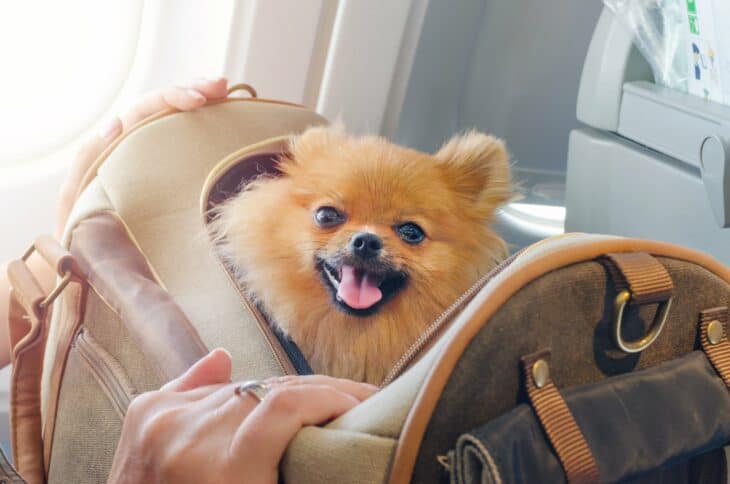
Above that line, the honest options narrow to three: a carrier that still checks pets, a cargo booking through an airline division or a specialist pet shipper, or not flying the dog at all. Driving is a real answer for a big dog on a domestic move, and for some families it is the right one.
If you do use the hold, the levers that matter are almost all about ground time. Book a nonstop rather than a connection, fly early morning or late evening in summer and midday in winter, and treat a tight connection as a reason to rebook rather than a bit of luck to hope for.
Delay is the enemy here. Live animals are loaded last and pulled off first for exactly this reason, but a crate can still sit on a cart for a long time if the aircraft goes tech or the ramp backs up.
Before you pick a marginal itinerary, it is worth understanding why flights get delayed and what a compressed aircraft turnaround does to ground handling.
There is now a fourth option for people who can pay for it. Charter operators, including dog-first services and ordinary business jets, will take an animal of any size in the cabin, which is why bringing a pet on a private jet has become a real market rather than a curiosity.
It is expensive, and it is the only way a 90-pound (41 kg) dog rides at your feet.
Whatever route you choose, get a veterinary check close to the trip and be blunt with the vet about the breed and the season.
Sedation is the classic mistake. It lowers blood pressure and impairs the dog’s ability to regulate its own temperature and balance, which is exactly the wrong trade for an animal about to spend hours in a crate nobody can check on.
So the next time you watch a crate roll away through the rubber flaps, you know where it is going: into a heated, pressurized compartment where your dog will most likely sleep through the whole thing.
The part worth worrying about is not up at 35,000 feet (10,700 m). It is the August afternoon on the ramp, the missed connection, and the shape of your dog’s face.
Sources and references used for research and fact-checking.
- U.S. Department of Transportation, Plane Talk: Traveling with Animals
- Electronic Code of Federal Regulations, 9 CFR Part 3, Subpart A: Humane Handling, Care, Treatment, and Transportation of Dogs and Cats
- PetFlight, 2025 Airline Pet Travel Summary
- Alaska Airlines, Pets in the Baggage Compartment
- American Airlines, Pets: Travel Information
- IATA, Live Animal Handling and Transport
Get the Newsletter
The latest aviation news and stories sent to your inbox.
About the Author

Tim is the owner and lead editor of AeroCorner since 2019, overseeing aviation content covering aircraft, airlines, airports, and the broader aviation industry. Through years of researching, writing, editing, and publishing aviation-focused content, he has developed extensive practical knowledge of commercial aviation and air travel. Based in Asia and a frequent traveler himself, Tim also brings firsthand passenger experience to AeroCorner’s coverage. Outside of publishing, he has also explored aviation firsthand through hands-on flight training in New Zealand.