

Table of Contents
On the night of Saturday, February 17, 2024, a Virgin Atlantic jet lifted off from Washington Dulles bound for London at 10:45 p.m. Thirty-five minutes later, over the Atlantic just east of Long Island, it hit a ground speed of 802 mph (1,291 km/h). It landed at Heathrow 45 minutes ahead of schedule.
Nothing unusual happened on board. The aircraft was moving through the air at its ordinary cruise speed, the same as on any other night.
The air itself was the thing going fast. A weather balloon released that evening from Sterling, Virginia measured wind of 265 mph (426 km/h) at around 35,000 feet over Washington.
That moving band of air is the jet stream. It is the reason the same long-haul route can take an hour longer in one direction than the other, and here is what it actually is, why it exists at all, how many of them there are, and why it quietly sets your arrival time.
What Is the Jet Stream?
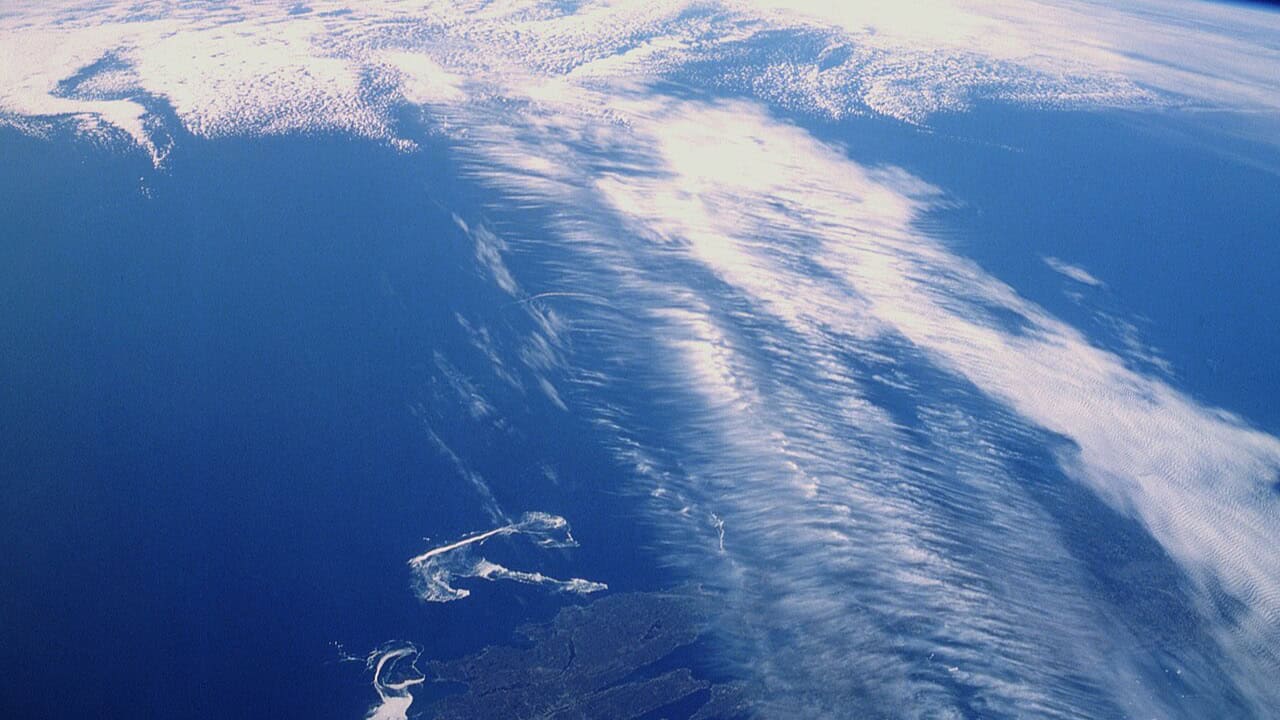
A jet stream is a relatively narrow band of very fast wind in the upper atmosphere, blowing from west to east. According to NOAA, it typically sits around 30,000 feet (9,100 m). That is cruise altitude for an airliner, which is the entire reason passengers ever notice it.
It is not the thin line that weather maps draw. NOAA describes jet streams as hundreds of miles wide and thousands of feet deep, with wind speed climbing steadily toward a fast core in the middle.
NOAA’s own comparison is a river. The current runs fastest mid-channel and slackens toward the banks, which is why these bands get called rivers of air.
The jet stream, in one paragraph
A band of fast west-to-east wind near 30,000 feet, hundreds of miles wide and thousands of feet deep, with the strongest wind in a core at its center. It forms where cold polar air meets warm tropical air, it is strongest in winter, and NOAA says its core can exceed 275 mph (442 km/h). There is more than one, and they move every day.
Why a Temperature Difference Creates a 200 MPH Wind
Two things have to happen at once for a jet stream to exist. One is a sharp temperature contrast. The other is the rotation of the Earth.
Start with temperature. Where a mass of cold polar air presses against a mass of warm tropical air, the pressure difference between them grows the higher you go. Air rushes from high pressure toward low pressure, and the wider the temperature gap, the harder it rushes.
February 17, 2024 is a clean example of that. At 7 p.m. that evening, temperatures were in the single digits in interior Maine and in the 70s in South Florida. A contrast that violent is what produced a 265 mph wind a few hours later.
Now add rotation, which decides the direction. The Earth’s surface at the equator is carrying everything on it eastward at over 1,000 mph (1,600 km/h), while a point at the pole is barely moving east at all, just slowly spinning.
Air that drifts away from the equator keeps its original eastward momentum while the ground underneath it rotates slower and slower. The air therefore outruns the surface below, which is why upper-level wind blows west to east rather than straight north or south. This is the Coriolis effect.
Those two ingredients peak together at a specific height. The temperature contrast keeps stacking the wind faster all the way up through the troposphere and then runs out at the tropopause, the boundary where the atmosphere’s temperature structure changes.
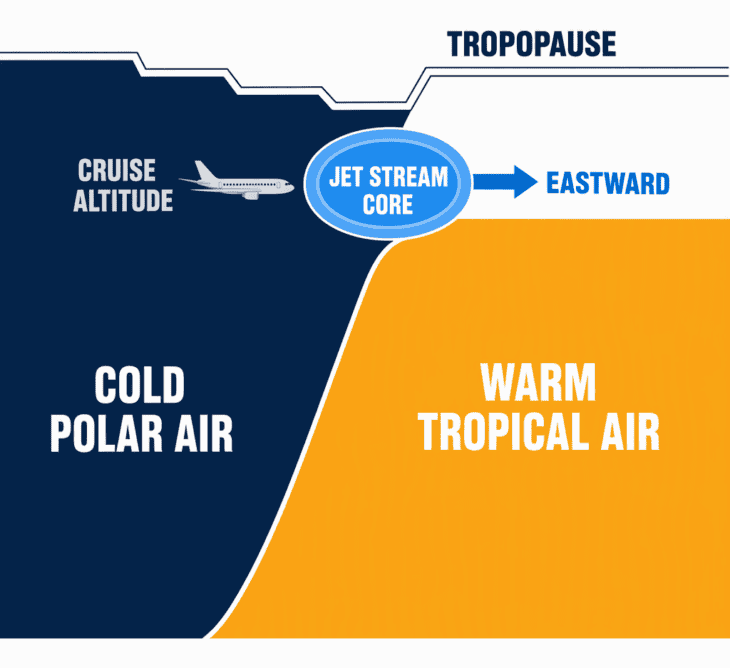
So the fastest wind on the planet lives at the ceiling of the weather layer, roughly four to eight miles up. Airliners cruise up there for their own unrelated reasons, thin air and low fuel burn, and simply inherited the fastest tailwind available.
There Is More Than One Jet Stream
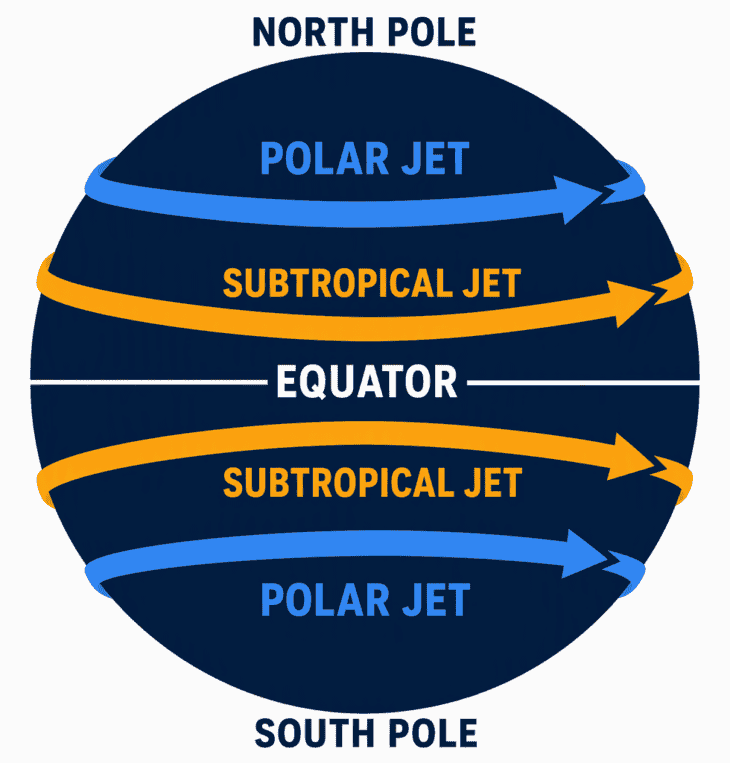
The plural matters, and almost nobody uses it. NOAA identifies a polar jet between the 50° and 60° latitude lines and a subtropical jet near the 30° line, and both exist in the northern and southern hemispheres. That is four major jet streams circling the planet.
The polar jet is the one that transatlantic and North Pacific flights spend their lives negotiating. Its core sits near 30,000 feet (9,100 m), it wanders enormous distances north and south, and its speed swings wildly.
The subtropical jet sits higher and behaves far better. Its core is near 39,000 feet (12,000 m), it meanders only slightly, and its seasonal-average speed is steadier from month to month.
| Polar jet | Subtropical jet | |
|---|---|---|
| Latitude | 50° to 60° north and south | Near 30° north and south |
| Core altitude | About 30,000 feet (9,100 m) | About 39,000 feet (12,000 m) |
| Core speed | 56 to 224 mph (90 to 360 km/h) | 101 to 179 mph (161 to 288 km/h), seasonal average |
| Behavior | Extremely variable, meanders far north and south | Very steady, meanders only slightly |
| Width | Roughly 5° of latitude | Roughly 10° of latitude |
Both jets follow the sun. As the sun climbs higher each day through spring, the average latitude of the jet stream shifts toward the pole, and by northern summer the polar jet typically sits near the United States and Canadian border.
Come autumn it slides back toward the equator. Both jets are strongest in winter, when the temperature gap that drives them is at its widest, and in summer they weaken and can merge into one.
265 mph was almost a record
The National Weather Service office serving Washington and Baltimore said the 265 mph wind measured on February 17, 2024 was the second-highest ever recorded at a comparable altitude since records began in the 1950s. The only stronger reading was 267 mph (430 km/h) on December 6, 2002.
Why the Jet Stream Decides Your Flight Time
An aircraft flies through the air, not over the ground. Its airspeed is set by its own engines and wings, but its speed over the ground is airspeed plus whatever the surrounding air happens to be doing.
A Boeing 787 cruises at roughly 561 mph (903 km/h). Drop it into a 240 mph tailwind and its speed over the ground climbs past 800 mph while absolutely nothing about the aircraft changes.
That is what happened across the eastern seaboard that February night. Virgin Atlantic 22 out of Dulles peaked at 802 mph. United 64 from Newark to Lisbon reached 835 mph (1,344 km/h) and landed 20 minutes early, and American 120 from Philadelphia to Doha topped out near 840 mph (1,352 km/h).
None of them broke the sound barrier. The speed of sound is 767 mph (1,234 km/h), but that is measured against the surrounding air, and each of those aircraft was still slipping through its own air mass at ordinary cruise speed. The air mass was the part doing 265 mph.
The saving is real but it is not symmetrical. AeroCorner’s own figures put Dulles to Heathrow at 3,667 miles (5,902 km) and about 7 hours 55 minutes, and the jet stream is why that number is only ever an average.
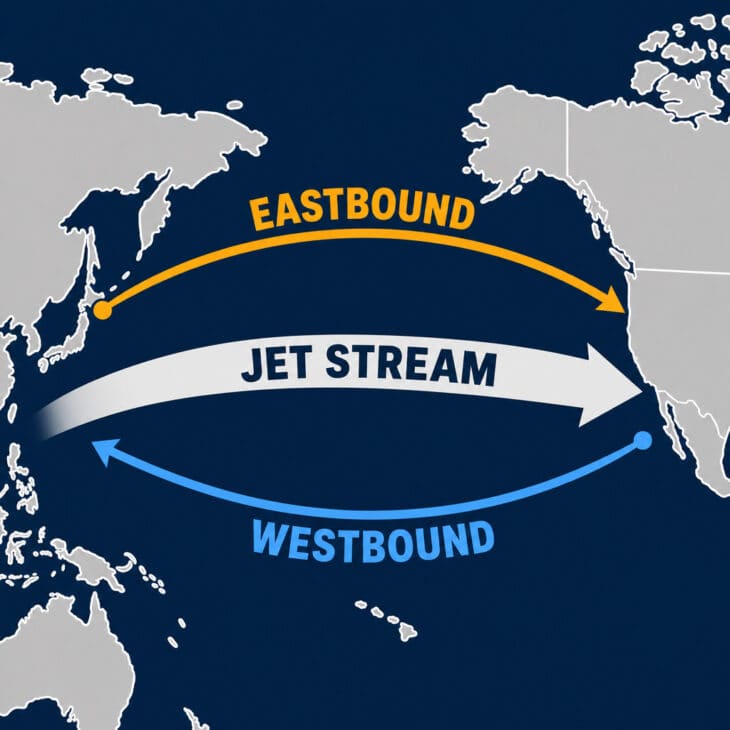
Eastbound flights aim to sit in the core and get paid in free ground speed. Westbound flights have to route around the same wind to avoid a brutal headwind, which is why the trip home takes about an hour longer and follows a completely different track.
There is a cost on the other side of the ledger, too. The edges of the jet are where wind speed changes fastest over a short distance, and that shear is exactly where clear-air turbulence, the kind nobody sees coming, tends to live.
That problem appears to be growing. A 2023 University of Reading study in Geophysical Research Letters found that at a typical point over the North Atlantic, annual hours of severe clear-air turbulence rose from 17.7 to 27.4 between 1979 and 2020.
That is an increase of 55% in four decades. The authors attribute it to a jet stream that has become more sheared as the atmosphere has warmed.
The Two Things People Get Wrong About the Jet Stream
Myth: the jet stream is the white trail behind the plane
It is not, and the two have nothing to do with each other. The jet stream is invisible. What you can see from the ground is a contrail, and it is made by the aircraft rather than by the atmosphere.
The white lines crossing the sky are condensed water vapor and ice crystals in engine exhaust, forming a short distance behind the aircraft. Contrails are a by-product of the engines and tell you nothing about the wind at that altitude.
The jet stream, by contrast, cannot be seen at all. It is detected by weather balloons, satellites and aircraft reports, which is why it arrives on your television as a cartoon arrow rather than a photograph.
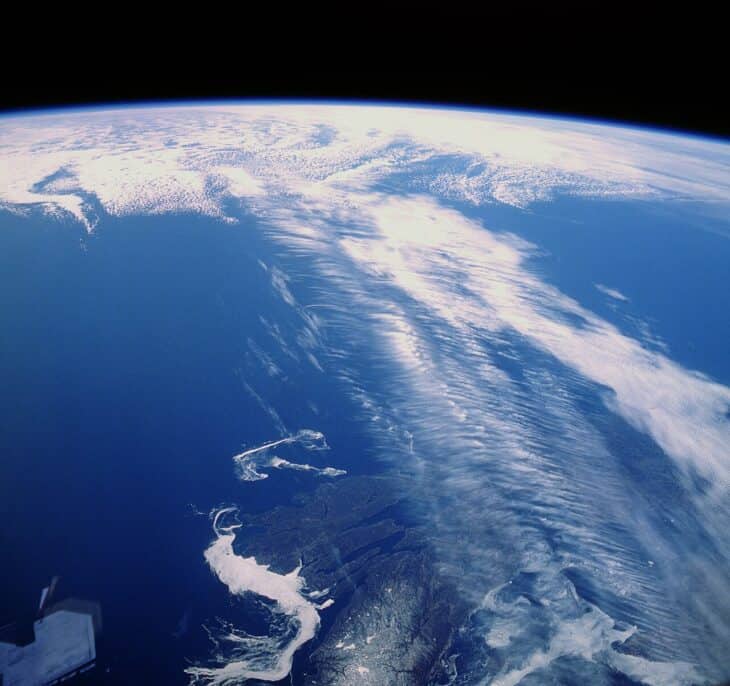
Which leads to the second misconception: that the cartoon arrow is a real, fixed feature. NOAA is blunt about this. Jet streams meander around the globe, dip and rise in both altitude and latitude, split apart, form eddies, and sometimes disappear altogether and reappear somewhere else.
That is why a flight plan is rebuilt from scratch every day rather than flown down a fixed line. It is one of several reasons the route your aircraft actually flies is rarely the straight line you would draw on a map.
The honest summary is that the jet stream is a moving target, chased eastbound and dodged westbound. A 240 mph swing in the wind dwarfs anything a crew can do with the throttles.
So the next time an arrivals board shows a transatlantic flight landing 40 minutes early, nothing clever happened in the cockpit. The aircraft found a fast-moving piece of atmosphere and stayed inside it for as long as it could.
And somewhere over the ocean, a flight heading the other way is quietly paying it all back.
Sources and references used for research and fact-checking.
- NOAA JetStream, The Jet Stream
- The Washington Post, Planes top 800 mph as near-record winds sweep high over Mid-Atlantic
- Geosciences LibreTexts, Jet Streams (Practical Meteorology, section 11.8)
- University of Reading, Aviation turbulence strengthened as the world warmed
- Geophysical Research Letters, Evidence for Large Increases in Clear-Air Turbulence Over the Past Four Decades
- Wikipedia, Jet stream
- AeroCorner, Flight Distance and Time: Washington (IAD) to London (LHR)
Get the Newsletter
The latest aviation news and stories sent to your inbox.
About the Author

Tim is the owner and lead editor of AeroCorner since 2019, overseeing aviation content covering aircraft, airlines, airports, and the broader aviation industry. Through years of researching, writing, editing, and publishing aviation-focused content, he has developed extensive practical knowledge of commercial aviation and air travel. Based in Asia and a frequent traveler himself, Tim also brings firsthand passenger experience to AeroCorner’s coverage. Outside of publishing, he has also explored aviation firsthand through hands-on flight training in New Zealand.