

The seat belt sign chimes, the coffee in your cup starts to shiver, and then the floor drops away for a heartbeat. Outside the window, the sky looks perfectly calm.
Most passengers assume the danger in that moment is to the airplane. The accident record says otherwise. The airplane is built for far worse, and the people who get hurt are almost always the ones who were not strapped in.
Here is what actually causes turbulence, why the most famous kind is invisible, and why a flight attendant walking the aisle is at far more risk than the wing outside your window.
What Causes Turbulence on a Plane?
Turbulence is air that is not moving smoothly. An airliner moves through the air the way a boat moves through water, so when a mass of air rises, sinks or swirls, the aircraft gets carried along with it.
The National Transportation Safety Board (NTSB), which investigates US airline accidents, sorts turbulence by where it comes from. Its list is convection, wind shear in clear air, mountain waves, surface features and the wakes of other aircraft. At cruising altitude, four of those matter.
The four kinds you meet at altitude
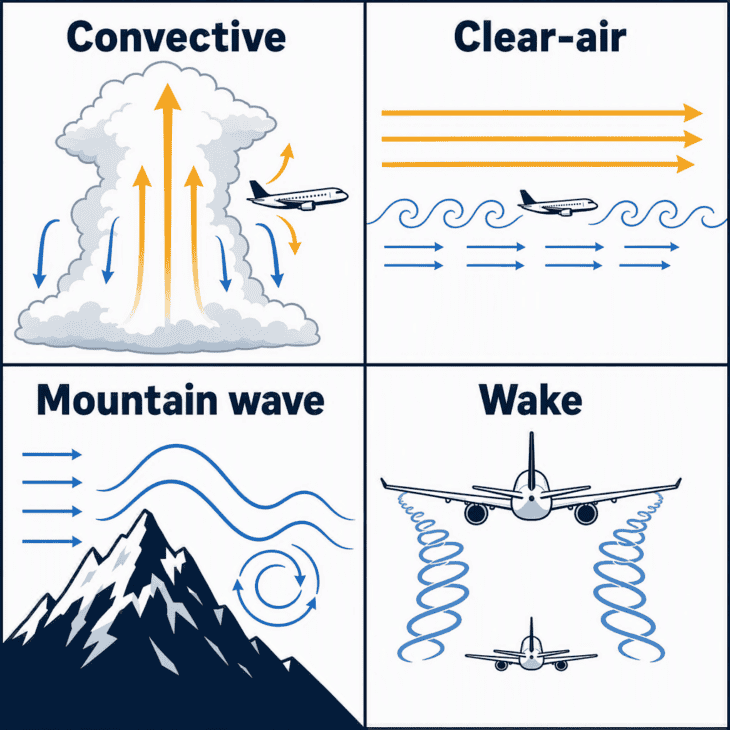
Convective: rising and sinking air in and around storm clouds, the cause of most injuries. Clear-air: wind shear at the edges of the jet stream, invisible to radar. Mountain wave: wind rippling downstream of a ridge. Wake: the spinning vortices that trail another aircraft’s wings.
Storms Cause Most of the Turbulence That Injures People
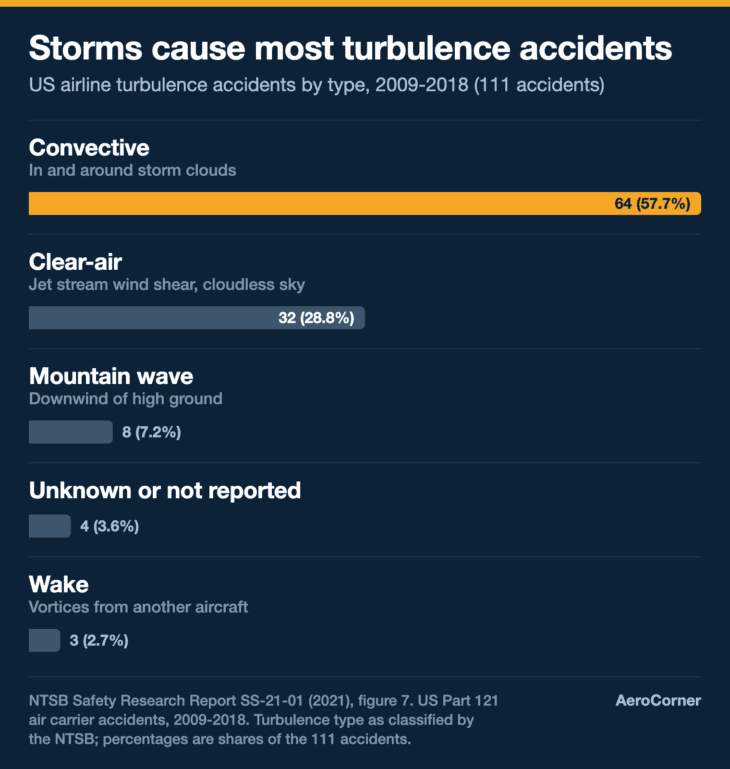
The kind that hurts the most people is not the invisible kind. In the NTSB’s 2021 study of US airline turbulence accidents from 2009 to 2018, convective turbulence was present in 64 of 111 accidents, or 57.7%. Clear-air turbulence was present in 32, or 28.8%.
Convective turbulence comes from the engine inside a thunderstorm: warm, moist air shooting upward while cooler air pours down beside it. An airliner crossing those currents gets shoved up, then down, in quick succession.
The storm is also bigger than the cloud you can see. The FAA’s Aeronautical Information Manual warns that a thunderstorm’s updrafts and downdrafts often reach far beyond the visible cloud. Severe turbulence, it says, “can be expected up to 20 miles from severe thunderstorms.”
That is why airline pilots steer wide around storm cells rather than threading between them. Weather radar helps, but only indirectly. In the manual’s own words, radar does not detect turbulence: it sees rain and hail, and pilots infer the rough air from how heavy the precipitation looks.
Singapore Airlines Flight 321, May 2024
Over southern Myanmar at 37,000 feet, a Boeing 777 was caught by an updraft over rapidly developing storm clouds. Singapore’s investigators found the load on the aircraft swung from +1.35 g to negative 1.5 g in 0.6 seconds. One passenger died, and 51 passengers and five cabin crew were seriously injured. The final report, published in May 2026, found the weather radar showed no returns in the minutes before the encounter, and investigators could not rule out a radar fault.
Clear-Air Turbulence: The Kind Nobody Sees Coming
Clear-air turbulence is what most people picture: a jolt in a cloudless sky, with nothing on the radar. It lives mostly around the jet streams, the narrow rivers of fast wind near cruising altitude that also explain why transatlantic flights take a different route each way.
The speed of the wind is not the problem. The FAA’s clear-air turbulence guidance says it is the wind shear, the difference in speed from one layer of air to the next, that makes the atmosphere buckle into waves and overturn. Jet streams faster than about 110 knots at the core are the ones most likely to produce it.
Those turbulent patches are large, and they wander. The FAA puts a typical one at 100 to 300 miles (160 to 480 km) long, 50 to 100 miles (80 to 160 km) wide and about 5,000 feet deep, lasting anywhere from 30 minutes to a day.
Because there are no raindrops in it, weather radar cannot see it. Pilots rely on forecasts and on reports from aircraft ahead of them, which is why a crew will sometimes change altitude with nothing visibly wrong outside.
Clear-air turbulence was also behind the most recent turbulence death on a US airline in the NTSB’s 2021 study. In December 1997, a United Boeing 747 flying from Tokyo to Honolulu hit it at 31,000 feet, and a passenger whose seat belt was unfastened was killed.
Clear-air turbulence is getting worse
A University of Reading study published in 2023 found that at a typical point over the North Atlantic, the yearly total of severe clear-air turbulence rose 55% between 1979 and 2020, from 17.7 hours to 27.4 hours. The researchers link the rise to warmer air strengthening the wind shear in the jet stream.
Mountain Waves and Wakes
When strong wind blows across a mountain range, it can set the air downwind rippling like water behind a rock in a stream. The aviation safety reference Skybrary notes these waves can carry vertical currents of up to 2,000 feet per minute, with violent rotors forming beneath them.
Mountain waves figured in 8 of the NTSB’s 111 accidents. They are also behind one of the deadliest turbulence disasters in airline history, which comes up below.
Wake turbulence is man-made. Every wing that produces lift sheds two counter-rotating vortices from its tips, and the FAA notes they grow stronger the heavier and slower the aircraft making them.
That is why air traffic controllers are required to leave extra space behind the heaviest jets, up to 8 nautical miles for a small aircraft following one of the largest. Wake figured in just 3 of the 111 accidents in the NTSB study.
Is Turbulence Dangerous?
To the airplane, very rarely. US rules require an airliner’s structure to withstand at least 2.5 g in maneuvers and negative 1 g, then add a safety factor of 1.5 on top before anything is allowed to fail.
It must also be designed for sharp vertical gusts of 56 feet per second, about 38 mph (61 km/h), at low altitude. The accident record reflects that margin: of the 111 turbulence accidents on US airlines from 2009 to 2018, none substantially damaged the aircraft. The worst harm was to seats, ceiling panels and overhead bins.
The airliners that have been lost met air far beyond what they were built for. In March 1966, BOAC Flight 911, a Boeing 707, broke apart downwind of Mount Fuji, killing all 124 aboard, after investigators found gust loads “considerably in excess of the design limit.”
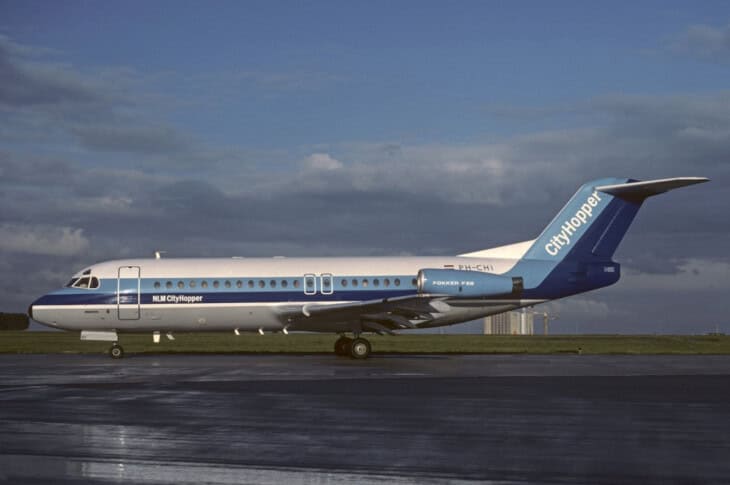
In October 1981, a Dutch Fokker F28 lost a wing after flying into a tornado near Moerdijk, at loads estimated at +6.8 g. That short, old list is covered in our look at whether turbulence can crash a plane.
Even American Airlines Flight 587, the deadliest crash tied to a wake encounter, was not brought down by the wake. The NTSB found the Airbus A300’s tail was torn off by the first officer’s “unnecessary and excessive rudder pedal inputs” in response to it. Of the 265 people killed, 260 were on board and five were on the ground.
To people, it is a different story. The NTSB found turbulence was the most common type of accident on US airlines, 37.6% of all of them from 2009 to 2018.
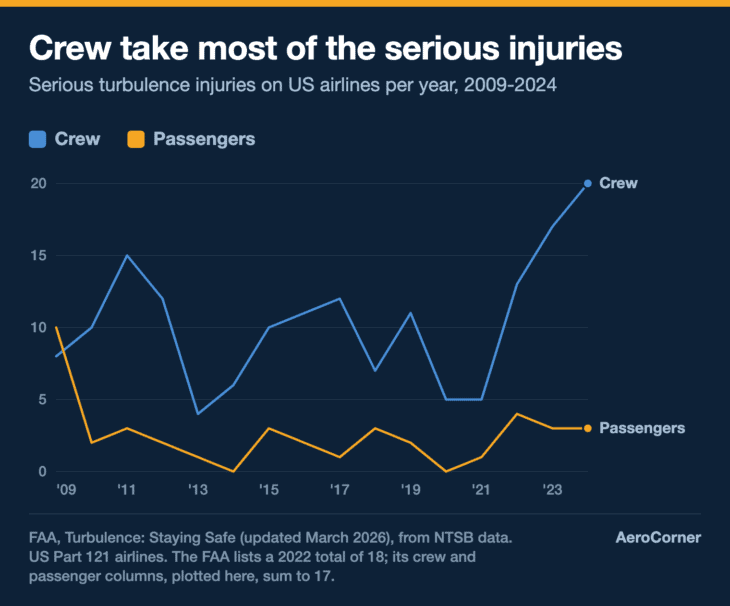
The people hurt are overwhelmingly crew. Flight attendants were 97 of the 123 people seriously injured, or 78.9%, and 74 of the 84 flight attendant injuries with a known location happened in the aft section of the cabin.
Almost nobody hurt was buckled in. Of those 123 people, only one passenger was documented as wearing a seat belt, and about half of the accidents happened during descent or approach, when crews are up securing the cabin.
The FAA’s latest counts show the same pattern: in 2024, US airlines recorded 23 serious turbulence injuries, 20 of them to crew. It is the clearest case for keeping a belt loosely fastened whenever you are seated, and the reason behind why planes have seat belts at all.
The Myth of the Plane That Fell Thousands of Feet
The myth
Severe turbulence feels like the airplane fell hundreds or even thousands of feet. In one of the most violent encounters of recent years, the flight data recorded a drop of 178 feet.
That encounter was Singapore Airlines Flight 321. According to the preliminary report from Singapore’s Transport Safety Investigation Bureau, the 777 lost 178 feet in 4.6 seconds, from 37,362 feet to 37,184 feet.
What hurt people was not the height lost but how fast the load flipped. Going from +1.35 g to negative 1.5 g in 0.6 seconds lifted anyone unbelted out of their seat, and the swing back to +1.5 g within four seconds dropped them again.
That is how turbulence injures people. A belted passenger moves with the seat. An unbelted one, or a flight attendant pushing a cart, keeps going when the floor drops away, then meets the ceiling or the floor coming back up.
So the next time the seat belt sign chimes over a calm-looking sky, the airplane is not the thing to worry about. It was built for this and far worse.
The only part of the system that is not bolted down is you. Buckle up, and spare a thought for the crew still on their feet in the back.
Sources and references used for research and fact-checking.
- National Transportation Safety Board, Preventing Turbulence-Related Injuries in Air Carrier Operations Conducted Under Title 14 Code of Federal Regulations Part 121 (Safety Research Report SS-21-01)
- Federal Aviation Administration, Turbulence: Staying Safe
- Federal Aviation Administration, Advisory Circular 00-30C, Clear Air Turbulence Avoidance
- Federal Aviation Administration, Aeronautical Information Manual, Chapter 7, Section 1: Meteorology
- Federal Aviation Administration, Aeronautical Information Manual, Chapter 7, Section 4: Wake Turbulence
- Federal Aviation Administration, Order JO 7110.65, Air Traffic Control, Chapter 1, Section 2: Terms of Reference
- SKYbrary Aviation Safety, Mountain Waves
- Legal Information Institute, Cornell Law School, 14 CFR 25.337, Limit maneuvering load factors
- Legal Information Institute, Cornell Law School, 14 CFR 25.303, Factor of safety
- Legal Information Institute, Cornell Law School, 14 CFR 25.341, Gust and turbulence loads
- Ministry of Transport, Singapore, Transport Safety Investigation Bureau Preliminary Investigation Findings of Incident Involving SQ321
- Mothership, Actions of flight crew appropriate for unexpected turbulence, cannot rule out weather radar malfunction: TSIB report on SQ321
- University of Reading, Aviation turbulence strengthened as the world warmed
- Wikipedia, BOAC Flight 911
- Wikipedia, NLM CityHopper Flight 431
- Wikipedia, American Airlines Flight 587
- Wikipedia, United Airlines Flight 826
Get the Newsletter
The latest aviation news and stories sent to your inbox.
About the Author

Tim is the owner and lead editor of AeroCorner since 2019, overseeing aviation content covering aircraft, airlines, airports, and the broader aviation industry. Through years of researching, writing, editing, and publishing aviation-focused content, he has developed extensive practical knowledge of commercial aviation and air travel. Based in Asia and a frequent traveler himself, Tim also brings firsthand passenger experience to AeroCorner’s coverage. Outside of publishing, he has also explored aviation firsthand through hands-on flight training in New Zealand.