

Table of Contents
It is a miserable afternoon at the gate. Rain is running down the terminal glass in sheets, the ramp crew are in bright waterproofs, and half the people in the boarding area have already decided the flight is doomed.
Then the board updates. On time. The jet bridge retracts, the airplane taxis out through standing water, and it leaves in weather that looks, from a passenger seat, genuinely alarming.
Rain is the most visible weather there is, which is why passengers blame it. It is also close to the least important thing on a dispatcher’s list. Here is what an airliner is actually certified to fly through, and the short list of conditions that really do stop it.
Can Planes Fly in Rain?
Yes. Commercial airliners fly in rain every day, including rain heavy enough that you cannot see the wingtip from the window. Rain on its own is not a limitation for a modern jet, and there is no rule anywhere that grounds a flight because it is raining.
What can stop a flight is the weather that often arrives with rain: the violent air inside a thunderstorm, precipitation that freezes onto the wing, wind across the runway, or visibility low enough that the crew cannot legally complete the approach. Those are four separate problems, and rain is a symptom of at most one of them.
The short version
Rain is a certification requirement, not a hazard. Engines are tested to keep running in extreme rain and hail, and windshields are designed to stay usable in it. Flights stop for thunderstorms, freezing precipitation, crosswind, and low visibility. If your flight was cancelled on a rainy day, one of those four was almost certainly the real reason.
Rain Is Something the Engine Has to Survive to Be Legal
Before an engine can be certified in the United States, it has to prove it can swallow water. The relevant rule is 14 CFR 33.78, and it is unusually blunt about what counts as passing.
The engine must run acceptably through “any three minute continuous period in rain” and “any 30 second continuous period in hail” at the FAA’s certification standard concentrations. Acceptable operation, the rule says, “precludes flameout, run down, continued or non-recoverable surge or stall, or loss of acceleration and deceleration capability.”
The concentration is not a drizzle. Appendix B to Part 33 sets the standard rain water content at 20 grams of water per cubic meter of air from sea level up to 20,000 feet. That is a thunderstorm core, sustained for three minutes, with the engine at power.
The airplane around the engine is built to the same assumption. Cockpit windshields are heated, wipers and rain repellent are certified equipment, and the pilots’ required view is defined in heavy precipitation, not in fair weather.
The accident that wrote the current rule
On 24 May 1988, TACA Flight 110, a Boeing 737-300, flew into a thunderstorm on approach to New Orleans. At 16,500 feet it took in so much water and hail that both CFM56 engines flamed out.
The crew glided the airplane down and put it on a grass levee beside NASA’s Michoud Assembly Facility. All 45 people on board walked away. The airplane was later flown off the levee and returned to service.
CFM redesigned parts of the engine in response, and the FAA rewrote the rain and hail ingestion standards outright. The version of 33.78 quoted above was adopted as a final rule on 26 March 1998. Every large jet engine certified since then has had to prove it, which is precisely why heavy rain is now an unremarkable event.
The Four Things That Actually Ground Flights
Airline weather decisions are not made on how bad the sky looks. They are made against specific, numerical limits, and only a handful of them bite.
| Condition | Does it stop the flight? | The limit that actually bites |
|---|---|---|
| Heavy rain alone | Almost never | None. Engines and airframes are certified for it |
| Thunderstorm at or near the airport | Usually, at least a hold or a ground stop | Windshear, plus a 20-mile avoidance guideline |
| Freezing rain, ice pellets, hail | Often outright | De-icing holdover time, which can be zero |
| Crosswind above the operator limit | Yes, until the wind shifts | Around 33 knots on a dry runway, less when wet |
| Visibility below approach minimums | Yes, for most crews and most airports | Approach category: CAT I, II or III |
1. Thunderstorms, and the wind hiding inside them
The danger in a thunderstorm is not the water. It is the microburst: a column of cold air that drops out of the cloud, hits the ground, and spreads outward.
NOAA describes an outflow up to about 2.5 miles (4 km) across, lasting only a few minutes, with winds that can exceed 100 knots. An airplane flying through one low to the ground meets a strong headwind, then a downdraft, then a tailwind. Airspeed collapses at the exact moment there is no altitude to trade for it.
That is what killed Delta Air Lines Flight 191 at Dallas/Fort Worth on 2 August 1985. The L-1011 flew into a thunderstorm on approach, and 136 people on board plus one driver on the ground were killed. Twenty-seven survived.
The NTSB pointed at the decision to fly through the storm, the absence of microburst escape training, and the lack of any usable windshear warning.
Aviation’s response was to build the warning that did not exist. NASA developed airborne windshear detection, the FAA required low-altitude windshear systems on turbine airliners under 14 CFR 121.358, and Terminal Doppler Weather Radar went in at major airports.
The FAA’s Aeronautical Information Manual now tells pilots to avoid any thunderstorm identified as severe or giving an intense radar echo by at least 20 miles (32 km).
Twenty miles of avoidance around a line of storms is a lot of sky to give away. When those storms sit on top of a hub, the result is holding, diversions, and the ground stops and flow control programs that keep departures on the gate hundreds of miles away.
It is the same logic, scaled up, that makes tropical systems and hurricanes shut an airport down days before the wind arrives.
Lightning, oddly, is not on the list. Airliners are struck routinely and designed to conduct the current through the skin and out again, which is why a lightning strike rarely does more than leave a scorch mark.
2. Freezing precipitation and a clock measured in minutes
Rain that freezes on contact is the single most reliable flight-stopper on this list, and it is the one passengers least expect.
A wing works because air stays attached to a very particular shape. A layer of ice you could barely feel with your hand changes that shape enough to cost significant lift and add drag, which is why airplanes are sprayed before departure and why the wing must be clean at the moment of takeoff, not at the moment of spraying.
The gap between those two moments is called holdover time, and the FAA publishes tables of it every winter. In light freezing rain at 27°F (-3°C) or above, the FAA’s 2025-2026 guidelines give ordinary Type I de-icing fluid a holdover time of just 2 to 5 minutes. Thicker Type IV anti-icing fluid, applied undiluted, buys 15 to 30 minutes.
That is the whole departure window. Push back, taxi, wait in the queue, and the protection expires before the runway. If it does, the airplane goes back and gets sprayed again, which is why a snowy or icy morning turns into cascading delays rather than a smooth flow.
There is one case where ordinary, non-freezing rain starts the same clock. A wing still full of cold-soaked fuel after a long flight can sit below freezing at the skin, so rain landing on it turns to ice, and the FAA publishes a separate holdover time for exactly that.
There is a column in the FAA's tables with nothing in it
The holdover tables carry a catch-all heading labelled “Other,” defined in the notes as heavy snow, ice pellets, moderate and heavy freezing rain, small hail and hail. Where the numbers should be, the FAA prints a caution: no holdover time guidelines exist. No fluid on the market is qualified to protect a wing in those conditions for any length of time at all, so the airplane does not go. That is the difference between rain and freezing rain in one line.
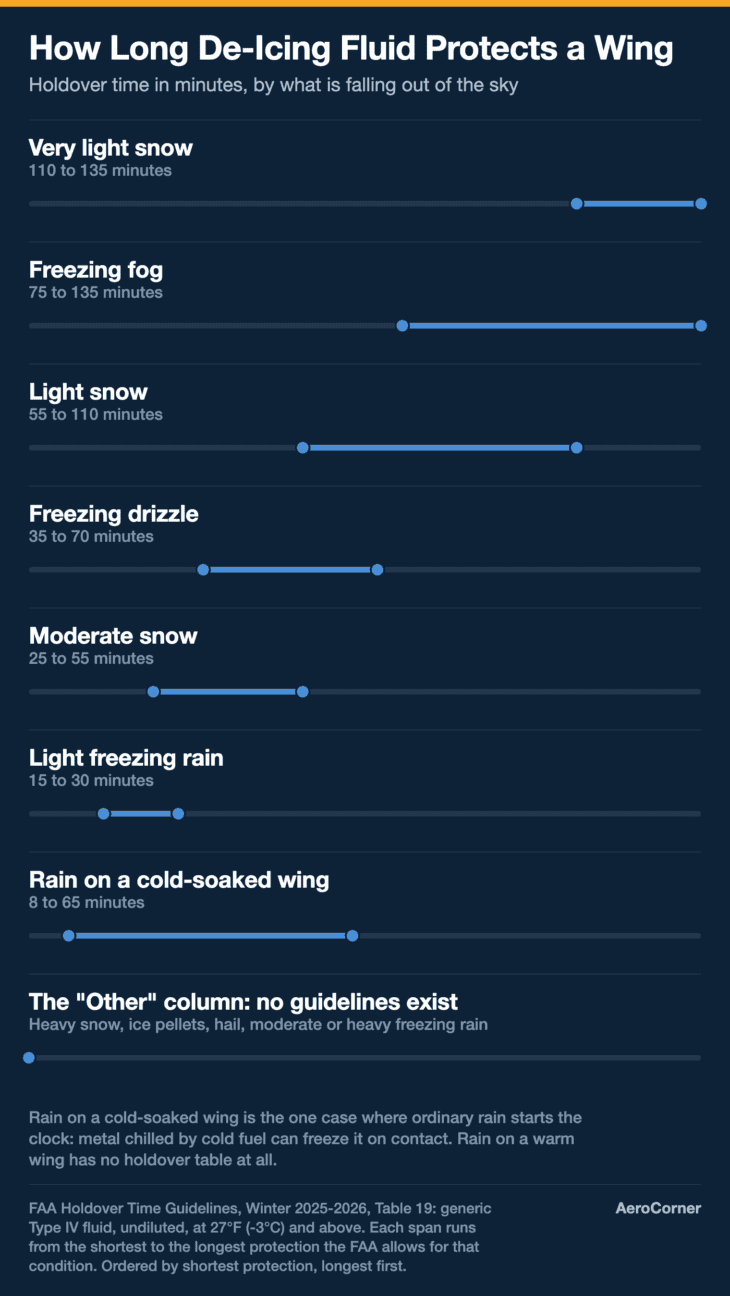
Snow behaves the same way, on a longer clock, which is why flights do keep operating in snow as long as the de-icing pads can keep up with the departure rate.
3. Wind across the runway, and what the water does to it
Every airliner has a maximum demonstrated crosswind, established during certification flight testing. For a 737-800 it is around 33 knots on a dry runway. Strictly it is a demonstration rather than a structural limit, but most airlines adopt it as a hard operating limit anyway.
Water lowers it. Once braking and steering are degraded, operators cut the allowable crosswind, often to 25 knots or less on a runway saturated by heavy rain. A wind that was perfectly legal an hour ago becomes a diversion when the rain arrives, because the airplane’s limit moved rather than the wind.
This is where rain does genuinely matter. Under the FAA’s runway condition rules, a runway counts as wet with damp surfaces or up to 1/8 inch (3 mm) of water. More than 1/8 inch and it is contaminated, with standing water risking hydroplaning, in which the tires ride on a film of water and stop gripping.
Airports report a runway condition code for each third of the runway, from 6 for dry down to 0 for no braking action. Crews recalculate their landing distance against that number, and a heavy shower can be enough to make a short, wet runway unusable for a given weight while a longer one nearby stays fine.
4. Visibility, and the number the crew has to beat
An instrument approach comes with a minimum visibility and a decision height. Reach that height without the runway environment in sight and the crew must go around, whatever the fuel situation feels like.
A standard Category I approach typically bottoms out at a 200-foot decision height with runway visual range around 1,800 to 2,400 feet. Category II takes it to roughly 100 feet and 1,000 feet of visual range. Category IIIb goes lower still, with no decision height or one below 50 feet and visual range down to about 150 feet.
The catch is that the lower categories need an approved airplane, a specifically qualified crew, and airport equipment to match, usually with the airplane landing itself. Most runways in the world are Category I only. That is why fog closes airports that heavy rain would not touch: fog attacks the one number that has no workaround.
Why “Cancelled Because of Rain” Is Almost Always Wrong
The myth
“They cancelled it because of the rain.” Rain almost never appears in an airline’s actual cancellation reasoning. What appears is a thunderstorm cell over the arrival airport, a de-icing queue longer than the holdover time, a crosswind above limits, an approach below minimums, or an airplane that is now in the wrong city because of one of those four.
The official statistics make the same point from the other direction. In June 2026, US airlines reported extreme weather as the direct cause for just 1.05 percent of all flights, according to Bureau of Transportation Statistics data.
Yet the BTS’s fuller accounting, which adds the weather buried inside air traffic system delays and weather’s pro-rata share of knock-on late-arriving aircraft, put weather’s share of delayed flights at 31.4 percent that month. Across the first half of 2026 it ran between 22.6 and 31.4 percent.
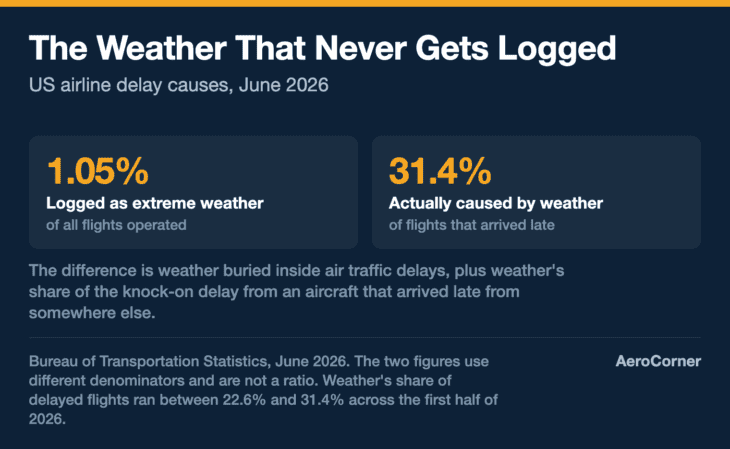
That gap is the real story. Weather causes a great deal of disruption, and almost none of it is logged as weather, because most of it reaches you second hand: the airplane that should be your airplane is stuck behind a storm somewhere else. The sky above your own airport can be perfectly flyable while the schedule falls apart.
Aircraft type matters too. The certification standards above apply to large transport jets, and the answer changes completely once you leave the airline world.
A light single-engine airplane has no de-icing capability, a far lower crosswind limit, and a pilot who may not be instrument rated, so rain that a 737 ignores can genuinely ground it. Helicopters face their own set of weather constraints again.
So the next time rain is hammering the terminal windows and the board still says on time, the board is probably right. The airplane outside was built and tested for exactly this, and the crew are watching four numbers that have very little to do with how wet the ramp looks.
Worry instead about the tall, hard-edged cloud on the horizon, the temperature sitting a degree either side of freezing, the windsock standing straight out across the runway, and the grey wall that swallows the far end of it. Those are the four that actually decide whether you fly.
Sources and references used for research and fact-checking.
- Cornell Law School, Legal Information Institute, 14 CFR 33.78 - Rain and hail ingestion
- Federal Aviation Administration, FAA Holdover Time Guidelines, Winter 2025-2026
- Bureau of Transportation Statistics, Weather's Share of Delayed Flights
- Federal Aviation Administration, Lockheed L-1011, Delta Air Lines Flight 191 - Lessons Learned
- National Oceanic and Atmospheric Administration, JetStream: Thunderstorm Hazards - Damaging Wind
- Federal Aviation Administration, Aeronautical Information Manual, Chapter 7: Safety of Flight
Get the Newsletter
The latest aviation news and stories sent to your inbox.
About the Author

Tim is the owner and lead editor of AeroCorner since 2019, overseeing aviation content covering aircraft, airlines, airports, and the broader aviation industry. Through years of researching, writing, editing, and publishing aviation-focused content, he has developed extensive practical knowledge of commercial aviation and air travel. Based in Asia and a frequent traveler himself, Tim also brings firsthand passenger experience to AeroCorner’s coverage. Outside of publishing, he has also explored aviation firsthand through hands-on flight training in New Zealand.