

Table of Contents
On March 24, 2026, 43 percent of the TSA officers scheduled at Houston’s Bush Intercontinental Airport did not show up for work. They were more than five weeks into a shutdown without pay, and waits at the airport reached four hours.
That shutdown put a number on a workforce most travelers never think about. The TSA has about 50,000 transportation security officers, the people who run the checkpoint, inside a total workforce the agency puts at nearly 65,000. Both figures come from TSA’s own fact sheet, and the White House used the same 50,000 in March 2026.
How Many TSA Agents Are There?
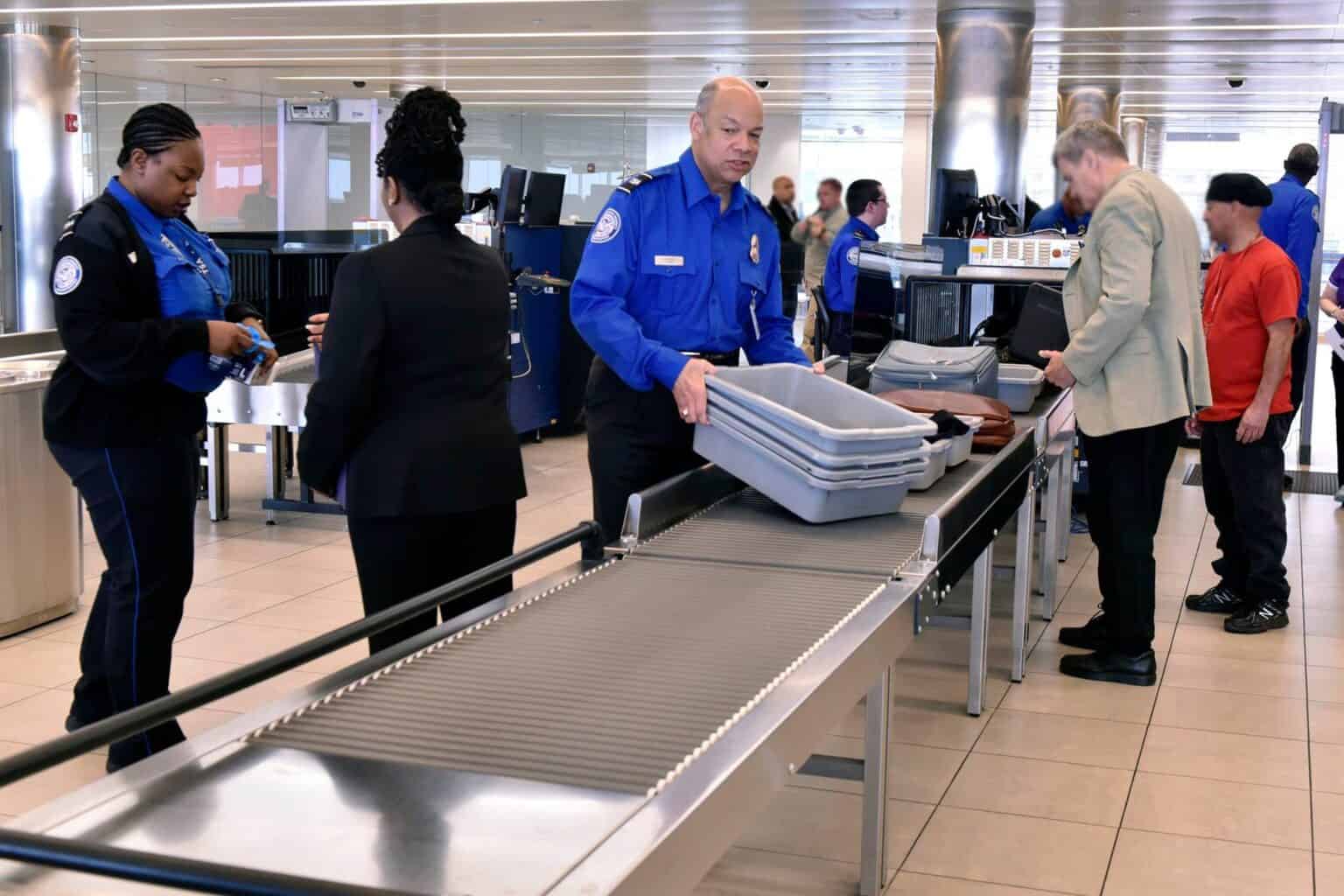
There are about 50,000 transportation security officers, which is the official title for what most people call TSA agents. They screen an average of nearly 2.5 million passengers a day at nearly 440 airports, according to TSA.
The rest of the agency is inspectors, explosives specialists, canine handlers, headquarters staff and federal air marshals. TSA’s fact sheet gives nearly 65,000 for everyone. Its leadership page and a March 2026 White House memorandum say about 60,000.
The count at a glance
About 50,000 transportation security officers (TSA fact sheet and White House, March 2026). Nearly 65,000 TSA employees in all. 50,460 screener positions and 61,844 total positions in the budget Congress enacted for fiscal 2024, with air marshals left out. About 55,000 officers, by the TSA administrator’s own count in October 2026.
Where the TSA’s 61,844 positions go
The most detailed public breakdown is in TSA’s budget justification to Congress. It lists the positions funded in fiscal 2024, the last full-year budget Congress enacted before the agency’s fiscal 2026 request, and the same level carried through 2025.
| Group | Positions, FY2024 enacted |
|---|---|
| Transportation security officers (screener pay line) | 50,460 |
| Airport management (federal security directors and their staff) | 4,215 |
| Inspectors and regulation (aviation 1,100, surface 724, air cargo 635) | 2,459 |
| Headquarters and mission support | 1,946 |
| Explosives detection canine program | 912 |
| Vetting (Secure Flight 307, fee-funded vetting 411, other 105) | 823 |
| Everything else (intelligence 426, screener training 348, screening equipment 200, inflight security staff 42, private screening oversight 13) | 1,029 |
| Total published positions | 61,844 |
| Federal air marshals | Not published |
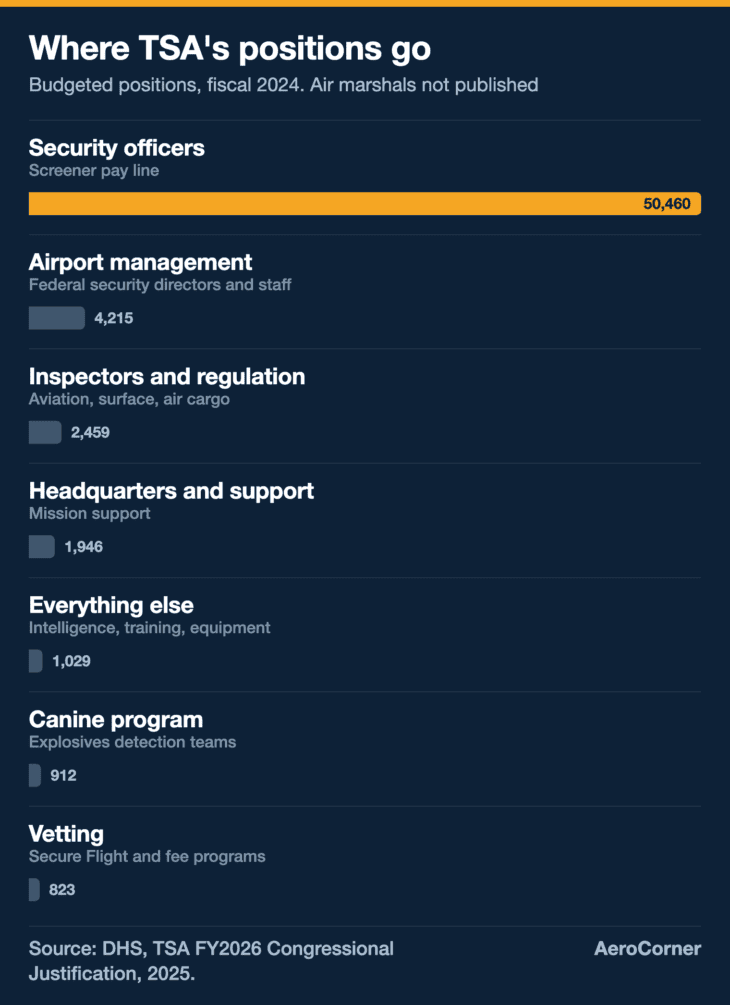
The shape is lopsided. About 82 percent of the published positions sit on the screener pay line, and 1,946 cover headquarters and mission support.
The surprise is the line that is missing. The same budget sets aside $710 million in pay for the Federal Air Marshal Service in fiscal 2024, and lists zero positions beside it. A Congressional Research Service report explains why: air marshal numbers are Sensitive Security Information.
The jobs outside the checkpoint are small but specialized. TSA’s fact sheet lists more than 1,300 transportation security inspectors, who oversee more than 40,000 transportation operators, plus over 380 explosives specialists and more than 1,000 canine teams of one dog and one handler.
Why the numbers differ
Search the question and you will see 50,000, 55,000, 60,000 and 65,000. Most of them are right. They measure different things.
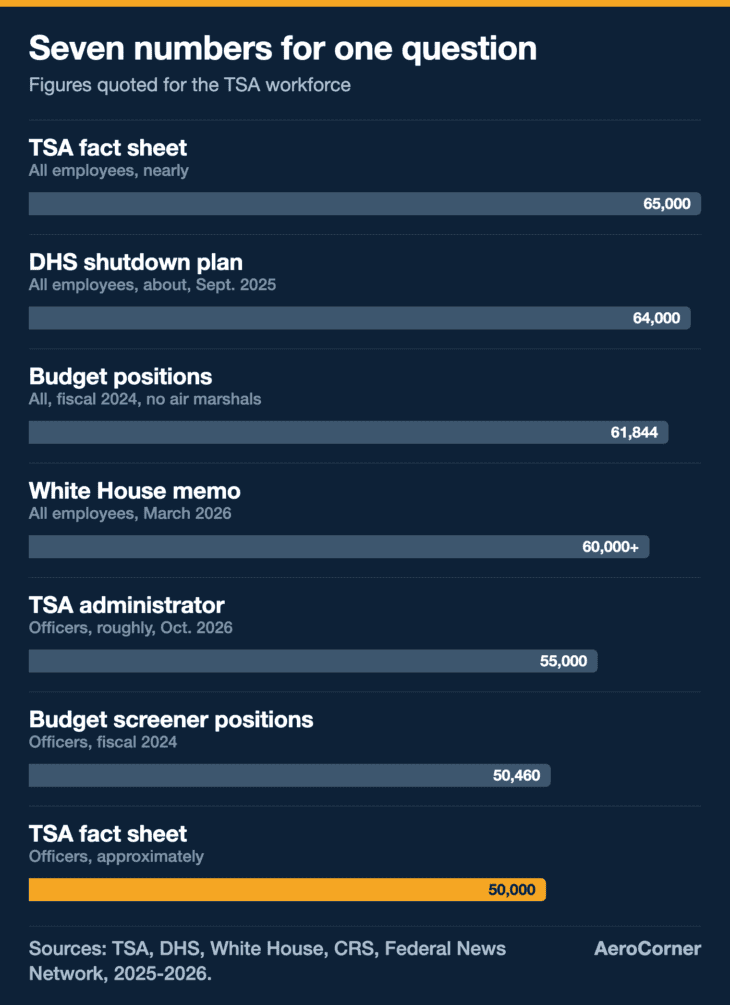
Everyone versus the checkpoint. The 60,000 and 65,000 figures count the whole agency. The 50,000 counts only transportation security officers. Treating the first as a screener count adds 10,000 to 15,000 people who never touch a bin.
The most repeated mistake
“The TSA has 65,000 agents” is wrong. Nearly 65,000 is TSA’s count of every employee, from headquarters analysts to canine handlers. The officers who check your bag number about 50,000.
Positions versus people. A budget counts funded slots, not names. The fiscal 2024 budget funded 61,844 positions but only 58,639 full-time equivalents. A full-time equivalent is one year of paid work, so vacancies and partial years pull it below the position count.
The administrator’s higher figure. TSA Administrator David Cummins told Federal News Network in October 2026 that the agency employs “roughly 55,000 transportation security officers today.” That is the newest number, but it was spoken in an interview, and TSA has published no breakdown behind it.
The screeners who are not TSA employees. At 20 airports, including San Francisco International and Kansas City International, screening is done by private companies under TSA oversight through the Screening Partnership Program. Those officers are not federal employees, so they sit outside every headcount above.
The date. The workforce moves every month. Reuters reported in April 2026 that TSA had lost more than 1,600 workers across the two funding lapses, and Cummins put attrition at 15 to 20 percent in October, so a count from early 2025 and one from late 2026 describe different agencies.
The secret line. No published figure includes a number for air marshals. TSA’s fact sheet says only that “thousands” fly every day.
How the number got here, and where it is going
TSA completed the federalization of airport security by the end of 2002. Two shutdowns in 2025 and 2026, the longest on record, tested the workforce built since.
Oct. 1 to Nov. 12, 2025
43-day government shutdown. Screeners worked without pay. CRS counts about 61,000 of roughly 64,000 TSA employees as excepted from furlough under the DHS plan.
Feb. 14, 2026
DHS-only shutdown begins. It lasts 75 days, the longest partial shutdown in US history. Daily callouts rise from about 4 percent to 11 percent on average.
March 27, 2026
White House orders TSA paid. The memorandum says nearly 500 officers had quit since the shutdown began.
April 2026
Budget proposes cuts. The fiscal 2027 request would shed more than 9,400 TSA workers, partly by moving smaller airports to private screening. Reuters reports the agency lost more than 1,600 workers in the two funding lapses.
April 30, 2026
Shutdown ends. DHS funding is signed into law.
October 2026
Fewer positions, no layoffs. Cummins says attrition runs at 15 to 20 percent and TSA will not backfill every vacancy.
The shutdown showed how thin the margin is. On March 24, 2026, callouts reached 37 percent at JFK and Atlanta and 40 percent at Houston Hobby, CRS reports, and hiring a replacement screener typically takes four to six months.
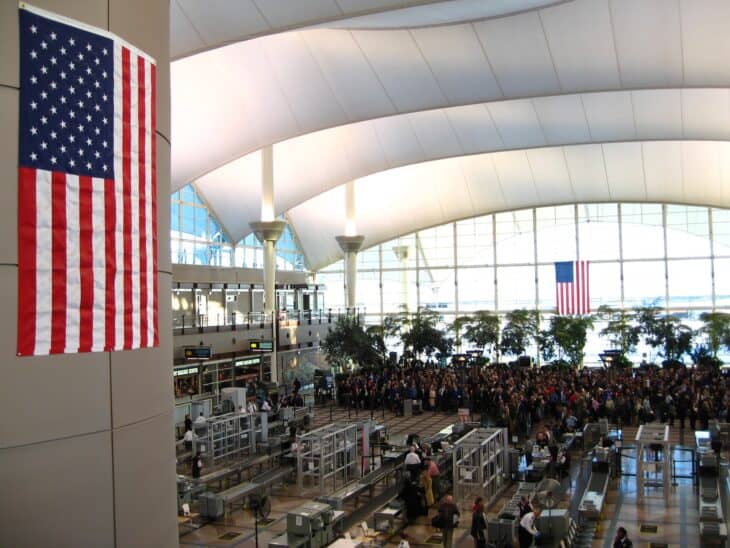

That last point is the one to watch. Cummins said TSA will shrink by not replacing officers who leave, with no layoffs, and that it plans to improve the private screening program. The next budget justification will show how far the 50,000 has moved.
How 50,000 compares
TSA screened 904 million passengers in 2024, Reuters reported. Spread across 50,000 officers, that is about 18,000 passengers per officer per year, or roughly 50 a day.
The other federal workforce that keeps flights moving is far smaller. The FAA had 11,027 certified air traffic controllers in September 2026, about one for every four and a half TSA officers.
The checkpoint those officers run keeps changing too, as the end of the shoes-off rule showed. About 50 million people are now enrolled in PreCheck, according to Cummins, and the choice between PreCheck and CLEAR shapes which lane they stand in.
FAQ
Sources and references used for research and fact-checking.
- Transportation Security Administration, TSA at a Glance
- Department of Homeland Security, Transportation Security Administration Fiscal Year 2026 Congressional Justification
- Transportation Security Administration, Leadership and Organization
- The White House, Paying Our Great Transportation Security Administration Officers and Employees
- Congressional Research Service, Federal Government Shutdowns and the Impact on Civil Aviation (R49491)
- Federal News Network, TSA leader details PreCheck upgrades, staffing plans and chair decision
- Reuters via The Spokesman-Review, Trump proposes to shed 9,400 TSA workers, $1.5 billion from budget
- Transportation Security Administration, Screening Partnership Program
- Transportation Security Administration, TSA pay, technology spur agency growth over last two years
- Transportation Security Administration, New hire training for West Coast TSA officers
- Transportation Security Administration, TSA ConfirmID
Get the Newsletter
The latest aviation news and stories sent to your inbox.
About the Author

Tim is the owner and lead editor of AeroCorner since 2019, overseeing aviation content covering aircraft, airlines, airports, and the broader aviation industry. Through years of researching, writing, editing, and publishing aviation-focused content, he has developed extensive practical knowledge of commercial aviation and air travel. Based in Asia and a frequent traveler himself, Tim also brings firsthand passenger experience to AeroCorner’s coverage. Outside of publishing, he has also explored aviation firsthand through hands-on flight training in New Zealand.