

Table of Contents
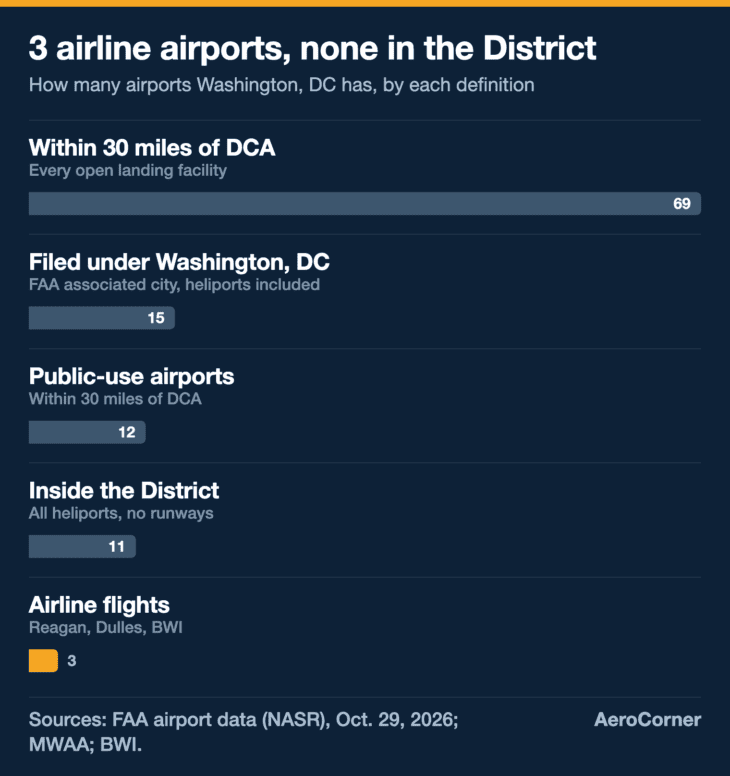
Washington, DC is served by three airports with airline flights: Ronald Reagan Washington National (DCA), Washington Dulles International (IAD) and Baltimore/Washington International Thurgood Marshall (BWI). Together they handled about 79.1 million passengers in 2025, according to the two airport operators.
None of them is inside the District of Columbia. Reagan and Dulles are in Virginia, BWI is in Maryland, and the FAA’s airport records, effective October 29, 2026, show no runway anywhere in the District. What DC does have is 11 heliports.
How Many Airports Are in Washington, DC?
Three, if you mean airports where you can buy an airline ticket to Washington. Zero, if you mean runways inside the District’s borders. Both answers are correct, and the gap between them explains most of the confusion online.
The FAA’s own filing adds a third answer. It lists 15 open landing facilities with Washington, DC as their associated city: Reagan National, Dulles, Manassas Regional and 12 heliports. All three of those airports sit in Virginia counties.
The count at a glance
3 airports with airline flights (Reagan National, Dulles, BWI). 0 runway airports inside the District of Columbia. 11 heliports inside the District. 15 landing facilities the FAA files under Washington, DC, heliports included. 12 public-use airports within 30 miles of Reagan National. 69 open landing facilities within those 30 miles. FAA data effective October 29, 2026.
Washington’s Landing Facilities, Broken Down
The FAA gives every landing facility an “associated city,” the place it serves, which is not always the place it sits. The table below counts three ways: by that FAA filing, by what is physically inside the District, and by distance from Reagan National.
| Facility type | Filed under Washington, DC | Inside the District | Within 30 miles of DCA |
|---|---|---|---|
| Public-use airports | 3 | 0 | 12 |
| Private-use airports | 0 | 0 | 13 |
| Heliports | 12 | 11 | 43 |
| Seaplane bases | 0 | 0 | 1 |
| Total | 15 | 11 | 69 |
The 11 heliports inside the District are mostly hospital pads, such as Children’s, Sibley Memorial and MedStar Georgetown University Hospital. The US Park Police helicopter base, Eagle’s Nest, sits in Anacostia Park. Only one, the privately owned South Capitol Street heliport, is open to the public.
The 12th heliport filed under Washington is the Pentagon’s, which stands on the Virginia side of the Potomac. The FAA files it under the city it serves, as it does Reagan National.
Twelve airports within 30 miles of Reagan are open to any pilot. Seven are publicly owned and five are private businesses that open their runways to the public.
| Airport | Code | State | Miles from DCA | Owner |
|---|---|---|---|---|
| Ronald Reagan Washington National | DCA | VA | 0 | Public |
| Potomac Airfield | VKX | MD | 8.4 | Private |
| College Park | CGS | MD | 10.9 | Public |
| Freeway | W00 | MD | 15.6 | Private |
| Maryland | 2W5 | MD | 17.7 | Private |
| Fort Meade Executive | FME | MD | 22.0 | Public |
| Montgomery County Airpark | GAI | MD | 23.0 | Public |
| Washington Dulles International | IAD | VA | 23.7 | Public |
| Lee | ANP | MD | 26.0 | Private |
| Manassas Regional | HEF | VA | 27.2 | Public |
| Davis | W50 | MD | 27.7 | Private |
| Baltimore/Washington International | BWI | MD | 29.9 | Public |
Joint Base Andrews, home of the Air Force One jets, is 9.6 miles (15 km) from Reagan and is among the 13 private-use airports. It is a military field, so it never appears in a travel answer.
The Three Airports With Airline Flights
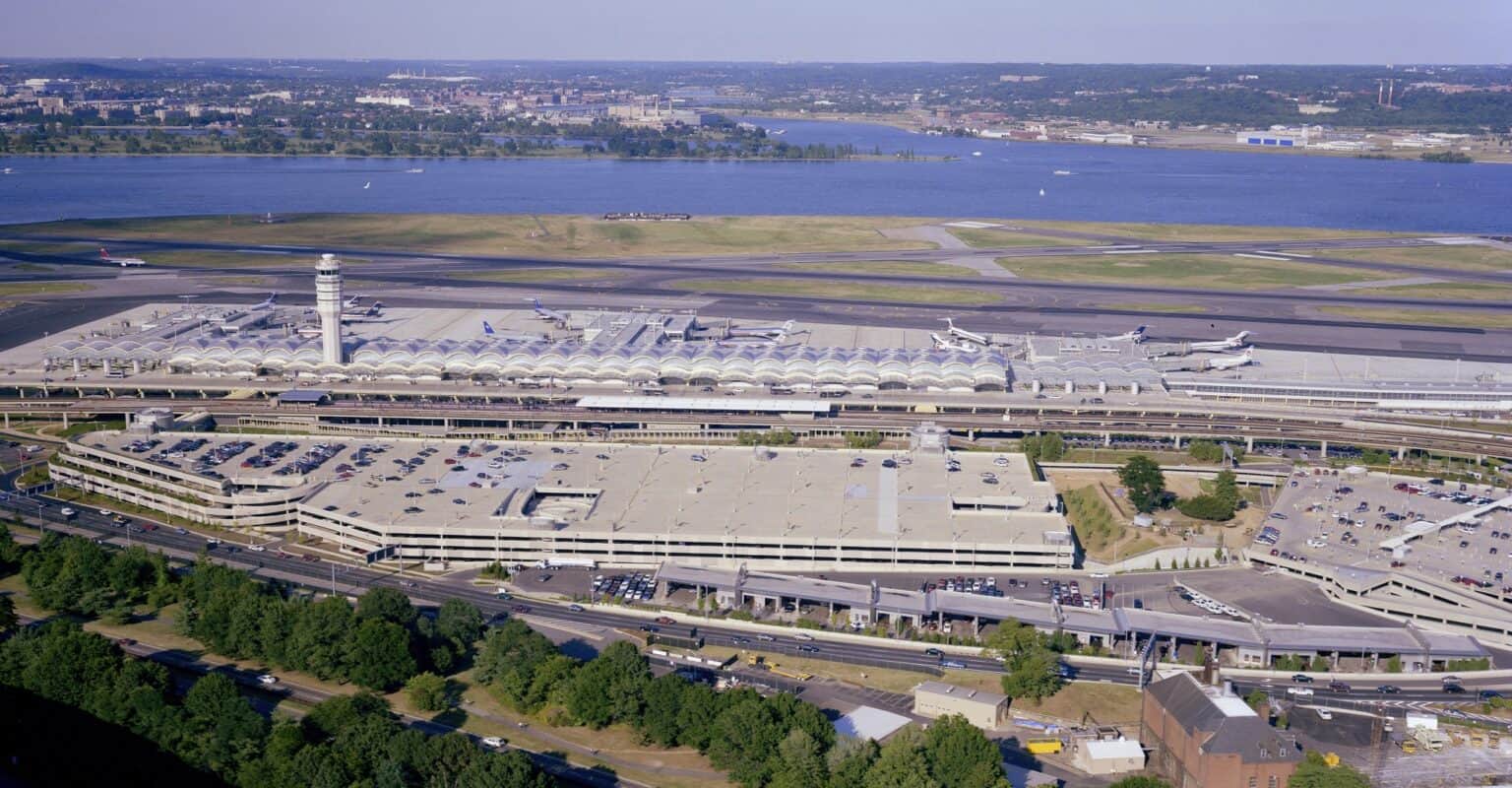
Reagan National is the close-in airport, opened on June 16, 1941, across the Potomac from downtown. It handled 24.89 million passengers in 2025, down 5.3 percent from its 2024 record. The Metropolitan Washington Airports Authority blamed softer government travel, the 43-day federal shutdown and the after-effects of the January 2025 midair collision that killed 67 people.
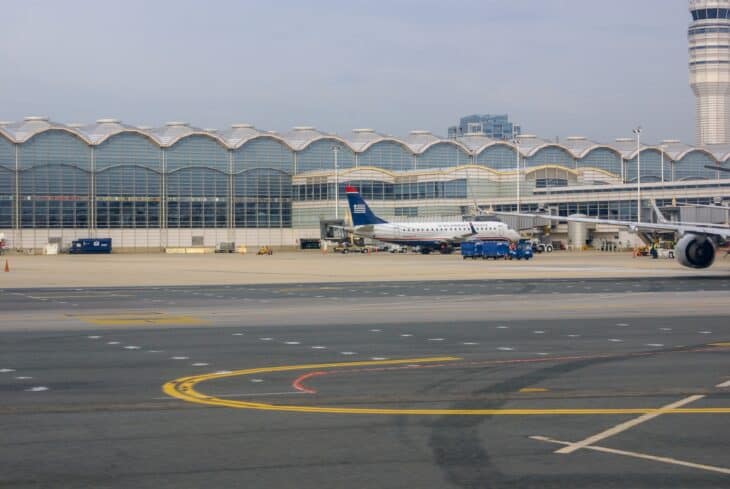

Reagan is small for its traffic: 861 acres and three runways, the longest 7,169 feet (2,185 m). Federal law also bars nonstops from Reagan to airports more than 1,250 miles (2,012 km) away, with a limited set of exemptions, a rule covered in our explainer on the Reagan National perimeter rule.
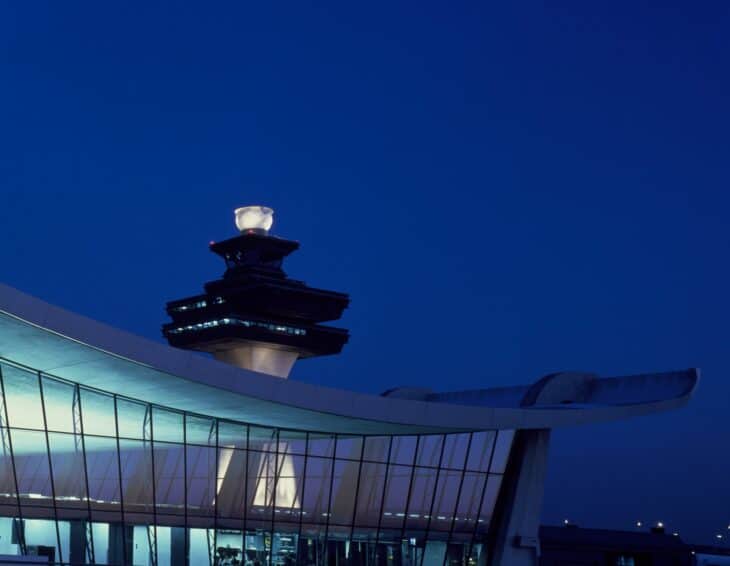
Dulles, dedicated on November 17, 1962, is the long-haul airport, 26 miles (42 km) west of downtown in Loudoun and Fairfax counties. It set records in 2025 with 29.01 million passengers, 10.53 million of them international, and it covers 13,000 acres with four runways up to 11,500 feet (3,505 m).
BWI opened as Friendship International Airport in 1950 and is owned by the State of Maryland. It sits about 30 miles (48 km) northeast of Washington and handled 25.22 million passengers in 2025, down 6.8 percent.
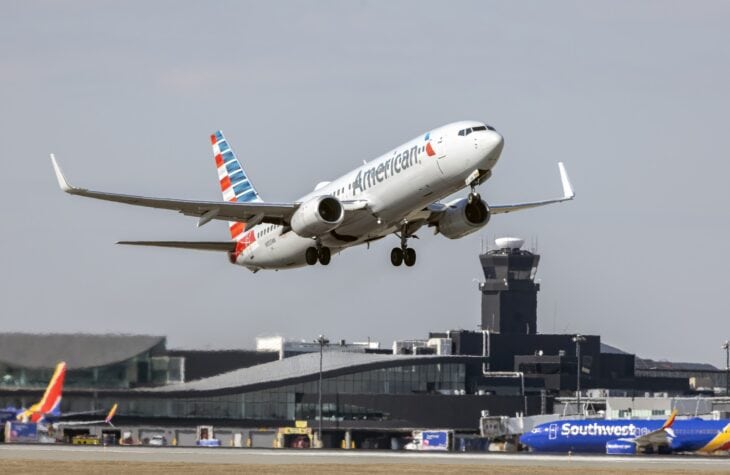

Busiest is a matter of measure. Dulles carried the most passengers, but in AeroCorner’s analysis of airline schedule data (passenger-airline departures, averaged over six sample weeks from June to November 2026), Reagan scheduled the most flights: about 464 departures a day, against about 448 at Dulles and about 338 at BWI.
Reagan’s flights stay mostly inside its 1,250-mile limit, while Dulles flew to 44 foreign countries in the November sample week. Which one suits a given trip is the subject of our DCA vs IAD guide.
The world's oldest airport is inside the no-fly ring
College Park Airport in Maryland, 10.9 miles from Reagan, was established by the US Army Signal Corps in August 1909, when Wilbur Wright taught Lieutenants Frederic Humphreys and Frank Lahm to fly there. It is often called the world’s oldest continuously operated airport. Today it is one of only two general aviation airports left inside Washington’s Flight Restricted Zone.
Why Other Sites Give a Different Number
Search the question and you will see two, three, four or “none.” Each counts something different.
Two is the count of airports that carry “Washington” in their name and are run by the Metropolitan Washington Airports Authority: Reagan and Dulles, both owned by the federal government. Airport databases that sort by FAA filing also show two, because BWI is filed under Baltimore.
Three is the travel answer, and the one airlines and booking sites use. IATA’s metropolitan code for Washington, WAS, covers all three airports. Four usually adds Richmond International, 94 miles (152 km) south of Reagan, which some Virginia guides treat as a Washington-area option.
Reagan National is not in DC, legally
Reagan National is often described as the airport ‘in DC.’ Part of it was built on mudflats on the District side of the river, but in 1945 Congress passed a law placing the airport legally within Virginia, under federal jurisdiction. The FAA lists it in Arlington County, Virginia.
The bigger totals come from the FAA’s records, and they depend on where you draw the line. The District’s own boundary holds 11 heliports. A 30-mile circle around Reagan holds 69 facilities, from BWI down to private grass strips and a seaplane base.
The District has had no runway for decades. Fixed-wing flying at Bolling Field and the neighboring naval air station at Anacostia, its last airfields, ended in 1962 because the airspace was too crowded next to National Airport.
Why the Count Stays Small: The Flight Restricted Zone
Washington’s airspace is among the most restricted in the US. Since February 2002, a Flight Restricted Zone has covered roughly 13 to 15 nautical miles (15 to 17 miles, 24 to 28 km) around Reagan National, inside a wider Special Flight Rules Area in force since February 2009.
Only three general aviation airports were ever allowed inside the zone, the “Maryland Three”: College Park, Potomac Airfield and Washington Executive/Hyde Field. Pilots who fly there need a TSA background check and a personal identification number. Hyde Field closed on November 30, 2022, leaving two.
Those rules are why a metro area of this size has so few small airports close in, and why the count is unlikely to grow. The airline count is stable too: it has been three since Dulles opened in 1962, and the numbers that move are passengers and private heliports. Nationally, the US has 19,445 airports, and New York’s three major airports are the closest parallel to Washington’s split.
FAQ
Sources and references used for research and fact-checking.
- Federal Aviation Administration, NASR 28-day subscription: airport data (APT CSV), effective October 29, 2026
- Metropolitan Washington Airports Authority, Washington's Airports Served Record 54 Million Passengers in 2025
- Maryland Aviation Administration, BWI Marshall monthly statistics, December 2025
- AOPA, Security Brief: Washington, D.C., Flight Restricted Zone/DC-3 Airports
- AOPA, Washington Executive Airport/Hyde Field closes
- Cornell Law School Legal Information Institute, 14 CFR 93.343
- US Government Publishing Office, 49 U.S.C. 49109, Nonstop flights
- Wikipedia, Ronald Reagan Washington National Airport
- Wikipedia, Washington Dulles International Airport
- Wikipedia, Baltimore/Washington International Airport
- Wikipedia, College Park Airport
- Wikipedia, Bolling Air Force Base
- IATA, Fact sheet: IATA location codes
Get the Newsletter
The latest aviation news and stories sent to your inbox.
About the Author

Tim is the owner and lead editor of AeroCorner since 2019, overseeing aviation content covering aircraft, airlines, airports, and the broader aviation industry. Through years of researching, writing, editing, and publishing aviation-focused content, he has developed extensive practical knowledge of commercial aviation and air travel. Based in Asia and a frequent traveler himself, Tim also brings firsthand passenger experience to AeroCorner’s coverage. Outside of publishing, he has also explored aviation firsthand through hands-on flight training in New Zealand.