

Table of Contents
Washington’s closest airport has had a mileage limit since 1966. Congress has spent the last 26 years carving holes in it, and two Virginia senators now want to close most of them again.
Ronald Reagan Washington National Airport is not supposed to have nonstop flights longer than 1,250 statute miles (2,010 km). Yet it flies to 12 cities beyond that line, from Seattle to San Juan, on 50 congressional exemptions that add up to 25 daily round trips.
The DCA perimeter rule is now back in play. The DCA Air Safety Act, unveiled by Senators Tim Kaine and Mark Warner on September 10, 2026, would remove 30 slot exemptions by the end of 2032, and at least 26 of them must be beyond-perimeter flights. That is more than half of the airport’s long-haul flying.
Why a Washington Airport Has a Mileage Limit at All
The perimeter rule began in January 1966, when jet service came to National. It started as a voluntary airline agreement that limited jet flights to 650 statute miles (1,050 km), with seven grandfathered exceptions.
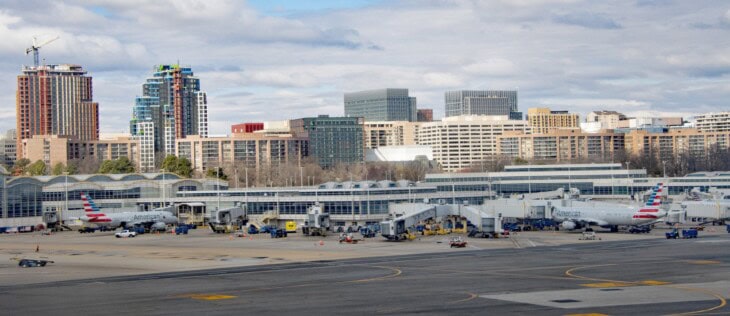
The logic was geographic. National was meant to be the short-haul airport, close to downtown and hemmed in by the Potomac. Washington Dulles, farther out in Virginia, was meant to take the long-haul growth.
A separate federal slot rule followed in 1969. It caps National at 60 instrument flight operations an hour between 6 a.m. and midnight, split into 37 air carrier, 11 commuter and 12 general aviation slots, according to the Metropolitan Washington Airports Authority (MWAA). A slot covers one takeoff or one landing, so a daily round trip uses two.
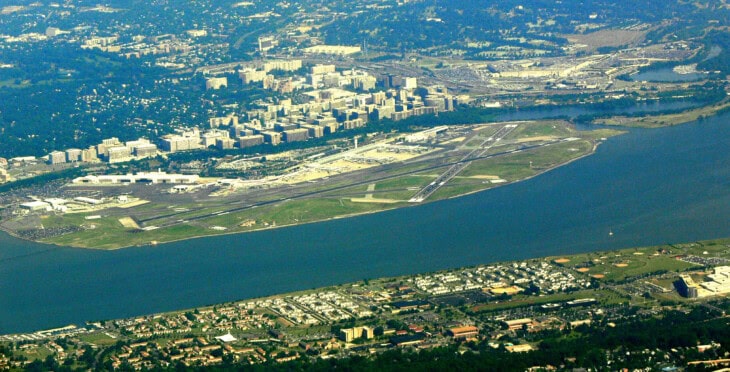
The perimeter itself kept moving. The Metropolitan Washington Airports Policy of 1981 wrote it into federal policy at 1,000 miles (1,600 km). In 1986 it was stretched to 1,250 miles so that Houston could get nonstop flights, with Dallas also inside the line.
That is why the limit sits where it does today. Our route data puts Houston Hobby at 1,217 miles from DCA, comfortably inside the line, while Austin, at 1,314 miles, falls just outside it.
The 50 Exemptions That Get Around It
The 1,250-mile rule has not changed since 1986. Instead, Congress wrote exceptions into four FAA reauthorization bills.
Here is how the beyond-perimeter count was built, per MWAA and the Congressional Research Service:
- 2000: 24 new exemptions, 12 of them beyond the perimeter.
- 2003: 22 new exemptions, 12 of them beyond the perimeter.
- 2012: 8 new beyond-perimeter exemptions, plus 8 existing ones converted to beyond-perimeter flying.
- 2024: 10 new beyond-perimeter exemptions, two each to Alaska, American, Delta, Southwest and United.
That makes 40 beyond-perimeter exemptions by 2012, or 20 round trips, plus the 10 added in 2024. The total is 50 takeoff and landing rights supporting 25 daily round trips.
The 2024 batch opened routes to San Diego, San Antonio, Seattle, Las Vegas and San Francisco. Alaska’s San Diego flight launched on March 17, 2025, flown with a Boeing 737-800. Alaska said at the time that San Diego had more passengers than any other US airport without DCA service.
| City beyond the perimeter | Distance from DCA | Airlines |
|---|---|---|
| San Francisco (SFO) | 2,436 miles (3,920 km) | Alaska, United |
| Portland, Oregon (PDX) | 2,345 miles (3,774 km) | Alaska |
| Seattle (SEA) | 2,323 miles (3,739 km) | Alaska, Delta |
| Los Angeles (LAX) | 2,306 miles (3,711 km) | Alaska, American, Delta |
| San Diego (SAN) | 2,271 miles (3,655 km) | Alaska |
| Las Vegas (LAS) | 2,084 miles (3,354 km) | American, Southwest |
| Phoenix (PHX) | 1,975 miles (3,178 km) | American |
| Salt Lake City (SLC) | 1,847 miles (2,972 km) | Delta |
| San Juan (SJU) | 1,558 miles (2,507 km) | JetBlue |
| Denver (DEN) | 1,472 miles (2,369 km) | American, Frontier, United |
| San Antonio (SAT) | 1,379 miles (2,219 km) | American |
| Austin (AUS) | 1,314 miles (2,115 km) | Southwest |
The longest, San Francisco, is nearly twice the distance the rule allows. The SFO flight takes a typical 6 hours 5 minutes, the longest nonstop on DCA’s board.
Why the Long Flights Are the Ones on the Block
The bill is framed as a safety measure after the January 2025 midair collision near the airport. The NTSB found that managing DCA’s traffic had been a longstanding challenge, and that airlines bunched flights into surges that added to controller workload.
MWAA’s own numbers show the squeeze. The airport says DCA was designed for 15 million passengers a year and now handles about 25 million. It counted 26.3 million in 2024 and just under 24.9 million in 2025.
The bill says Congress has added 64 daily flights since 2000. It would remove 30 of those exemptions, and it requires that at least 26 of them be beyond-perimeter slots, alongside a hard cap of 28 arrivals an hour.
That split is what has drawn fire. View from the Wing’s Gary Leff calculated that beyond-perimeter rights are just 5.6% of DCA’s slots, yet must account for at least 86.7% of the cuts.
Two airlines with everything at stake
By View from the Wing’s count, Alaska holds 12 takeoff and landing rights at DCA and Frontier holds 6. Every one of them is a beyond-perimeter exemption, so both airlines’ entire Reagan National presence sits in the pool the bill targets.
The fight is also a replay. In 2023 the CEOs of Alaska, American and United jointly opposed adding DCA flights, citing FAA and MWAA warnings about delays. An FAA memo that MWAA cites predicted delays could rise by more than 25% with 20 more daily round trips.
The 2024 reauthorization settled on five round trips instead, after Texas Senators Ted Cruz and John Cornyn pushed to loosen the rule and Virginia and Maryland senators pushed back. “For years, Senator Kaine and I have been warning that DCA is overcrowded and have fought to reduce the number of slot exemptions at the airport,” Warner said of the new bill.
What Happens to the Flights Now
Nothing, yet. The text Kaine’s office released on September 10 carried no bill number, and it would have to pass both chambers and be signed before the FAA had to act.
If it became law, the FAA, not Congress, would pick which 30 exemptions go. It would publish a proposed list, take 60 days of public comment, then remove six a year from 2028, with the last gone by December 31, 2032.
The FAA could delay a given year’s cuts by one year if it found no measurable safety benefit, but every cut must still happen by the 2032 deadline. The bill also bars court challenges to those choices.
Because a round trip uses two slots, 26 beyond-perimeter cuts means at least 13 of today’s 25 long-haul round trips would go. Five of the 12 cities, Portland, Salt Lake City, San Diego, San Antonio and Austin, have one scheduled daily departure in our data, so any cut that reached them would end the route.
For travelers in those cities, the fallback is the one the 1966 rule intended all along: fly into Dulles, 24 miles (38 km) from National.
Sources and references used for research and fact-checking.
- Office of Senator Tim Kaine, DCA Air Safety Act (bill text)
- Metropolitan Washington Airports Authority, DCA Reagan National Slot & Perimeter Rules
- Congressional Research Service, Reagan National Airport Slot and Perimeter Rules and Exemptions Authorized in 2024 (IN12504)
- NTSB, Testimony of Chair Jennifer Homendy on the NTSB Final Report on the DCA Midair Collision
- Wikipedia, Ronald Reagan Washington National Airport
- View from the Wing, New Safety Bill Requires Cutting Half Of Washington National Airport's Long-Distance Flights
- Virginia Mercury, Va.'s US Sens. Kaine, Warner introduce bill to curb overcrowding at Reagan National Airport
- ARLnow, Reagan National confirms its lowest air traffic numbers in three years
- AeroRoutes, Alaska Airlines Adds San Diego - Washington Reagan From March 2025
- Alaska Airlines, Alaska Airlines selected to connect San Diego and Ronald Reagan Washington National Airport with nonstop service
- Live and Let's Fly, Alaska Airlines, American Airlines, United Airlines Oppose Changes To DCA Perimeter Rule
Get the Newsletter
The latest aviation news and stories sent to your inbox.
About the Author

Tim is the owner and lead editor of AeroCorner since 2019, overseeing aviation content covering aircraft, airlines, airports, and the broader aviation industry. Through years of researching, writing, editing, and publishing aviation-focused content, he has developed extensive practical knowledge of commercial aviation and air travel. Based in Asia and a frequent traveler himself, Tim also brings firsthand passenger experience to AeroCorner’s coverage. Outside of publishing, he has also explored aviation firsthand through hands-on flight training in New Zealand.