

Table of Contents
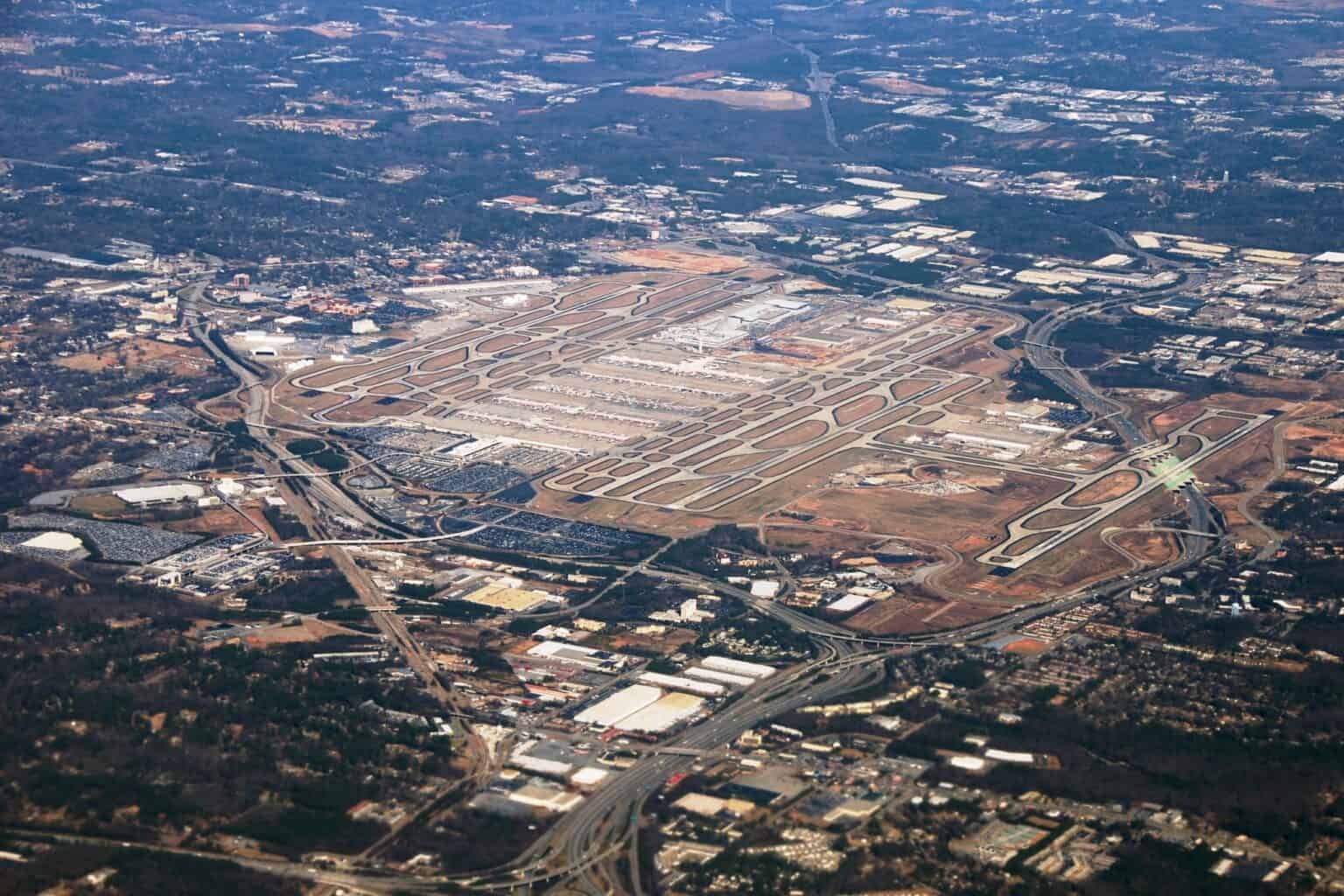
Hartsfield-Jackson Atlanta International Airport has five runways, according to the FAA airport record effective October 29, 2026. All five are parallel and run east to west.
That is fewer than Chicago O’Hare, Dallas/Fort Worth or Denver. Yet Atlanta handled 106.3 million passengers in 2025, more than any airport on Earth, according to Airports Council International.
How Many Runways Does Atlanta Airport Have?
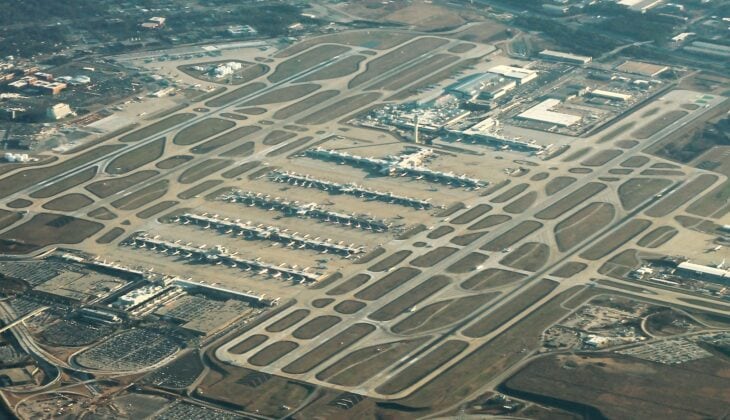
Atlanta has five runways: 8L/26R, 8R/26L, 9L/27R, 9R/27L and 10/28. There are no diagonal or crosswind runways, so every takeoff and landing at the airport heads either roughly east or roughly west.
The five sit in two groups on either side of the terminal and concourses. The north side holds a pair, 8L/26R and 8R/26L. The south side holds three: 9L/27R, 9R/27L and the newest runway, 10/28.

Atlanta's runways at a glance
5 runways, all parallel, all east-west (FAA data, October 2026). Longest: 9L/27R at 12,390 feet. Shortest: three runways at 9,000 feet. Newest: 10/28, opened May 27, 2006. Total length: 49,389 feet, about 9.4 miles (15.1 km).
Each runway carries two numbers because it has two ends. Pilots landing toward the east use 8L, and pilots landing toward the west on the same strip of concrete use 26R. So the five runways show up as 10 runway numbers on an airport diagram, which explains some of the confusion over the count.
Oddly, the FAA record gives all five the same heading, 095 degrees magnetic, yet they are numbered 8, 9 and 10. With five parallel runways there are not enough left and right letters to go around, so Atlanta’s runways share neighboring numbers instead, part of the system explained in our guide to runway markings and signs.
All 5 Atlanta Runways, by Length
| Runway | Side of airfield | Length | Width |
|---|---|---|---|
| 9L/27R | South | 12,390 ft (3,776 m) | 150 ft |
| 8R/26L | North | 9,999 ft (3,048 m) | 150 ft |
| 8L/26R | North | 9,000 ft (2,743 m) | 150 ft |
| 9R/27L | South | 9,000 ft (2,743 m) | 150 ft |
| 10/28 | South | 9,000 ft (2,743 m) | 150 ft |
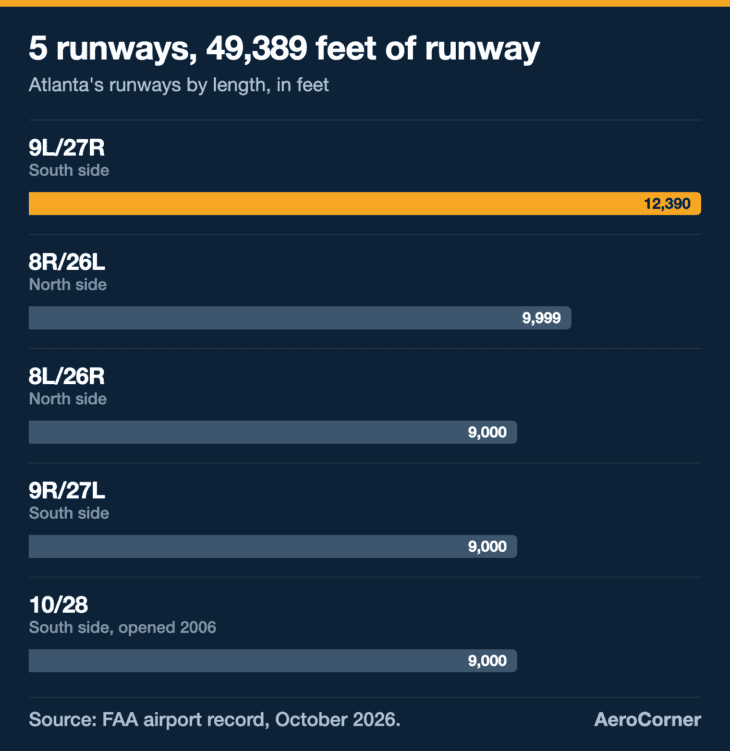
Added together, the five runways come to 49,389 feet, about 9.4 miles (15.1 km) of runway. Three of the five are exactly 9,000 feet long, modest next to the longest runways in the US.
The outlier is 9L/27R on the south side. At 12,390 feet it beats the next longest by almost 2,400 feet and is long enough for the largest airliners, including the Airbus A380. Why some jets need that much concrete is the subject of our explainer on how long a runway needs to be.
The layout matters as much as the length. Working from the FAA’s published runway-end coordinates, each runway in the north pair sits only about 1,000 feet from its neighbor, as do 9L and 9R in the south. The fifth runway, 10/28, sits about 4,200 feet south of 9R/27L, far enough away to work as a separate stream of traffic.
Why the Numbers Differ
Five is not the only number in circulation. Search for Atlanta’s runways and you can still find a business listing describing “2 parallel runways,” pages written before 2006 that say four, and the 10 runway numbers on the airport diagram.
No, Atlanta does not have two runways
A listing that turns up in Atlanta airport searches credits it with 2 parallel runways. The FAA record lists five. One plausible source of the mix-up: the airfield is split into two runway complexes, a pair to the north and three to the south.
The four figure is simply out of date. Atlanta finished its fourth parallel runway in December 1984 and flew with four until 10/28 opened on May 27, 2006, so anything written before mid-2006 is correct for its time and wrong today.
The lengths drift too. Many sources, including Wikipedia’s summary of the airport, call 8R/26L a 10,000-foot runway. The FAA record lists it at 9,999 feet, one foot short, which is why our table says 9,999.
The FAA record also shows how the runways are run. Atlanta Tower uses a separate radio frequency for each of the five runways, and ground control splits the airfield three ways: the north pair, 9L and 9R together, and 10/28 on its own.
The Fifth Runway: $1.28 Billion and a Bridge Over I-285
Runway 10/28 is the reason Atlanta’s count is five and not four. It cost $1.28 billion to build, and because the only room left for it was south of the existing airfield, it had to cross Interstate 285, the beltway around the city.
The solution was to bridge the highway. The 9,000-foot runway was built with two bridges over I-285 that can carry up to 1.3 million pounds, according to The Atlanta Journal-Constitution, so drivers on the beltway pass underneath landing jets.
A runway that was never meant to add flights
Airport officials did not expect the fifth runway to attract more flights. Its job was to cut delays. On its 10th birthday in 2016, officials credited it with saving the airline industry $260 million a year in delay costs, with more than 100,000 takeoffs and landings a year.
The gain came from geometry. Because 10/28 sits well clear of the other runways, it made triple simultaneous landings possible. Arrival on-time performance rose from 71.8% in 2005 to 84.4% in 2015, according to Bureau of Transportation Statistics figures reported by the AJC.
A sixth runway has been on the drawing board since then. In 2016 the airport’s master plan expected one squeezed in north of the fifth runway, but the FAA record as of October 2026 still lists five.
How 5 Runways Compare With Other Big US Airports
Atlanta’s runway count is unremarkable for an airport its size. O’Hare has eight, Dallas/Fort Worth seven and Denver six, according to the same FAA data. Los Angeles gets by with four.
| Airport | Runways | Longest runway |
|---|---|---|
| Chicago O’Hare (ORD) | 8 | 13,000 ft |
| Dallas/Fort Worth (DFW) | 7 | 13,401 ft |
| Denver (DEN) | 6 | 16,000 ft |
| Atlanta (ATL) | 5 | 12,390 ft |
| Los Angeles (LAX) | 4 | 12,923 ft |
What stands out is how hard Atlanta works each runway. ACI counted 807,625 takeoffs and landings at Atlanta in 2025, about 2,200 a day, or roughly 161,500 per runway over the year. O’Hare, which rebuilt its airfield to reach eight runways, logged 857,392 movements, about 107,200 per runway.
So O’Hare now has more flights overall, but Atlanta still has more passengers, the measure behind its title as the busiest airport in the world. It does that with three fewer runways.
FAQ
Sources and references used for research and fact-checking.
- AirNav (FAA airport master record data), Hartsfield/Jackson Atlanta International Airport (KATL)
- AirNav (FAA airport master record data), Chicago O'Hare International Airport (KORD)
- AirNav (FAA airport master record data), Dallas-Fort Worth International Airport (KDFW)
- AirNav (FAA airport master record data), Denver International Airport (KDEN)
- AirNav (FAA airport master record data), Los Angeles International Airport (KLAX)
- Airports Council International World, World's Busiest Airports: Atlanta Holds, Asia Climbs
- The Atlanta Journal-Constitution, Hartsfield-Jackson's fifth runway hits 10th birthday
- Wikipedia, Hartsfield-Jackson Atlanta International Airport
- Atlanta.com, How many runways does Atlanta have?
Get the Newsletter
The latest aviation news and stories sent to your inbox.
About the Author

Tim is the owner and lead editor of AeroCorner since 2019, overseeing aviation content covering aircraft, airlines, airports, and the broader aviation industry. Through years of researching, writing, editing, and publishing aviation-focused content, he has developed extensive practical knowledge of commercial aviation and air travel. Based in Asia and a frequent traveler himself, Tim also brings firsthand passenger experience to AeroCorner’s coverage. Outside of publishing, he has also explored aviation firsthand through hands-on flight training in New Zealand.