

Table of Contents
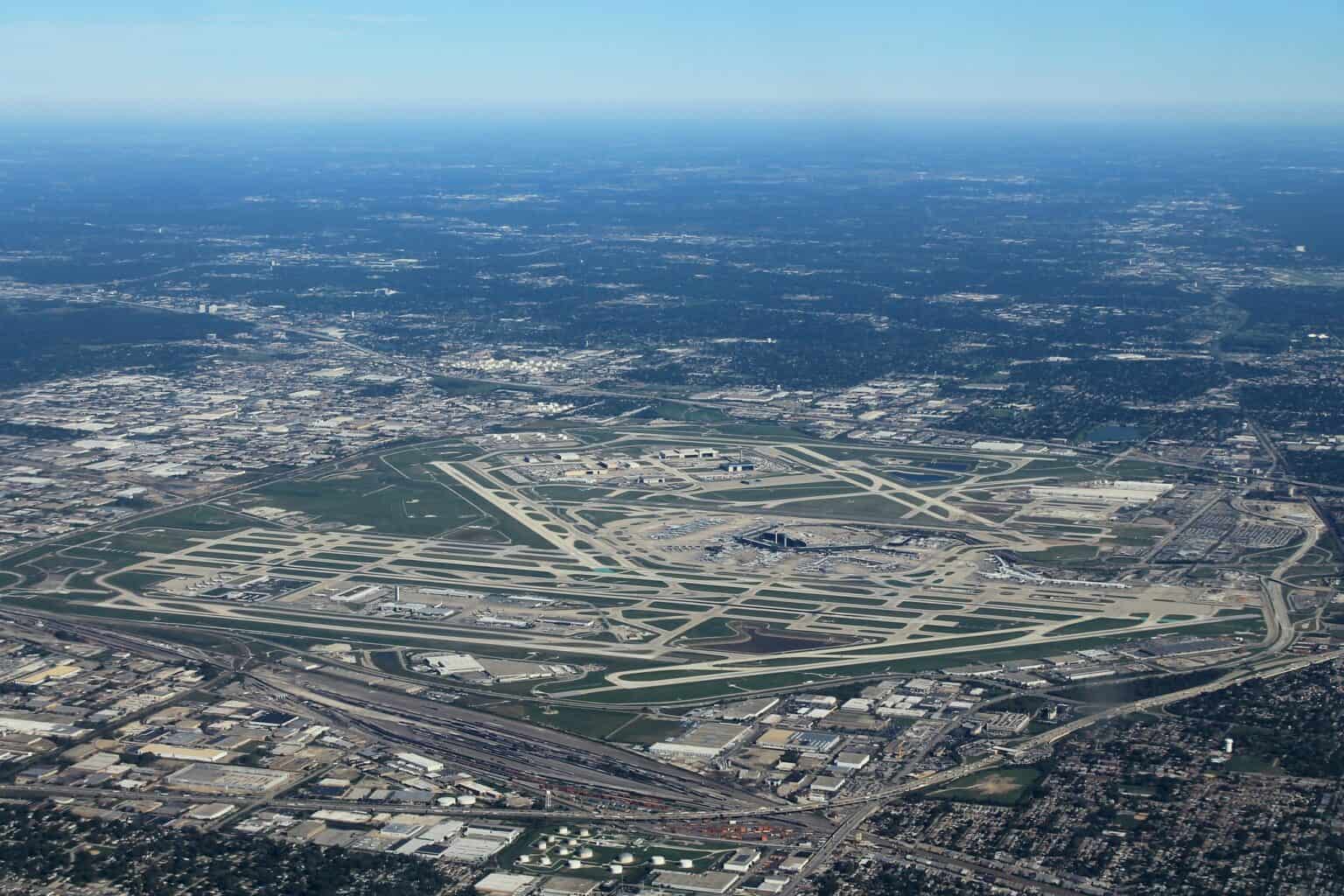
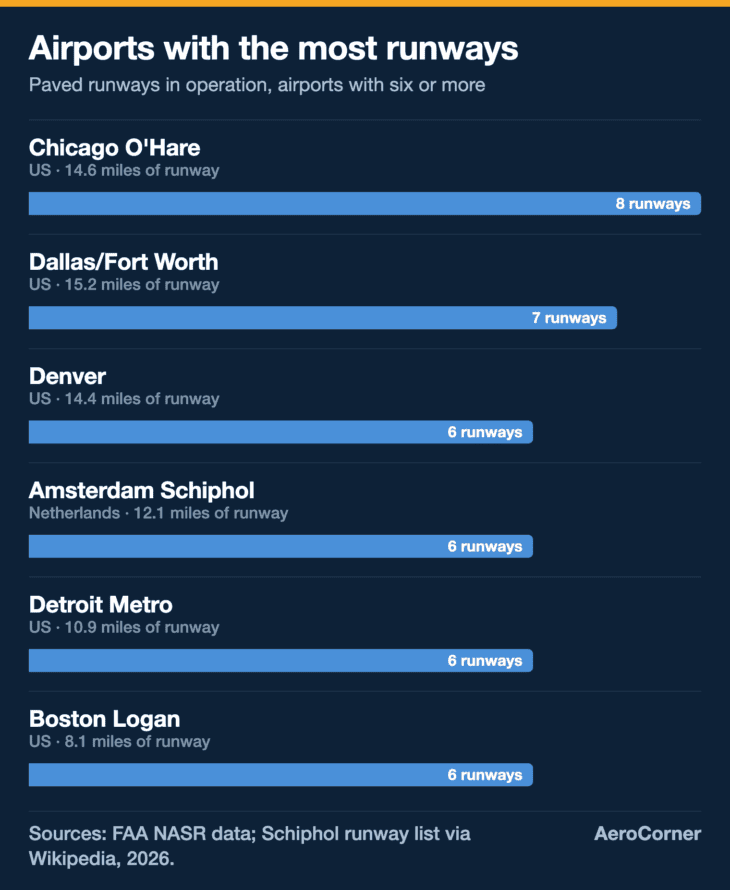
Chicago O’Hare International Airport has the most runways of any airline airport in the world: eight paved runways in operation, as of November 2026. Dallas/Fort Worth is second with seven, and four airports share third place with six: Denver, Amsterdam Schiphol, Detroit and Boston.
This list ranks every airport with airline service that has five or more runways. The measure is the number of paved runways in operation, counted from the FAA’s runway records for the US, the airport operators where they publish a list, and each airport’s runway table for the rest.
Thirteen airports make the cut. Ties are ordered by combined runway length, which turns up the list’s first surprise: O’Hare has the most runways, but Dallas/Fort Worth has the most runway.
| Rank | Airport | Runways | Combined length | Longest runway |
|---|---|---|---|---|
| 1 | Chicago O’Hare (US) | 8 | 14.6 miles (23.4 km) | 13,000 ft (3,962 m) |
| 2 | Dallas/Fort Worth (US) | 7 | 15.2 miles (24.5 km) | 13,400 ft (4,085 m) |
| T3 | Denver (US) | 6 | 14.4 miles (23.2 km) | 16,000 ft (4,877 m) |
| T3 | Amsterdam Schiphol (Netherlands) | 6 | 12.1 miles (19.5 km) | 12,467 ft (3,800 m) |
| T3 | Detroit Metro (US) | 6 | 10.9 miles (17.6 km) | 12,003 ft (3,659 m) |
| T3 | Boston Logan (US) | 6 | 8.1 miles (13.0 km) | 10,083 ft (3,073 m) |
| T7 | Istanbul (Turkey) | 5 | 11.7 miles (18.8 km) | 13,451 ft (4,100 m) |
| T7 | Shanghai Pudong (China) | 5 | 11.4 miles (18.4 km) | 13,123 ft (4,000 m) |
| T7 | Guangzhou Baiyun (China) | 5 | 11.3 miles (18.2 km) | 12,467 ft (3,800 m) |
| T7 | Houston Bush Intercontinental (US) | 5 | 9.5 miles (15.4 km) | 12,001 ft (3,658 m) |
| T7 | Toronto Pearson (Canada) | 5 | 9.5 miles (15.2 km) | 11,120 ft (3,389 m) |
| T7 | Atlanta Hartsfield-Jackson (US) | 5 | 9.4 miles (15.1 km) | 12,390 ft (3,776 m) |
| T7 | Milwaukee Mitchell (US) | 5 | 6.2 miles (10.0 km) | 9,990 ft (3,045 m) |
How this ranking works
We count paved runways in operation at airports with scheduled airline service. A runway is one strip of pavement, so 9L/27R is one runway with two ends, not two. Helipads, seaplane lanes, grass strips, closed runways and military fields are left out. US counts come from the FAA’s NASR airport data for the cycle effective October 29, 2026, cross-checked with the airport operators; other airports from their published runway tables, cross-checked with the public-domain OurAirports database. Ties are ordered by combined runway length.
1. Chicago O’Hare: 8 runways
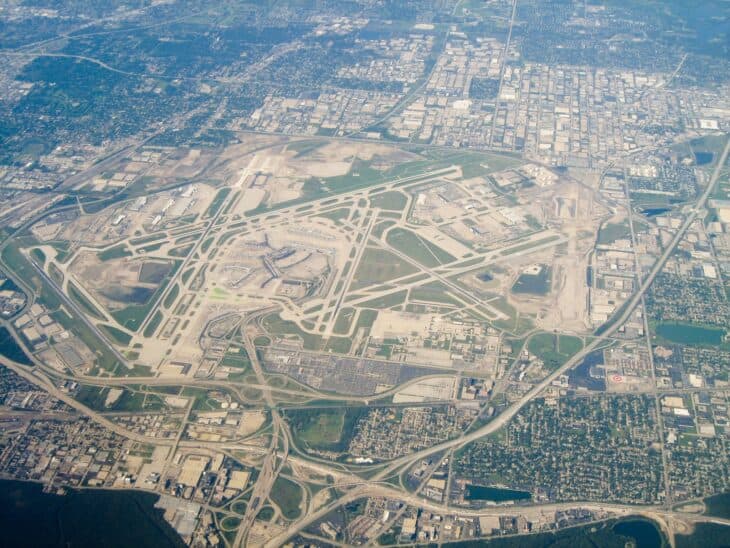

O’Hare has eight active runways, according to the Chicago Department of Aviation. Six run parallel east to west, and two cut across them on a northeast to southwest diagonal.
The newest, Runway 9C/27C, opened in 2020 at 11,245 feet (3,428 m). The longest is 10L/28R at 13,000 feet (3,962 m), which was extended by 3,000 feet in 2008.
Getting to eight meant tearing up old runways as well as building new ones. The city decommissioned 18/36 in 2008, 14L/32R in 2016 and 14R/32L in 2018 to make room for the parallel layout, a story told in full in how O’Hare got to eight runways.
Chicago has 12 runways in two airports
Add Midway’s four active runways to O’Hare’s eight and Chicago runs 12 airport runways inside one city. Only two of Midway’s four take airline traffic, though: the Chicago Department of Aviation lists 4L/22R and 13R/31L as general aviation runways.
2. Dallas/Fort Worth: 7 runways
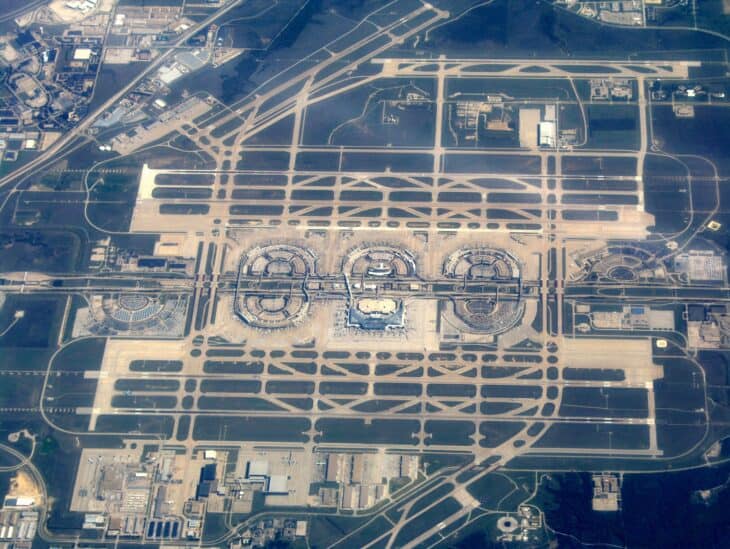

Dallas/Fort Worth International has seven runways: five parallel north to south and two diagonal runways, 13L/31R and 13R/31L. DFW’s own fact sheet lists all seven.
What DFW lacks in count it makes up in length. Four of its runways are 13,400 feet (4,085 m) long, and its seven runways add up to 15.2 miles (24.5 km) of pavement, more than O’Hare’s 14.6 miles (23.4 km) across eight.
That is the most runway of any airport on this list. Even DFW’s shortest runway, 17L/35R, is 8,500 feet (2,591 m).
3. Denver: 6 runways
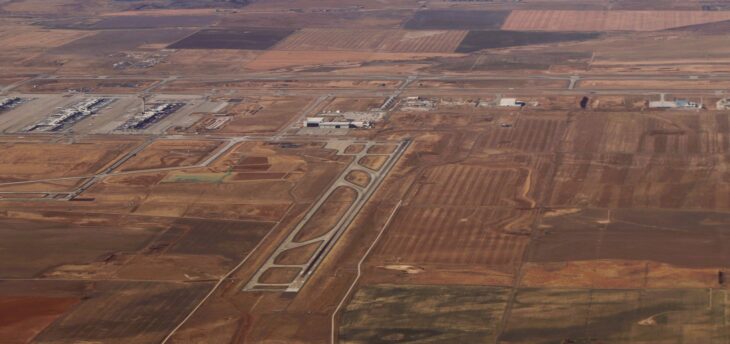
Denver International has six runways laid out in a pinwheel: two east to west and four north to south. Five of them are exactly 12,000 feet (3,658 m) long.
The sixth, 16R/34L, opened in 2003 at 16,000 feet (4,877 m). It is the longest public-use runway in North America, and it gives Denver the most combined runway of any six-runway airport, 14.4 miles (23.2 km).
The extra length is about altitude, not size. Denver sits roughly a mile above sea level, where thin air means a fully loaded Airbus A380 or Boeing 747-8 needs far more pavement to get airborne on a hot day, a point covered in why Denver’s airport is so big.
3. Amsterdam Schiphol: 6 runways
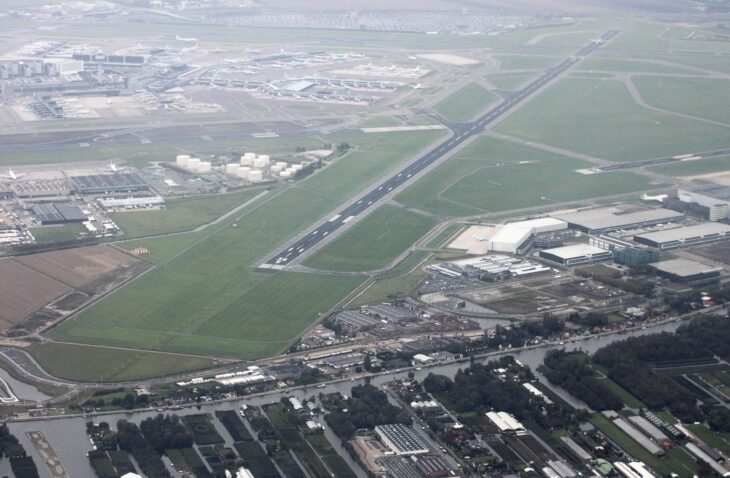

Schiphol has six runways, the only airport outside the US with a confirmed six. Each has a Dutch name: Polderbaan, Kaagbaan, Buitenveldertbaan, Aalsmeerbaan, Zwanenburgbaan and Oostbaan.
The Polderbaan, at 12,467 feet (3,800 m), opened in 2003 so far west of the terminal that its taxiway bridges the A5 motorway. Taxiing to or from it can take 10 to 20 minutes.
The sixth runway is a technicality for airline passengers. The Oostbaan, 04/22, is only 6,608 feet (2,014 m) long and is used mainly by general aviation.
3. Detroit Metro: 6 runways
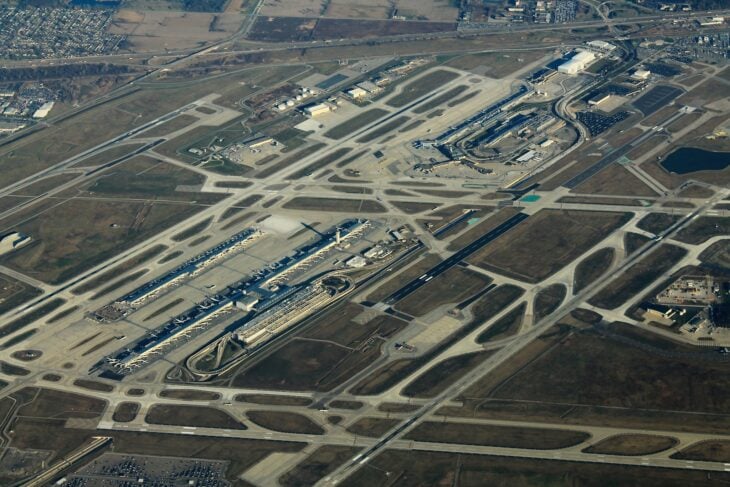

Detroit Metropolitan Wayne County Airport has six runways: four parallel runways running northeast to southwest and two crosswind runways running east to west. The longest, 4R/22L, is 12,003 feet (3,659 m).
Detroit built its layout over half a century. The first of today’s runways were added in 1949, the crosswind 9R/27L opened in 1993, and the last of the six, 4L/22R, was finished in December 2001, ahead of the McNamara Terminal’s opening in 2002.
3. Boston Logan: 6 runways
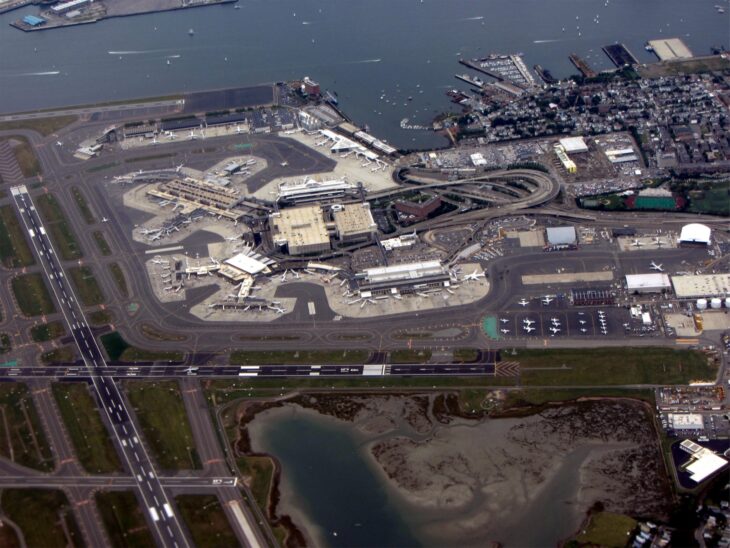

Boston Logan fits six runways onto 2,384 acres (965 ha) on Boston Harbor, which explains why it has the least combined runway of any six-runway airport, 8.1 miles (13.0 km). Its longest runway, 15R/33L, is 10,083 feet (3,073 m).
Logan’s sixth runway is the shortest on this list. Runway 15L/33R is just 2,557 feet (779 m), too short for any jet airliner.
Runway 14/32, at 5,000 feet (1,524 m), was Logan’s first major runway addition in more than 40 years when it opened on November 23, 2006. Runway lengths like these are set by the worst day an aircraft has to handle, as explained in how long a runway needs to be.
7. Istanbul: 5 runways
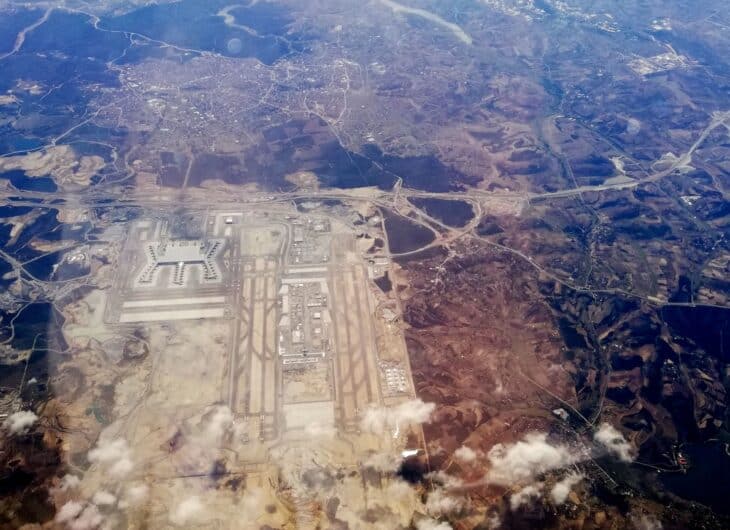

Istanbul Airport, which replaced Atatürk Airport for scheduled passenger flights, operates five runways. Two parallel pairs run north to south: 16L/34R and 16R/34L at 12,303 feet (3,750 m), and 17L/35R and 17R/35L at 13,451 feet (4,100 m).
The fifth, 18/36, is shorter at 10,039 feet (3,060 m) and is planned to grow to match the 16/34 pair. Istanbul’s master plan adds more runways in later phases, so it is the airport most likely to climb this list.
Some runway tables already list a sixth, east-west strip, 09/27, at 9,250 feet (2,819 m), which matches the remote runway in the plan. We count five until that runway is confirmed in regular operation.
7. Shanghai Pudong: 5 runways
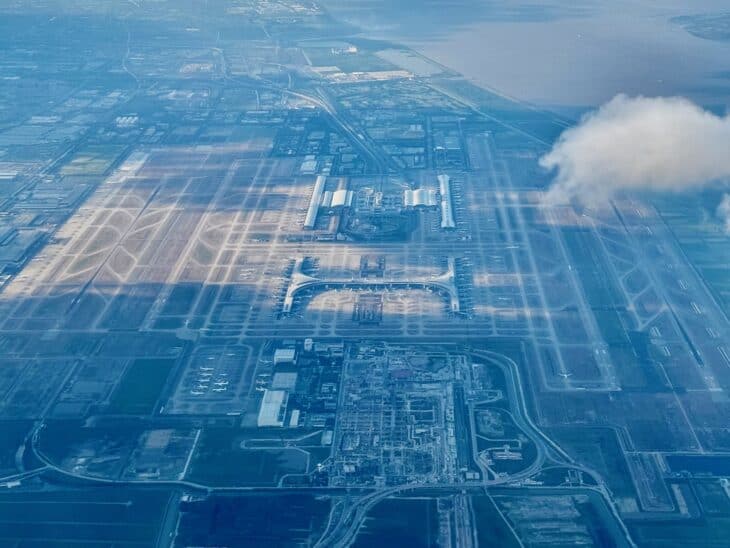

Shanghai Pudong has five runways, but only four carry airline traffic. Four parallel runways flank the terminals, the longest of them 17L/35R at 13,123 feet (4,000 m).
The fifth, 15/33, is 11,155 feet (3,400 m) long and is used for COMAC C919 test flights rather than regular airline operations. It counts under this list’s measure, but a passenger flying through Pudong will only ever use the other four.
7. Guangzhou Baiyun: 5 runways
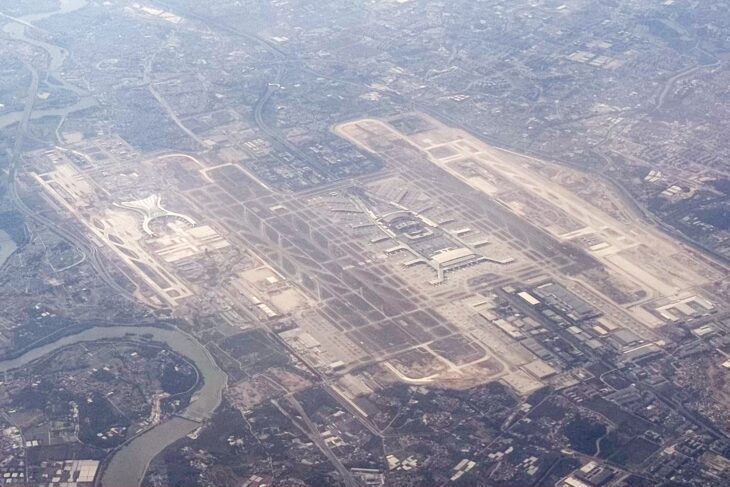

Guangzhou Baiyun is the newest member of the five-runway club. Its fourth runway, 01L/19R, opened on January 23, 2025, and its fifth, 03/21, opened on October 30, 2025, with the new Terminal 3.
That made Baiyun the first airport in China with five commercial runways in operation. The two inner runways handle takeoffs and the two outer ones landings, and the longest two are each 12,467 feet (3,800 m).
7. Houston Bush Intercontinental: 5 runways
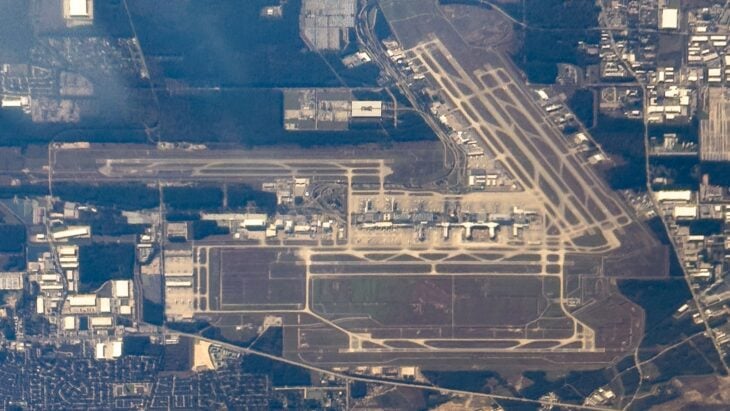
George Bush Intercontinental in Houston has five runways on a 10,000-acre (40 km²) site. Three run east to west and two run northwest to southeast, with 15L/33R the longest at 12,001 feet (3,658 m).
Its runways add up to 9.5 miles (15.4 km), only slightly ahead of Toronto Pearson on the tie-break.
7. Toronto Pearson: 5 runways
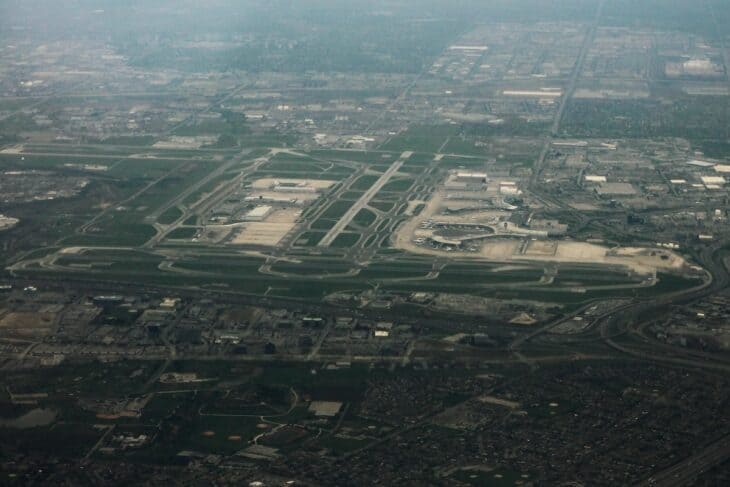

Toronto Pearson is the only Canadian airport on this list, with three runways running east to west and two north to south. The longest, 05/23, is 11,120 feet (3,389 m).
Runways in two directions give Pearson a runway facing into the wind more often than a one-direction layout would.
7. Atlanta Hartsfield-Jackson: 5 runways
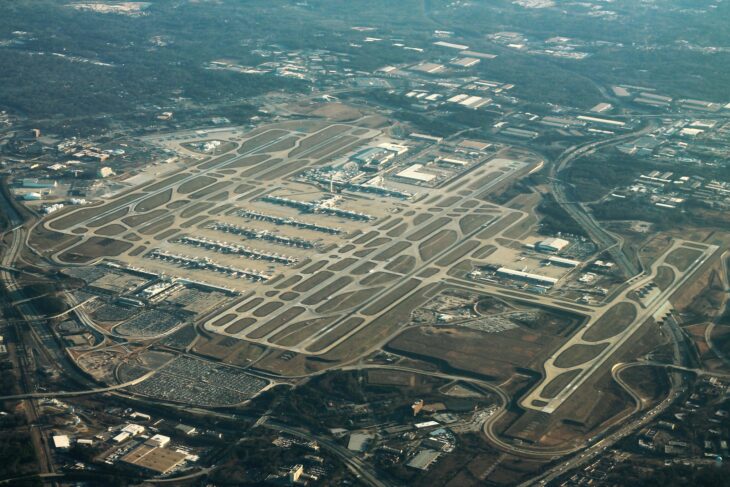

Atlanta has five runways, and every one of them points the same way. FAA records list 8L/26R, 8R/26L, 9L/27R, 9R/27L and 10/28, all aligned east to west, with no crosswind runway at all.
The longest, 9L/27R, is 12,390 feet (3,776 m), and the other four are 9,000 to 9,999 feet long. Atlanta is the clearest case that layout matters as much as count: it has fewer runways than O’Hare or Dallas, but none of them cross.
7. Milwaukee Mitchell: 5 runways
Milwaukee Mitchell International is the surprise on this list: a mid-size airport with as many runways as Atlanta. FAA records show five runways, led by 1L/19R at 9,990 feet (3,045 m).
Two of them are short. Runway 1R/19L is 4,182 feet (1,275 m) and 7L/25R is 4,797 feet (1,462 m), which is why Milwaukee’s five runways add up to just 6.2 miles (10.0 km), the least on the list.
What about Midway, Edwards and the four-runway airports?
Midway has four runways, not five
Chicago Midway is often listed with five runways. The Chicago Department of Aviation says there are currently four active runways at Midway, and the FAA’s runway records agree. Only two of them, 4R/22L and 13L/31R, are air carrier runways.
Military fields are left off the ranking because they have no airline service, but they hold the real extremes. Rogers Dry Lake at Edwards Air Force Base in California has seven more official lakebed runways besides its main runway, and the longest, 17/35, is 7.5 miles (12.1 km) long.
FAA records also list a Navy outlying field near Pace, Florida, with eight paved strips, each just 1,800 feet (549 m) long. It ties O’Hare on count, but it is a training field, not an airport anyone can fly to.
Below the cut sits a large four-runway club. In the US alone it includes Los Angeles, New York JFK, San Francisco, Miami, Las Vegas, Orlando, Washington Dulles and Minneapolis, and abroad Beijing Daxing and Chongqing Jiangbei.
Runway count is not traffic, either. San Diego handles all of its airline flights on a single runway, 9,401 feet (2,865 m) long, and length is a different ranking altogether, covered in the longest runways in the world.
FAQ
Sources and references used for research and fact-checking.
- Federal Aviation Administration, NASR 28-Day Subscription, airport and runway data, cycle effective October 29, 2026
- Chicago Department of Aviation, O'Hare and Midway facility facts
- DFW International Airport, DFW Airport facts
- Wikipedia, Denver International Airport
- Wikipedia, Amsterdam Airport Schiphol
- Wikipedia, Detroit Metropolitan Airport
- Wikipedia, Logan International Airport
- Wikipedia, Istanbul Airport
- Wikipedia, Shanghai Pudong International Airport
- Wikipedia, Guangzhou Baiyun International Airport
- Wikipedia, George Bush Intercontinental Airport
- Wikipedia, Toronto Pearson International Airport
- Wikipedia, Milwaukee Mitchell International Airport
- Wikipedia, Beijing Daxing International Airport
- Wikipedia, Chongqing Jiangbei International Airport
- Wikipedia, Rogers Dry Lake
- Wikipedia, Runway
- OurAirports, OurAirports runway data
Get the Newsletter
The latest aviation news and stories sent to your inbox.
About the Author

Tim is the owner and lead editor of AeroCorner since 2019, overseeing aviation content covering aircraft, airlines, airports, and the broader aviation industry. Through years of researching, writing, editing, and publishing aviation-focused content, he has developed extensive practical knowledge of commercial aviation and air travel. Based in Asia and a frequent traveler himself, Tim also brings firsthand passenger experience to AeroCorner’s coverage. Outside of publishing, he has also explored aviation firsthand through hands-on flight training in New Zealand.