

Table of Contents
Get Global Entry if you will leave the country even once in the next five years. It costs $120, includes TSA PreCheck, and adds a fast lane through customs on the way home, so the upgrade over the cheapest PreCheck is $40.25, about $8 a year.
Get TSA PreCheck on its own if you never fly abroad, cannot spare the time for a Global Entry interview, or are not a U.S. citizen, national or permanent resident looking for the cheapest way through airport security.
Below, the two are compared on what they speed up, price, family rules, approval, reach, eligibility and how each held up in the 2026 DHS shutdown. Prices and rules are from tsa.gov and cbp.gov as listed in November 2026.
| Criterion | Global Entry | TSA PreCheck | Edge |
|---|---|---|---|
| What it speeds up | Customs on arrival in the U.S., plus PreCheck screening on departure | Security screening on departure only | Global Entry |
| Price for 5 years | $120 | $79.75 (IDEMIA), $84.95 (CLEAR or Telos) | PreCheck |
| Extra cost of Global Entry* | $40.25 over 5 years, about $8.05 a year | Nothing | PreCheck |
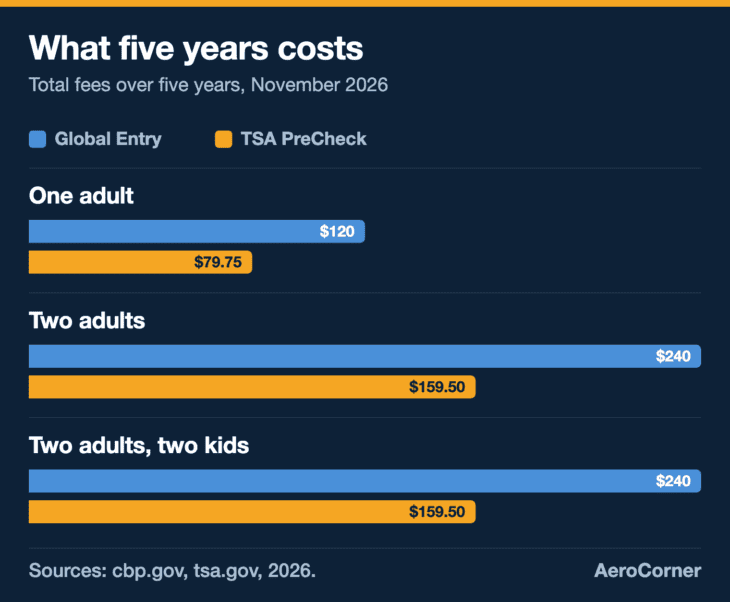
| Two adults and two kids, 5 years* | $240 | $159.50 | PreCheck |
| Getting approved | 80% approved within 2 weeks, then an in-person interview | About 5-minute form, 10-minute visit; most numbers in 3 to 5 days | PreCheck |
| Where it works | 77 airports with Global Entry processing (62 U.S., 15 abroad), plus land borders | PreCheck lanes on 99 participating airlines | Global Entry |
| Kids | Under 18 free with a member parent, but each child needs an account and interview | 17 and under free with a member; ages 13 to 17 on the same reservation | PreCheck |
| Who can apply | U.S. citizens, permanent residents and citizens of 23 partner countries | U.S. citizens, U.S. nationals and permanent residents | Global Entry |
| 2026 DHS shutdown | Arrivals processing halted Feb. 22 to March 11 (17 days) | Stayed open | PreCheck |
How we compared
Fees are the ones listed on tsa.gov/precheck and cbp.gov on November 25, 2026. The PreCheck price used in the math is the cheapest provider, IDEMIA, at $79.75; CLEAR and Telos charge $84.95, which cuts the Global Entry premium to $35.05. Both memberships last five years. The family figure assumes both parents enroll and both kids are under 18, so the kids pay nothing in either program. Airport and airline counts are our counts of CBP’s and TSA’s own lists. Card credits are listed as facts only.
What each one actually speeds up
The two programs work at opposite ends of a trip. TSA PreCheck changes how you are screened when you leave: TSA says you keep on your belt, light jacket and shoes, and leave electronics and 3-1-1 liquids in your bag. Since July 2025, TSA has let travelers at domestic checkpoints keep their shoes on in any lane, as our piece on the TSA shoes-off rule explains.
Global Entry is a U.S. Customs and Border Protection program for coming home. CBP describes it as expedited clearance for pre-approved, low-risk travelers on arrival in the U.S., and its benefits list includes TSA PreCheck access as part of the same membership.
So the question is never which one is faster at security. With either membership you use the same PreCheck lane, and TSA says about 99% of PreCheck passengers wait less than 10 minutes. The difference is the passport line after an international flight.
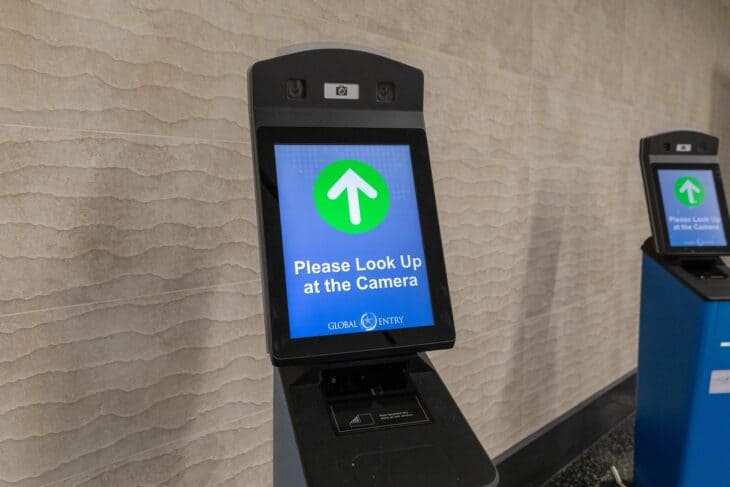
At airports with CBP’s Global Entry Touchless Portals, members are cleared by a camera using what CBP calls biometric facial comparison technology, instead of queuing for passport control with everyone else.

Edge: Global Entry. It does everything PreCheck does, plus the customs line PreCheck never touches.
Price and the real cost of upgrading
Global Entry costs $120 for five years, and CBP says the fee is non-refundable, even if your application is denied. PreCheck is sold through three TSA-authorized providers, and in November 2026 tsa.gov listed new enrollment at $79.75 with IDEMIA and $84.95 with CLEAR or Telos.
That makes the upgrade $40.25 over PreCheck through IDEMIA, or $35.05 over the other two. Spread over five years, Global Entry costs about $8.05 a year more than the cheapest PreCheck.
Put another way, if you take one international round trip a year, you pay roughly $8 each time you skip the passport line. Take two a year and it falls to about $4.
PreCheck renewals are cheaper than a first enrollment: IDEMIA lists $58.75 online and CLEAR $72.95 online. TSA lets you renew online up to six months before your membership expires, and you keep the same Known Traveler Number.
Edge: TSA PreCheck. It is the cheaper of the two, though only by about $8 a year.
Families and kids
Kids cost nothing in either program, but the rules differ. TSA says children 12 and under can join a PreCheck parent in the lane, while teens 13 to 17 need the PreCheck indicator on their own boarding pass, which means booking them on your reservation.
Global Entry has no minimum age, and CBP says every applicant needs their own account, whatever their age. CBP waives the $120 fee for anyone under 18 whose parent or legal guardian is a member or has an application pending, but each child still needs an account and an interview, with a parent present.
For two parents and two kids, that puts five years of Global Entry at $240 and PreCheck through IDEMIA at $159.50. The real cost of Global Entry for a family is the extra interviews, not the money.
Edge: TSA PreCheck. Kids ride along with no paperwork, while Global Entry needs every child enrolled and interviewed.
Getting approved
PreCheck is the quicker path. TSA says the online form takes about five minutes and the in-person visit about 10, at more than 1,300 enrollment locations, and most applicants get their Known Traveler Number in 3 to 5 days, though some wait up to 60.
Global Entry takes two steps. CBP says 80% of applications are approved within two weeks, though some take 12 months or longer, and a conditional approval is followed by an interview at a Global Entry Enrollment Center.
The interview is the bottleneck, and Enrollment on Arrival is the way around it. If you are conditionally approved, you can do the interview with a CBP officer when you land from an international trip at one of the airports on CBP’s list, with no appointment.
Edge: TSA PreCheck. It can be done in a week, while Global Entry depends on an interview slot or your next trip abroad.
Where you can use them
CBP’s list names 77 airports with Global Entry processing. By our count, 62 are in the U.S. and its territories, and 15 are U.S. preclearance airports abroad, from Toronto, Vancouver and Dublin to Nassau, Aruba and Abu Dhabi, where you clear U.S. customs before you board.
CBP also says Global Entry can be used at land borders. PreCheck, by contrast, works at airport security for the airlines that take part, and TSA’s participating-airline list held 99 carriers in November 2026, from Delta, United, American and Southwest to ZIPAIR.
PreCheck is the benefit you will use most often, because every flight starts at a checkpoint. Global Entry adds its time savings at the other end, in the arrivals hall. For how long to allow at either end, see how early to arrive at the airport.
Edge: Global Entry. It covers the same checkpoints through PreCheck and adds arrivals, land borders and preclearance airports abroad.
Who can apply
TSA says PreCheck is only open to U.S. citizens, U.S. nationals and lawful permanent residents. Global Entry is open to U.S. citizens and permanent residents, and also to citizens of 23 partner countries on CBP’s list, including the United Kingdom, Germany, Japan, India, Brazil and Mexico.
Both involve a background check, and CBP says there may be extra requirements depending on your citizenship. For a frequent visitor from a partner country, Global Entry is the only one of the two on offer.
Edge: Global Entry. It is open to more people, including visitors from 23 countries.
How each held up in the 2026 shutdown
One week into the 2026 DHS funding lapse, DHS ended Global Entry service as an emergency measure. From 6 a.m. Eastern on February 22, 2026, CBP halted all Global Entry arrival processing at participating airports.
The same DHS release said TSA PreCheck remained operational with no change for travelers, with staffing reviewed case by case. Global Entry came back at 5 a.m. Eastern on March 11, after 17 days, while the DHS shutdown itself was still going on, The Points Guy reported.
Global Entry members kept PreCheck
Even while Global Entry arrival processing was shut from February 22 to March 11, 2026, members could still use the PreCheck lane on departure with their PASS ID, because TSA PreCheck stayed open. What they lost was the customs shortcut on the way home.
Edge: TSA PreCheck. It stayed open through the 2026 shutdown, while Global Entry’s customs lane was shut for 17 days.
Where CLEAR and Mobile Passport Control fit
CLEAR+ is a private membership, $219 a year at 63 airports, that verifies your identity with your face and walks you to the front of the security line. It does not change how you are screened and does nothing at customs, so it is an add-on to either program, not a third option. The full math is in our TSA PreCheck vs CLEAR comparison.
Mobile Passport Control is the free alternative for arrivals. It is a CBP app with no enrollment application, no background check and no fingerprints, open to U.S. citizens, permanent residents and some visitors, at 63 sites including 37 U.S. international airports and 15 preclearance locations.
It does not include PreCheck, and it only works where CBP has switched it on. If you fly abroad once every few years, PreCheck plus the free app is a sensible pairing.
Who should pick which
| If you… | Pick | Because |
|---|---|---|
| Fly abroad at least once in the next five years | Global Entry | About $8 a year more buys the customs lane and PreCheck |
| Only ever fly within the U.S. | TSA PreCheck | Global Entry adds nothing you would use |
| Fly next week and have no membership yet | TSA PreCheck | Most numbers arrive in 3 to 5 days, with no interview wait |
| Travel abroad with young kids | Global Entry, if you can interview everyone | Kids are free, but each needs their own membership to use the customs lane |
| Are a citizen of a partner country | Global Entry | PreCheck is closed to you |
| Fly abroad once every few years | PreCheck plus Mobile Passport Control | The free app covers the odd arrival |
Some travel credit cards reimburse the fee for either program. Chase, for one, lists a statement credit of up to $120 every four years on the Sapphire Reserve for a Global Entry, TSA PreCheck or NEXUS application charged to the card, which covers Global Entry in full.
Myth: your Global Entry card gets you into the PreCheck lane
It does not. TSA says a trusted traveler card will not give you PreCheck access on its own. You have to enter your CBP PASS ID, the nine-digit number on the back of the card, in the Known Traveler Number field of every booking or airline profile, or your boarding pass will not show the PreCheck indicator. You also cannot upgrade a PreCheck membership to Global Entry: TSA says you cannot switch or upgrade between programs, so Global Entry is a new application and a new $120 fee.
FAQ
Sources and references used for research and fact-checking.
- Transportation Security Administration, TSA PreCheck
- Transportation Security Administration, DHS to End 'Shoes-Off' Travel Policy
- Transportation Security Administration, TSA PreCheck FAQ
- Transportation Security Administration, TSA PreCheck Participating Airlines
- U.S. Customs and Border Protection, Global Entry
- U.S. Customs and Border Protection, How to Apply for Global Entry
- U.S. Customs and Border Protection, Global Entry Eligibility
- U.S. Customs and Border Protection, Airports with Global Entry
- U.S. Customs and Border Protection, Enrollment on Arrival
- U.S. Customs and Border Protection, Global Entry Touchless Portal Instructions
- U.S. Customs and Border Protection, Mobile Passport Control
- U.S. Department of Homeland Security, DHS Implements Emergency Measures to Conserve Resources and Manpower Impacting Travelers
- The Points Guy, Global Entry resumes Wednesday after 17-day suspension
- CLEAR, CLEAR+
- Chase, Chase Sapphire Reserve
Get the Newsletter
The latest aviation news and stories sent to your inbox.
About the Author

Tim is the owner and lead editor of AeroCorner since 2019, overseeing aviation content covering aircraft, airlines, airports, and the broader aviation industry. Through years of researching, writing, editing, and publishing aviation-focused content, he has developed extensive practical knowledge of commercial aviation and air travel. Based in Asia and a frequent traveler himself, Tim also brings firsthand passenger experience to AeroCorner’s coverage. Outside of publishing, he has also explored aviation firsthand through hands-on flight training in New Zealand.