

Table of Contents
Two in three working satellites in orbit now belong to one company, and that company retires its old ones by the hundred.
There are 11,174 working Starlink satellites in orbit, according to astrophysicist Jonathan McDowell’s Starlink tracker, with data as of Nov. 28, 2026. SpaceX has launched 13,122 of them, and 1,934 have already come back down.
How Many Starlink Satellites Are There?
The working count is 11,174. Add 14 satellites that McDowell lists as failed but still in orbit, and 11,188 Starlinks are up there in total.
That makes Starlink about 65% of every working satellite in orbit. McDowell’s catalog counted 17,316 active satellites on Nov. 26, 2026, of which 11,177 were Starlinks.
The Starlink count at a glance
Working: 11,174. In orbit, working or not: 11,188. Launched since 2019: 13,122. Already reentered or never reached orbit: 1,934. Share of all working satellites: about 65%. Source: Jonathan McDowell, data as of Nov. 28, 2026.
These are SpaceX’s commercial broadband satellites only. Starshield, the military version SpaceX builds for the U.S. government, is tracked separately: McDowell lists 249 of those working, and they are not in the 11,174.
What the 11,174 Working Starlinks Are Doing
“Working” does not mean every satellite is serving customers from its final orbit. McDowell sorts each Starlink by what its orbit shows it doing.
| Status | Satellites | Share |
|---|---|---|
| In an operational shell | 9,643 | 86% |
| Moved out of the constellation, still maneuvering | 926 | 8% |
| Being lowered for disposal | 350 | 3% |
| Drifting to a new orbital plane | 133 | 1% |
| Climbing to operational altitude | 89 | 1% |
| In reserve or relocating | 33 | 0.3% |
| Total working | 11,174 | 100% |
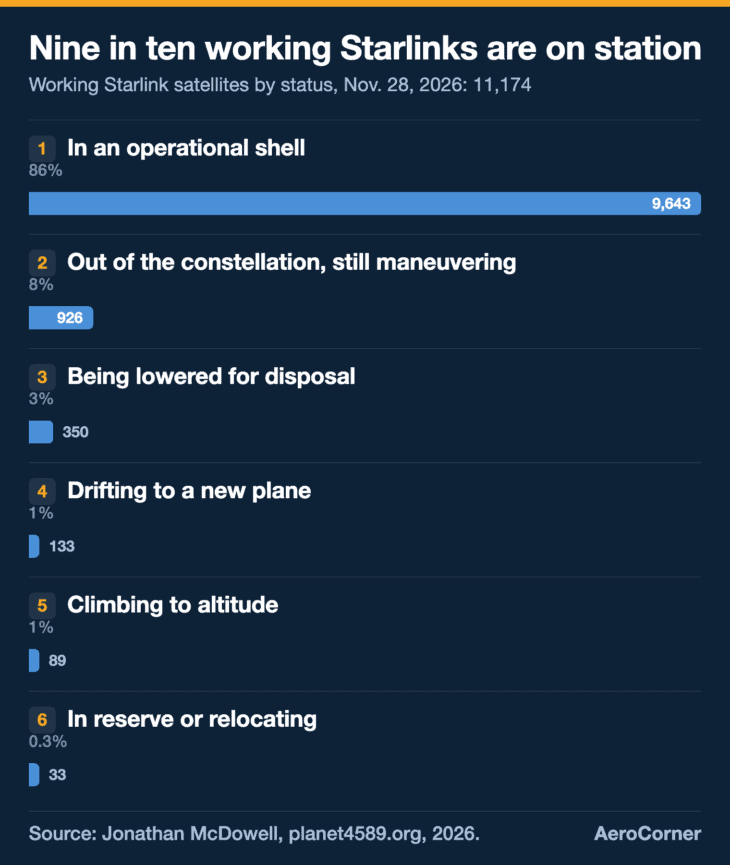
So the satellites in their working shells number 9,643, about 86% of the fleet. McDowell notes that satellites outside an operational orbit may still be providing service, so this is an orbital status, not a customer count.
The surprise is the 350 being lowered on purpose. SpaceX retires Starlinks by steering them down to burn up, and the fleet is always partly in turnover.
By generation
| Generation | Launched | Working now |
|---|---|---|
| Gen1 (prototypes, V1.0, V1.5) | 4,714 | 3,070 |
| Gen2 (V2 Mini, including direct-to-cell) | 8,336 | 8,052 |
| Gen3 (V3, launched on Starship) | 72 | 52 |
| Total | 13,122 | 11,174 |
The fleet is now mostly second generation: 8,052 of the 11,174 working satellites are V2 Minis. About a third of the Gen1 satellites ever launched, 1,633 of 4,714, have already reentered.
The 52 V3 satellites in orbit came up on two Starship flights, 26 on Flight 14 in late September and 26 on Flight 15 on Nov. 13, 2026. None had reached an operational shell by Nov. 28, so they are still raising or drifting.

Why Other Sites Give Different Starlink Numbers
Search this question and you will find answers from about 6,000 to more than 13,000. Almost all of the spread comes from three things: the date, the noun, and the source.
The stale number
A page dated Nov. 7, 2026 still tells readers SpaceX has 6,370 active Starlinks. That is below the 6,693 McDowell counted on Jan. 1, 2025. By November 2026 the real figure was about 11,200, so the page is short by almost half the fleet.
The date. The working fleet grew by about 1,950 satellites between Jan. 1 and Nov. 26, 2026, according to McDowell’s data. Any count more than a few months old is already well short.
The noun. “Launched” (13,122), “in orbit” (11,188), “working” (11,174) and “in operational orbit” (9,643) are four different numbers, and headlines swap them freely. The 13,000 figure counts nearly 2,000 satellites that no longer exist.
The source. Wikipedia’s Starlink article, for example, gave about 11,150 in orbit as of October 2026, with 10,800 to 11,100 operational depending on the tracker. McDowell’s two Starlink files, a few days apart, read 11,177 and 11,174, which is ordinary day-to-day churn.
Some articles also quote what SpaceX is allowed to launch rather than what it has. On Jan. 9, 2026 the FCC approved another 7,500 Gen2 satellites, bringing the authorized Gen2 constellation to 15,000. That is a license, not a count.
How Fast the Starlink Count Has Grown
SpaceX put up its first 60 operational satellites in May 2019. On Jan. 1, 2020, McDowell’s data shows just 116 working Starlinks.

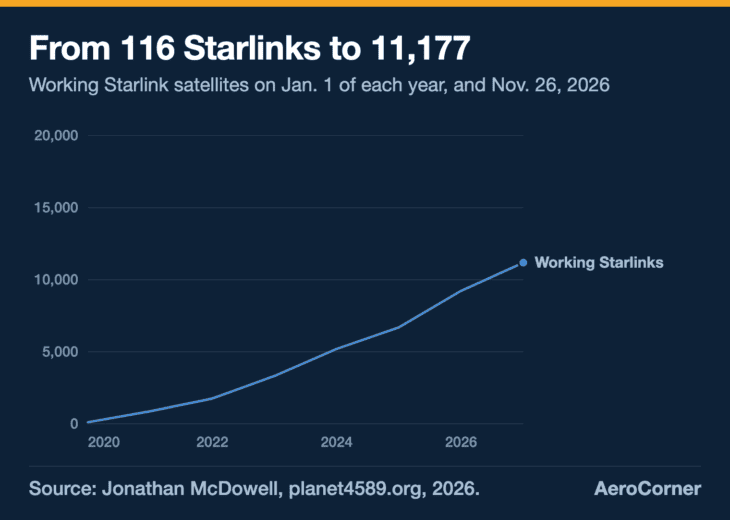
The count passed 1,700 at the start of 2022, 5,200 at the start of 2024 and 9,200 at the start of 2026. It reached 11,177 on Nov. 26, 2026.
Growth is launches minus reentries. In a 2017 FCC filing, SpaceX said its satellites would be deorbited at the end of useful lives of roughly five to seven years, so the oldest satellites are always being replaced as new ones arrive.
The next jump comes from Starship. Each V3 satellite is designed for 1 terabit per second of downlink capacity, according to Starlink’s published V3 specifications, and Starship carries them in batches of 26.
Starlink vs Every Other Constellation
No rival is close. McDowell’s tracker, on the same date, gives these working counts for the next four broadband constellations.
| Constellation | Working satellites |
|---|---|
| SpaceX Starlink | 11,174 |
| Eutelsat OneWeb | 651 |
| Amazon Leo (formerly Project Kuiper) | 428 |
| China’s Guowang (Xingwang in McDowell’s lists) | 282 |
| China’s Qianfan | 254 |
Those four rivals add up to 1,615 working satellites. Starlink has nearly seven times as many as all of them combined.
Starlink is also the biggest single slice of the wider count in our guide to how many satellites are in space, where every other operator on Earth shares the remaining third.
Why 11,174 Satellites Matter on a Plane
Those satellites are why in-flight Wi-Fi is changing fast. Airlines from American to Lufthansa are fitting Starlink terminals, and several US carriers now give in-flight Wi-Fi away, as our ranking of which airlines offer free in-flight Wi-Fi shows.
Not every carrier signed up. Delta turned it down, and its CEO reportedly pointed to Elon Musk, not the satellite count, as the reason Delta passed on Starlink.
FAQ
Sources and references used for research and fact-checking.
- Jonathan McDowell, Jonathan's Space Report, Starlink Launch Statistics
- Jonathan McDowell, Jonathan's Space Report, Satellite statistics: Satellite and Debris Population
- Jonathan McDowell, Jonathan's Space Report, Sat and Debris Population vs time, with Starlink (data file)
- Jonathan McDowell, Jonathan's Space Report, OneWeb Statistics
- Jonathan McDowell, Jonathan's Space Report, Kuiper Statistics
- Jonathan McDowell, Jonathan's Space Report, Xingwang Statistics
- Jonathan McDowell, Jonathan's Space Report, Qianfan Statistics
- Jonathan McDowell, Jonathan's Space Report, Starshield Statistics
- Broadband Breakfast, FCC Approves 7,500 More Starlink Gen2 Satellites
- Tesla North, Starlink's 26 New V3 Satellites Are Healthy and Raising Their Orbits
- Wikipedia, Starlink
Get the Newsletter
The latest aviation news and stories sent to your inbox.
About the Author

Tim is the owner and lead editor of AeroCorner since 2019, overseeing aviation content covering aircraft, airlines, airports, and the broader aviation industry. Through years of researching, writing, editing, and publishing aviation-focused content, he has developed extensive practical knowledge of commercial aviation and air travel. Based in Asia and a frequent traveler himself, Tim also brings firsthand passenger experience to AeroCorner’s coverage. Outside of publishing, he has also explored aviation firsthand through hands-on flight training in New Zealand.