

Table of Contents
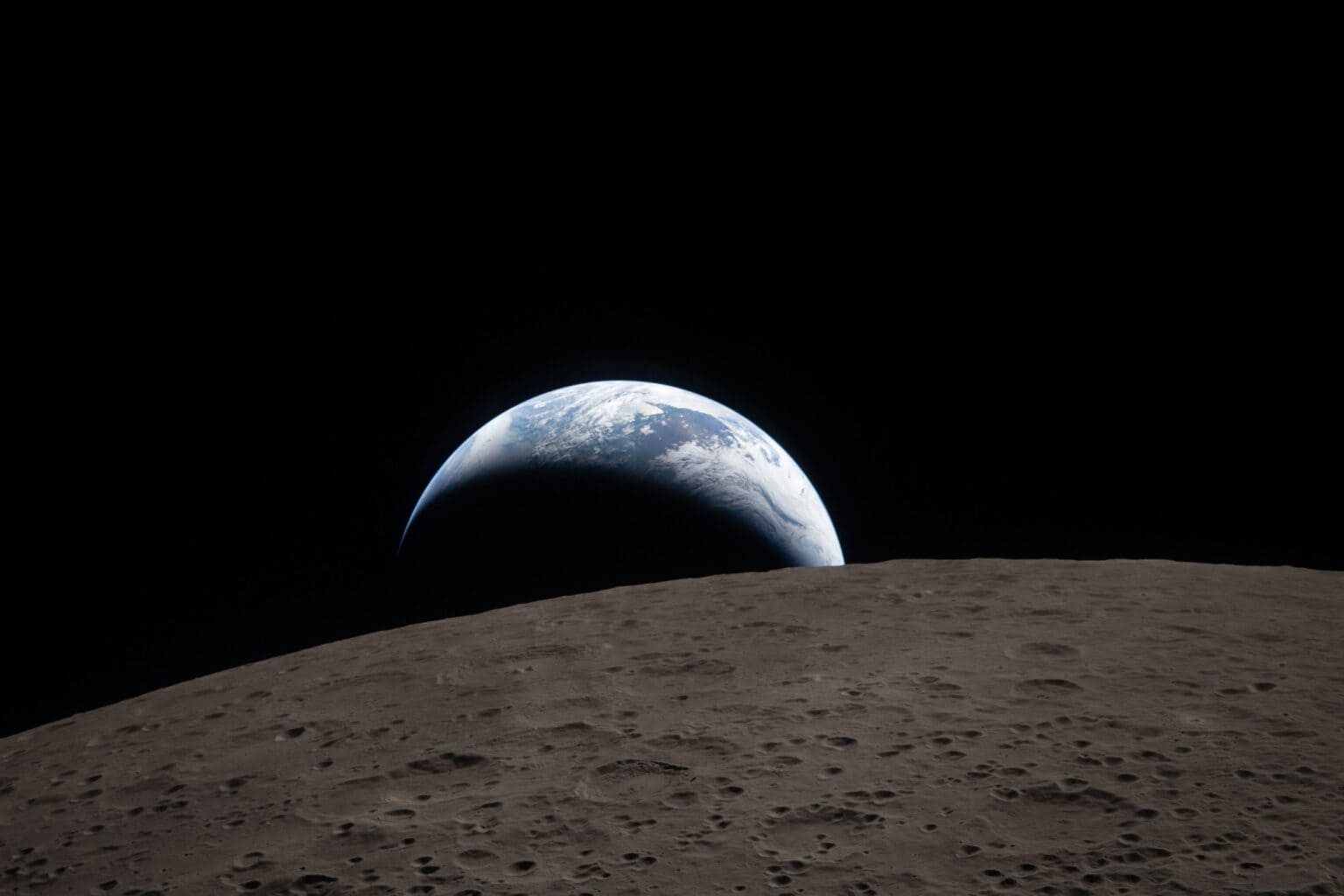
In April 2026, four astronauts looped behind the Moon on Artemis II and came home without setting foot on it. That left the record exactly where Apollo 17 left it in December 1972.
Twelve people have walked on the Moon, according to NASA’s own list of moonwalkers, checked in November 2026. All twelve were American men, they landed in pairs on six Apollo missions between July 1969 and December 1972, and four of them are still alive.
How Many People Have Walked on the Moon?
The answer is 12. Neil Armstrong and Buzz Aldrin were first, on Apollo 11 on July 20, 1969, and Gene Cernan and Harrison Schmitt were last, on Apollo 17. Nobody has landed since.
The count covers only people who stood on the surface. It leaves out the astronauts who flew to the Moon and stayed in the spacecraft, which is a much bigger group: 24 people on Apollo, and 28 once the Artemis II crew is added.
The count at a glance
Walked on the Moon: 12, on six Apollo landings, 1969 to 1972. Flew to the Moon on Apollo: 24, from 1968 to 1972, three of them twice. Flew to the Moon in total: 28, counting the four Artemis II astronauts of April 2026. Moonwalkers still alive: 4. Next planned landing: 2028.
All 12 Moonwalkers, Mission by Mission
Every landing carried two moonwalkers: the commander and the lunar module pilot. The third crew member, the command module pilot, stayed in lunar orbit and never went down.

| Mission | Landed (UTC) | Moonwalkers | Moonwalks | Time outside, per astronaut |
|---|---|---|---|---|
| Apollo 11 | July 20, 1969 | Neil Armstrong, Buzz Aldrin | 1 | 2 hr 31 min |
| Apollo 12 | Nov. 19, 1969 | Pete Conrad, Alan Bean | 2 | 7 hr 45 min |
| Apollo 14 | Feb. 5, 1971 | Alan Shepard, Edgar Mitchell | 2 | 9 hr 22 min |
| Apollo 15 | July 30, 1971 | David Scott, James Irwin | 3 | 18 hr 34 min |
| Apollo 16 | April 21, 1972 | John Young, Charles Duke | 3 | 20 hr 14 min |
| Apollo 17 | Dec. 11, 1972 | Gene Cernan, Harrison Schmitt | 3 | 22 hr 3 min |
| Total | 6 landings | 12 people | 14 | 80 hr 29 min |
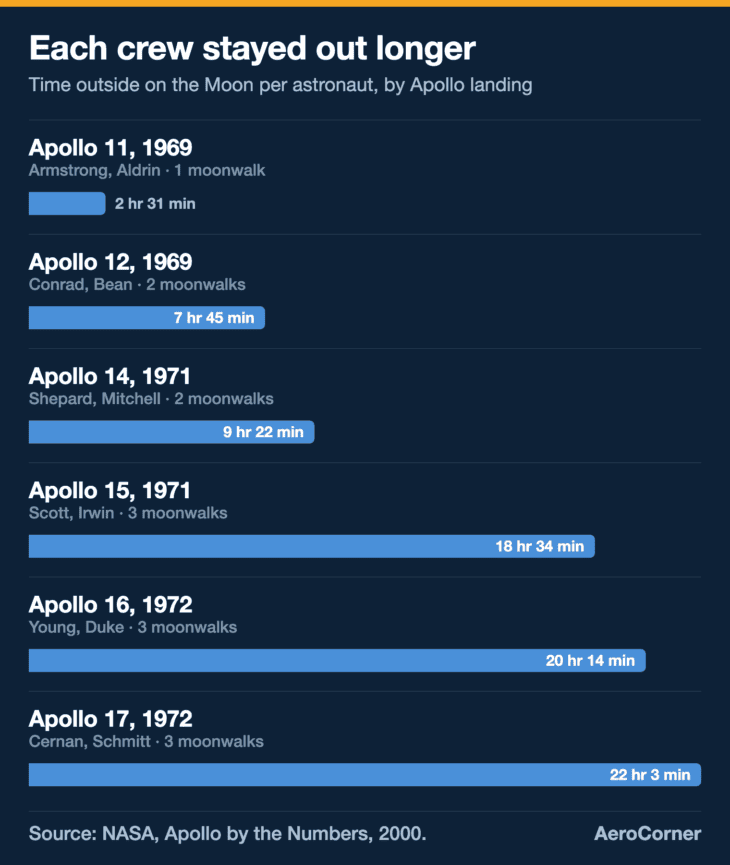
The split is lopsided. Armstrong and Aldrin, the most famous pair, spent the least time outside of anyone, about two and a half hours on a single moonwalk.
The last three crews brought a lunar rover and did three moonwalks each. Those six astronauts account for about 61 of the program’s 80.5 hours outside, roughly three quarters of all the walking anyone has ever done on the Moon.
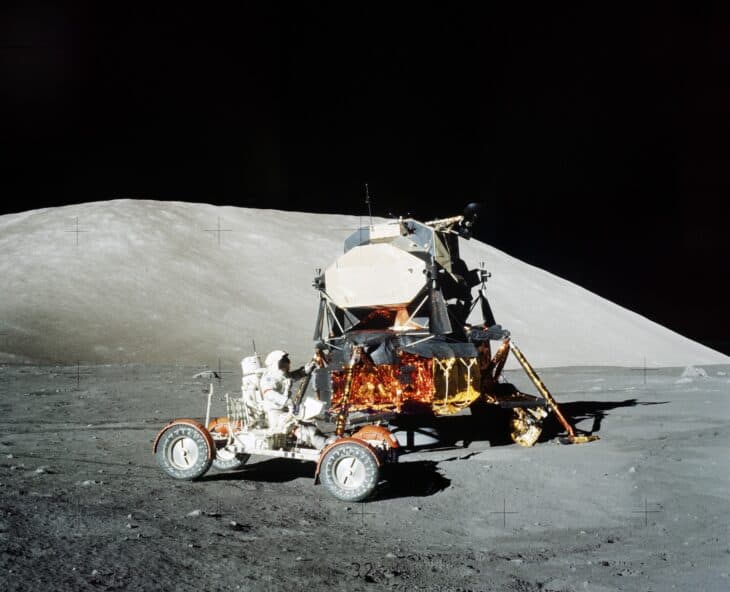

Counting the time the landers sat on the surface, crews were also inside, resting between moonwalks. Apollo 11 stayed 21 hours and 37 minutes; Apollo 17 stayed three days. Added up, all six landings come to just under 300 hours, about 12.5 days.
Why You See 12, 24 and 28
All three numbers are correct. They answer different questions, and a lot of pages quietly swap one for another.
12 walked on it. Everyone who landed got out, so “landed on the Moon” and “walked on the Moon” are the same 12 people. No one landed twice.
24 flew there on Apollo. NASA counts 24 astronauts who traveled from Earth to the Moon between 1968 and 1972, on nine missions with three seats each. That is 27 seats but only 24 people, because Jim Lovell, John Young and Gene Cernan each made the trip twice.
28 have flown there in total. Artemis II added Reid Wiseman, Victor Glover, Christina Koch and Canada’s Jeremy Hansen, who launched on April 1, 2026, and splashed down off San Diego on April 10. Hansen became the first person who is not American to travel to the Moon.


The most repeated mistake: "12 people have been to the Moon"
Twelve is the number who walked on it, not the number who went. Twice as many flew there on Apollo, and Artemis II brought the total to 28. The reverse error shows up too: Apollo 13 and Artemis II both flew around the Moon, but neither landed, and neither even entered lunar orbit.
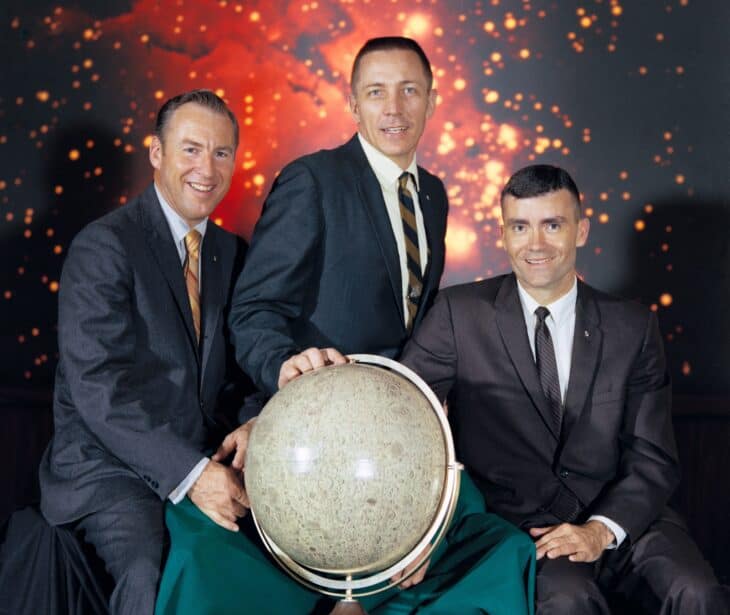
Apollo 13 is the near miss. Jim Lovell and Fred Haise were due to become moonwalkers seven and eight in April 1970, until an explosion in the service module on the way out forced NASA to abort the landing.

Artemis II flew farther than any crew before it, reaching 252,756 miles (406,771 km) from Earth and breaking the record Apollo 13 had held since 1970. It still did not land or orbit, so it adds to the “been to the Moon” count and not to the moonwalkers.
How Many Moonwalkers Are Still Alive?
Four of the 12 are alive as of November 2026: Buzz Aldrin of Apollo 11 (96), David Scott of Apollo 15 (94), Charles Duke of Apollo 16 (91) and Harrison Schmitt of Apollo 17 (91).
Ten of the 12 came to NASA from the US military, and Armstrong was already a NASA test pilot before he became an astronaut. Our guide to the most famous astronauts and the aircraft they flew first traces those flying careers.
Alan Shepard was the oldest to walk on the Moon, at 47 on Apollo 14. Charles Duke was the youngest, at 36 on Apollo 16. Schmitt, a geologist, was the only one of the twelve selected as a scientist rather than a pilot.
When Will the Number Change?
Not before 2028. NASA restructured Artemis in February 2026, so Artemis III is now a crewed test in Earth orbit planned for mid-2027, practicing rendezvous and docking with the two commercial landers.
Artemis IV and Artemis V are the landing missions, both planned for 2028, NASA officials said at an Oct. 23, 2026, briefing. On each, two crew members would ride a lander, either SpaceX’s Starship or Blue Origin’s Blue Moon, down to the surface and back.
If both fly, the count goes from 12 to 16 by the end of 2028. The landing date has already slipped once, from Artemis III to Artemis IV, so treat 2028 as a target rather than a promise.
July 1969
Apollo 11. Armstrong and Aldrin become moonwalkers one and two.
April 1970
Apollo 13 aborts. Lovell and Haise loop around the Moon without landing.
Dec. 1972
Apollo 17. Cernan and Schmitt make the last landing. Cernan is the last to climb back aboard.
April 2026
Artemis II. Four astronauts fly around the Moon, 28 people in total have now traveled there.
Mid-2027
Artemis III (planned). A crewed docking test in Earth orbit, with no Moon landing.
2028
Artemis IV and V (planned). The first landings since 1972, two moonwalkers each.
How 12 Compares With Everyone Who Has Been to Space
Hundreds of people have flown in space since 1961, but only 28 have gone as far as the Moon and only 12 have stood on it. Every one of the 28 flew on a NASA spacecraft.
The Moon also carries one person who never flew there. In 1998, NASA’s Lunar Prospector carried about an ounce (28 g) of the ashes of geologist Eugene Shoemaker, and the spacecraft was later crashed into the Moon, leaving the first human remains on its surface.
For a sense of how crowded the space closer to home has become, our count of how many satellites are in space runs to more than 17,000 working spacecraft. The Moon still has a population of zero.
FAQ
Sources and references used for research and fact-checking.
- NASA Science, Moonwalkers
- Wikipedia, List of Apollo astronauts
- Boeing, Artemis II crew back on Earth after historic lunar flyby
- WTOP (Associated Press), Artemis II's grand moon finale: Pacific splashdown caps NASA's lunar comeback
- SpacePolicyOnline, NASA is Full Steam Ahead on Artemis III, IV and V
- EarthDate, The Man on the Moon
Get the Newsletter
The latest aviation news and stories sent to your inbox.
About the Author

Tim is the owner and lead editor of AeroCorner since 2019, overseeing aviation content covering aircraft, airlines, airports, and the broader aviation industry. Through years of researching, writing, editing, and publishing aviation-focused content, he has developed extensive practical knowledge of commercial aviation and air travel. Based in Asia and a frequent traveler himself, Tim also brings firsthand passenger experience to AeroCorner’s coverage. Outside of publishing, he has also explored aviation firsthand through hands-on flight training in New Zealand.