

Table of Contents
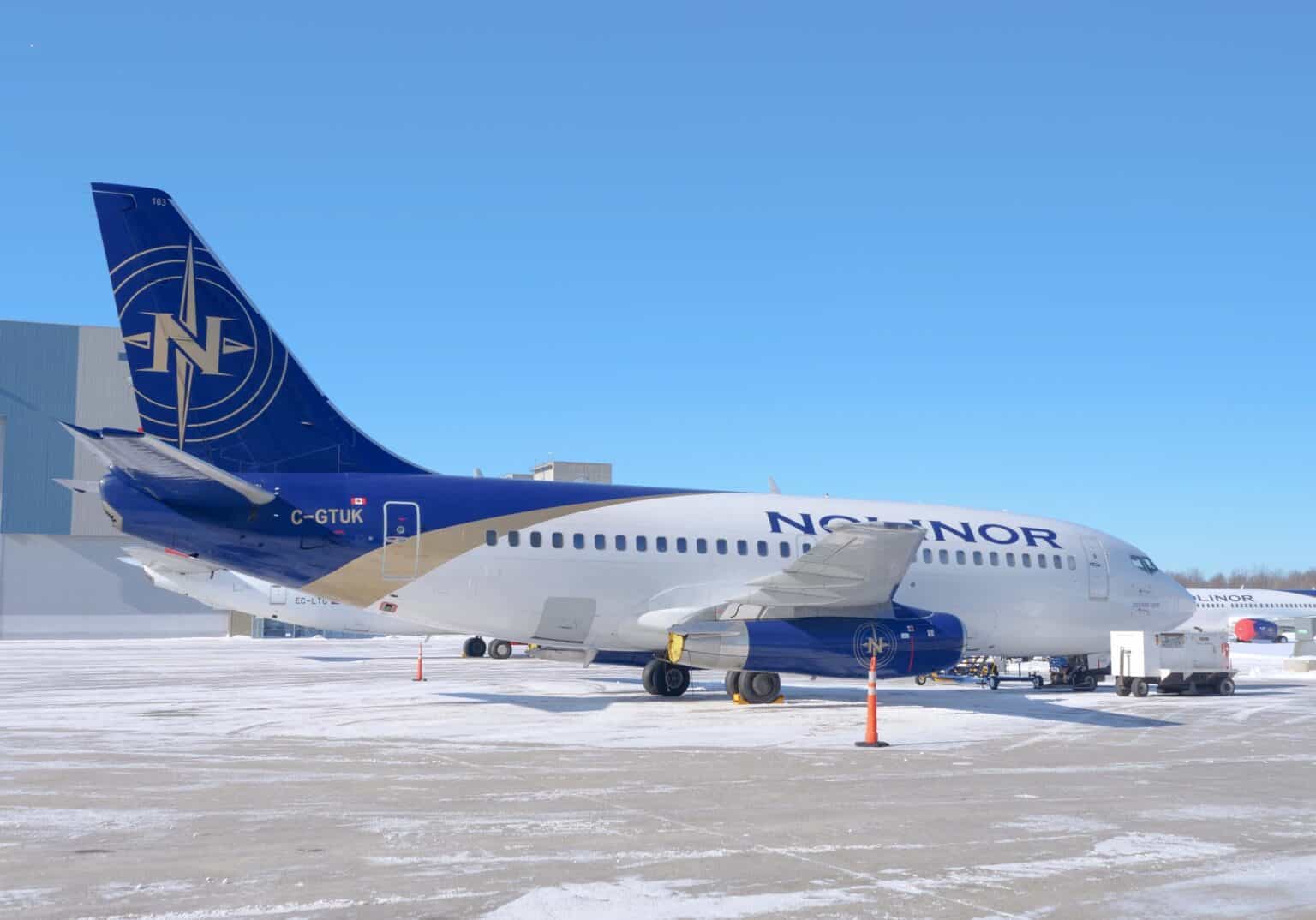
Boeing built 1,114 of the 737-200 family between 1967 and 1988. The type left scheduled US passenger service in 2008, yet a 1974 example still flies charters out of Montreal.
The most recent published estimate, from January 2026, puts the worldwide fleet at roughly 40 aircraft still in service. The firmest number is Canada’s: on November 27, 2026, the Transport Canada register listed 20 Boeing 737-200s, 19 of them outside a museum.
How Many Boeing 737-200s Are Still Flying?
Somewhere between about 17 and 50, depending on who counts and what they count. Published tallies since 2023 have ranged from 17 active passenger-delivered jets to 50 flying for 30 carriers, and the newest, from FlyMag in January 2026, says roughly 40.
No public database publishes a verified live count, so we went to the registers. Canada holds 20 current 737-200 registrations and the US holds 16, though a registration proves an aircraft exists on paper, not that it flew this week.
The count at a glance
Built: 1,114 (991 737-200s, 104 737-200C convertibles, 19 T-43A trainers). Still in service worldwide: roughly 40 (FlyMag, January 2026). On the Canadian register: 20, 19 outside a museum (Transport Canada, November 27, 2026). On the US register: 16, 3 of them museum aircraft (FAA, November 26, 2026). Largest operator: Nolinor Aviation of Montreal.
Who Still Has Them: the Canadian Register
Canada is where the Boeing 737-200 survives as a working airliner. Every one of the 20 aircraft below is listed with a certificate of airworthiness as its flight authority, and 16 are registered for commercial use.
| Registered owner | 737-200s | Registered for |
|---|---|---|
| Nolinor Aviation (Montreal Mirabel) | 10 | Commercial |
| Air Inuit (Montreal) | 5 | Commercial |
| Glencore Canada (Montreal Dorval) | 3 | Private |
| Buffalo Airways (Yellowknife) | 1 | Commercial |
| Alberta Aviation Museum Association (Edmonton) | 1 | Private |
| Total | 20 |
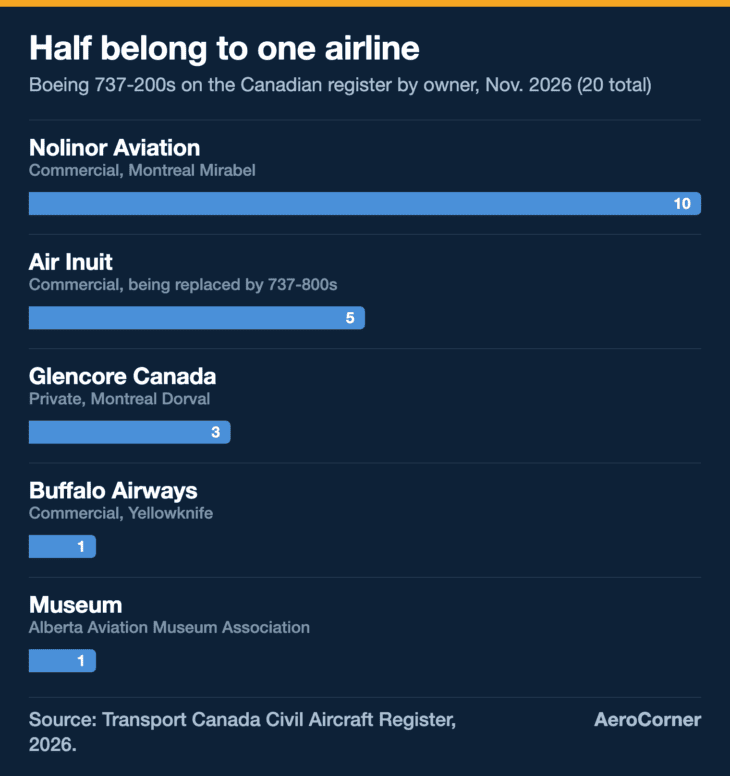
Nolinor alone holds half of them. Its April 2026 fleet list on Wikipedia shows ten 737-200s, all combis with up to 119 seats and gravel kits, which makes it the world’s largest operator of the type.
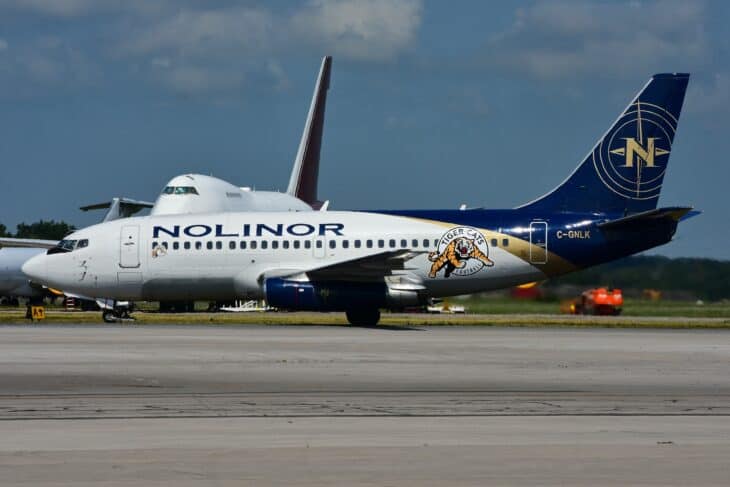
Nolinor’s own count runs a little behind its paperwork. In August 2025 it announced its eighth active 737-200, C-FTWW, said another was being prepared to return to service, and said it planned to buy a ninth in 2026.
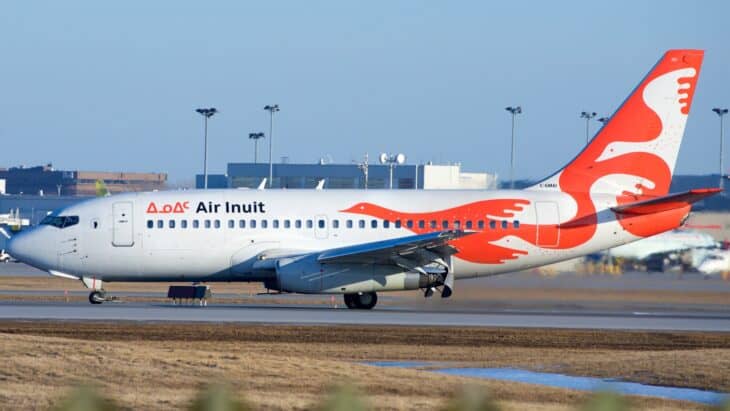
Air Inuit’s five are on borrowed time. The airline announced in 2023 that it would retire its 737-200 combis and replace them with three 737-800 combis, so this part of the table is expected to shrink.

Why the North Still Needs a 1970s Jet
The reason is gravel. Boeing offered the 737-200 with an Unpaved Strip Kit: a deflector on the nose gear and a vortex dissipator extending from the front of each engine, to reduce damage from stones and debris on remote, unpaved runways.
Alaska Airlines flew gravel-kitted 737-200 combis on its rural Alaska routes until it retired the type in 2007. Northern Canada is where that kind of flying carried on.
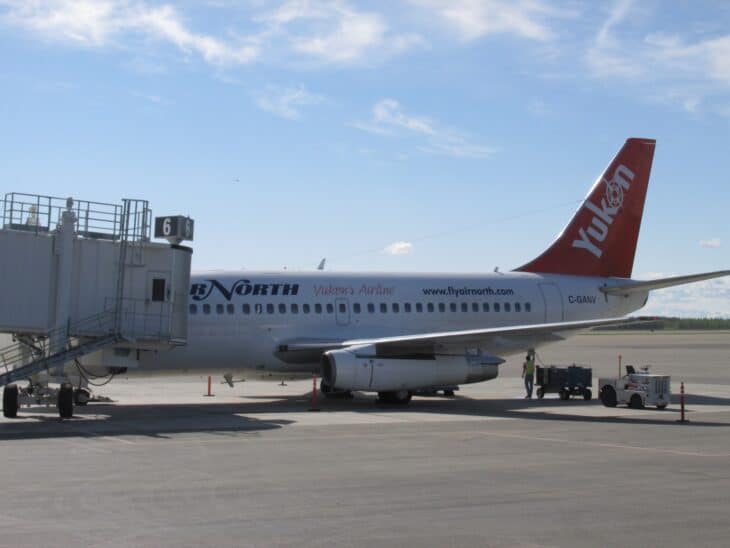

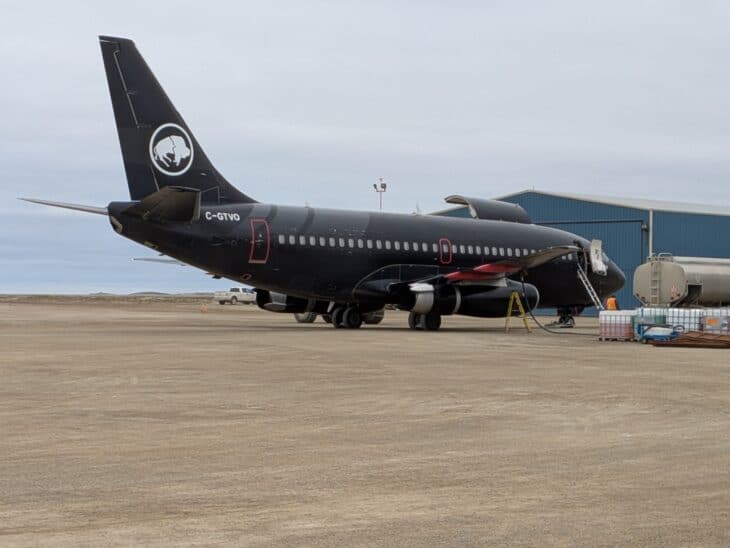
That is the job the survivors still do. Nolinor markets its 737-200s for passenger, cargo or combi missions to gravel, ice or unpaved runways, and calls the oversized cargo door the type’s strategic advantage.
The oldest one is 52
Nolinor’s C-GNLK was built in 1974 and entered service that May with the Dutch airline Transavia. It is widely described as the oldest 737 still flying passengers commercially, 52 years later.
Buffalo Airways of Yellowknife bought its 737-200 in 2023 from Chrono Aviation. The jet is a gravel-kitted combi with a hush kit, and the airline has talked about converting it to a full freighter; our explainer on what a hush kit is covers that bolt-on.

Not every northern operator held on. Canadian North flew its last scheduled passenger flight with a 737-200 on May 6, 2023.
Outside Canada: Charters, Corporations and Air Forces
The US register, in its November 26, 2026 file, lists 16 Boeing 737-200 series aircraft. Six are registered to Trans Executive Airlines of Hawaii and Rhoades Aviation, two to Sierra American Corp, five to private and corporate owners, and three to museums.
Several of those names match the ch-aviation active lists. Transair Express flies N413JG, and Ameristar Jet Charter flies N465TW, according to Simple Flying’s 2024 and 2025 counts.
Air forces are the other holdouts. The August 2025 ch-aviation list counts four 737-200s with the Indonesian Air Force, three with the Indian Air Force, and one each with the Ecuadorian and Mexican air forces.
The rest are scattered across small operators in Latin America, Africa and Indonesia, such as Avior Airlines in Venezuela and Canadian Airways Congo, often one or two jets apiece. The 737-200 is a small slice of the wider family: Boeing has delivered more than 12,700 737s, as our count of how many Boeing 737s there are shows.
Why the Numbers Differ
The figures you will find online disagree by a factor of three, and most of the gap is definition, not error. Four counts come up again and again.
| Published count | Date | What it counts |
|---|---|---|
| 50 flying, 30 carriers | September 2023 | Active aircraft, all versions (AirlineGeeks) |
| 19 active in North America | March 2024 | Eight companies in North America (ch-aviation via Simple Flying) |
| 17 active | August 2025 | Passenger-delivered 737-200s only, cargo-delivered versions excluded (ch-aviation via Simple Flying) |
| Roughly 40 in service | December 2025 | Worldwide, no source named (FlyMag) |
The 17 figure leaves out most of Canada
The widely shared count of 17 active 737-200s excludes aircraft delivered as cargo versions. Most of the jets still working in northern Canada are 737-200C combis and freighters, so that count misses the bulk of the fleet that actually keeps the type alive.
The 17 list is also tilted toward military flying: nine of its 17 jets belong to air forces in Indonesia, India, Ecuador and Mexico.
The registers err the other way. They count aircraft that are parked, held for spares, or waiting for a return to service, and three of the 16 US registrations belong to museums: the Museum of Flight, the Kansas Aviation Museum and the Alaska Aviation Museum.
Time matters too. Retirements keep coming, so a 2023 count of 50 and a late-2025 count of about 40 can both be right for their date.
How 1,114 Became a Few Dozen
The 737-200 was a stretched 737-100, launched by United Airlines in 1965. It first flew on August 8, 1967, and entered service with United in April 1968.
Aug. 1967
First flight. The stretched 737-200 flies four months after the original 737-100.
May 1971
The 737-200 Advanced enters service. All Nippon Airways introduces the improved version.
1974
C-GNLK is built. It goes to Transavia, and today flies for Nolinor.
1988
Production ends. The last 737-200 series aircraft is delivered to Xiamen Airlines.
March 2008
End of US scheduled passenger service. Aloha Airlines flies the last 737-200s in US scheduled service.
May 2023
Canadian North retires its last one. Nolinor, Air Inuit and Buffalo Airways carry on.
Its survival is unusual: a relatively high number of 737-200s remain in service compared with other early jetliners, which is why 737-200s keep turning up on lists of the oldest commercial passenger planes in service.
For comparison, about 420 Boeing 747s still fly, and our count of how many 747s are still flying breaks that fleet down the same way.
The next drop is already announced. When Air Inuit’s 737-800 combis replace its 737-200s, the type’s last strongholds will be Nolinor and a handful of military, corporate and freight operators.
FAQ
Sources and references used for research and fact-checking.
- Transport Canada, Canadian Civil Aircraft Register, bulk download (file dated November 27, 2026)
- Federal Aviation Administration, Releasable Aircraft Database (file dated November 26, 2026)
- Wikipedia, Boeing 737
- AirlineGeeks, Where Are Boeing 737-200s Flying in 2023?
- Simple Flying, How Many Boeing 737-200s Are Left?
- Simple Flying, Who Still Flies The Boeing 737-200 In North America?
- FlyMag, Canada's Nolinor Keeps The Boeing 737-200 Alive, And Operates More Of Them Than Anyone
- Skies Magazine, Nolinor Aviation adds an eighth Boeing 737-200 to its fleet
- Wikipedia, Nolinor Aviation
- Wikipedia, Air Inuit
- Wikipedia, Buffalo Airways
- Wikipedia, Canadian North
Get the Newsletter
The latest aviation news and stories sent to your inbox.
About the Author

Tim is the owner and lead editor of AeroCorner since 2019, overseeing aviation content covering aircraft, airlines, airports, and the broader aviation industry. Through years of researching, writing, editing, and publishing aviation-focused content, he has developed extensive practical knowledge of commercial aviation and air travel. Based in Asia and a frequent traveler himself, Tim also brings firsthand passenger experience to AeroCorner’s coverage. Outside of publishing, he has also explored aviation firsthand through hands-on flight training in New Zealand.