

Table of Contents
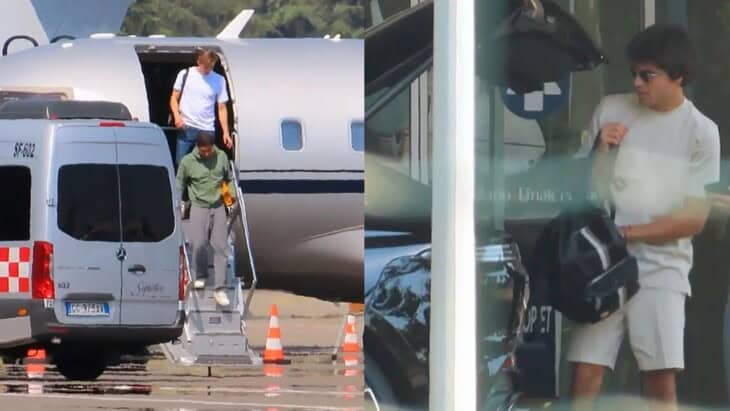
At the 2026 Belgian Grand Prix, three drivers sitting inside the top seven of the championship climbed off the same aircraft. George Russell, Oscar Piastri and Lando Norris shared a Cessna Citation CJ4 out of Nice, a light jet worth about $7 million, along with a photographer, a McLaren trainer and Mark Webber.
That single detail undoes most of what people assume about F1 drivers with private jets. The grid flies privately almost without exception, but hardly any of them own the aircraft.
Four drivers on the 2026 grid have a documented aircraft in their name. This article covers each of them with full specifications and tail numbers, the aircraft the rest of the field charters, the champions who owned jets before them, and why ownership makes so little sense in a sport that flies constantly.
Quick facts about F1 drivers and their private jets
Which F1 Drivers Own a Private Jet in 2026
Ownership on the current grid is a short list. Everyone else buys flights rather than aircraft.
| Driver | Aircraft | Registration | Status |
|---|---|---|---|
| Max Verstappen | Dassault Falcon 8X | PH-UTL | Owner since February 2025 |
| Fernando Alonso | Dassault Falcon 900C | Not public | Owner |
| Lance Stroll | Bombardier Challenger 604 | N18LS | Owner |
| Sergio Pérez | Bombardier Global Express XRS | Not public | Owner |
| Lewis Hamilton | Bombardier Challenger 605 | G-LCDH | Sold, owns nothing since |
| Rest of the grid | Charter and shared charter | Varies | No ownership |
Two things stand out. Three of the four owners are over 35, and two of them fly Dassault trijets, an aircraft family that has quietly become the Formula 1 default.
Max Verstappen: The Dassault Falcon 8X
Verstappen owns the most capable aircraft on the grid, and he is the only driver whose jet has become a fan object in its own right. Tracking accounts follow it, and the registration is a piece of personal branding.
PH-UTL stands for Unleash The Lion, a reference to the Dutch lion he races under. It entered the Dutch civil register on February 7, 2025, and is operated on his behalf by Exxaero, a Netherlands-based business aviation company that handles crew, planning and maintenance.
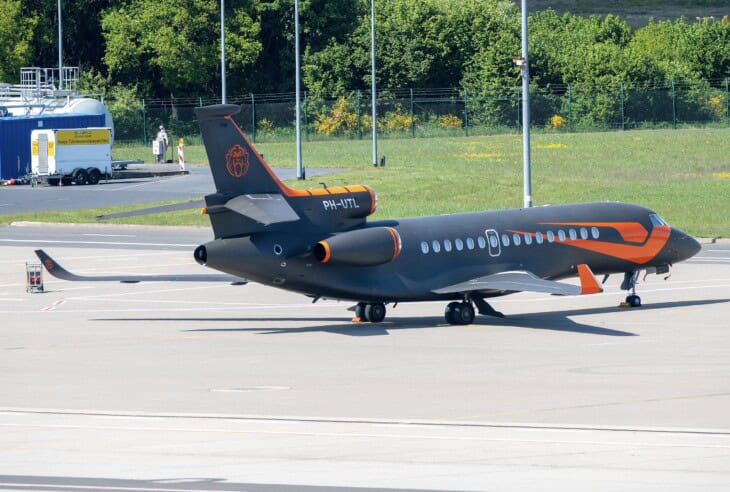


The paint is the giveaway on any apron. Matte black with orange accents, carrying his personal marks, on an aircraft type that is almost always delivered in conservative white.
The Dassault Falcon 8X is a three-engine ultra-long-range jet, the longest-cabin aircraft Dassault builds. Its 6,450 nautical mile range covers Amsterdam to Singapore or Europe to Los Angeles without stopping, which matters on a 22-race calendar spread across five continents.
Performance
Cabin
Registration
Why three engines keep showing up in F1
Both Verstappen and Alonso fly Dassault trijets, and Michael Schumacher did before them. The third engine buys two things a twin cannot: steep, short-field approaches into constrained airports like London City and Sion, and freedom from the ETOPS diversion rules that dictate how far a twin may stray from an alternate airport over water. On a calendar that includes Melbourne, Suzuka, Interlagos and Las Vegas, both matter.
The jet he replaced: Richard Branson’s Falcon 900EX
Verstappen’s first aircraft came with a story attached. He bought a 2008-build Dassault Falcon 900EX from Richard Branson’s Virgin group at the end of 2020, reportedly for around $15 million.
He registered it PH-DTF for Down To Fly, painted it matte dark grey with orange graphics, and had the cabin refurbished in 2021 with his MV33 logo worked into the interior.
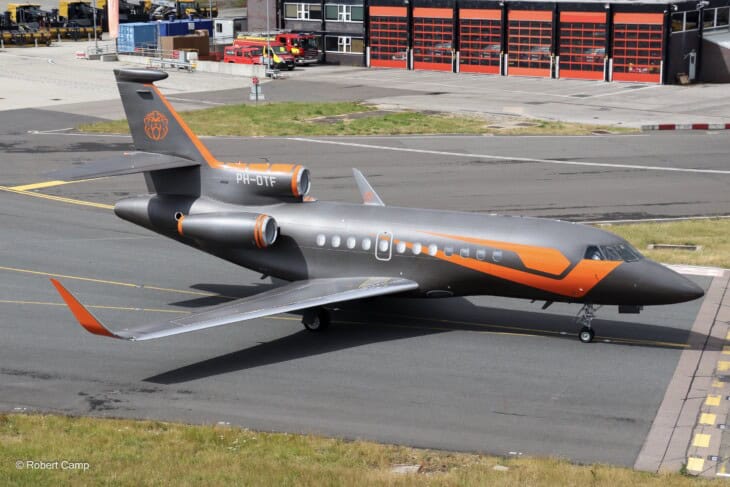
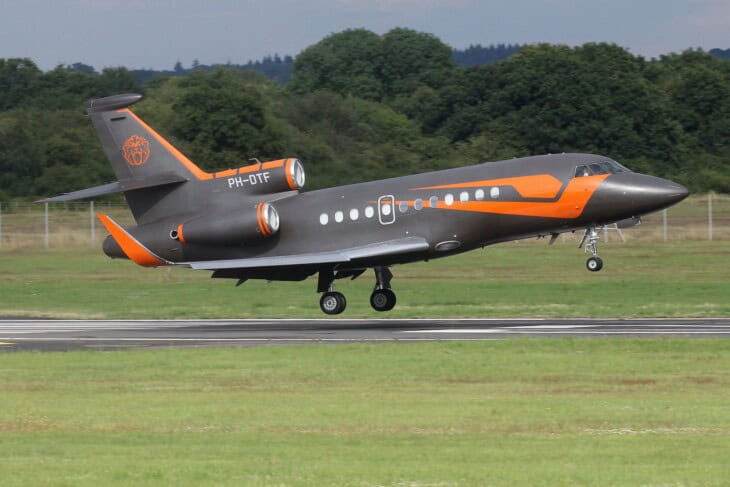
It went on the market in March 2025 at around £12 million, offered to buyers in the United States and Canada. That is roughly what a 17-year-old 900EX with those hours is worth, so this was a clean upgrade rather than a distress sale.
The range difference explains the move. The 900EX manages 4,500 nautical miles, the 8X does 6,450, and that gap is the difference between refuelling on the way to Asia and not.
Fernando Alonso: The Dassault Falcon 900C
Alonso has owned a Dassault Falcon 900C for years, a trijet reported at around $12 million and notably modest for a two-time world champion in his 25th season of top-level racing.
The 900C is the simplified, shorter-range member of the Falcon 900 family, built in small numbers in the early 2000s. It carries the same three-engine tail arrangement as Verstappen’s aircraft with about 4,000 nautical miles of range.
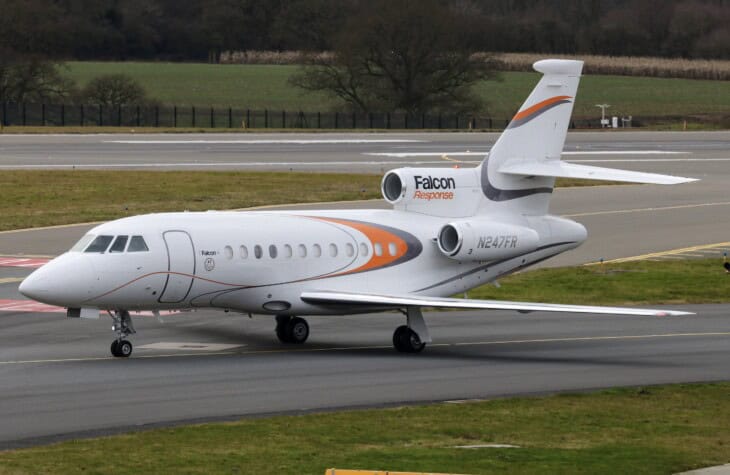

Alonso also signed a partnership with the aircraft brokerage and management firm EMCJET in 2020, which is the usual route for an owner who does not want to run a flight department personally.
Ownership does not mean he always flies his own aircraft. He arrived at the 2026 Belgian Grand Prix on a chartered Dassault Falcon 2000 from Strasbourg, which is exactly how owners behave when the jet is somewhere else or in maintenance.
Lance Stroll: The Bombardier Challenger 604
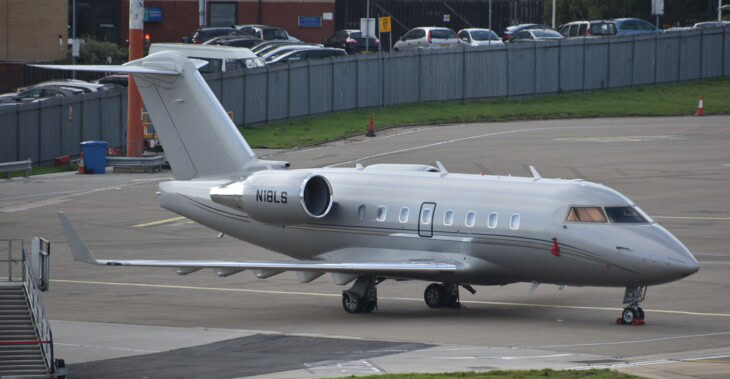
Lance Stroll flies a Bombardier Challenger 604 registered N18LS, a 2006 airframe carrying serial 5658 and his initials on the tail. It is the oldest owned aircraft on the grid and, at roughly $10 million in today’s used market, one of the cheapest.
The wider Stroll family aviation picture is a different order of magnitude. His father Lawrence Stroll, who owns the Aston Martin F1 team, took delivery of a three-year-old Bombardier Global 7500 on January 30, 2026, an aircraft valued at roughly $80 million.
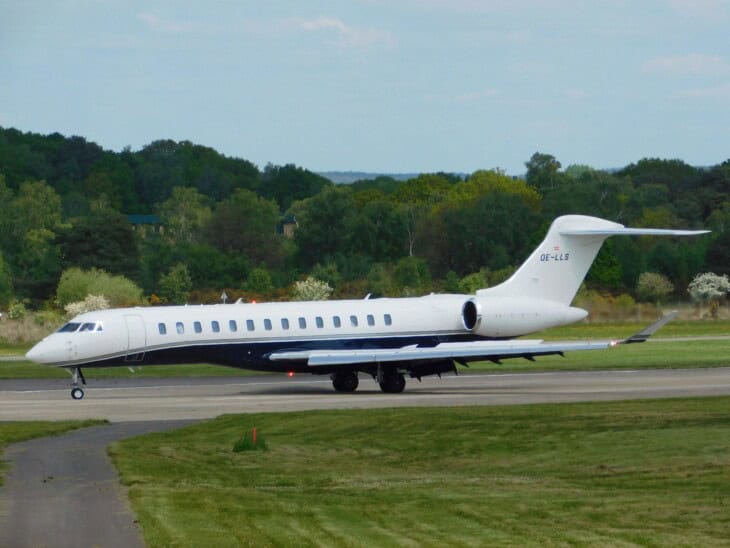
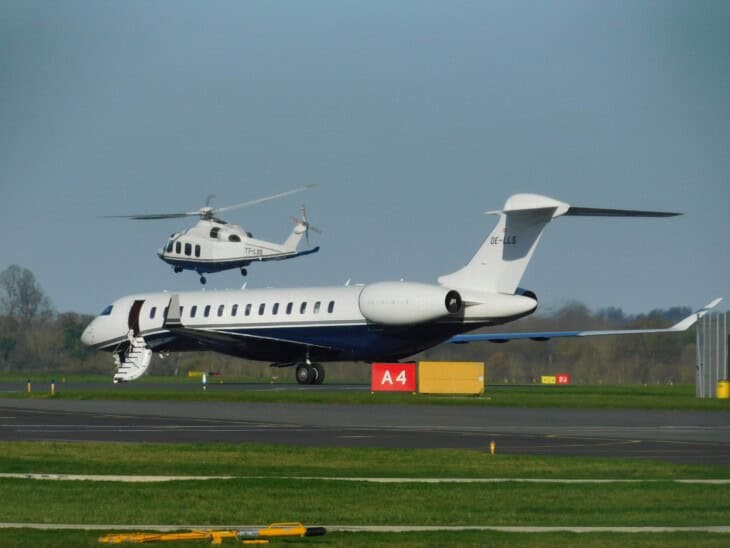
The Global 7500 is one of the very few aircraft that outranks Verstappen’s Falcon, and it sits near the top of any list of the longest range private jets in service. New York to Hong Kong is within its nonstop capability.
At the 2026 Belgian Grand Prix, Lance Stroll arrived on a Bombardier Global 5000 from Nice and transferred onward by AgustaWestland AW139 helicopter. Team-principal-level aviation and driver-level aviation blur together when your team principal is also your father.
Sergio Pérez: The Bombardier Global Express XRS
Pérez is back on the grid in 2026 with Cadillac alongside Valtteri Bottas, and he brought his aircraft with him. He arrived at Spa that season on a Bombardier Global Express XRS from Madrid, an aircraft reported at around $15 million.
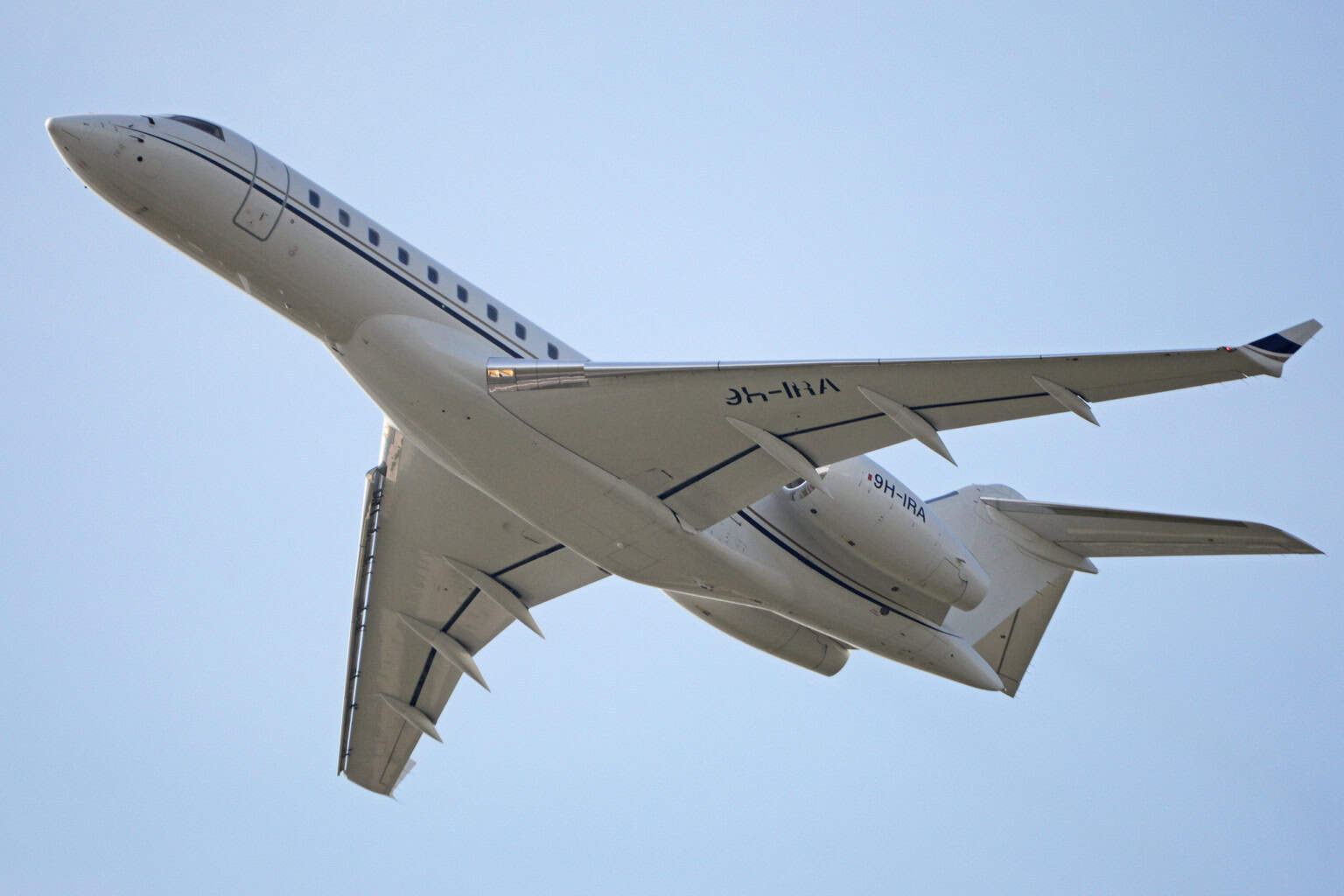
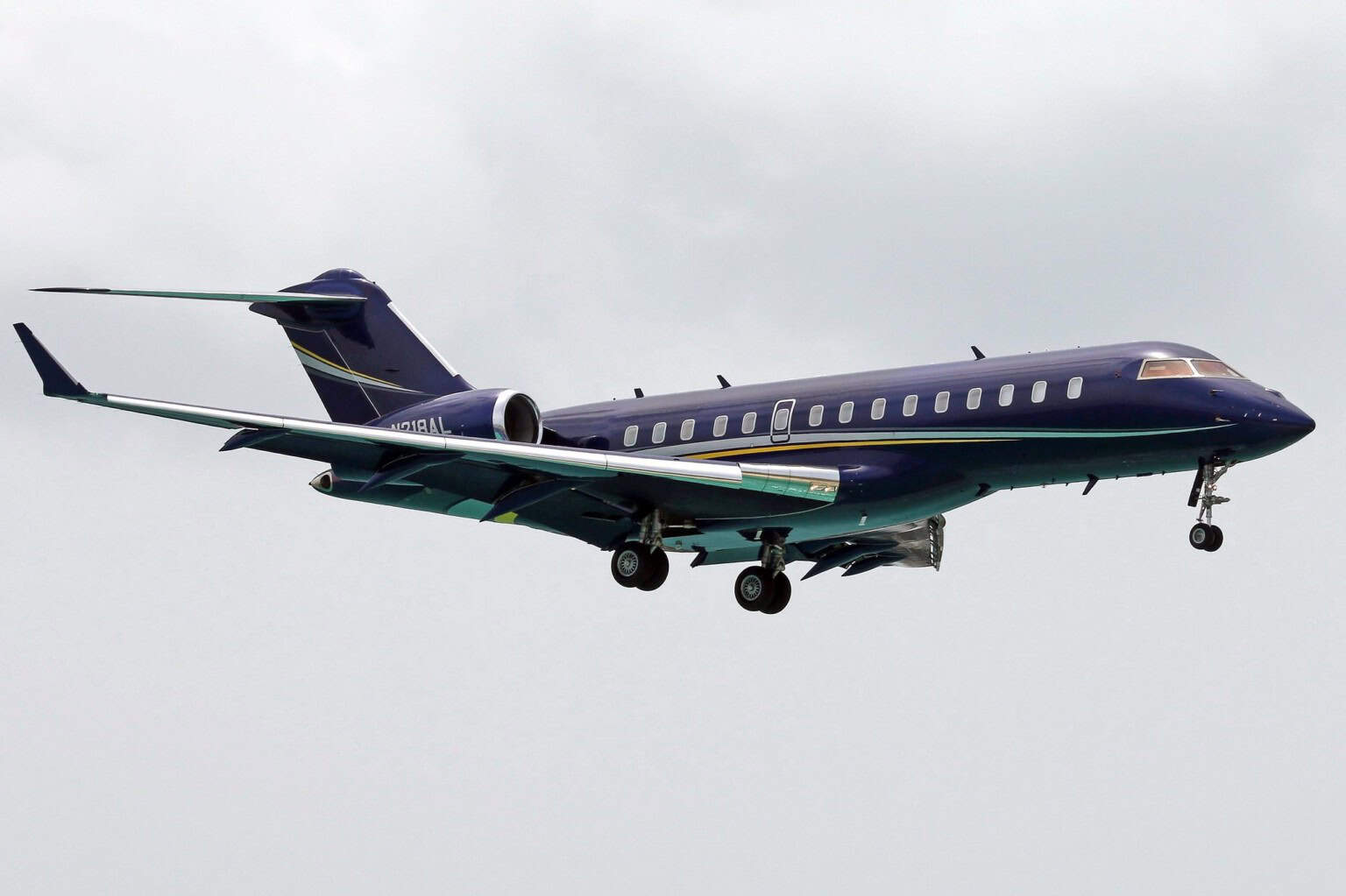

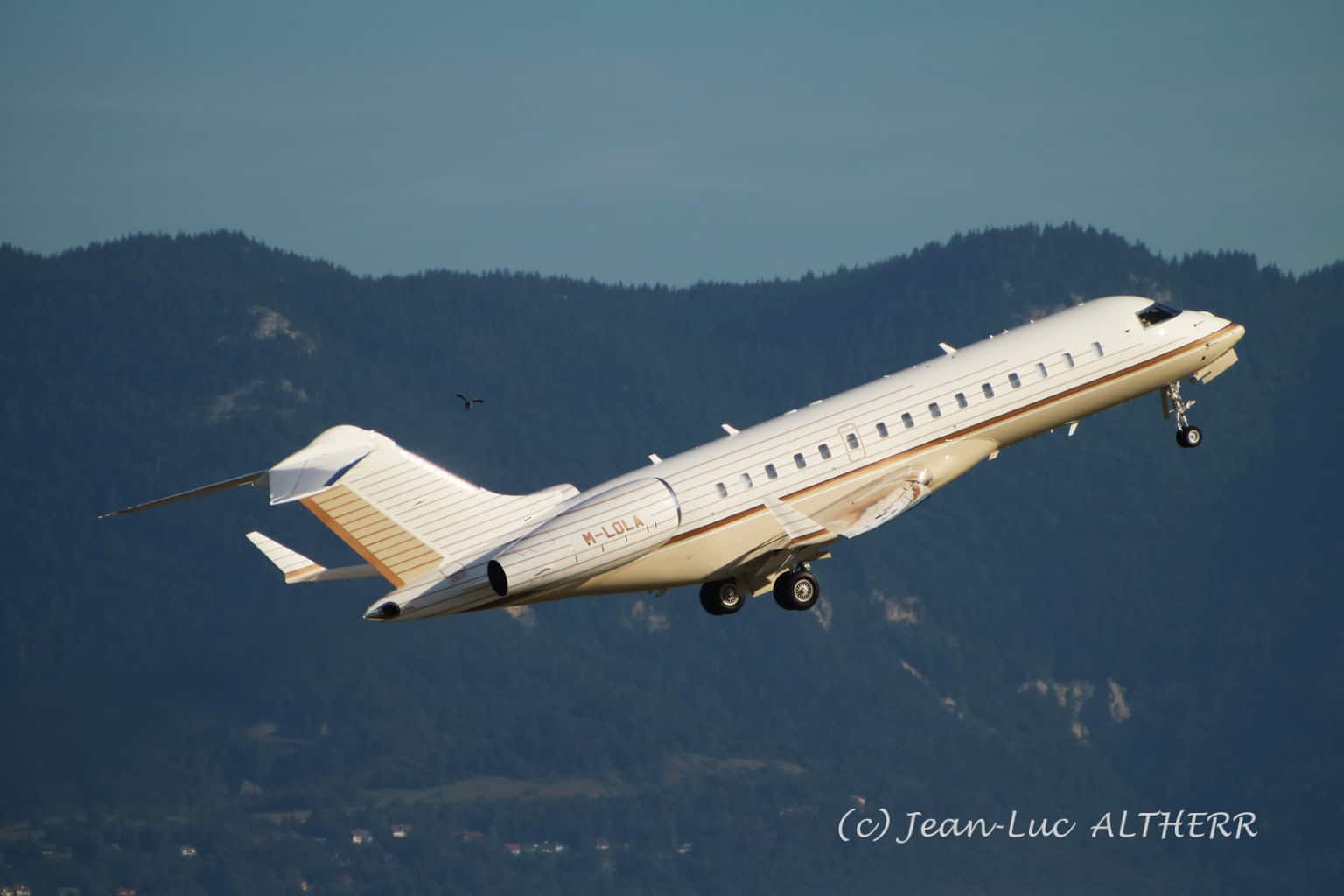
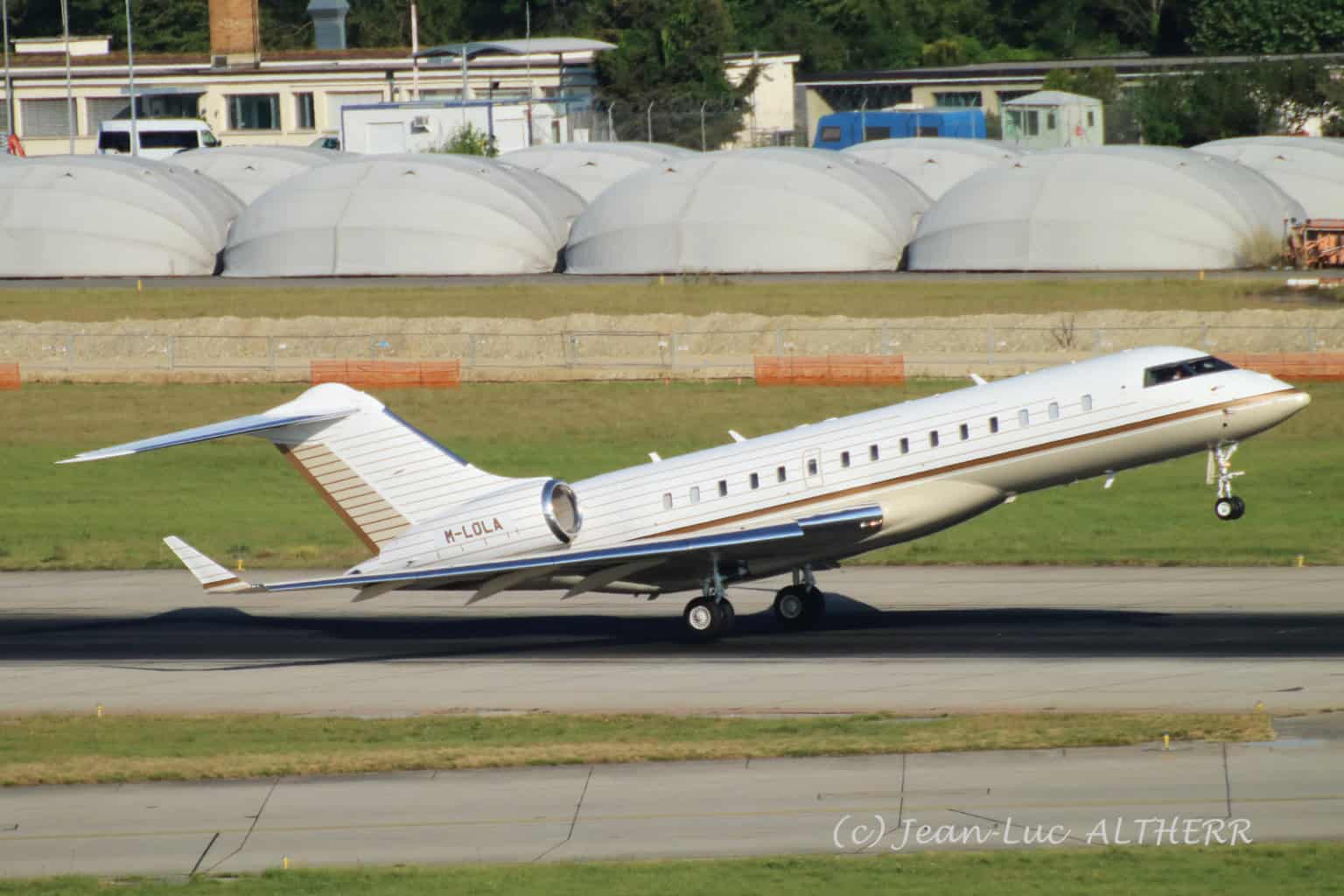
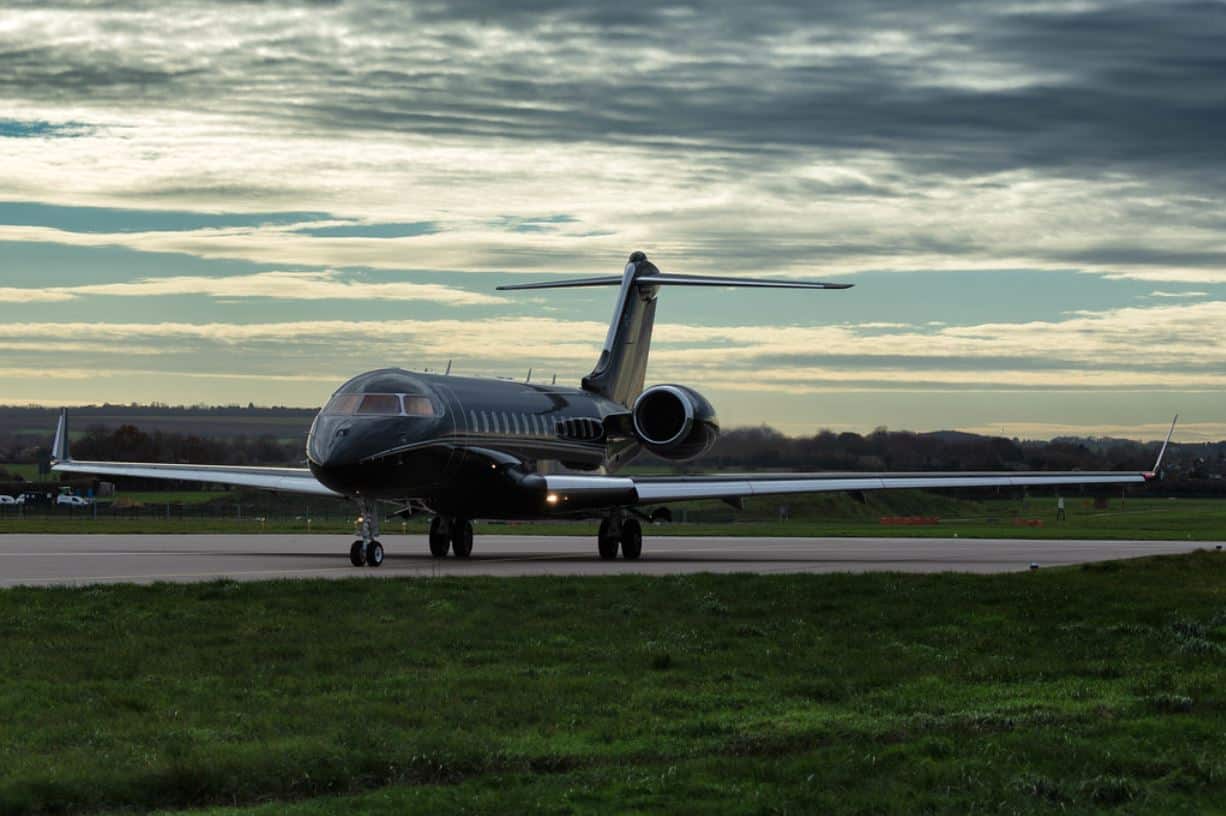
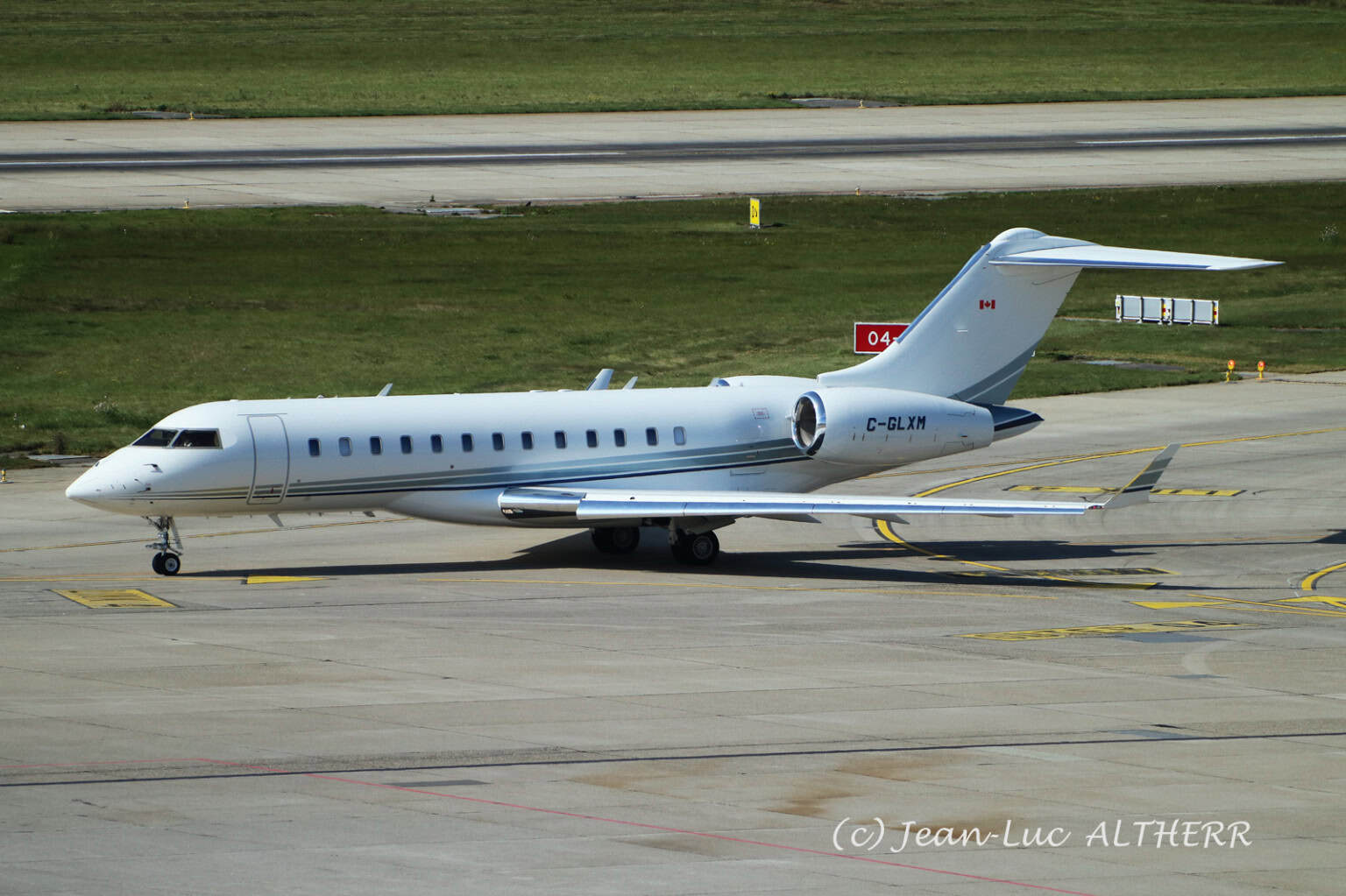
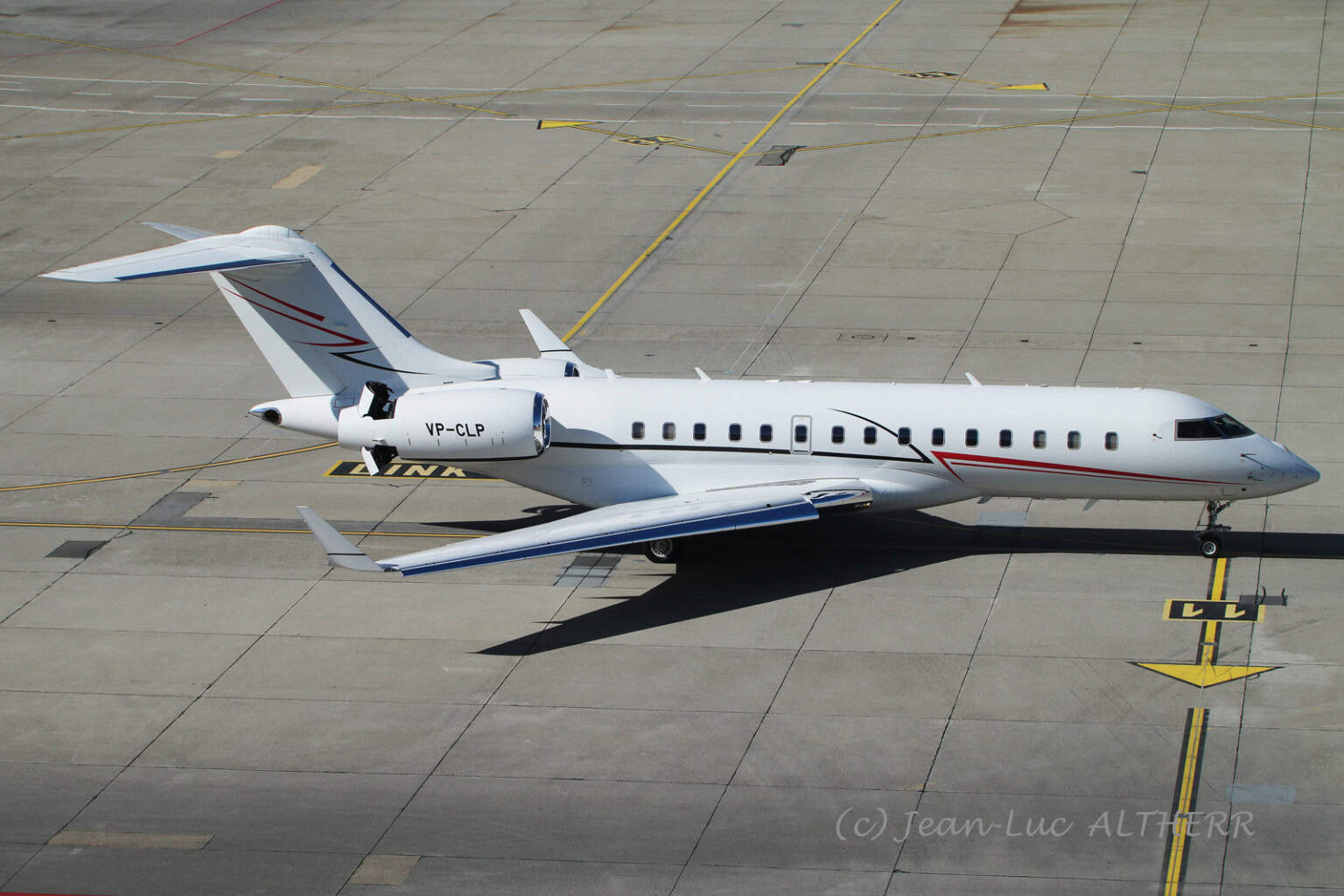
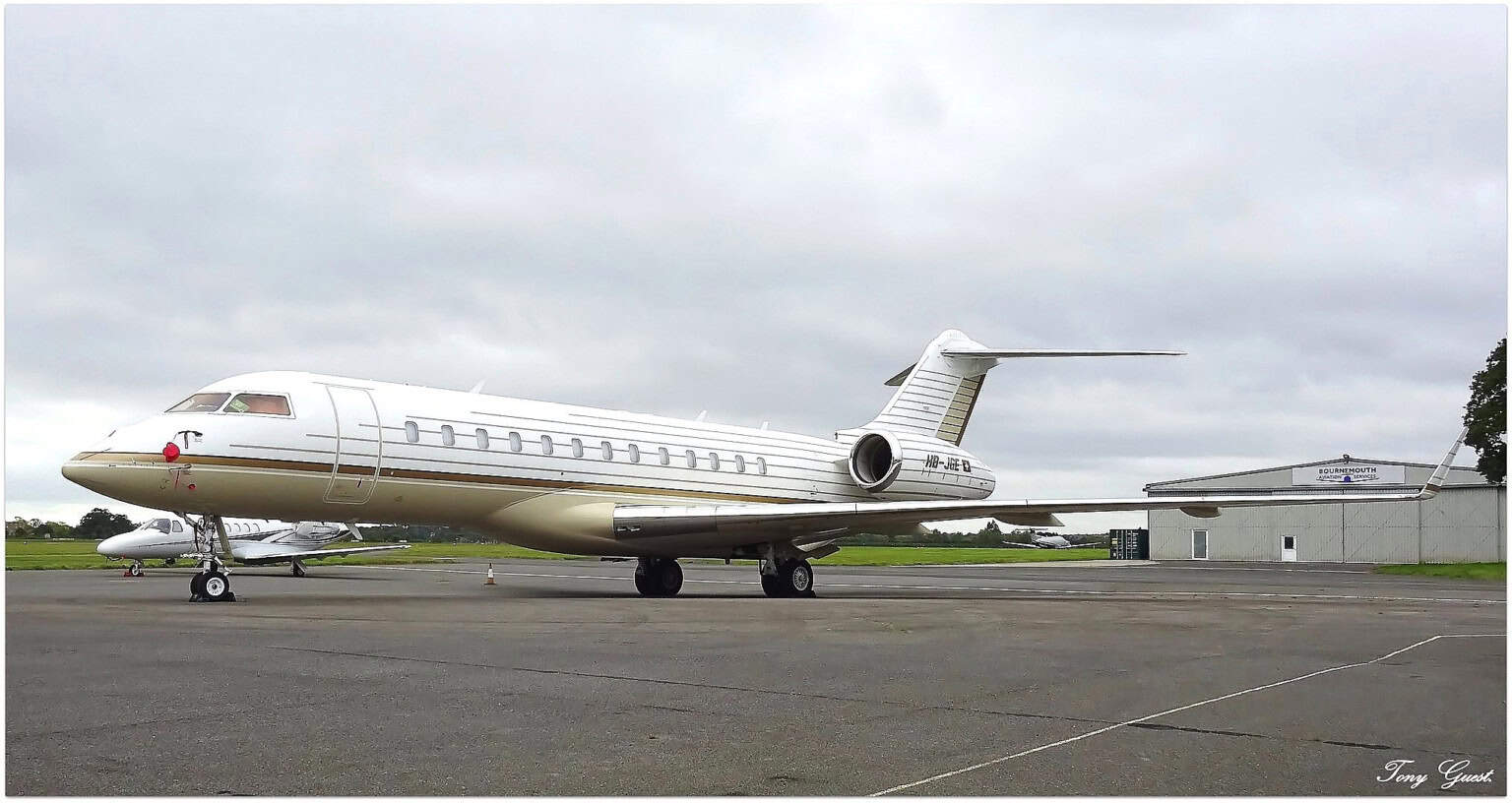
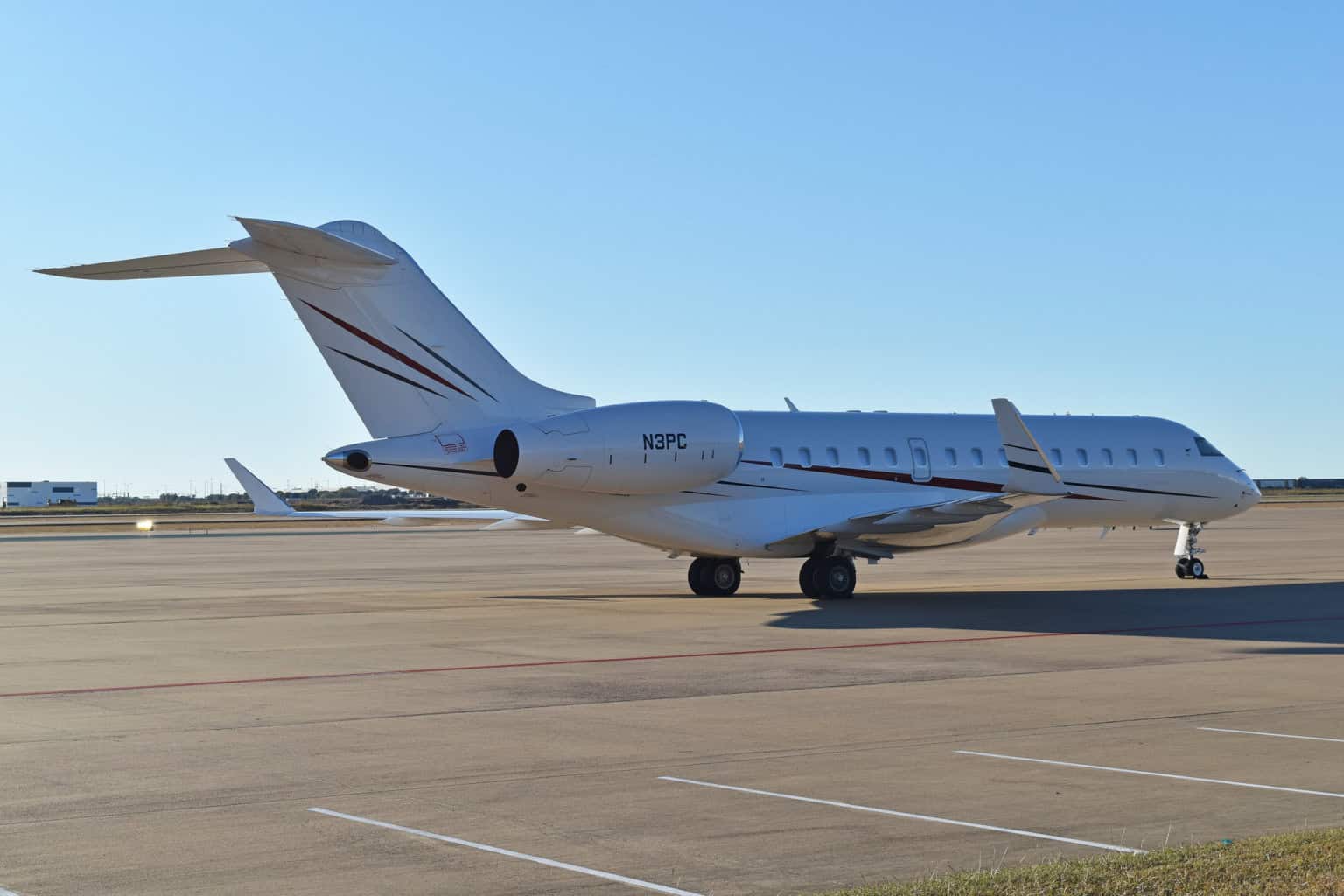
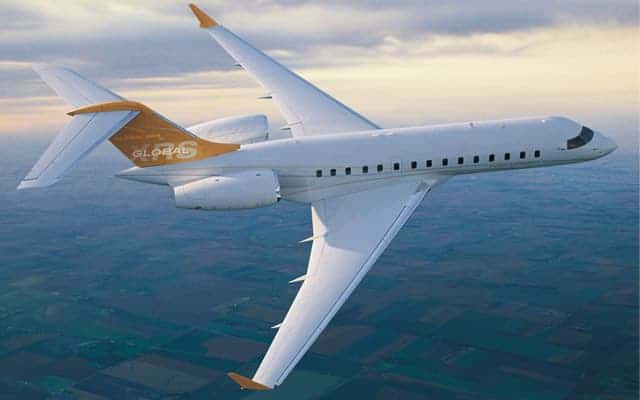
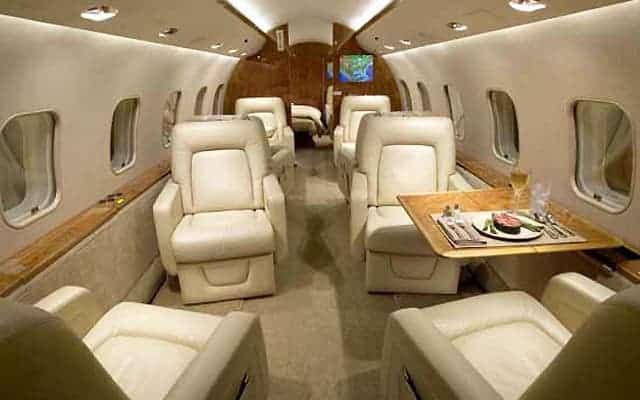

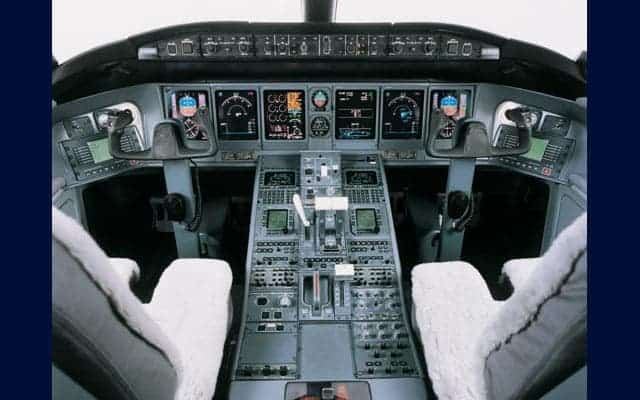
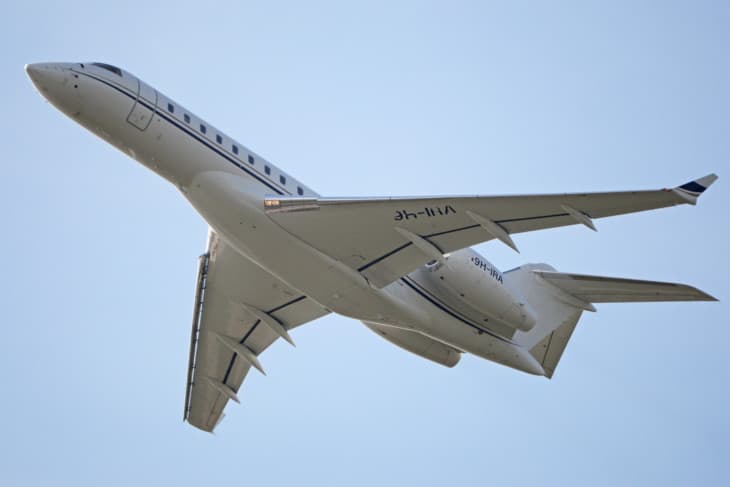
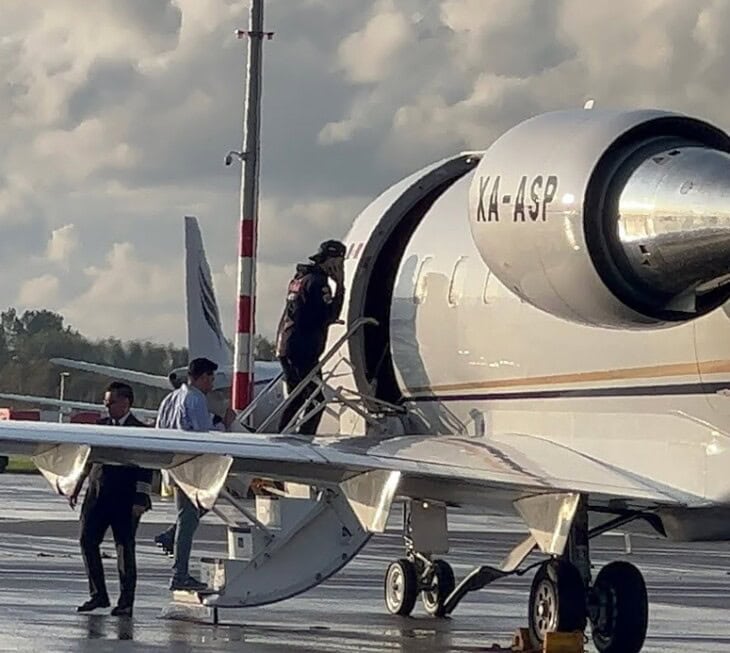
The XRS is the long-range Bombardier that competes directly with the Falcon 8X and the Gulfstream G550. Buying a used one is the value play in the category, since a 2008-era XRS delivers most of an 8X’s capability for a quarter of the money.
Pérez has a practical reason for wanting range that most of the field does not. Mexico to Europe is a long way, and he flies it repeatedly across a season.
Lewis Hamilton: The Champion Who Gave His Jet Away
Hamilton is the most famous name in any conversation about F1 private jets, and he has not owned an aircraft since 2019.
His Bombardier Challenger 605 was painted candy apple red and registered G-LCDH after Lewis Carl Davidson Hamilton. He bought it in 2013, became the subject of a Paradise Papers story about a £3.3 million VAT refund in 2017, and sold it as his environmental politics hardened.
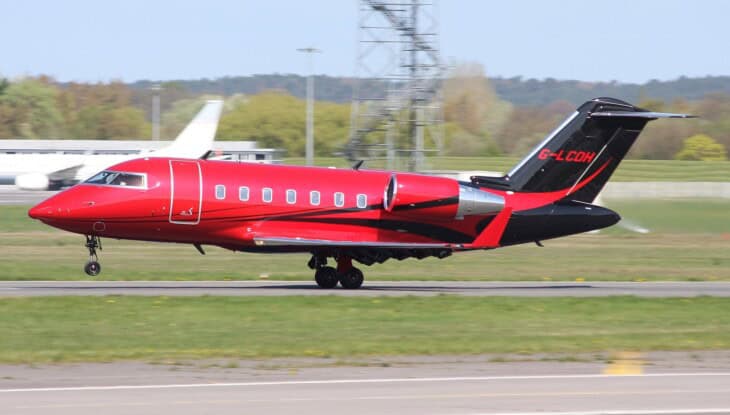
The airframe is still flying. It returned to the UK register as G-RANE in February 2019 with SaxonAir at London Luton, and anybody with the budget can now charter the aircraft Hamilton used to own. The full account of that sale is in our piece on Lewis Hamilton’s private jet.
He did not stop flying privately. In 2026 he leads Ferrari’s title challenge and arrived at Spa on a chartered Embraer Legacy 500 from Bologna, which is a smaller and less thirsty aircraft than the one he sold.
Selling a jet is not the same as grounding one
Hamilton’s Challenger did not stop flying when he sold it. It went to a charter operator and now carries paying passengers instead. What changes for a seller is personal utilisation: an owner flies more because the marginal cost of one more trip feels close to zero once the aircraft is paid for, while a charter customer confronts the full price of every leg. The saving comes from flying less, not from transferring the title.
What the Rest of the Grid Actually Flies
The 2026 Belgian Grand Prix produced the clearest single snapshot of how Formula 1 travels, because the paddock arrivals at Liège were photographed and identified aircraft by aircraft.
| Driver | Aircraft | From | Owned or chartered |
|---|---|---|---|
| Max Verstappen | Dassault Falcon 8X | Prague | Owned |
| Sergio Pérez | Bombardier Global Express XRS | Madrid | Owned |
| Lance Stroll | Bombardier Global 5000 | Nice | Family aircraft |
| Fernando Alonso | Dassault Falcon 2000 | Strasbourg | Chartered |
| Lewis Hamilton | Embraer Legacy 500 | Bologna | Chartered |
| Charles Leclerc | Bombardier Challenger 605 | Bologna | Chartered |
| Pierre Gasly | Embraer Praetor 600 | Milan | Chartered |
| Kimi Antonelli | Cessna Citation CJ2+ | Rimini | Chartered |
| Valtteri Bottas | Hawker 400XP | Nice | Chartered |
| Norris, Piastri, Russell | Cessna Citation CJ4 | Nice | Shared charter |
| Sainz, Albon | Cessna Citation XLS+ | Oxford | Shared charter |
| Hülkenberg, Bortoleto | Pilatus PC-24 | Barcelona | Shared charter |
Read the right-hand column and the picture inverts. Nine of twelve movements were charters, and three of them were shared between rivals from different teams.
The championship leader that weekend, Kimi Antonelli, flew in on a Citation CJ2+ from Rimini, a light jet worth about $3 million. That is roughly one-twentieth of what the driver sixth in the standings was flying.
The Nice problem
Look at the origin airports and Nice appears three times in one weekend. Monaco and the surrounding Côte d’Azur are home to a large share of the grid for tax and lifestyle reasons, which turns Nice into an unofficial Formula 1 hub airport on race weeks. That concentration is also why shared charters work: several drivers genuinely are leaving from the same place at the same time.
Why So Few Drivers Buy the Aircraft
The obvious explanation, that they cannot afford it, is wrong. A top-five F1 driver earns enough to buy a used Challenger outright in a single season.
The real answer is utilisation. Business aviation economics turn in favour of ownership somewhere above roughly 200 to 250 flight hours a year, once crew salaries, hangarage, maintenance programmes, insurance and depreciation are counted.
A driver does about 24 race weekends, plus testing, sponsor days and holidays. Most of those legs are short European hops, and the long-haul flyaways are flown on team or sponsor aircraft.
The arithmetic that keeps drivers renting
A used Challenger 604 costs around $10 million to buy and then $1.5 million to $2 million a year to keep flying before a single hour is logged: two full-time crews, a maintenance programme, hangar, insurance and inspections. Charter the same class of aircraft at roughly $7,000 an hour and you would need about 250 hours a year before ownership wins. Most drivers fly well under that number in their own name, which is why the grid rents.
Age and career stage matter too. The four owners are Verstappen, Alonso, Pérez and Stroll, all of whom have either a very long earning history or family wealth behind them.
The younger drivers are earning well but have not yet accumulated the capital, and they can access the same aircraft on demand. That is the same calculation that produces the empty legs and repositioning flights covered in our guide to private jet empty leg flights.
The Origin Story: How F1 Learned to Fly Itself
Driver aviation is older than most fans assume, and the first serious aviator on the grid did not buy a business jet. He bought an airline.
1979
u0026lt;strongu0026gt;Niki Lauda walks away from F1 to run an airline.u0026lt;/strongu0026gt; He had taken up flying in 1974 and bought his first aircraft in 1975. Lauda Air begins Austrian domestic charter work with two Fokker F27 Friendships.
1985
u0026lt;strongu0026gt;Lauda retires for good and builds the airline properly.u0026lt;/strongu0026gt; Lauda Air grows into Boeing 737s and 767s, later 777s, and Lauda flies as a line captain on his own aircraft.
1999
u0026lt;strongu0026gt;Nelson Piquet buys a Cessna Citation X.u0026lt;/strongu0026gt; Registered PR-JAQ in Brazil, it was then among the fastest civil aircraft in the world, cruising close to Mach 0.92.
2000s
u0026lt;strongu0026gt;Michael Schumacher flies a Dassault Falcon 2000EX.u0026lt;/strongu0026gt; A silver eight-seat trijet registered M-IKEL on the Isle of Man, logging 300 to 400 hours a year at the height of his Ferrari period.
2006
u0026lt;strongu0026gt;Rubens Barrichello buys an Embraer Legacy.u0026lt;/strongu0026gt; A Brazilian driver flying a Brazilian aircraft, at the point Embraer was breaking into the executive market.
2013
u0026lt;strongu0026gt;Lewis Hamilton buys the red Challenger 605.u0026lt;/strongu0026gt; Registered G-LCDH, valued at about £16.5 million, and imported through the Isle of Man in a structure that later surfaced in the Paradise Papers.
2019
u0026lt;strongu0026gt;Two jets leave the sport in the same year.u0026lt;/strongu0026gt; Hamilton sells the Challenger on environmental grounds, and Corinna Schumacher sells her husband’s Falcon 2000EX for a reported $29 million.
Late 2020
u0026lt;strongu0026gt;Max Verstappen buys Richard Branson’s Falcon 900EX.u0026lt;/strongu0026gt; It becomes PH-DTF, Down To Fly, in matte grey and orange.
February 2025
u0026lt;strongu0026gt;The Falcon 8X arrives.u0026lt;/strongu0026gt; PH-UTL, Unleash The Lion, enters the Dutch register on February 7 and the 900EX goes on the market a month later.
January 2026
u0026lt;strongu0026gt;Lawrence Stroll takes delivery of a Global 7500.u0026lt;/strongu0026gt; At roughly $80 million it becomes the most expensive aircraft attached to anyone in the paddock.
The through line is that F1 aviation has got quieter, not louder. Schumacher and Hamilton flew aircraft with their initials painted on the tail; today’s grid mostly books a CJ4 and splits it.
Niki Lauda: The Only Champion Who Flew the Airliner Himself
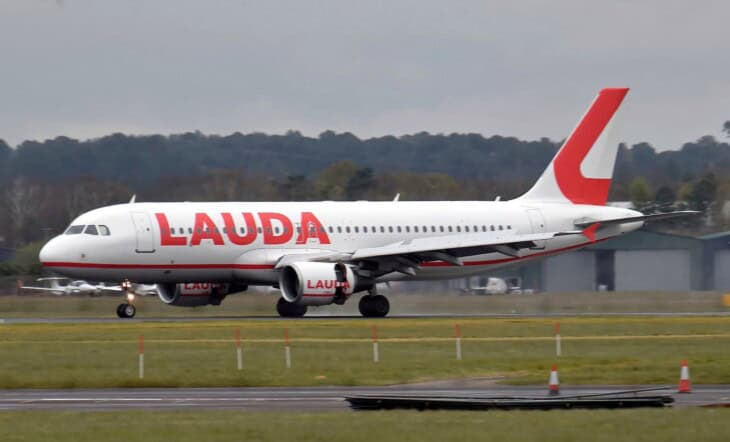
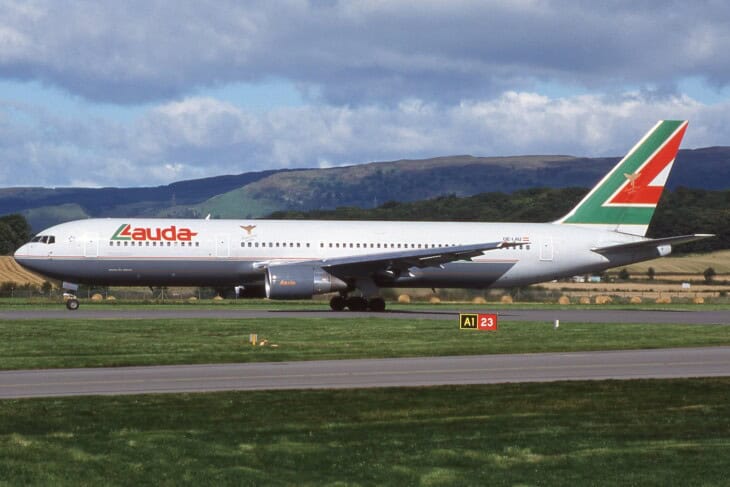
No driver has come close to Lauda’s involvement in aviation. He did not just own aircraft, he held an airline transport pilot licence and flew scheduled services as captain.
Lauda Air went bankrupt within three years of its 1979 launch, which forced him back into a race seat to fund it. He came out of retirement, won the 1984 title with McLaren, and used the money to rebuild the airline.
He founded two more carriers after Lauda Air: Niki in 2003 and LaudaMotion in 2016. He told The Guardian in 2004 that he still captained Niki flights at least twice a week.
Lauda Air Flight 004
On May 26, 1991, a Lauda Air Boeing 767-300ER broke up over Thailand after an uncommanded thrust reverser deployment in the climb, killing all 223 people on board. Lauda flew to the crash site, pushed publicly for answers, and took part in flight testing that proved the reverser deployment was unrecoverable. Boeing redesigned the thrust reverser locking system across the fleet as a result. It remains one of the clearest cases of an owner forcing a safety change on a manufacturer.
There is a strange footnote connecting Lauda to Hamilton. Between 2017 and 2018, Hamilton’s Challenger 605 spent roughly 22 months on the Austrian register as OE-IXI, operating with LaudaMotion.
Lauda is also the reason the grid’s list of celebrity pilots has an unbeatable entry at the top. No current driver holds a commercial licence.
Fuel Burn Across the F1 Fleet
The aircraft on this list span a factor of three in fuel consumption, which is a bigger spread than the sport’s own emissions debate usually acknowledges.
Typical cruise fuel burn by type, drawn from operator and manufacturer figures. Real-world numbers vary with weight, altitude, and stage length.
Split three ways, the CJ4 that carried Norris, Piastri and Russell to Spa burned roughly 47 gallons per hour per driver. Verstappen’s Falcon 8X flown alone burns about 340.
Formula 1 itself reported a 35% cut in its total carbon footprint against a 2018 baseline in June 2026, having removed almost 80,000 tonnes of CO2 equivalent from its operations in eight years. Travel emissions specifically fell 27%, or more than 21,000 tonnes.
Those figures cover the sport’s own freight, logistics and broadcast operations rather than what drivers do on their own time. Personal aviation is the part of the ledger that nobody publishes.
How They Are Getting to Zandvoort
The Dutch Grand Prix on August 21 to 23, 2026 is the last one Zandvoort will hold for the foreseeable future, and it carries the first F1 sprint ever run on Dutch soil.
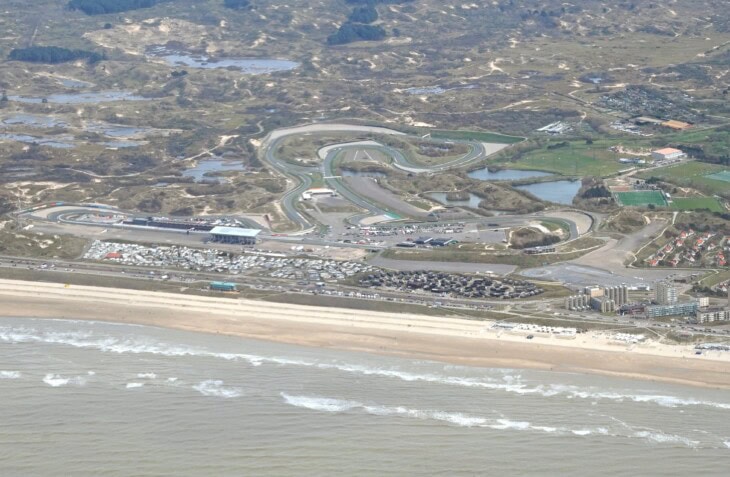
It is also Verstappen’s home race, on a weekend where he sits sixth in a championship led by Kimi Antonelli with Lewis Hamilton second for Ferrari. He has won at Zandvoort three times.
PH-UTL has flown into the Dutch GP before, and Zandvoort is one of very few races where the sport’s most expensive driver-owned jet has almost no distance to cover. Amsterdam Schiphol is 20 miles (32 km) from the circuit.
That is the quiet joke of F1 private aviation. The aircraft with 6,450 nautical miles of range spends a good part of its year on legs a car could manage.
How F1 Compares to Other Sports
Formula 1 has the most demanding travel calendar in professional sport and the lowest rate of aircraft ownership among its stars. That combination is unusual.
Cristiano Ronaldo owns a Gulfstream G650 worth around $75 million and Lionel Messi owns a Gulfstream V, on a football calendar that rarely leaves one continent in a season. Among athletes with private jets, footballers and basketball players out-own drivers by a wide margin.
The closest parallel is stock car racing, where the schedule is dense but domestic, and where NASCAR drivers with private jets tend to buy smaller, cheaper aircraft such as the Citation CJ series and the Learjet 60.
One reason is structural. F1 teams and sponsors move drivers as a matter of course, so a driver who owns nothing still never queues at a gate, a convenience gap explored in our comparison of private jet vs first class travel.
The other is manufacturer preference. Dassault has an unusually strong hold on this grid, which is uncommon in a market otherwise dominated by Gulfstream and Bombardier, as our guide to the best private jet manufacturers lays out.
FAQ
Sources and references used for research and fact-checking.
- Kym Illman, F1 Drivers' Luxury Private Jets at the Belgian Grand Prix
- Simple Flying, Max Verstappen's Dassault Falcon 8X
- Flying Insight, Max Verstappen puts private jet up for sale
- PlanetF1, Seven incredible private jets owned by F1 drivers
- Jet Finder, Formula 1 Drivers That Own Private Jets
- SuperYachtFan, Lance Stroll: Net Worth and Private Jet
- Pure Luxe, Billionaire Lawrence Stroll takes delivery of an $80 million private jet
- Simple Flying, From The Racetrack To The Runway: Niki Lauda And His Airlines
- Formula 1, Formula 1 on track to meet Net Zero 2030 target as it reports a 35% reduction in its carbon footprint
- ESPN, Dutch Grand Prix 2026: Race start time, how to watch, full schedule
- Forbes, F1 Standings 2026 After The Hungarian Grand Prix
- General Motors, Cadillac Formula 1 Team Unites F1 Stars to Launch 2026 Campaign
Get the Newsletter
The latest aviation news and stories sent to your inbox.
About the Author

Tim is the owner and lead editor of AeroCorner since 2019, overseeing aviation content covering aircraft, airlines, airports, and the broader aviation industry. Through years of researching, writing, editing, and publishing aviation-focused content, he has developed extensive practical knowledge of commercial aviation and air travel. Based in Asia and a frequent traveler himself, Tim also brings firsthand passenger experience to AeroCorner’s coverage. Outside of publishing, he has also explored aviation firsthand through hands-on flight training in New Zealand.