

Table of Contents
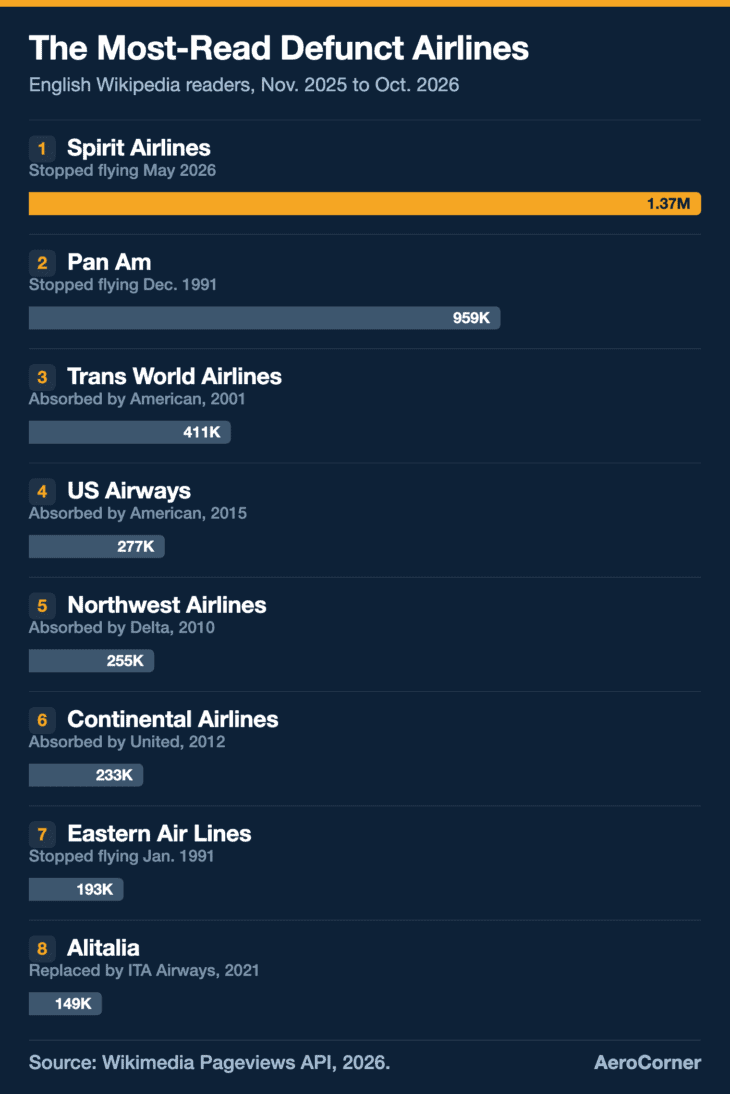
The most famous defunct airline right now is Spirit Airlines, which stopped flying on May 2, 2026, and drew 1,366,930 English Wikipedia readers in the 12 months to October 2026. Pan Am, gone since December 1991, is a clear second with 958,946.
This list ranks 15 airlines that no longer fly under their own name by how many people still look them up. Each entry gives when the airline started, when it stopped, and whether it collapsed or was swallowed by a rival, as of November 2026.
The split is the surprise. Seven of the 15 ran out of money and stopped flying, seven were merged into bigger airlines, and one, Alitalia, handed its whole operation to a new state carrier.
| Rank | Airline | Readers (12 months) | Years flying | How it ended |
|---|---|---|---|---|
| 1 | Spirit Airlines | 1,366,930 | 1983 to 2026 | Shut down |
| 2 | Pan Am | 958,946 | 1927 to 1991 | Shut down |
| 3 | Trans World Airlines (TWA) | 410,831 | 1930 to 2001 | Bought by American |
| 4 | US Airways | 276,547 | 1939 to 2015 | Merged with American |
| 5 | Northwest Airlines | 255,050 | 1926 to 2010 | Merged with Delta |
| 6 | Continental Airlines | 232,697 | 1934 to 2012 | Merged with United |
| 7 | Eastern Air Lines | 192,652 | 1926 to 1991 | Shut down |
| 8 | Alitalia | 148,892 | 1947 to 2021 | Operation sold to ITA Airways |
| 9 | BOAC | 138,982 | 1940 to 1974 | Merged into British Airways |
| 10 | Jet Airways | 138,642 | 1993 to 2019 | Shut down |
| 11 | Swissair | 125,826 | 1931 to 2002 | Shut down |
| 12 | Braniff International | 118,497 | 1928 to 1982 | Shut down |
| 13 | Lauda Air | 115,934 | 1979 to 2012 | Merged into Austrian Airlines |
| 14 | Kingfisher Airlines | 105,870 | 2005 to 2012 | Shut down |
| 15 | AirTran Airways | 83,495 | 1993 to 2014 | Bought by Southwest |
How this ranking works
Every airline here has stopped flying under its own name. We counted English Wikipedia readers for each one from November 2025 to October 2026, people only with bots excluded, and added the views of redirect titles such as TWA. Spirit’s count includes six months when it was still flying, so it partly measures the collapse as news. Airlines whose brand has since been restarted by a new owner, such as Mexicana, were left out.
1. Spirit Airlines (1983 to 2026)
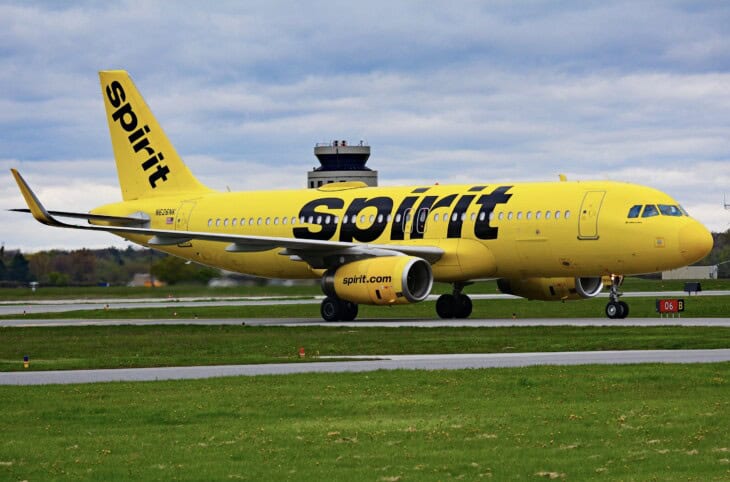
Spirit is the newest airline on this list and the most read. It started life in 1964 as a trucking company, moved into charter flights in 1983 and took the Spirit name in 1992.
It built the American ultra-low-cost model of cheap base fares plus fees for almost everything else, and by 2023 it was the seventh-largest passenger carrier in North America. Then a federal judge blocked its merger with JetBlue in January 2024, and Spirit filed for Chapter 11 in November 2024 and again on August 29, 2025.
Bailout talks with the federal government collapsed, and Spirit announced it was stopping all flights on May 2, 2026. Its last flight, from Detroit, landed at Dallas-Fort Worth shortly after midnight that day; our explainer on who owns Spirit Airlines now follows what happened to the company after the planes stopped.
May 2 keeps coming up
Spirit stopped flying on May 2, 2026. Continental and United announced their merger on May 2, 2010, and Southwest completed its purchase of AirTran on May 2, 2011. Three of the airlines on this list met their end, or the deal that ended them, on the same date.
2. Pan Am (1927 to 1991)

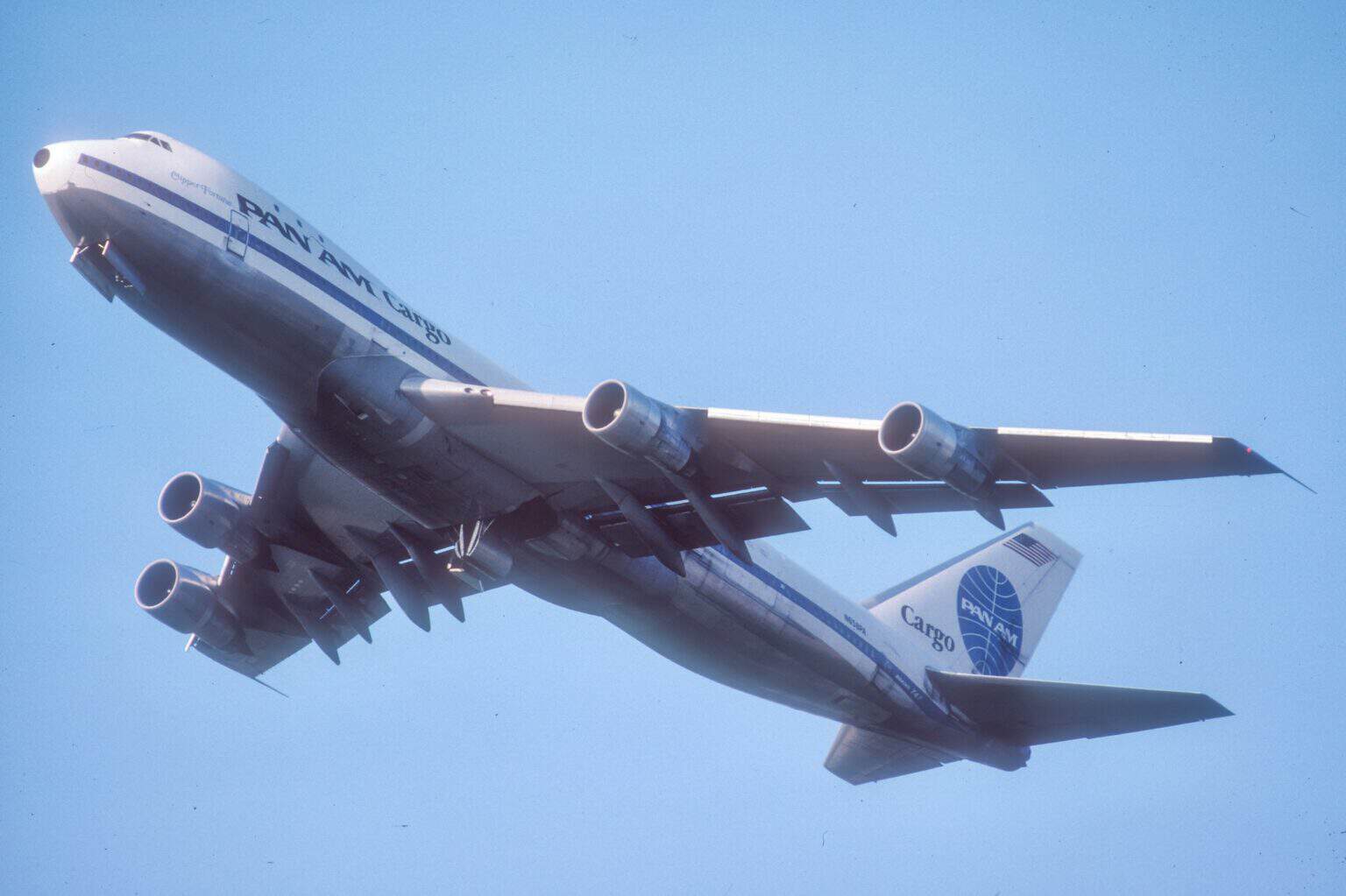
Pan American World Airways began in 1927 carrying mail and passengers between Key West, Florida, and Havana, Cuba. Under Juan Trippe it became the largest international airline for much of the 20th century, and in 1970 it flew 11 million passengers to 86 countries.
It led the jet age with the Boeing 707 and the Boeing 747-100, and its blue globe logo remains a cultural icon. What broke it was the bombing of Pan Am Flight 103 over Lockerbie, Scotland, on December 21, 1988, which killed 270 people and whose fallout led to the airline’s bankruptcy.
Pan Am filed for bankruptcy on January 8, 1991, and stopped flying on December 4, 1991, after Delta declined to make a final payment under its rescue deal. The full story is in our piece on what happened to Pan Am.
3. Trans World Airlines (1930 to 2001)
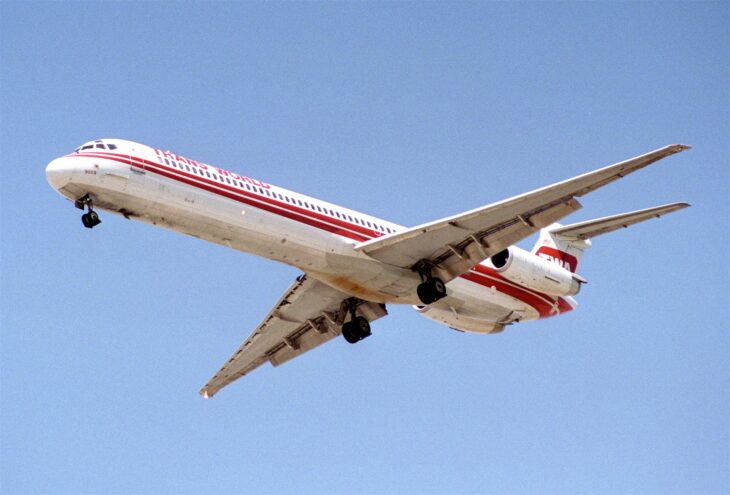

TWA began in 1930 as Transcontinental and Western Air, flying Ford Trimotors coast to coast. Howard Hughes held a controlling stake by 1944 and pushed it into Europe, the Middle East and Asia, making it a second, unofficial US flag carrier after Pan Am.
Carl Icahn’s 1988 leveraged buyout left the airline buried in debt, and it went through Chapter 11 in 1992 and 1995. The loss of TWA Flight 800 in 1996 added to the strain.
American Airlines bought TWA in 2001, and TWA filed for bankruptcy a third time as part of the deal. The last TWA flight flew on December 1, 2001; our article on what happened to TWA covers the sale in detail.
4. US Airways (1939 to 2015)
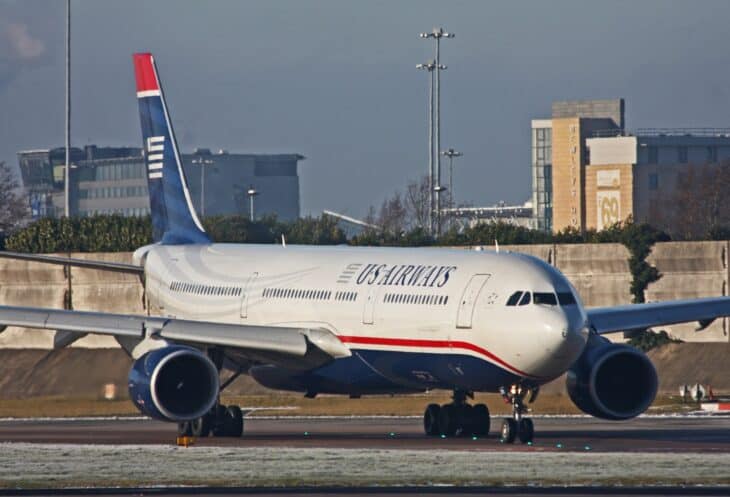

US Airways started in Pittsburgh in 1939 as All American Aviation, a mail carrier, became Allegheny Airlines in 1953 and USAir in 1979. It absorbed Piedmont and Pacific Southwest Airlines and took the US Airways name in 1997.
It filed for Chapter 11 in 2002 and again in 2004, and in 2005 the smaller America West took it over in a reverse merger while keeping the US Airways name. In 2013 it merged with American Airlines, and the FAA issued the two a single operating certificate on April 8, 2015.
The final US Airways flight was numbered 1939, for the founding year. It left Philadelphia on October 16, 2015, and landed in San Francisco as American Airlines Flight 1939.
5. Northwest Airlines (1926 to 2010)
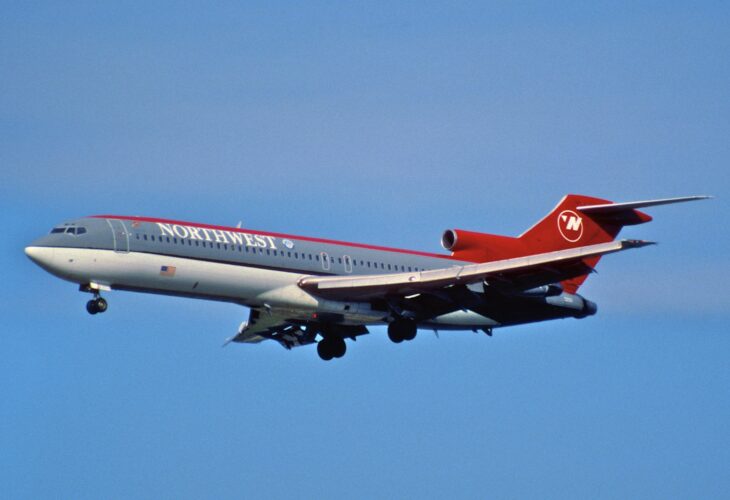

Northwest started flying in 1926, was later headquartered beside Minneapolis-Saint Paul airport and, after World War II, came to dominate flights across the Pacific from its Tokyo hub. It carried 5.1 million passengers across the Pacific in 2004, more than any other US airline.
Northwest filed for Chapter 11 on September 14, 2005, the first bankruptcy in its 79 years. Delta announced a merger on April 14, 2008, it was approved that October, and the combined airline became the largest in the world until American and US Airways joined in 2013.
6. Continental Airlines (1934 to 2012)

Continental began in 1934 as Varney Speed Lines and was one of three launch airlines for the Boeing 747 under its longtime boss Robert Six. Texas International took control in 1981, and Continental went through Chapter 11 in 1983, restarting three days later with 25 cities instead of more than 70.
It recovered to become one of the more successful US airlines, and on May 2, 2010, it announced an $8.5 billion merger with United. United kept its own name but took Continental’s operating certificate and globe livery, so United’s globe logo came from Continental.
The two flew under a single certificate from November 30, 2011, and the integration finished on March 3, 2012. The last Continental flight took off from Phoenix and landed in Cleveland as United Flight 1267.
7. Eastern Air Lines (1926 to 1991)
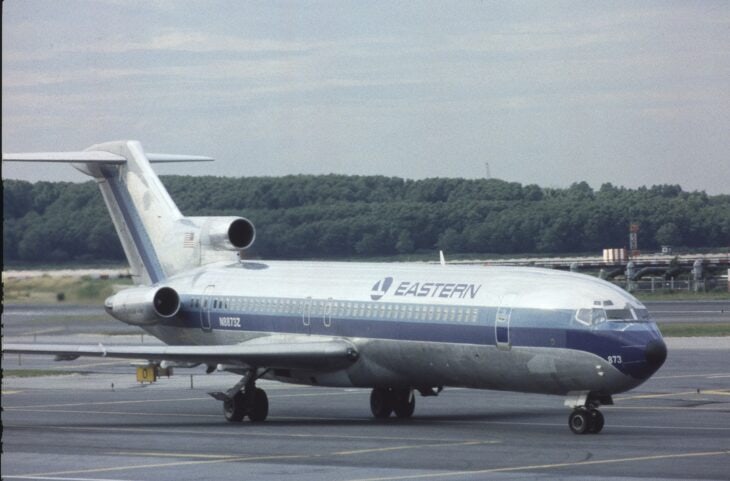

Eastern began in 1926 as Pitcairn Aviation and was run in its early decades by the World War I ace Eddie Rickenbacker. It held a near monopoly on New York to Florida flights for two decades and started the hourly Eastern Air Lines Shuttle between New York, Washington and Boston in 1961.
Frank Lorenzo bought Eastern in 1985 and moved assets to his other airlines, including Continental. A lockout of the mechanics on March 4, 1989, turned into a strike that pilots and flight attendants joined, and the airline never recovered.
Eastern stopped flying in January 1991 and was liquidated, with American taking many of its Latin America routes from Miami. Its best-known legacy in safety is Eastern Air Lines Flight 401, the 1972 crash behind the ground proximity warnings on every airliner.
8. Alitalia (1947 to 2021)

Alitalia flew its first service in 1947 and was Italy’s flag carrier for more than 70 years. It was owned by the Italian government until it was privatized in 2009, lost money as a private company, and entered extraordinary administration in 2017.
The government took it back in March 2020. Alitalia flew for the last time on October 15, 2021, the day it sold its whole operation to ITA Airways, a new state-owned airline.
9. BOAC (1940 to 1974)
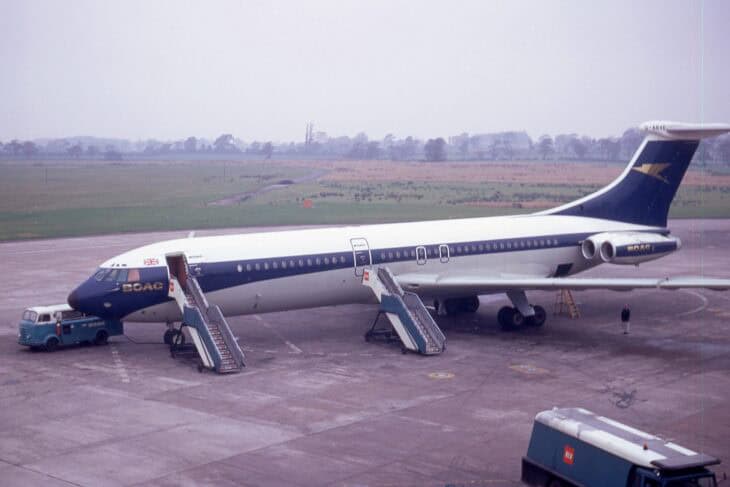

British Overseas Airways Corporation was formed in 1939 from Imperial Airways and British Airways Ltd, began flying in April 1940 and kept long-haul services running through World War II. In May 1952 it became the first airline to put a passenger jet, the de Havilland Comet, into service.
That lead did not last: every Comet 1 was grounded in April 1954 after a series of crashes. BOAC did not fail, though. It was merged with British European Airways under the Civil Aviation Act 1971, and on March 31, 1974, the two became today’s British Airways.
10. Jet Airways (1993 to 2019)
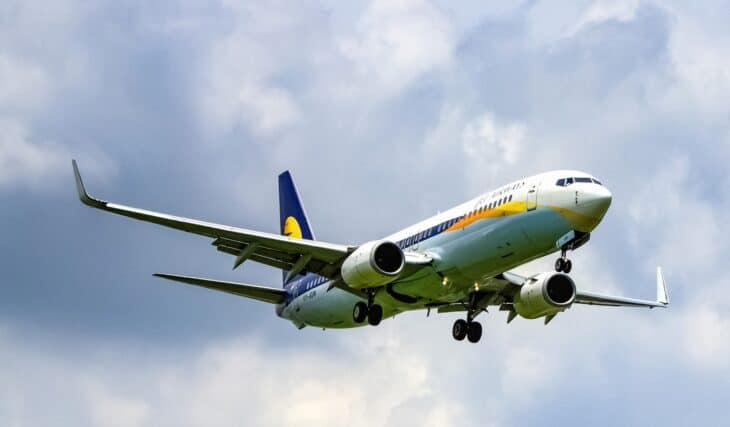

Jet Airways started in 1993 and grew into one of India’s largest airlines, with 21.2% of the domestic market in February 2016 and more than 300 daily flights at its peak. Low-cost rivals IndiGo and SpiceJet pushed fares down, and Jet lost first place to IndiGo in October 2017.
It stopped flying on April 17, 2019. A plan to restart under new owners kept slipping, and on November 7, 2024, the Supreme Court of India ordered the company liquidated, ending any chance of a comeback.
11. Swissair (1931 to 2002)

Swissair was so financially solid for most of its 71 years that it was nicknamed the “Flying Bank.” Its late-1990s “Hunter Strategy” of buying stakes in smaller airlines overstretched it, and the crash of Swissair Flight 111 in September 1998 killed all 229 people aboard.
After the downturn that followed the September 11 attacks, the cash ran out and the fleet was grounded in October 2001, the same crisis that finished off the US airlines that disappeared after 9/11.
The Swiss government kept it flying until March 31, 2002, and its last flight landed in Zurich from Sao Paulo on April 1, 2002, the day its regional arm Crossair became Swiss International Air Lines.
12. Braniff International (1928 to 1982)

Braniff flew from 1928, mostly across the Midwest, the Southwest and Latin America, and became famous in the 1960s and 1970s for its Emilio Pucci uniforms. It took delivery of the 100th Boeing 747 built in 1970.
In the late 1970s it expanded into Europe and Asia, then ran into high fuel prices, high interest rates and new competition after the 1978 deregulation of US airlines. On May 12, 1982, its flights at Dallas-Fort Worth were grounded that morning and passengers were told Braniff was no longer flying.
13. Lauda Air (1979 to 2012)
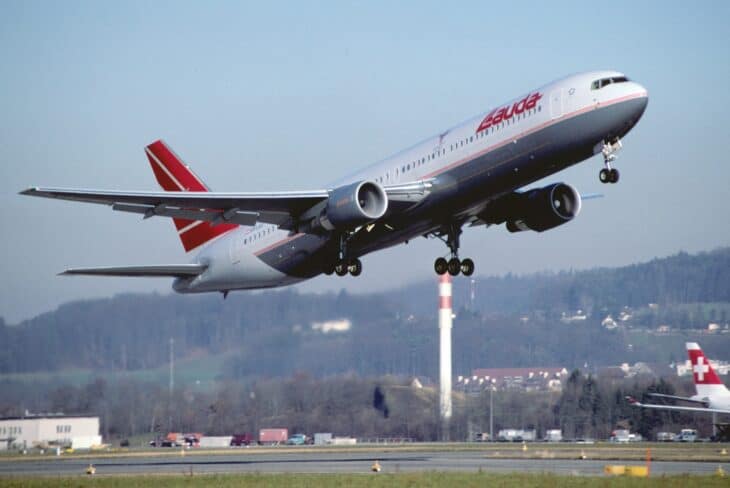

Formula One world champion Niki Lauda founded Lauda Air in April 1979 with two Fokker F27s, and it grew into a long-haul airline based at Vienna. On May 26, 1991, Lauda Air Flight 004, a Boeing 767-300ER, crashed in Thailand after takeoff from Bangkok, killing all 223 people aboard.
Austrian Airlines later took the airline over and merged it in on July 1, 2012. The name disappeared on April 6, 2013, when Austrian replaced it with its Austrian myHoliday brand.
14. Kingfisher Airlines (2005 to 2012)
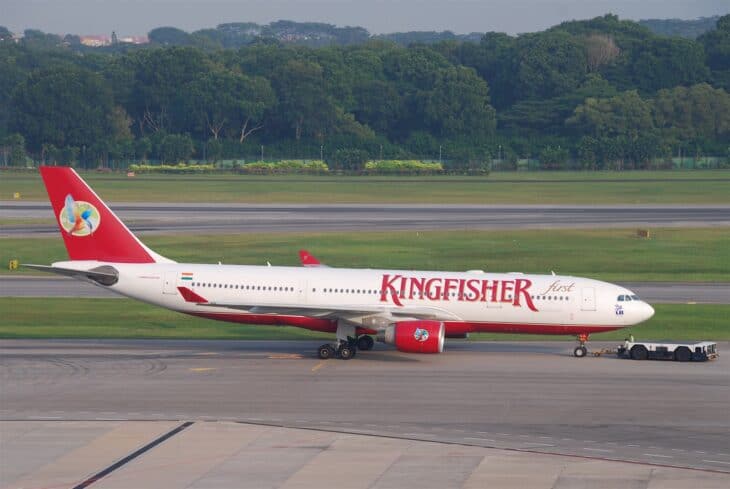

Kingfisher, the airline of the United Breweries Group led by Vijay Mallya, started flying in 2005 and had the second-largest share of India’s domestic market until December 2011. It lost money from its first year to its last.
By early 2012 it had lost more than ₹70 billion (about $750 million), half its fleet was grounded and unpaid staff were on strike. India’s aviation regulator suspended its license, and Kingfisher stopped flying on October 20, 2012.
15. AirTran Airways (1993 to 2014)
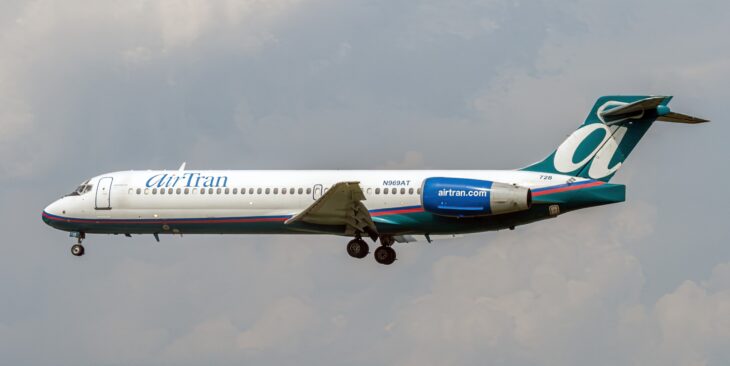

AirTran began in 1993 as Conquest Sun Airlines and merged with the troubled ValuJet in 1997, taking the AirTran name. From its Atlanta hub it ran nearly 700 daily flights and was the world’s largest operator of the Boeing 717.
Southwest bought AirTran on May 2, 2011, and folded it in gradually. AirTran’s last revenue flight operated on December 28, 2014.
The next five, and the ones people remember differently
Just outside the top 15 are Canadian Airlines (83,372 readers), Ansett Australia (80,916), Pacific Southwest Airlines (75,858), Sabena (73,979) and Olympic Airlines (73,128). Germanwings, Virgin America, America West and Air Berlin all drew between 56,000 and 63,000.
Some well-known names rank lower than their reputation suggests. Monarch Airlines drew 52,203 readers and Wow Air 31,269, People Express, whose story is told in what happened to People Express, did not make the readership cut at all.
Isn't Pan Am coming back?
Not as the same airline. The current owner of the Pan Am brand has partnered with the consultancy AVi8 Air Capital to study a possible relaunch, but as of November 2026 it has not announced a start date for scheduled flights. A new airline under an old name is a new company: the Pan Am that flew the 747 ended in December 1991. Braniff shows how this goes: two later airlines used its name, in 1983 to 1989 and 1991 to 1992, and neither was the original.
For airlines that have survived since the 1920s and are still flying, see our list of the oldest airlines in the world.
FAQ
Sources and references used for research and fact-checking.
- Wikimedia Foundation, Pageviews API
- NPR, Spirit Airlines ceases operations after escalating financial struggles
- Wikipedia, Spirit Airlines
- Wikipedia, Pan Am
- Wikipedia, Trans World Airlines
- Wikipedia, US Airways
- Wikipedia, Northwest Airlines
- Wikipedia, Continental Airlines
- Wikipedia, Eastern Air Lines
- Wikipedia, Alitalia
- Wikipedia, British Overseas Airways Corporation
- Wikipedia, Jet Airways
- Wikipedia, Swissair
- Wikipedia, Braniff International Airways
- Wikipedia, Lauda Air
- Wikipedia, Kingfisher Airlines
- Wikipedia, AirTran Airways
Get the Newsletter
The latest aviation news and stories sent to your inbox.
About the Author

Tim is the owner and lead editor of AeroCorner since 2019, overseeing aviation content covering aircraft, airlines, airports, and the broader aviation industry. Through years of researching, writing, editing, and publishing aviation-focused content, he has developed extensive practical knowledge of commercial aviation and air travel. Based in Asia and a frequent traveler himself, Tim also brings firsthand passenger experience to AeroCorner’s coverage. Outside of publishing, he has also explored aviation firsthand through hands-on flight training in New Zealand.