

Table of Contents
The entryway is the room that decides the mood before anyone even sits down. It is also the room most decor themes skip entirely, treated as a pass-through rather than a space worth designing. Aviation decor fits here more naturally than almost anywhere else in the house.
A hallway is already about arrival, departure, and movement between one place and another, the same story every flight tells. A porthole mirror, a suitcase side table, or a runway-stripe rug all carry that idea of a journey beginning, without ever feeling like a costume.
The 25 ideas below range from small swaps like hooks and doormats to bigger commitments like wallpaper and built-in benches. Mix a few that match the size of your entryway rather than trying to fit every idea into one narrow hall.
01. Round Airplane Window Porthole Mirror
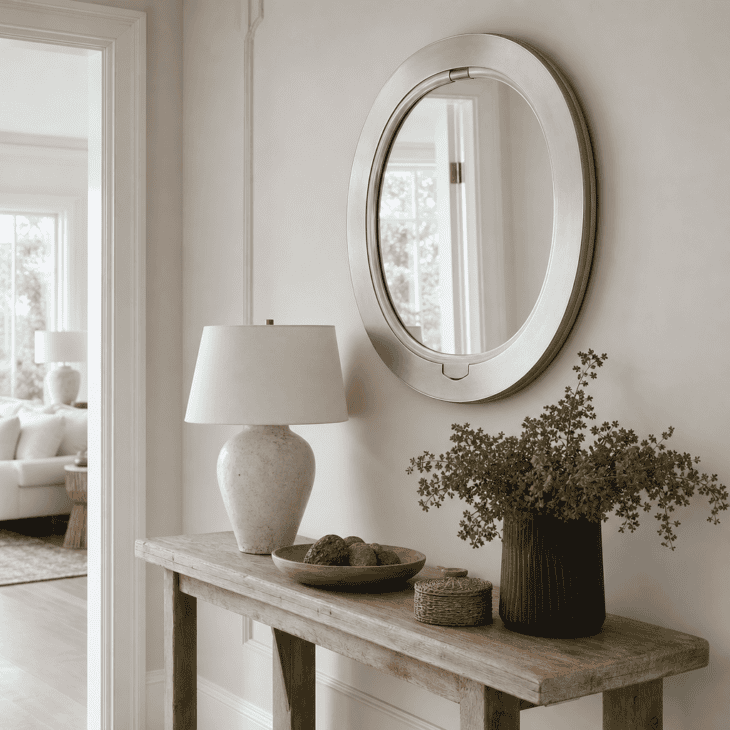
What it is A round mirror set inside a brushed aluminum or matte black frame with a narrow inner bezel and a small molded latch detail, sized to echo the scale of a real cabin window, typically 20 to 26 inches across. Most versions mount with a single hidden bracket like any standard wall mirror.
Why it works Every entryway benefits from a mirror for a last-glance check on the way out, so this idea upgrades a fixture the room already needs rather than adding pure decoration. The round porthole shape also breaks up a hallway full of rectangular frames and doorways, the same way it stands out on a stretch of aviation aviation wall art elsewhere in the house.
How to get it Search “airplane window mirror” or “porthole mirror” through home decor retailers and Etsy makers who build these to order in several diameters. Choose a convex mirror if you want the true cabin-window effect, or a flat mirror for a more practical, distortion-free check before heading out. Hang it at eye level for the average adult in the household, roughly 60 to 65 inches to the mirror’s center. A slightly recessed frame reads more authentic than a flush, flat surround.
02. Airport Split-Flap Departure Board Wall Clock
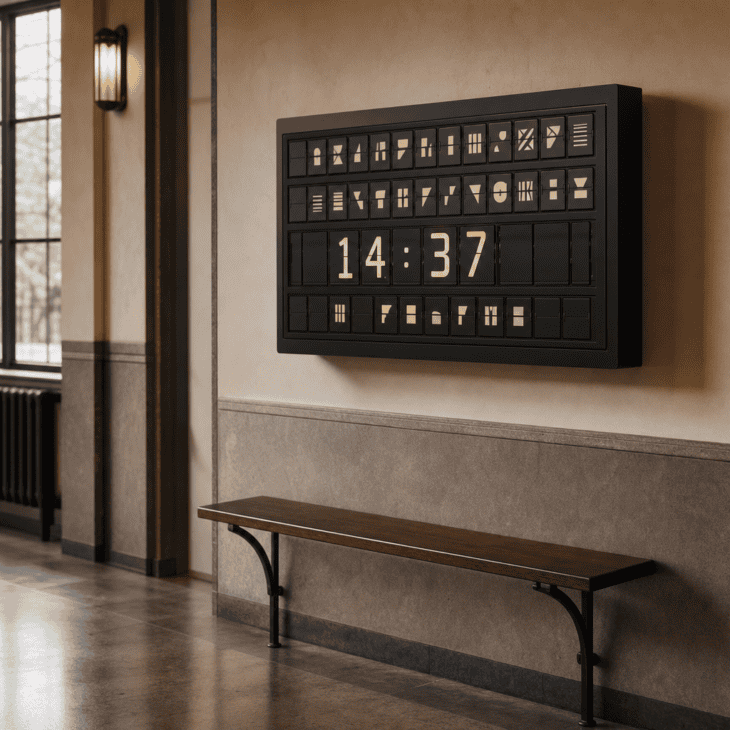
What it is A mechanical clock built from small flip tiles, housed in a matte black or brushed steel casing, that flips over with an audible click the way old airport and train station departure boards once did. Most tabletop and wall versions show only the time, not simulated flight listings.
Why it works Split-flap displays are one of the most instantly recognizable pieces of airport nostalgia, evoking the exact sound and motion of checking a gate number before a flight. Placed in a hallway, the periodic click also gives an otherwise silent pass-through space a small moment of mechanical life.
How to get it Several specialty clockmakers now sell reproduction split-flap clocks specifically marketed for home use, ranging from compact tabletop units to larger wall-mounted versions. Confirm the model runs on a quiet stepper motor if the entryway sits near a bedroom, since older mechanisms can be loud. Mount it at a height where the flip motion is visible in passing, roughly shoulder height. Battery or plug-in power both work; a plug-in version needs a nearby outlet planned into the hallway layout.
03. Vintage Stacked Suitcase Side Table
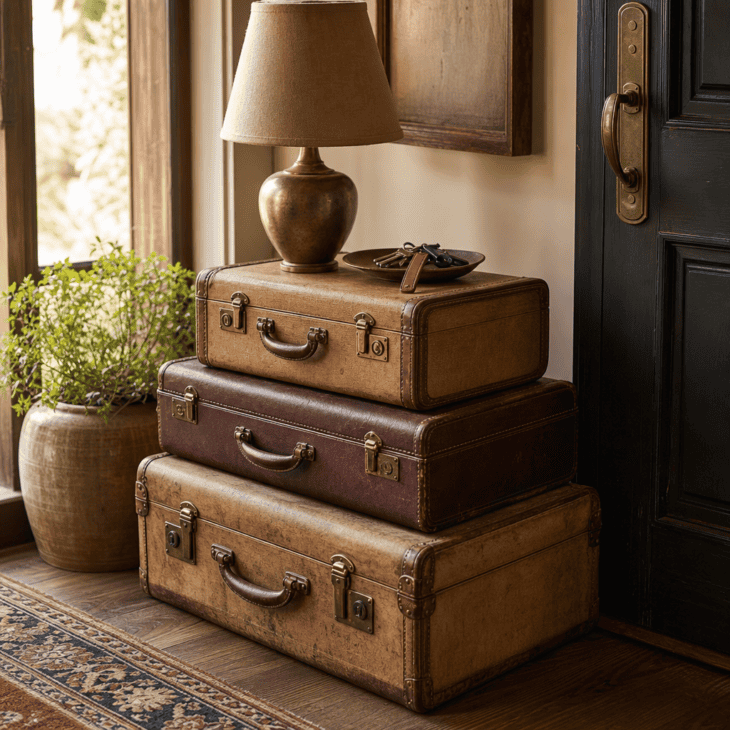
What it is Three vintage or reproduction hard-sided suitcases, graduating from largest at the bottom to smallest on top, secured with interior wood dowels or a bonding adhesive so the stack functions as a stable side table. A flat lacquered top disc finishes the surface for a lamp or dish.
Why it works A stacked-suitcase table turns storage into furniture, since the cases themselves can hold scarves, gloves, or off-season shoes behind their latches. The worn leather and canvas also bring genuine texture and history into an entryway, the kind of patina that matches well against vintage aviation decor used elsewhere in the home.
How to get it Estate sales, flea markets, and vintage luggage sellers on Etsy are the most reliable sources for authentic pieces with real wear. Choose suitcases with sturdy latches and intact handles if you plan to actually use the interior storage, not just display the stack. A furniture-safe adhesive or a set of hidden dowels keeps the stack from shifting when brushed against in a busy hallway. Wipe leather cases with a conditioning balm once or twice a year to keep them from drying out and cracking.
04. Runway Centerline Stripe Hallway Runner Rug
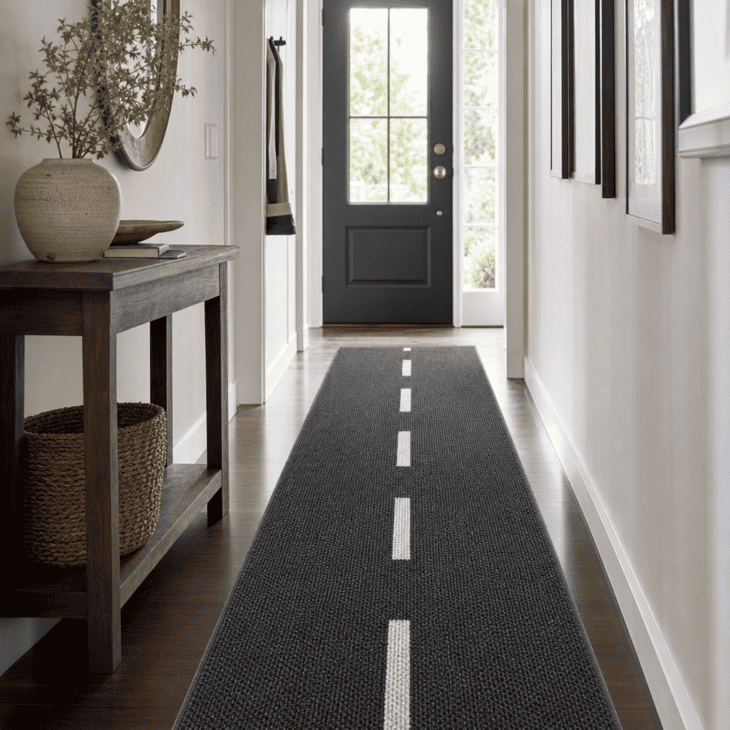
What it is A long, narrow woven runner printed with the broken centerline and edge markings of a runway strip, usually in charcoal grey and white on a low-pile, machine-washable base. Standard lengths run from 6 to 10 feet to fit most residential hallways.
Why it works A hallway already shares a runway’s long, narrow proportions, so the stripe pattern reads as an obvious fit rather than a forced theme. It also does the practical job any entry runner needs to do, since a bold graphic stripe hides scuffs and shoe marks far better than a solid pale color.
How to get it Search “runway stripe rug” or “airport runway runner” through home textile retailers, where the pattern now appears in several standard runner sizes. Measure the hallway length first and leave two to three inches of bare floor on each end for the cleanest look. Choose a rug with a non-slip backing for a hardwood or tile entryway. Machine-washable, low-pile options hold up best against daily foot and pet traffic near a front door.
05. Airplane Silhouette Wall Hooks for Coats and Bags
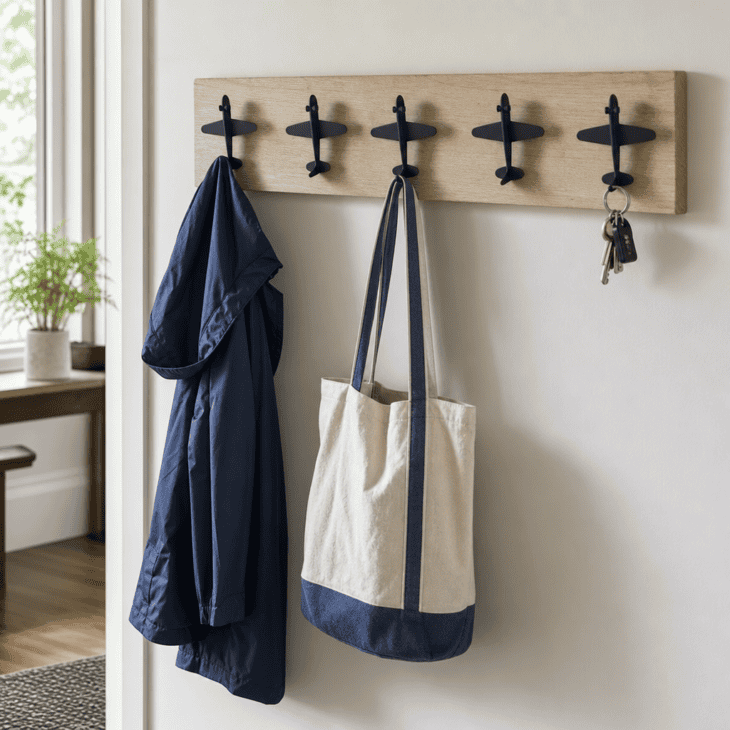
What it is A row of three to five matte black or brass metal hooks, each cast in the side-profile silhouette of a small propeller airplane, mounted individually or pre-fixed to a single light wood backing board. Weight ratings typically run from 5 to 10 pounds per hook, enough for coats and bags.
Why it works A hook rail is one of the hardest-working fixtures an entryway owns, and a silhouette shape gives that daily-use object a distinct identity without adding any bulk to a narrow hallway. Five identical airplane hooks in a row also read as a considered set rather than mismatched hardware.
How to get it Search “airplane wall hook” through home hardware retailers and Etsy metalworkers who cast these in small batches. Mount the backing board into wall studs, or use heavy-duty drywall anchors if studs do not line up with the hook spacing. Space individual hooks 6 to 8 inches apart so bulky winter coats do not overlap. A mixed row of two or three finishes, such as matte black and brass, adds visual interest without looking cluttered.
06. Vintage Airline Route Map Wallpaper Mural
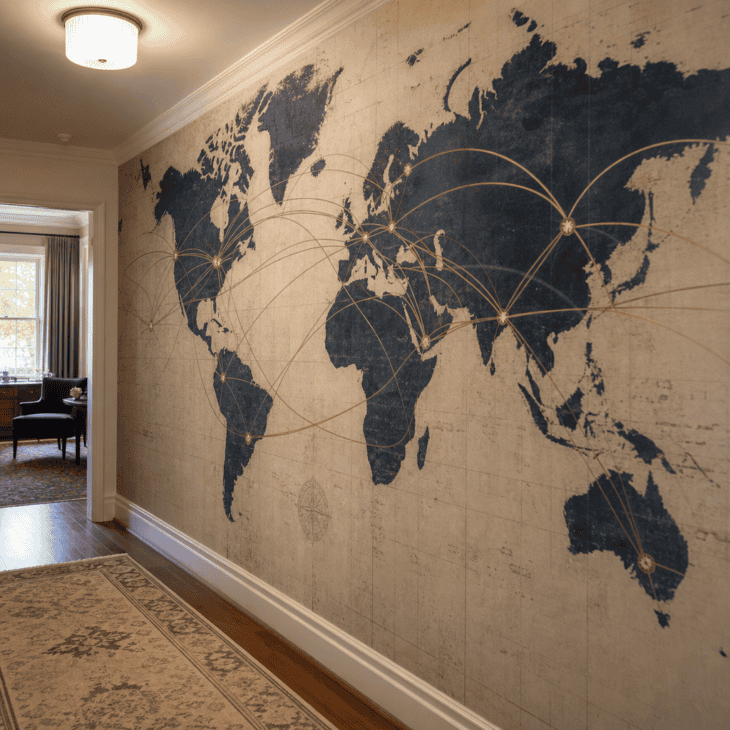
What it is A large-format wallpaper mural printed with a stylized, generic route-map graphic, arcing gold or cream flight-path lines set against a muted navy or sepia world outline with no readable city names. Most muralists print these as a multi-panel peel-and-stick set sized to a single accent wall.
Why it works A route map is one of aviation’s most graphic, sweeping images, and blown up to wall scale it turns a plain hallway into a genuine focal point instead of a corridor to walk past. Because the lines suggest distance and connection rather than a single destination, the mural also complements a nearby gallery wall of smaller framed pieces without competing with it.
How to get it Custom wallpaper services like Etsy print-on-demand muralists or specialty mural companies can size a route-map design to an exact wall measurement. Choose a peel-and-stick, removable adhesive if the home is rented or the design might change in a few years. Measure the wall width and height precisely before ordering, since most murals print as fixed panels that must align edge to edge. Reserve this idea for one accent wall only; a full hallway of mural paper can feel overwhelming in a narrow space.
One statement piece per wall
A route-map mural, a gallery wall, and a wayfinding sign set all compete for the same visual attention. Pick one bold statement per wall and let smaller accents like hooks and a doormat fill in the rest.
07. Propeller Blade Umbrella Stand
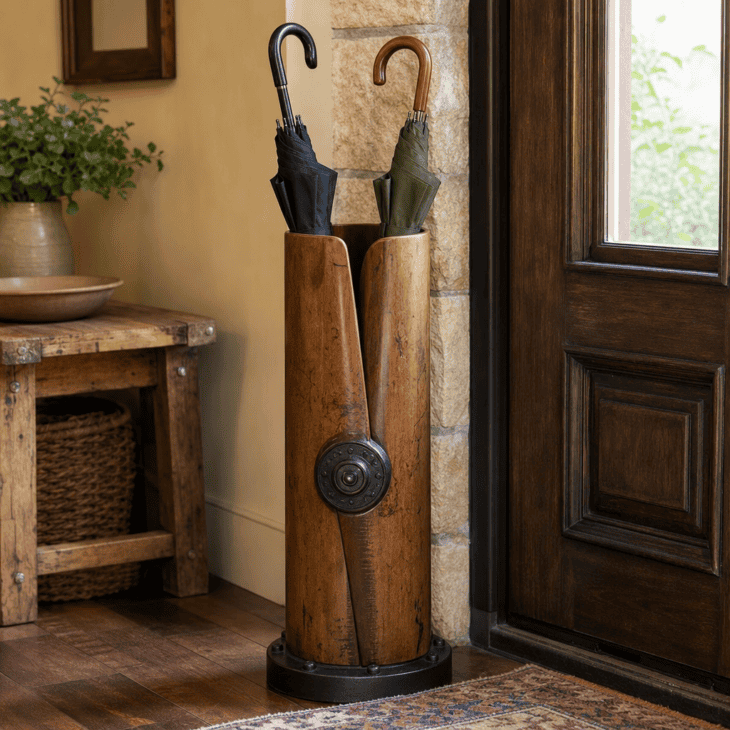
What it is A repurposed two-blade wooden propeller, one blade trimmed and hollowed to form a narrow vertical holder, mounted upright on a weighted round metal base wide enough to keep the whole piece stable. The holder typically fits four to six standard umbrellas.
Why it works An umbrella stand is a fixture most entryways already need, and a propeller shape turns that purely practical object into a genuine conversation piece rather than a plain ceramic cylinder. The tall, narrow profile also fits well against a wall in even a tight hallway, without eating into walking space.
How to get it A handful of aviation-salvage furniture makers build these to order from reclaimed wooden propellers, or a woodworker can adapt a decorative propeller blade with a drilled holder insert. Confirm the base is weighted enough to prevent tipping when umbrellas are added or removed. Choose a water-resistant liner insert if the household regularly stores wet umbrellas, to protect the wood finish. Position it within arm’s reach of the door rather than tucked into a corner, so it actually gets used.
08. Wing-Shaped Floating Console Table
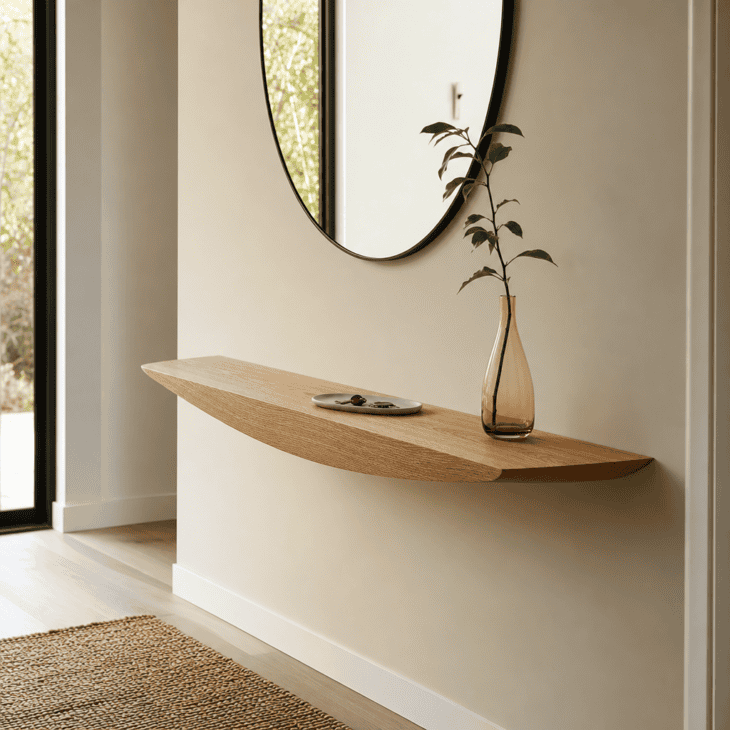
What it is A slim wall-mounted console table, its surface tapered at both ends into a shallow curve that suggests an airplane wing, built in light oak, walnut, or powder-coated steel. Hidden wall brackets carry the weight, so no legs interrupt the floor beneath it.
Why it works A floating console solves the real problem of a narrow entryway, where a legged table can block passage or catch a passing hip. The wing taper also gives an otherwise plain shelf a clear design point of view, especially useful as a landing spot near a home office decor scheme that continues down the hall.
How to get it Custom furniture makers and a handful of modern design retailers now sell tapered floating consoles, or a carpenter can shape a standard floating shelf to a wing profile. Confirm the wall brackets are rated for the combined weight of the table plus whatever sits on it, generally 30 to 50 pounds for a shelf this size. Mount into studs wherever possible rather than relying on anchors alone. Keep the surface styling minimal, a tray and one small object, so the wing shape stays the visual focus.
09. Repurposed Airport Luggage Cart Entry Table
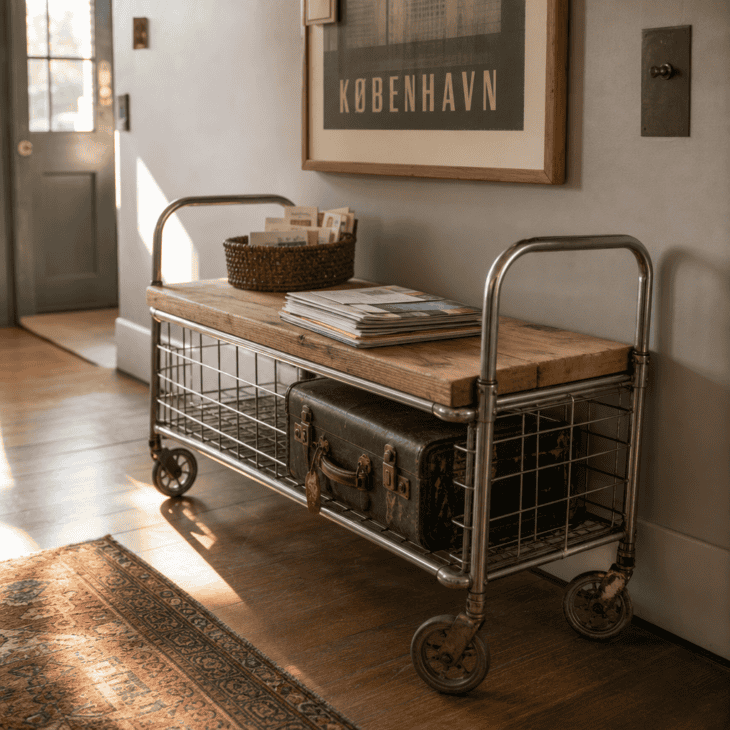
What it is A vintage chrome-and-wire airport luggage cart, its flat wire bed fitted with a cut wood or tempered glass panel to create a stable, usable table surface, wheels kept intact for the industrial look. Most retired carts stand between 30 and 34 inches tall, close to standard console height.
Why it works A luggage cart carries real airport provenance in a way a reproduction piece never quite matches, and its open wire structure keeps a narrow hallway from feeling visually heavy. The rolling wheels also add genuine function, letting the table shift out of the way during a move or a party, the same easy mobility prized in aviation home bar ideas built around rolling carts.
How to get it Airport surplus auctions, industrial salvage dealers, and vintage furniture sellers occasionally list retired luggage carts, though supply is limited and prices vary widely by condition. A local glass shop can cut a panel to fit the wire bed’s exact dimensions for a clean, wobble-free surface. Lock the caster wheels if the cart will sit in place most of the time. Wipe chrome regularly with a metal polish to prevent surface rust from indoor humidity.
10. Boarding Pass Print Wall Art Strip
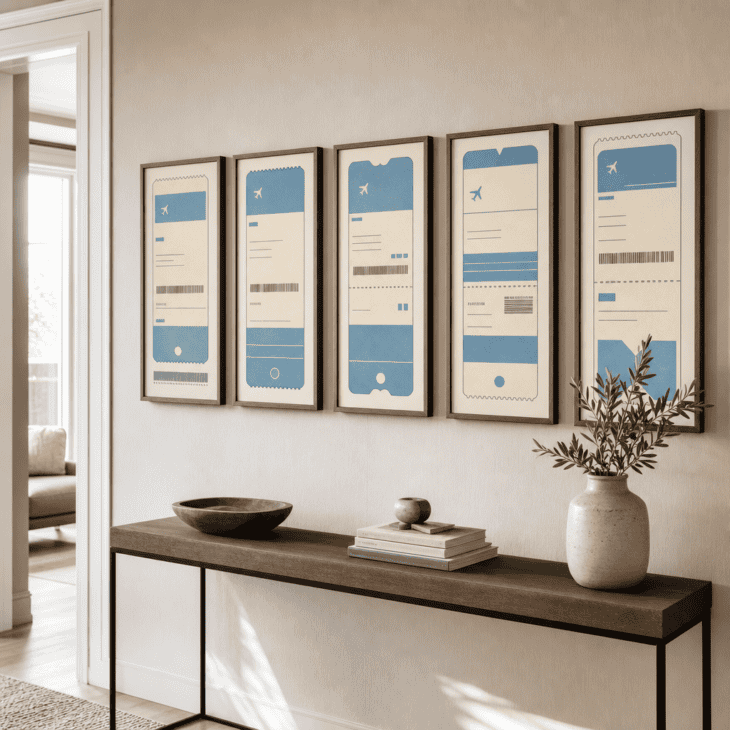
What it is A set of four to six slim framed prints, each styled after the color blocking and perforated stub shape of a vintage boarding pass, hung in a single straight horizontal line rather than a clustered grid. Frames typically measure a narrow 5 by 12 or 6 by 15 inches to suit the elongated ticket shape.
Why it works A hallway’s long, uninterrupted wall is one of the few places in a house built for a horizontal line, and a boarding-pass strip fills that space without needing a large single artwork. The repeated ticket shape also creates rhythm as someone walks past, more like a sequence than a static display.
How to get it Search “boarding pass print set” through print-on-demand art shops and framing retailers, many of which sell these specifically as matched sets. Use a laser level to keep the horizontal line straight across an uneven hallway wall. Space frames 3 to 4 inches apart for a tight, graphic rhythm. Choose a slim matte black or brass frame so the color blocking inside stays the focus.
11. Brass Compass Rose Inlay Doormat
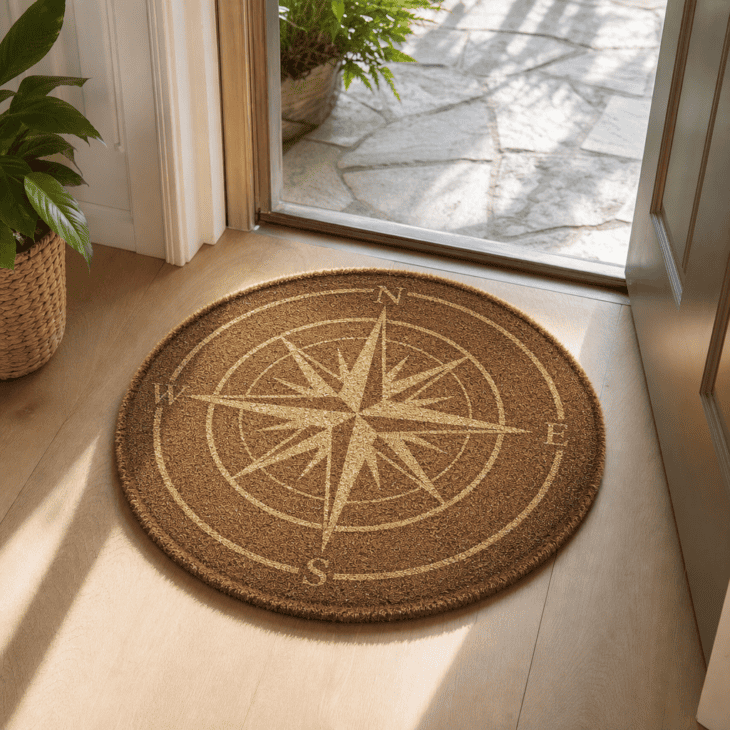
What it is A round or oval coir doormat woven with a compass rose pattern in a brass or gold-toned fiber against a natural tan background, sized for placement just inside the threshold rather than outside where weather would wear it down. Standard diameters run 24 to 30 inches.
Why it works A compass rose is navigation’s original wayfinding symbol, and placed at the exact point where a household sets out each day, it carries real symbolic weight without needing an aircraft in sight. The round shape also breaks up a hallway of straight rug edges and rectangular furniture.
How to get it Search “compass rose doormat” or “nautical compass rug” through home decor retailers, since the pattern crosses over from nautical decor and is more widely available than aviation-specific designs. Choose a rubber-backed mat to prevent sliding on hardwood or tile. Coir fibers do best kept indoors, just past the threshold, since direct rain exposure shortens their lifespan. Shake it out weekly and vacuum on a low-suction setting to keep the woven pattern crisp.
12. Aviator Key and Sunglasses Catch-All Tray
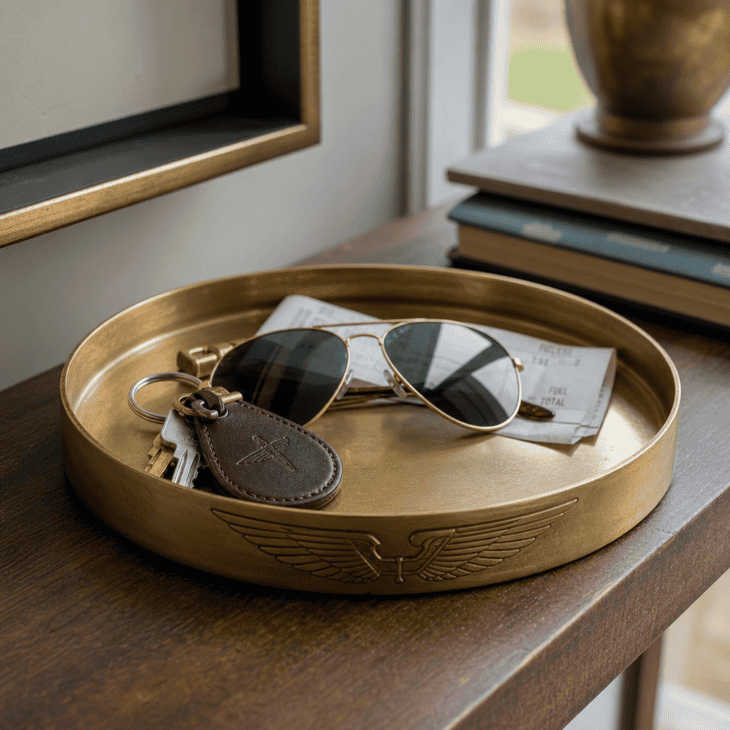
What it is A shallow round or oval tray in brushed brass or matte black, roughly 6 to 8 inches across, with a subtle embossed aircraft-wing or propeller motif pressed into the rim. Most sit directly on a console table or floating shelf with no mounting required.
Why it works Every household loses a set of keys eventually, and a dedicated tray by the door is one of the simplest fixes, especially useful sitting beside a stack of gifts for aviation lovers waiting to be handed off. The subtle wing detail keeps the theme present without turning a small, everyday object into a costume piece.
How to get it Search “aviation catch-all tray” or “wing embossed dish” through home decor shops and independent metalworkers on Etsy, who often offer several finish options. Choose brass or gold-toned finishes for a warmer entryway palette, or matte black for a more modern look. A slightly raised rim keeps small items like coins and rings from sliding off when the tray is bumped. Position it at the exact spot where household members naturally pause, usually beside the door or on the console.
13. Vintage Airline Luggage Tag Gallery Wall
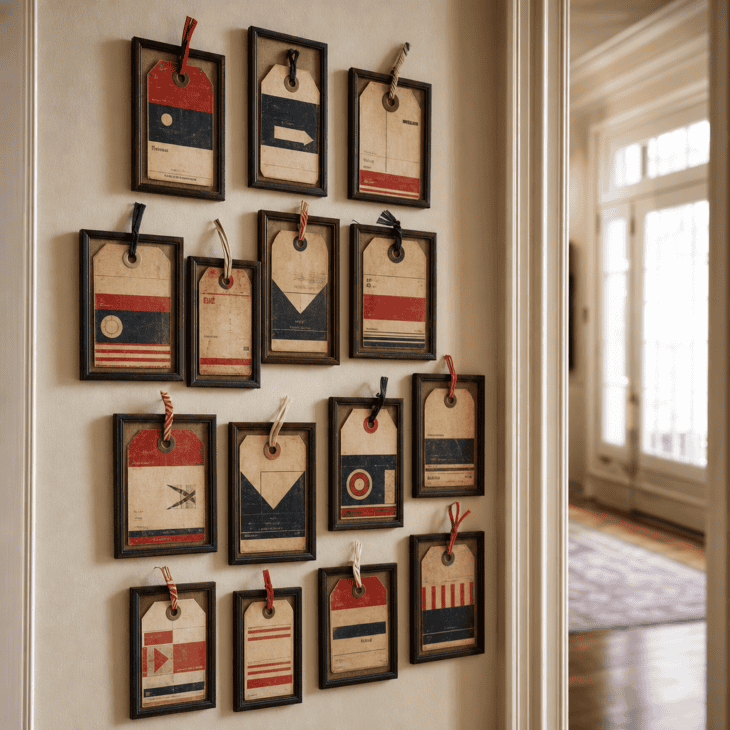
What it is A collection of eight to twelve small vintage or reproduction luggage tags, each roughly 2 by 4 inches with a punched hole and short ribbon loop, individually framed in slim shadow boxes and arranged in a loose, organic cluster rather than a strict grid. Faded cream, red, and navy tones dominate most authentic sets.
Why it works Luggage tags are small, personal objects with real travel history attached to them, and grouped together they read as a collected archive rather than a single mass-produced print. The loose cluster arrangement also suits a narrow hallway better than a large single canvas, since it can wrap around a doorway or light switch, the same forgiving logic behind most aviation gallery wall layouts.
How to get it Vintage luggage tags turn up regularly at flea markets, estate sales, and specialty travel-memorabilia dealers online, usually at a low individual price. Buy a few extra beyond your target count, since shadow-box framing works best when you can choose the strongest pieces from a slightly larger set. Lay the cluster out on the floor first, adjusting spacing before committing to nail holes. Use identical or closely matched frame styles so the variety in the tags themselves stays the visual interest, not the frames.
14. Aircraft Yoke Wall-Mounted Mail and Key Organizer
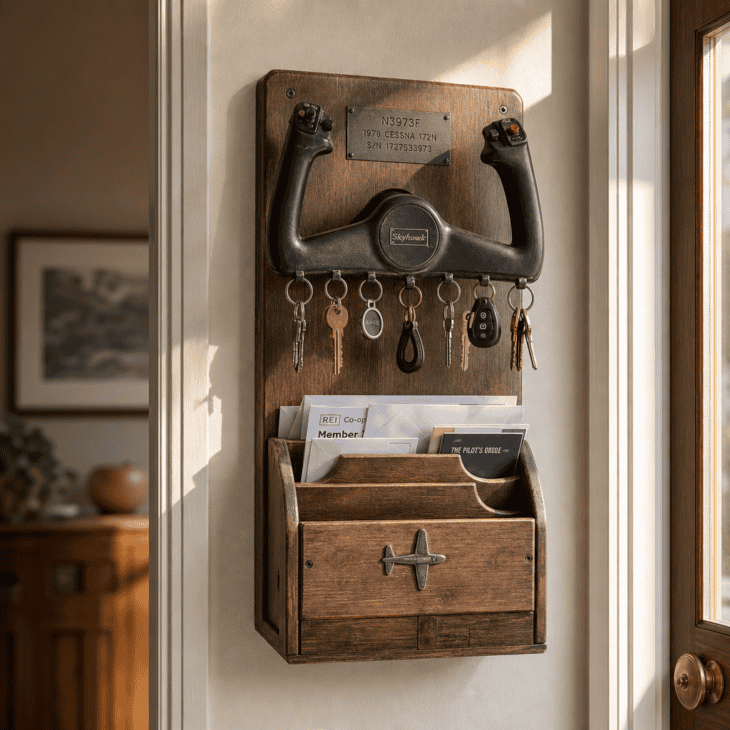
What it is A wall-mounted organizer built around a small decommissioned or reproduction aircraft control yoke, fixed horizontally to a wood backing board with two or three mail slots cut beneath it and small hooks added along the yoke’s crossbar for keys. Overall size runs roughly 16 by 20 inches for a general aviation yoke.
Why it works A control yoke is one of the most recognizable objects in general aviation, and repurposing it as an organizer gives it new daily function instead of leaving it as a static collectible gathering dust on a shelf. The combination of mail slots and hooks also solves two entryway clutter problems in a single fixture.
How to get it Aviation salvage dealers and retired flight-school equipment sales occasionally list decommissioned yokes, or a reproduction resin yoke works just as well for this purpose. A woodworker can build the backing board and mail slots to the yoke’s exact width. Mount into wall studs given the combined weight of the yoke and a full mail slot. Keep the crossbar hooks limited to two or three so keys do not obscure the yoke’s shape entirely.
15. Vintage Airport Terminal Bench for the Entryway
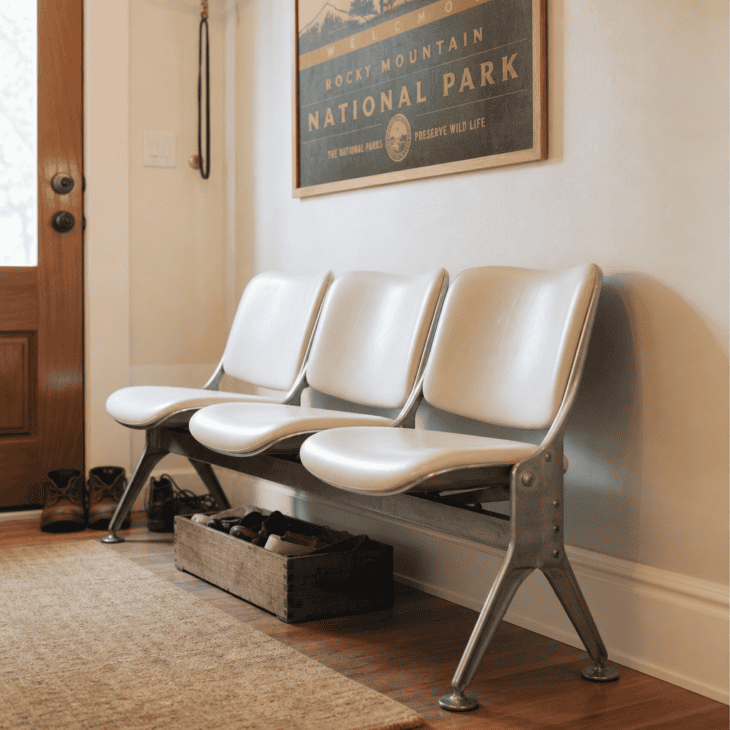
What it is A row of two to three connected bucket seats on a shared brushed aluminum frame, upholstered in cream or navy vinyl, styled directly after the mid-century benches once common in airport gate areas. Standard connected units run 44 to 66 inches long depending on seat count.
Why it works An entryway with somewhere to sit while putting on shoes is measurably more functional than one without, and a terminal bench delivers that seating with a strong mid-century silhouette instead of a generic upholstered bench. The connected-seat design also holds up to years of daily use, since the shared metal frame was built for continuous public seating.
How to get it Vintage furniture dealers who specialize in mid-century transit and airport seating occasionally list original units, while several reproduction furniture makers now sell close copies at a lower price point. Measure the hallway width carefully, since even a two-seat bench needs 44 inches of clear wall space plus room to walk past. Choose vinyl over fabric upholstery for easier cleaning near a front door. A slim console table at one end extends the bench’s function without adding legs to the walking path.
16. Vintage Flight Jacket Wall Display on a Wooden Dowel
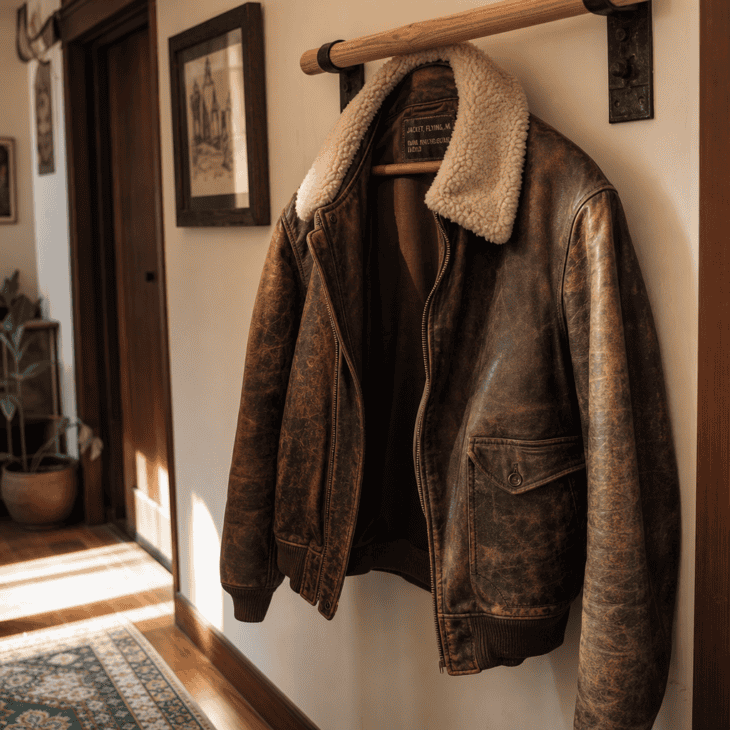
What it is A single vintage or reproduction leather flight jacket with a sherpa or wool collar, hung open on a plain wooden dowel mounted a few inches off the wall rather than folded on a hanger, letting the jacket’s full shape show. Dowel mounts typically extend 4 to 6 inches from the wall.
Why it works A jacket displayed open on a dowel reads as considered styling rather than a coat left out, the same trick used to display a robe or kimono. A worn leather flight jacket also brings genuine texture and history into an entryway that a framed print cannot match, and it works as a functional piece too, ready to grab on the way out.
How to get it A real vintage flight jacket from an army-navy surplus store or a specialty leather dealer works best for this display, though a well-made reproduction achieves the same look. Choose a single thick wooden dowel, at least 1.5 inches in diameter, mounted on two simple wall brackets so the jacket drapes without slipping. Leave the jacket unzipped and slightly angled rather than centered flat, for a more natural, worn look. Condition the leather every year or two to keep it supple if it hangs exposed to daylight.
17. Instrument Cluster Wall Trio: Barometer, Clock, and Thermometer
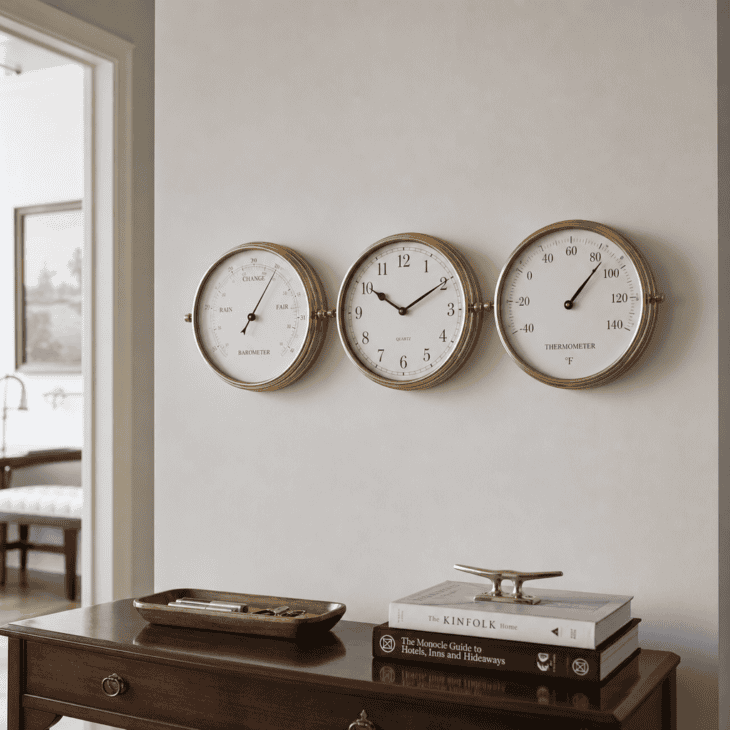
What it is Three round brass-cased instruments, a barometer, a clock, and a thermometer, each with a white dial face and black needle styled after cockpit gauges, hung in a tight horizontal row typically 4 to 6 inches apart. Individual cases usually measure 4 to 6 inches across.
Why it works Grouped instrument dials give a hallway wall genuine function, since a working barometer and thermometer actually tell you something useful before you step outside, unlike most purely decorative wall art. The matched brass casings also read as a set even though each instrument does a different job, similar to the precision-minded pieces that anchor an home office decor scheme.
How to get it Nautical and aviation instrument retailers sell matched brass barometer, clock, and thermometer trios as boxed sets, often marketed for a den or study but equally suited to a hallway. Choose a set with a lacquered brass finish to resist tarnishing from humidity near a front door. Hang all three at the same height on a level horizontal line for the cleanest look. A barometer needs the occasional tap and calibration check against a known local reading to stay accurate.
18. Model Airplane Squadron Suspended Above the Stairwell

What it is Five to eight diecast or plastic model propeller airplanes, each suspended from the ceiling on clear fishing line at staggered heights and angles, arranged to suggest a squadron climbing or banking together above a stairwell or double-height entry. Individual models typically span 4 to 8 inches wingtip to wingtip.
Why it works A stairwell or double-height entry is one of the few spots in a home with real vertical space to fill, and a suspended squadron uses that height in a way a wall-mounted piece never could. The staggered angles also create genuine movement as the light shifts through the day, extending the same collecting instinct behind most model airplane display setups into three dimensions.
How to get it Build the squadron from an existing model collection or order a themed set from a diecast retailer, choosing lightweight models so the fishing line and ceiling anchors are not overloaded. Use small eye-hook ceiling anchors rated for the combined weight, rarely more than a pound or two total. Vary the line length by 6 to 12 inches between models so the group reads as mid-flight rather than a flat, even row. Dust the models every few months with a soft brush, since suspended pieces collect dust faster than shelved ones.
19. Runway Edge-Light LED Baseboard Strip
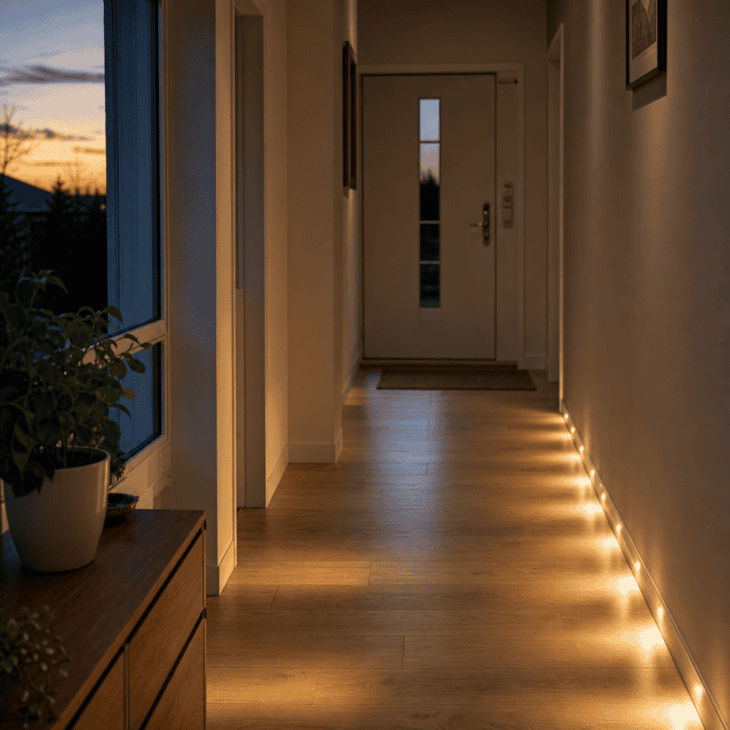
What it is A warm white LED strip mounted along the baseboard at floor level, either continuous or broken into evenly spaced points, running the length of the hallway to mimic the guiding line of runway edge lights. Most kits include a built-in dusk or motion sensor for automatic activation.
Why it works Floor-level pathway lighting is already a recommended safety feature for a nighttime hallway, and the evenly spaced runway logic gives that necessary lighting a specific visual identity instead of a generic glow strip. It is a subtler nod to aviation than most decor on this list, visible mainly after dark rather than all day.
How to get it Choose a low-voltage LED baseboard kit with a motion or dusk sensor, sold by several smart-home lighting retailers for hallway and stairway safety use. Most install with an adhesive backing and a plug-in transformer, requiring no electrician for a standard low-voltage run. Set brightness low enough for nighttime wayfinding without lighting the whole hallway. Route the cable behind the baseboard trim or through a cable channel so no wiring shows at floor level.
20. Aircraft Rivet-Pattern Console Table Runner
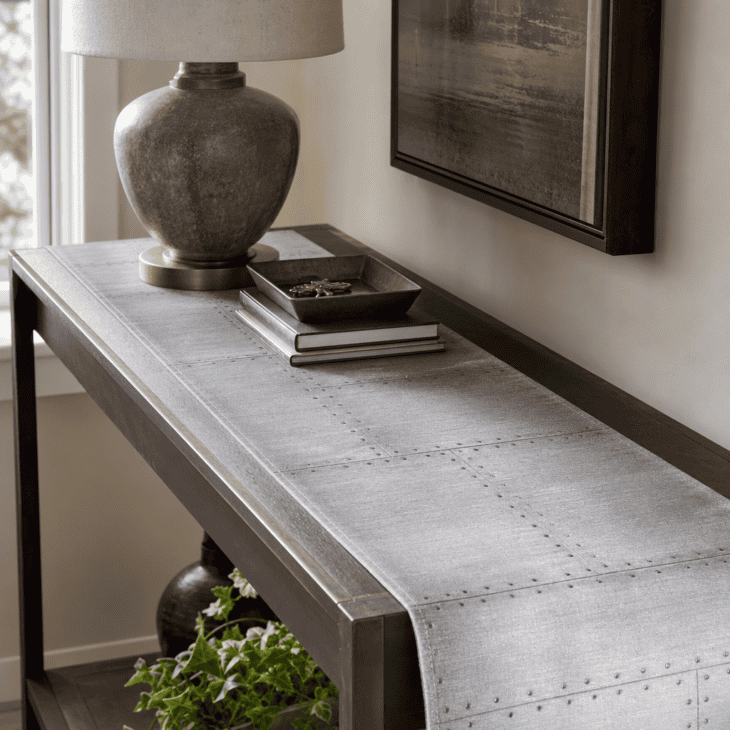
What it is A narrow fabric table runner, roughly 14 by 72 inches, in brushed silver or pewter grey printed with a subtle repeating pattern of rivet lines and panel seams like the surface of an aircraft fuselage. The pattern reads as texture from a distance rather than an obvious graphic up close.
Why it works A console table runner is a low-commitment way to add pattern to an entryway without repainting or reupholstering anything, and the rivet-seam print is subtle enough to sit under a lamp or tray without competing with them. It is one of the few ideas on this list that reads as aviation only on closer inspection, which suits a household that wants a lighter touch.
How to get it Search “aircraft panel table runner” or a general metallic geometric-print runner through home textile shops, since the pattern crosses over from industrial-style decor. Choose a runner slightly shorter than the console’s full length so a few inches of wood show at each end. Machine-washable polyester blends resist wrinkling better than natural fiber for a surface handled daily. Iron on a low setting if the fabric shows fold lines from shipping.
21. Vintage Airport Wayfinding Sign Set
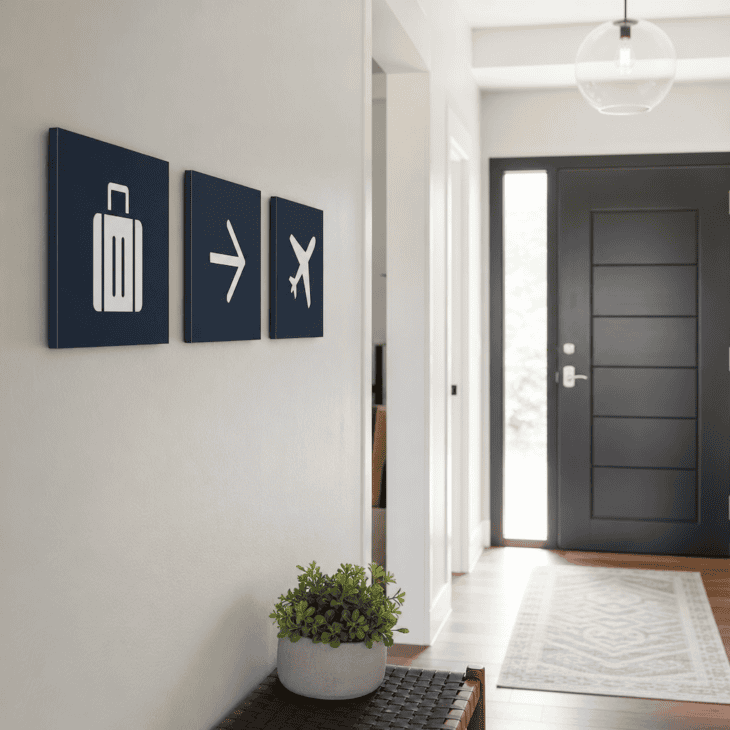
What it is A set of three small rectangular wall signs, roughly 6 by 10 inches, in matte navy or charcoal with simple white icon graphics such as a suitcase, a directional arrow, and an airplane symbol, deliberately built around icons rather than lettered words. Most mount flush with two small screws or adhesive strips.
Why it works Airport signage is instantly recognizable even stripped down to icons alone, and using symbols rather than text keeps the set from looking like a prop from a specific real terminal. A short run of three signs also genuinely helps orient a hallway that branches toward a coat closet, a staircase, or a garage door.
How to get it Search “airport icon wall sign” or “wayfinding wall art set” through home decor shops and Etsy sign makers who produce these as matched trios. Position each sign near the actual area it references, the suitcase icon near a closet, the arrow near a turn, so the set does real wayfinding work. Choose powder-coated metal over printed wood for a crisper icon edge and better durability near a busy entry. Keep the trio’s spacing and mounting height consistent for a clean, intentional look.
22. Aviation-Themed Shoe Storage Bench with Cubby Rows
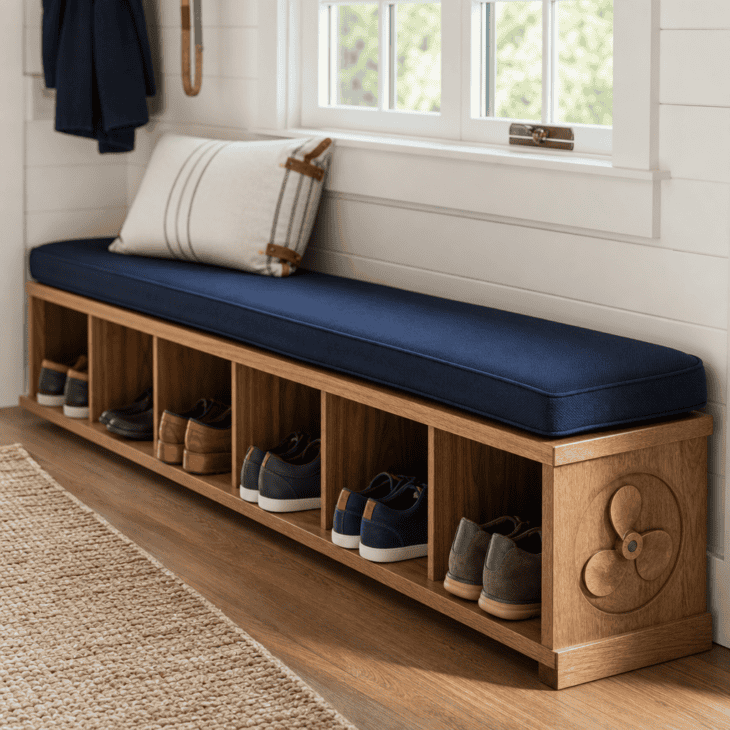
What it is A wooden entryway bench, typically 36 to 48 inches long, with three to five open cubby compartments built beneath a padded seat cushion, one small propeller or wing detail carved or inlaid into an end panel. Cubby openings are usually sized for one pair of shoes each.
Why it works Shoe clutter is one of the most common entryway complaints, and a bench that solves storage and seating in one piece earns its floor space more than a purely decorative object would. The single restrained aviation detail keeps the bench functional first, decorative second, which suits a piece the whole household uses daily.
How to get it Standard cubby storage benches are widely available through furniture retailers; a woodworker can add a custom propeller or wing carving to an off-the-shelf piece for a modest additional cost. Measure the household’s actual shoe count before buying, since undersized cubbies get overwhelmed quickly in a multi-person home. Choose a bench with a removable cushion cover for easy washing near a high-traffic door. Solid wood construction holds up to daily sitting weight better than particleboard over the long run.
23. Flight Log Guest Book Table for the Entryway
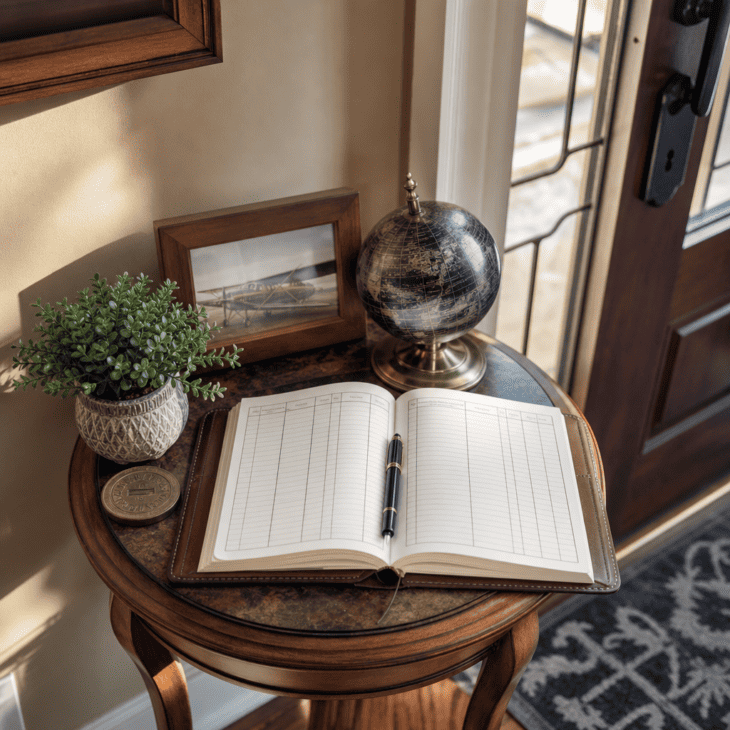
What it is A leather-bound guest book styled after a pilot’s paper flight log, with ruled columns for a date, a name, and a short note in place of departure and arrival fields, displayed open on a small round side table near the door with a pen resting in the crease. Most books run 40 to 60 pages, enough for years of visitors.
Why it works A guest book gives an entryway a genuine keepsake function, collecting a record of visitors the same way a flight log records every leg flown. Framing it as a log rather than a plain guest book also gives first-time visitors an easy, specific prompt instead of a blank page they have to think about filling.
How to get it Search “flight log guest book” through stationery shops and Etsy bookbinders, several of whom print ruled columns specifically formatted after real pilot logbooks. Choose a book with a sturdy sewn binding if it will sit open on a table for years rather than a glued spine that loosens with repeated handling. Keep a spare pen nearby, since guest book pens are the first thing to go missing. Move the book to a drawer during large parties if open pages might get damaged by a crowd.
24. Vintage Airline Timetable Framed Print Trio
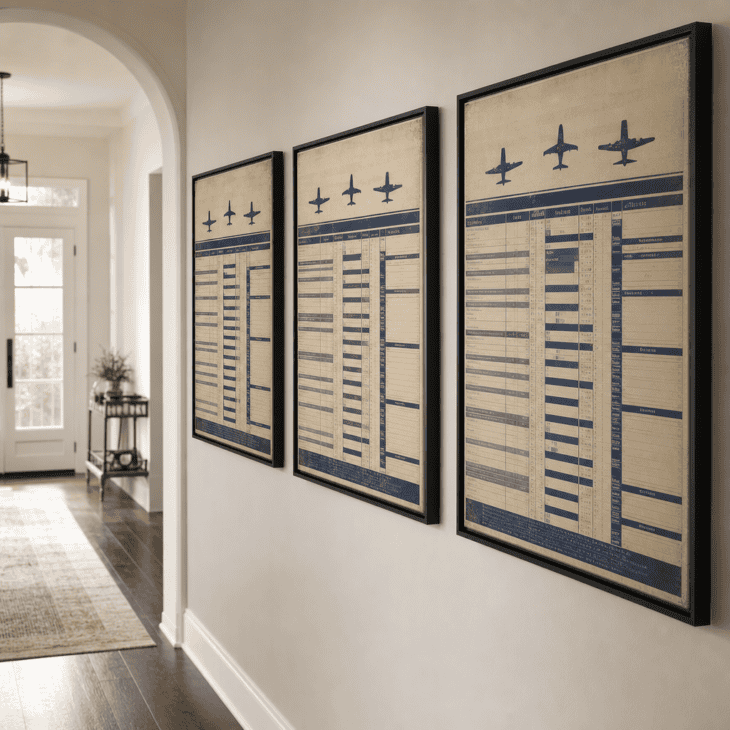
What it is Three matching slim black or walnut frames, each holding a faded, generic timetable-style graphic in cream and navy with abstract ruled columns rather than real flight data, hung in an evenly spaced horizontal row. Standard print sizes run 11 by 14 or 12 by 16 inches.
Why it works A timetable’s dense grid of columns and rows is quietly graphic even without any words to read, and three matching frames in a row give a hallway wall a sense of order that a single large print does not. The muted cream and navy palette also stays neutral enough to sit near almost any other decor style in the house.
How to get it Search “vintage timetable print” or “airline schedule wall art” through print shops and vintage poster reproduction sellers. Use identical frames and matting across all three prints so the set reads as a trio rather than three unrelated pieces. Hang them at consistent height and spacing, 3 to 4 inches apart, ideally centered on the width of a stairwell or door frame below. A UV-protective glass or acrylic glazing keeps the faded print tones from shifting further under direct hallway light.
25. House Number Displayed as an Airport Gate Sign
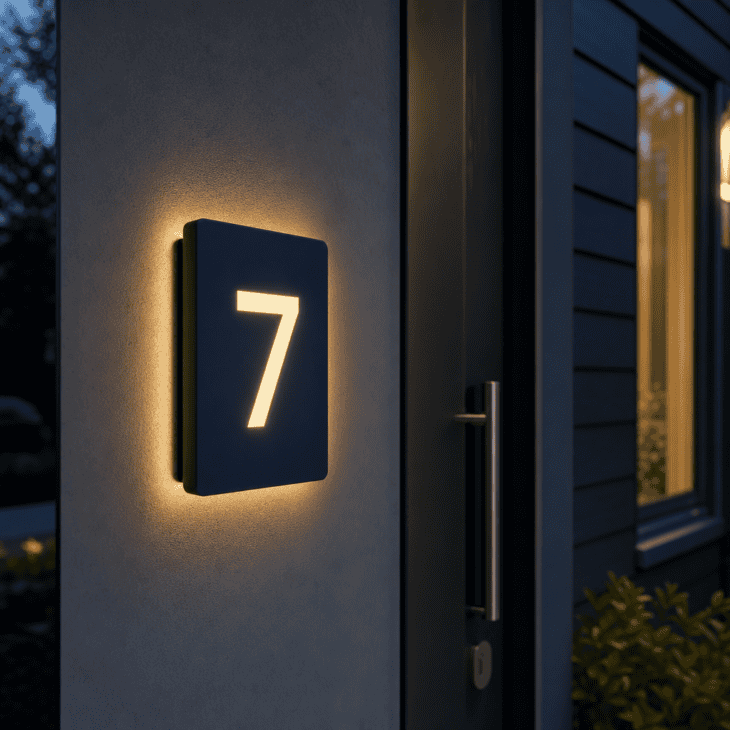
What it is A small backlit or reflective house number plaque in matte navy or charcoal, the numeral set in a clean, bold sans-serif font styled after an airport gate sign, mounted directly beside the front door where a house number typically goes. Most run 8 to 12 inches wide for a single or double-digit number.
Why it works A house number is one fixture every entryway already needs by law, so restyling it costs nothing in extra function and gives the very first thing a visitor sees a distinct identity. The gate-sign font and backlighting also make the number genuinely easier to read after dark, solving a real problem for delivery drivers and guests alike.
How to get it Search “modern illuminated house number” through home hardware retailers, then choose a bold, evenly weighted sans-serif font for the closest match to real gate signage. Confirm local code allows illuminated address signs before wiring in a backlit version; a solar-powered or battery unit sidesteps that question entirely. Mount at a height visible from the street or front walk, not tucked behind a porch post. Check the bulb or LED module’s expected lifespan so a burnt-out number does not go unnoticed for months.
Small entryway? Start with these
A narrow hallway with no room for a bench or console still has space for hooks, a doormat, a mirror, and a runner rug. Save furniture pieces like the terminal bench or luggage cart table for a wider foyer.
Get the Newsletter
The latest aviation news and stories sent to your inbox.
About the Author

Hanna writes AeroCorner's aviation-lifestyle and decor guides, turning a love of flight into ideas for your home, celebrations, and gift lists.