Military Helicopters
Bell AH-1Z Viper
ICAO: SUCO
The Army's armed scout that spotted targets from behind cover
Updated: by Tim de Vries
The latest aviation news and stories sent to your inbox.
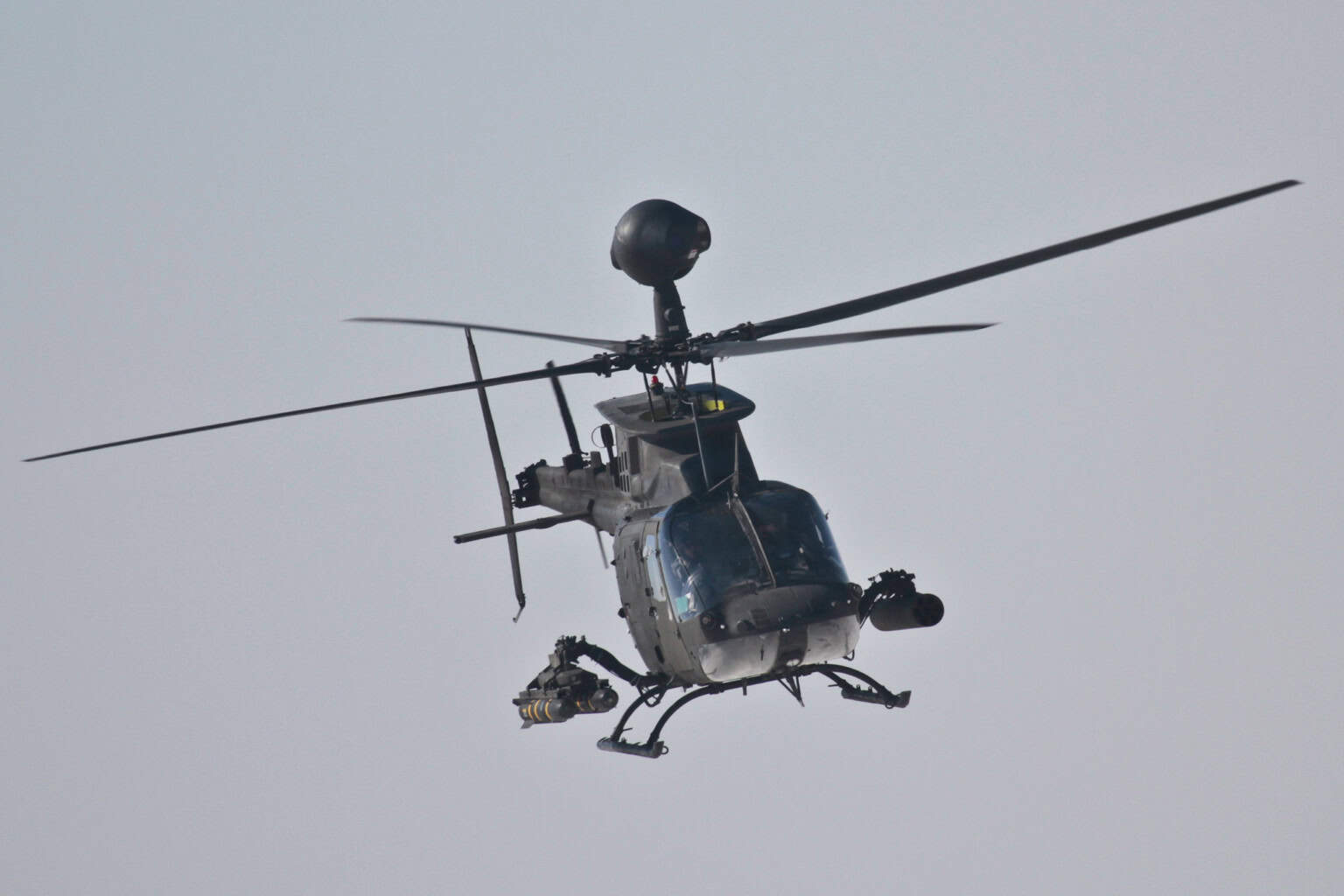
The Bell OH-58D Kiowa Warrior is a two-seat armed reconnaissance helicopter built for the U.S. Army, recognizable by the ball-shaped sight above its rotor. Developed from the OH-58 Kiowa under the Army Helicopter Improvement Program, it entered service in 1985, flew in the Persian Gulf, Desert Storm, Iraq and Afghanistan, and was retired by the Army in 2017.


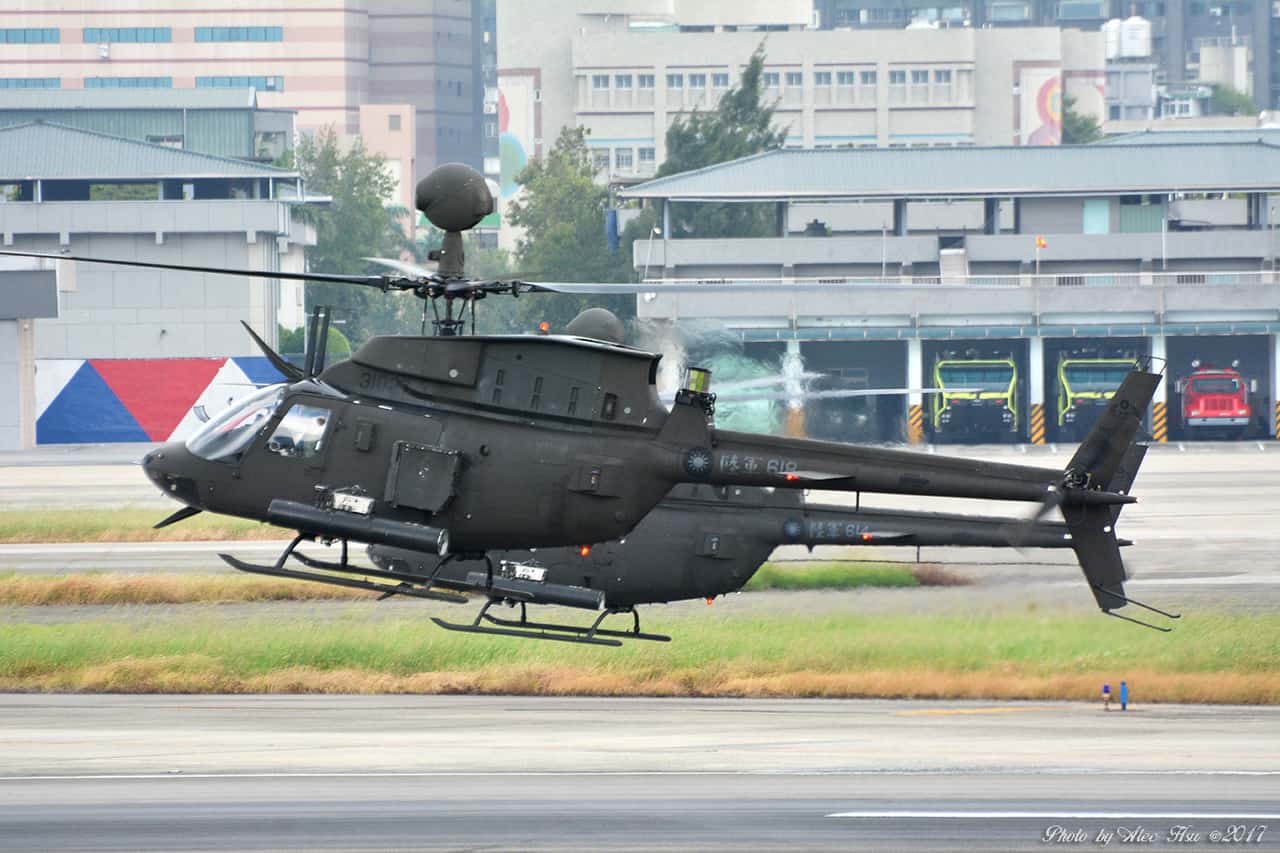
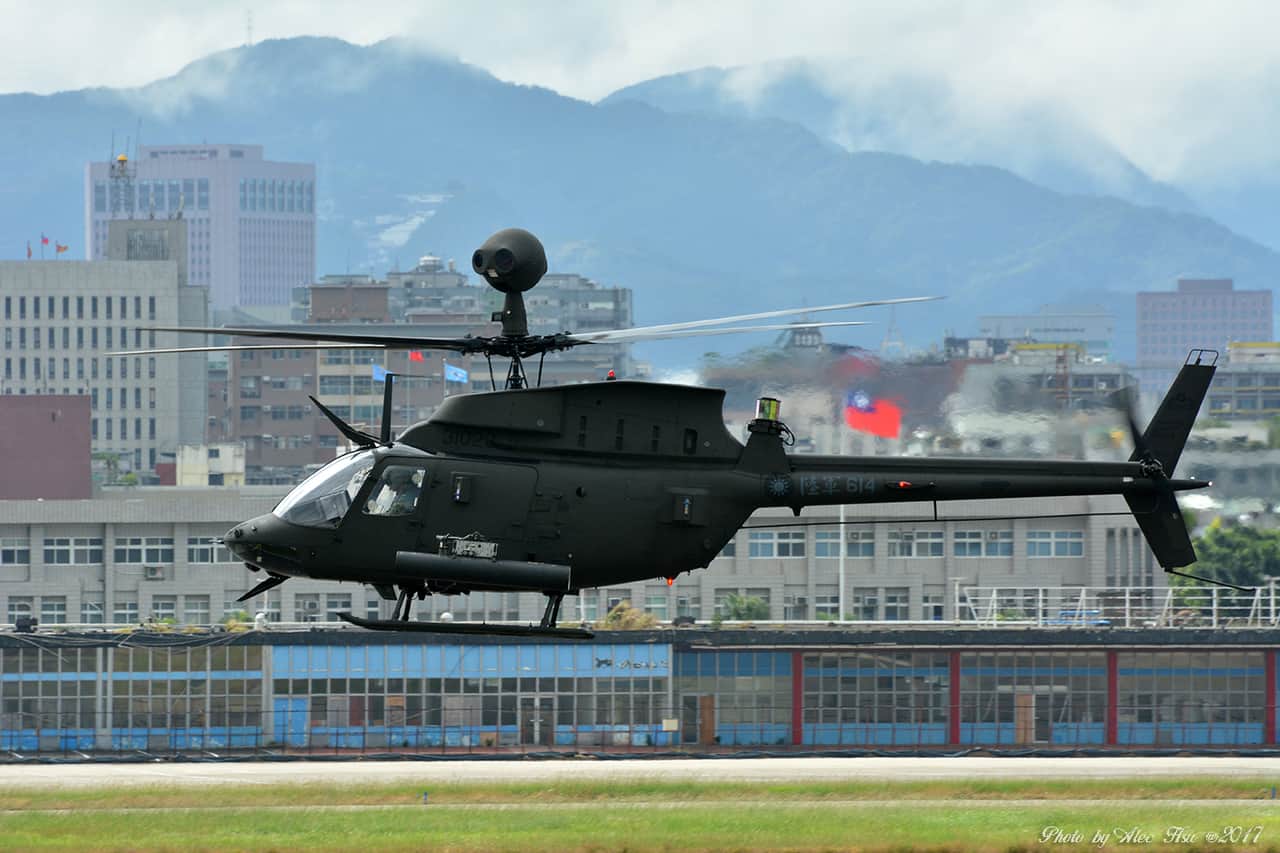
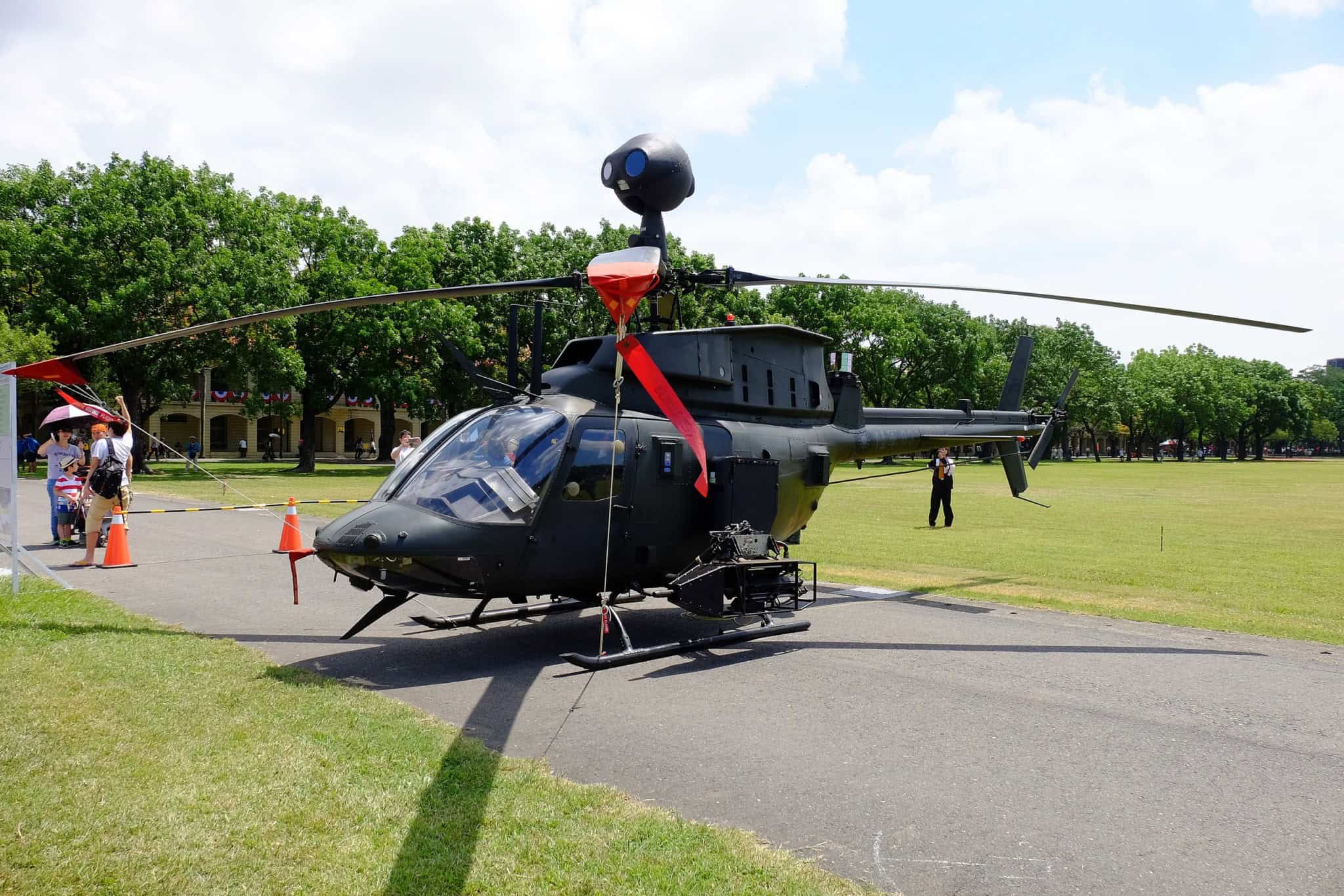
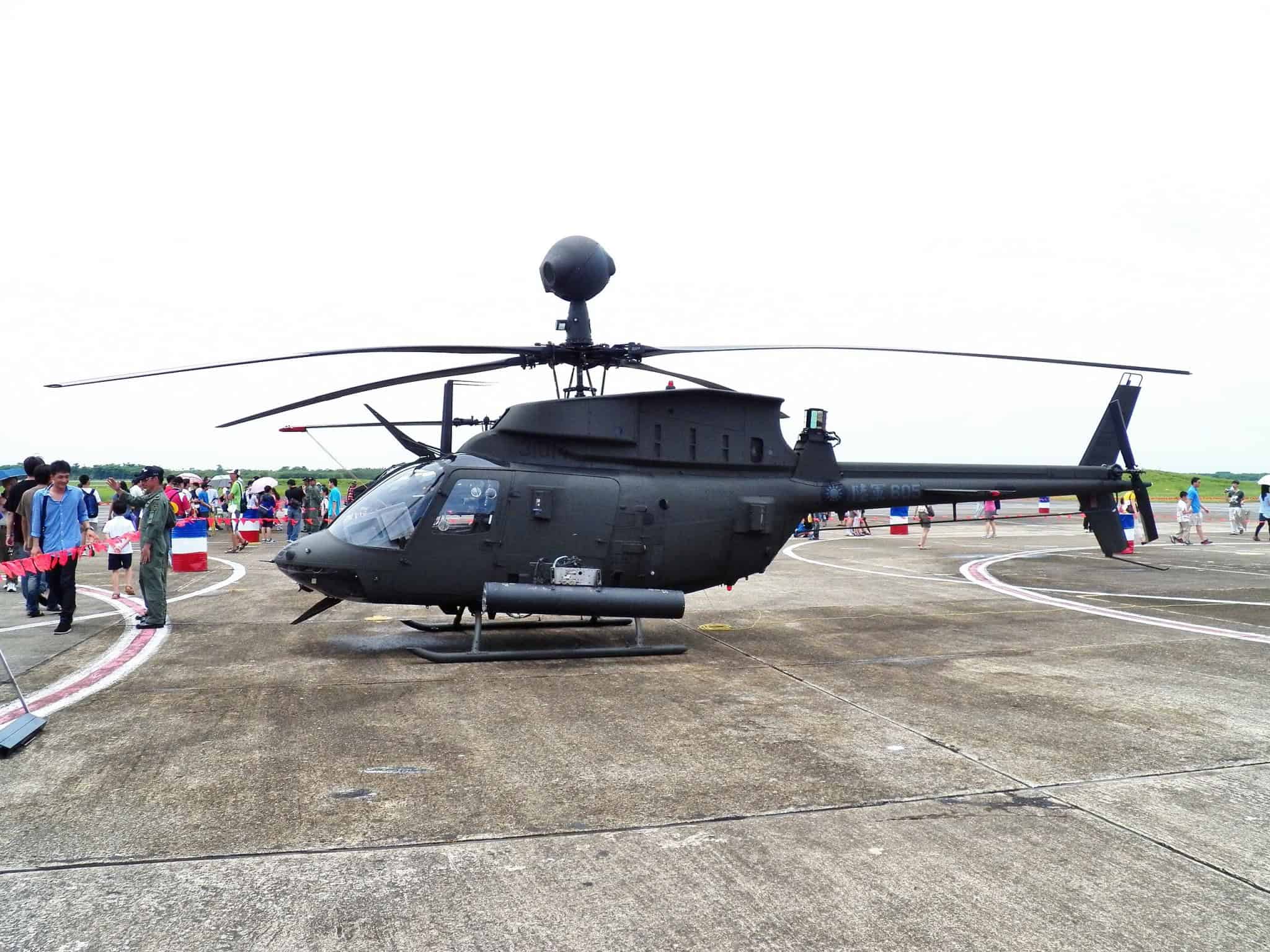
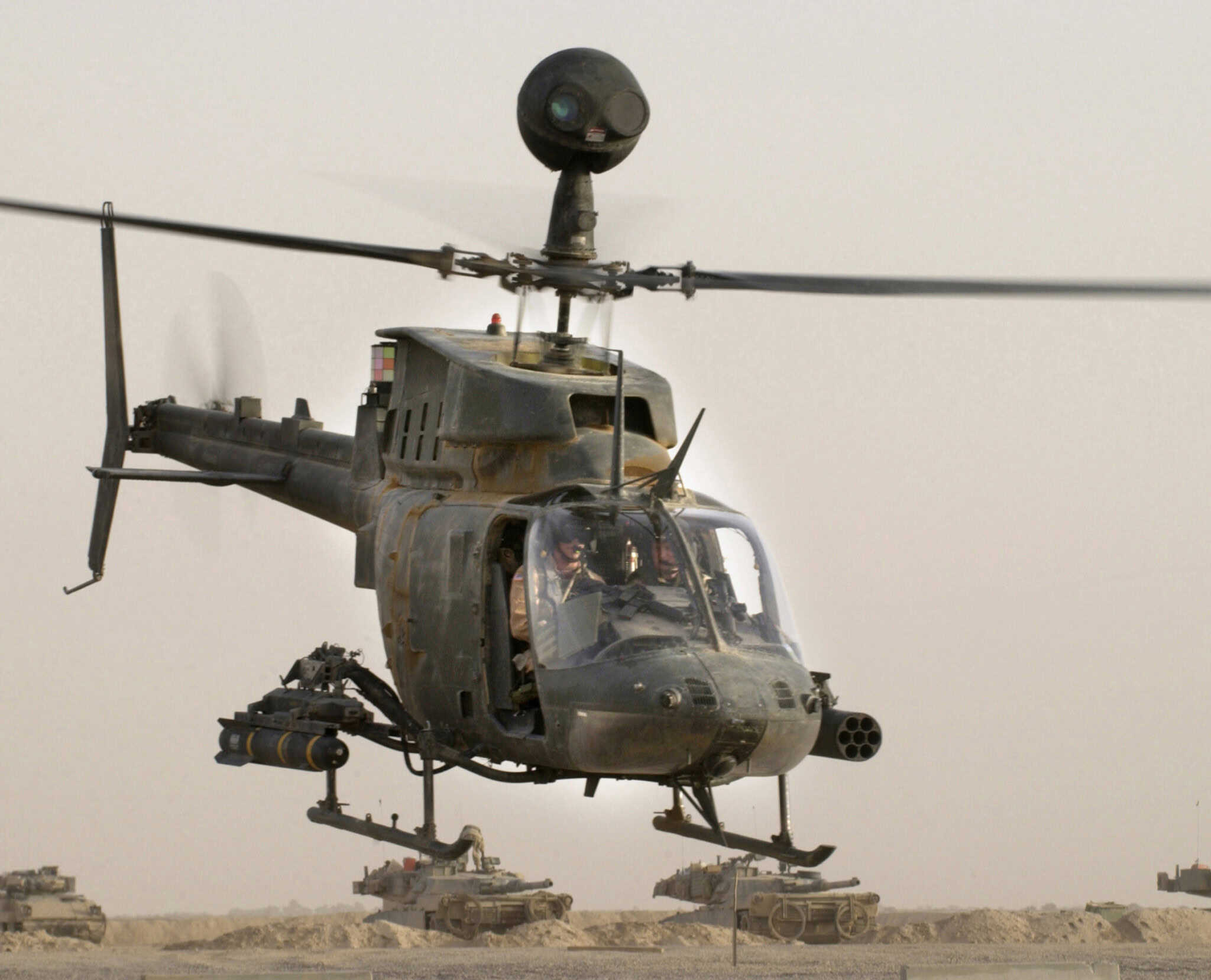

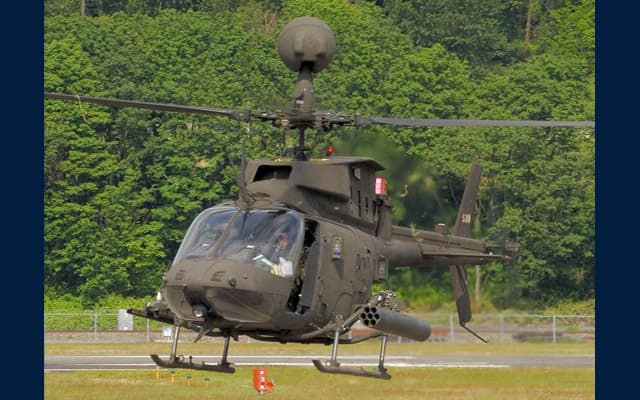

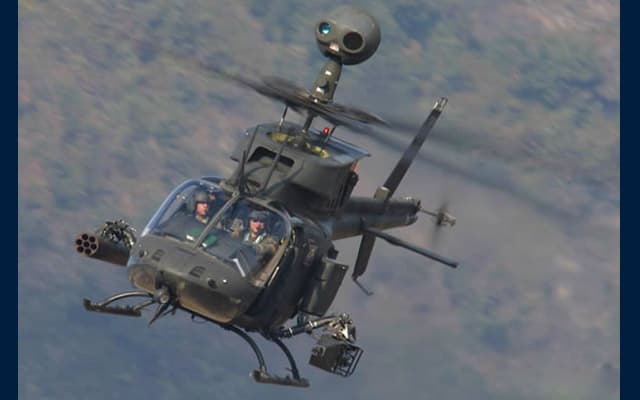
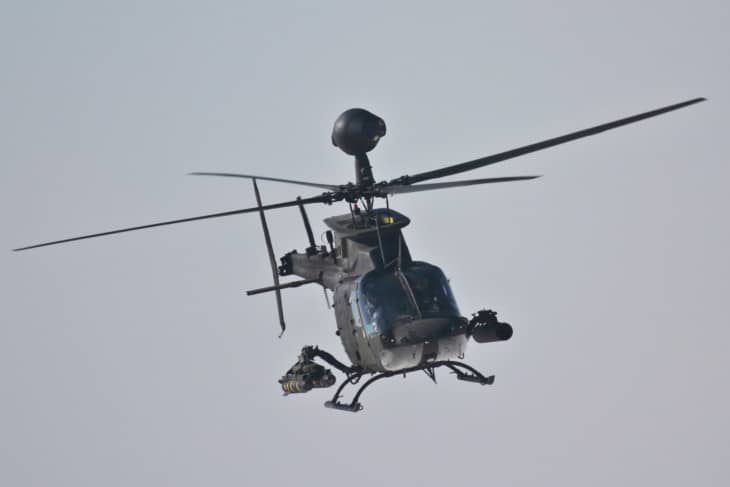
The Bell OH-58D Kiowa Warrior is a two-seat, single-engine armed reconnaissance helicopter built for the U.S. Army. Its job was to find the enemy first, then fire on targets itself or hand them to Apache helicopters, artillery and ground forces.
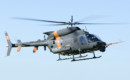
It is easy to recognize. A ball-shaped sensor sits on a mast above the four-blade main rotor, so the crew could watch a target while the helicopter stayed hidden behind trees or terrain.
The OH-58D first flew on October 6, 1983, and entered service in 1985. The U.S. Army retired it in 2017, and Taiwan still had about three dozen in service in May 2026.
Scouting is one of the classic types of military helicopter missions, and the OH-58D was the Army’s dedicated scout for more than 30 years. This page covers the D model; the Kiowa family also includes the unarmed OH-58A and OH-58C, and the civilian Bell 206 JetRanger they were derived from.
The Kiowa began as a loser. In October 1960 the U.S. Navy, acting for the Army, asked helicopter makers for a Light Observation Helicopter, and in May 1965 the Army picked the Hughes OH-6 Cayuse over Bell’s entry.
Bell reworked its design into the civilian Model 206A JetRanger, with a sleeker fuselage and more cargo space. When Hughes could not meet its production commitments, the Army reopened the competition in 1967, and Bell’s 206A was declared the winner in 1968.
The Army designated it the OH-58A and named it Kiowa, after the Native American tribe. It received the first one at Bell’s Fort Worth plant in May 1969, and production aircraft reached South Vietnam that August, joining the other helicopters of the Vietnam War.
The Army ordered 2,200 OH-58As, each powered by a 317 shp Allison T63-A-700. From March 1978, 275 of them were converted to the OH-58C, with a 420 shp T63-A-720 engine, a new instrument panel and better protection.
Across all versions, 2,325 OH-58s were produced, plus 56 Bell 206B-1s for Australia.
By the 1970s the Army wanted a scout that could see farther, navigate precisely and survive at the front alongside the new AH-64 Apache. It studied an all-new Advanced Scout Helicopter, then shelved it when Congress declined to fund the program.
In November 1979 the Army chose to modify existing helicopters instead. The result was the Army Helicopter Improvement Program (AHIP), built around a mast-mounted sight, and in September 1981 Bell won the development contract with its Model 406, beating an upgraded Hughes OH-6.
Bell replaced the OH-58C’s 420 shp engine and two-blade rotor with a 650 shp Allison 250-C30R turboshaft, designated T703-AD-700 by the military, driving a four-blade, soft-in-plane rotor. The first of five prototypes flew on October 6, 1983, and deliveries began in 1985.
Most OH-58Ds were not new helicopters. Bell built them by converting existing OH-58A and OH-58C airframes, and it had performed 412 of those conversions for the Army by the end of 1999.
The program nearly died young. In 1988 the Army planned to stop buying the OH-58D, until Congress approved $138 million to expand it so the helicopter could hunt targets for the Apache as a hunter-killer team.
The four-blade rotor made the OH-58D quieter than the two-blade OH-58C, and it was the first Army helicopter with an all-composite main rotor hub. Bell later used the same rotor design on its civilian Bell 407.
The armed version came out of the Persian Gulf. From September 1987, Bell fitted weapons to 15 OH-58Ds for Operation Prime Chance, the escort of oil tankers during the Iran-Iraq War, and began delivering them after 98 days.
They took over from special operations teams flying armed Little Birds. Flying mostly at night from mobile sea bases, a frigate and a destroyer, the OH-58Ds patrolled against gunboats that had been laying explosives in the Gulf.
The experience led the Secretary of the Army to arm the whole type for scouting and armed reconnaissance, and the armed aircraft became the OH-58D Kiowa Warrior. The first was delivered in May 1991, every OH-58D from the 202nd aircraft onward was built to that standard, and in January 1992 Bell received its first contract to retrofit the rest.
The feature that defines the OH-58D is the mast-mounted sight (MMS), the ball above the rotor. It houses a television camera, a thermal imaging system and a laser rangefinder/designator on a gyro-stabilized platform.
Putting the sensors above the rotor let the crew hover behind trees or a ridgeline with only the sight exposed. From there they could find, range and laser-designate targets by day or night and in poor weather, from a standoff distance.
The laser could guide the Kiowa Warrior’s own Hellfire missiles or mark targets for Apaches, other aircraft and artillery. The OH-58D was also the first Army helicopter fielded with a MIL-STD-1553 data bus, which passed sensor data straight to precision-guided weapons.
The workload was heavy. The pilot in the right seat normally flew while the left-seat pilot worked the sight, often heads-down in the cockpit for long stretches in a low hover.
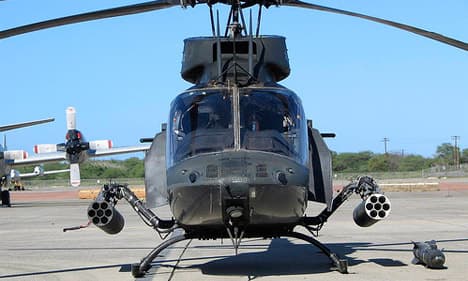
The Kiowa Warrior carries its weapons on two universal quick-change pylons, one on each side of the fuselage. Each pylon takes one of four loads:
Its self-protection suite included an AN/ALQ-144 infrared jammer, radar warning receivers and a laser warning detector.
The Army described the Kiowa Warrior as a lightly armed reconnaissance helicopter. It was a scout that could fight, not an attack helicopter like the AH-1 Cobra or the Apache it worked with, and our ranking of the best attack helicopters in the world covers those types.
The full specification table for the OH-58D is on this page. A few of its numbers get quoted against published figures that do not match, usually because they describe a different measurement or a different load.
Speed is the first. The panel’s maximum speed of 130 kt (150 mph, 241 km/h) comes from Forecast International and Wikipedia’s Jane’s-based table, and so does its cruise speed of 110 kt (127 mph, 204 km/h).
The Federation of American Scientists gives a 125-knot maximum and an 80-knot cruise, both as indicated airspeed. Indicated airspeed is the cockpit instrument reading, a different measurement from the true airspeed most specification tables quote.
Range is the second. The panel’s 300 nm (350 mi, 560 km) is the range Forecast International publishes, while Wikipedia’s table gives a much shorter 161 miles (260 km).
Both FAS and Wikipedia give an endurance of about two hours, which is the better guide to a real mission. A scout spent much of its flight hovering at low level rather than cruising in a straight line.
Weight is the third. The panel’s 5,500 lb (2,500 kg) maximum takeoff weight is the armed Kiowa Warrior’s limit; FAS gives 4,500 lb (2,041 kg) for the unarmed OH-58D.
With an empty weight of 3,829 lb (1,737 kg), that leaves roughly 1,670 lb (758 kg) for two crew, fuel and weapons. The 2,000 lb (907 kg) figure sometimes quoted as payload is the rating of the cargo hook for slung loads, not an internal load.
Power is the last. The engine is rated at 650 shp (485 kW), but the transmission was the tighter limit: Forecast International rates it at 510 shp maximum continuous on the original OH-58D and 575 hp on armed aircraft.
Size mattered as much as any number. Two Kiowa Warriors fit inside a C-130 Hercules once the tail fin was tilted, the rotor blades and stabilizer folded and the sight removed, and Forecast International says one could be ready to fly within 10 minutes of unloading.
In Operations Desert Shield and Desert Storm, the Army deployed more than 100 OH-58Ds, with published counts ranging from 115 to 130. According to the Tennessee National Guard, they flew nearly 9,000 hours with a 92 percent fully mission capable rate.
The same history says the Kiowa Warrior had the lowest ratio of maintenance hours to flight hours of any combat helicopter in the Army. Through the 1990s it supported U.S. forces in Haiti, Somalia and Bosnia.
Iraq and Afghanistan were its heaviest use. The OH-58D flew nearly half of all Army reconnaissance and attack missions in the wars after 9/11, the highest usage rate of any Army aircraft, and by 2013 Bell counted more than 820,000 combat hours on the OH-58 airframe.
Crews flew it far harder than it was designed for. The original OH-58 was meant to fly about 14 hours a month, but the Tennessee National Guard says it averaged 85 to 90 hours a month.
The cost was high. In Iraq and Afghanistan, more than 35 Kiowas were lost to combat and accidents and 35 pilots were killed, and the high-density altitude in Afghanistan caused problems for the underpowered single-engine helicopter.
To keep the Kiowa viable beyond 2025, the Army started the Cockpit and Sensor Upgrade Program (CASUP), which produced the OH-58F. It added a nose-mounted targeting and surveillance sensor alongside the MMS and a new cockpit.
The first OH-58F flew on April 26, 2013, about 200 lb (91 kg) lighter than the D model. The Army terminated CASUP in March 2014, and halted production of new Wartime Replacement Aircraft at the same time, as it prepared to retire the whole fleet.
Money forced the decision. In 2013 the Army had more than 330 Kiowas, and upgrading them was estimated to cost about $10 billion.
In January 2014 the Army’s chief of staff, Gen. Ray Odierno, said the service could not afford all the aircraft fleets it had under its budget.
Capability was the other factor. The OH-58D could meet 20 percent of the Army’s armed aerial scout requirements and the OH-58F would have met 50 percent, while pairing Apaches with drones met 80 percent.
The Aviation Restructuring Initiative settled it. Retiring the Kiowa would help fund Apache upgrades, and the Army planned to move National Guard and Reserve Apaches into the active force to take over the scout role, even though the Apache costs about 50 percent more to operate.
Divestment formally began in April 2014. The last squadron, the 82nd Airborne’s 1st Squadron, 17th Cavalry Regiment, deployed to South Korea in 2016, and on January 25, 2017, its Kiowas flew their final exercise at Rodriguez Live Fire Range before handing over to Apaches.
Not everyone was convinced. The 82nd Airborne’s aviation brigade commander noted that Kiowas could be pushed off a C-130 and airborne within half an hour, while Apaches unloaded from a C-17 took three hours.
The Army’s last OH-58Cs, used as trainers, left service in September 2020.
No new helicopter did. After 2017 the AH-64 Apache took over armed reconnaissance, working with RQ-7 Shadow drones that an Apache crew could control to scout ahead.
Every attempt at a dedicated successor has been cancelled. The RAH-66 Comanche was ended in 2004, the Bell ARH-70 Arapaho in 2008, and the Armed Aerial Scout program in late 2013.
The fourth, the Future Attack Reconnaissance Aircraft (FARA), pitted the Bell 360 Invictus against the Sikorsky Raider X. The Army cancelled it on February 8, 2024, saying drones and space-based sensors had changed aerial reconnaissance, and said it did not plan another crewed Kiowa replacement.
The same announcement set out plans to phase the Shadow out of the fleet. The Army’s stated plan in 2024 was to fill the scout role with newer unmanned systems rather than a new helicopter, and we found no revived crewed scout program as of September 2026.
After retirement, the Army offered its Kiowa Warriors to allies as excess defense articles, stored at the Davis-Monthan Air Force Base “boneyard” in Arizona. Greece, for example, paid only for packing, crating, handling, transport and any refurbishment.
Croatia and Tunisia were the first to request them in 2016, for 16 and 24 aircraft, and Croatia received its first five that year. Greece was granted 70 in early 2018, initially based at Stefanovikio.
Taiwan bought its own. Its army acquired 39 OH-58Ds in the 1990s to scout for its AH-1W Super Cobras, and around three dozen were still in service in May 2026.
That may not last. Reports in January and May 2026, citing Taiwanese media and military sources, said the army was weighing an early retirement, possibly by 2028, because of spare-parts shortages and trouble keeping the mast-mounted sight serviceable.
Armed UH-60M Black Hawks and Jump 20 drones were among the options reported to replace them.
Saudi Arabia took a different branch of the family: 15 Bell 406CS Combat Scouts, an export derivative with a roof-mounted sight in place of the MMS.
In 1992 the flyaway cost of a new OH-58D was $6.7 million, according to The War Zone, and that is the figure in the panel.
Because most OH-58Ds were rebuilt from older airframes, conversion costs are the other common figure. Forecast International put an OH-58A-to-D conversion at about $10 million in 2011 dollars, and the planned OH-58F conversions were estimated at $4 million to $5 million each.
The Pima Air & Space Museum in Tucson, Arizona, displays OH-58D serial 93-0976. The museum also has an OH-58A, serial 69-16112, among its Kiowas.
No. The Army retired the armed OH-58D Kiowa Warrior in 2017, after its last squadron flew a final exercise in South Korea on January 25, 2017, and retired its last OH-58C trainers in September 2020. The AH-64 Apache and unmanned aircraft took over the scout role.
The AH-64 Apache, teamed with drones, took over armed reconnaissance. Every attempt at a dedicated replacement has been cancelled, most recently the Future Attack Reconnaissance Aircraft in February 2024, and the Army said it would not start another crewed Kiowa replacement.
The Bell 206 JetRanger. The OH-58A was the Army’s version of the Bell 206A, and Bell’s civil Bell 407 later adopted the four-blade composite rotor developed for the OH-58D.
The Pima Air & Space Museum lists 150 mph (241 km/h) for the original, unarmed OH-58A with its 317 shp engine. The OH-58D reaches a similar 130 kt (150 mph); it has more than twice the engine power, but it is also much heavier.
Its maximum speed is 130 kt (150 mph, 241 km/h), according to Forecast International and Wikipedia’s Jane’s-based figures, which also give a cruise speed of 110 kt (127 mph, 204 km/h). The Federation of American Scientists lists a 125-knot maximum indicated airspeed.
Bell performed 412 OH-58D conversions for the U.S. Army through 1999, according to Forecast International, most of them rebuilt from OH-58A and OH-58C airframes. Taiwan acquired another 39, and 2,325 OH-58s of all versions were produced.
No official ranking exists. The AH-64 Apache that replaced the Kiowa has more speed, durability and firepower, according to the 82nd Airborne’s aviation brigade commander, who in 2016 called it “just a far more capable platform.” Our ranking of the best attack helicopters compares it with its rivals.
It is the mast-mounted sight, a stabilized sensor turret above the main rotor containing a television camera, a thermal imager and a laser rangefinder/designator. It let the crew watch and designate targets while the helicopter stayed hidden behind trees or terrain.
Not by the Army’s own description. It called the Kiowa Warrior a lightly armed reconnaissance helicopter: it could fire Hellfire missiles, rockets and a .50-caliber machine gun, but its main job was finding targets for Apaches, artillery and ground forces.
Cost and capability. Upgrading the fleet was estimated at about $10 billion, and Apaches teamed with drones could perform more of the armed scout mission, so the Army divested the Kiowa under its Aviation Restructuring Initiative between 2014 and 2017.
Sources and references used for research and fact-checking.