Military Propellor Planes
North American O-47
ICAO: O47
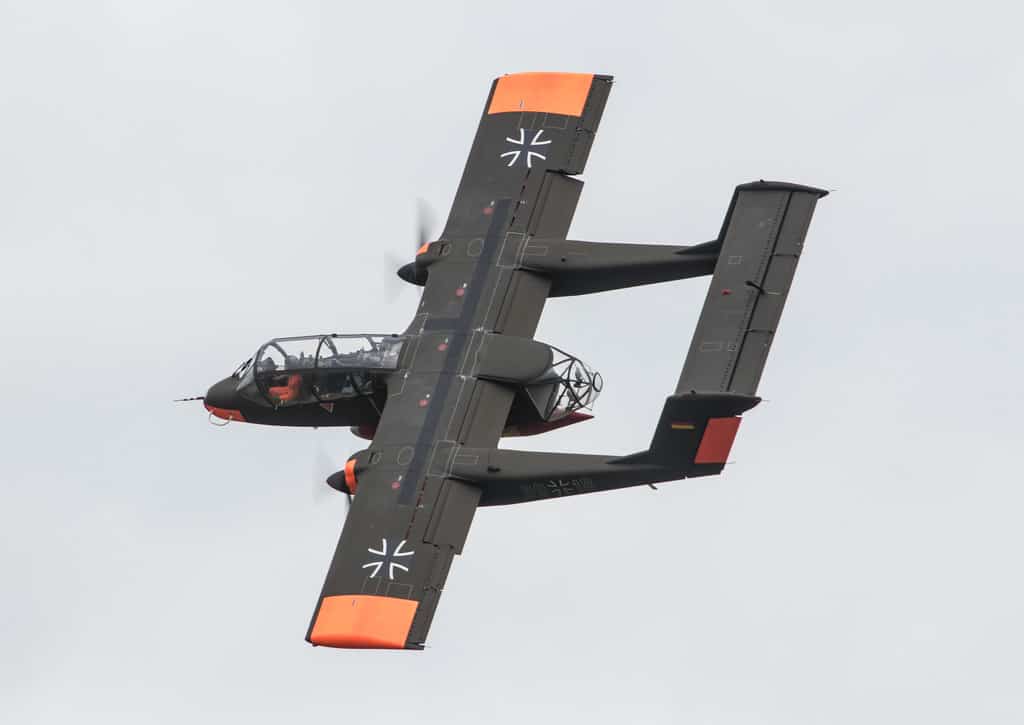
The North American Rockwell OV-10 Bronco was a twin-boom turboprop built for forward air control and light attack, and it flew combat for the U.S. Marine Corps, Air Force and Navy from Vietnam to Iraq and Syria.
Updated: by Tim de Vries
The latest aviation news and stories sent to your inbox.
The OV-10 Bronco was the first aircraft designed from the start for counter-insurgency warfare. It flew its first test flight on 16 July 1965 and entered U.S. service in 1969. Its twin booms, glazed cockpit and short-field ability made it a favorite of the crews who directed airstrikes from low altitude.
Live Fleet Activity (V10)
Fetching live data…



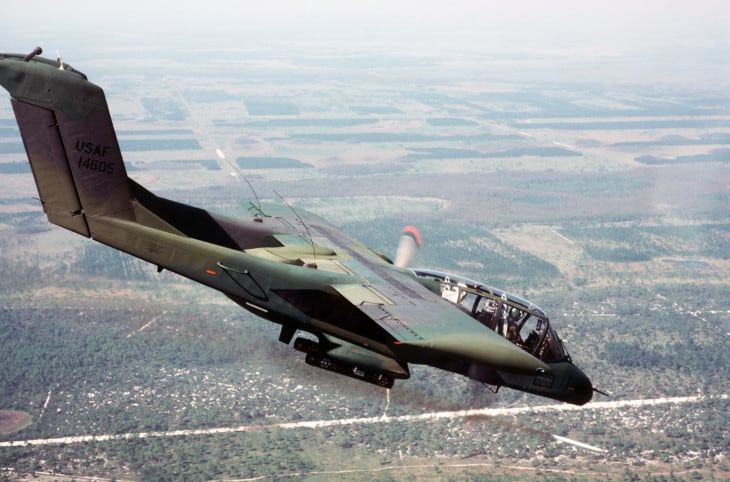
The OV-10 Bronco is a twin-turboprop light attack and observation aircraft built by North American Rockwell. The “O” stands for observation and the “V” for short takeoff and landing capability.
It was the first aircraft designed specifically for counter-insurgency and limited war. Its job was to fly slowly over the battlefield, find targets, and direct strikes by faster aircraft.
The full specification table for the aircraft is on this page. The sections below explain the numbers and the story behind them.
A tri-service requirement for a Light Armed Reconnaissance Aircraft was issued in 1963, and eleven proposals followed. North American’s NA-300 was selected in August 1964, with a contract for seven prototypes about two months later.
The prototype first flew on 16 July 1965. The first production OV-10A was delivered in June 1967 and the type entered service in October 1969, according to Wikipedia’s summary of the program.
The idea came from two Marine officers, W.H. Beckett and K.P. Rice, who wanted a rugged, simple aircraft to support troops on the ground instead of another complex jet fighter.

A wide central fuselage joins the wing, which carries two tail booms. The horizontal stabilizer sits between them, leaving the rear of the fuselage free for a hinged cargo door.
With the second seat removed, the cargo bay can carry 3,200 lb (1,450 kg) of freight, five paratroopers, or two litter patients and an attendant.
The booms line up with the propeller wash, which helps directional control on takeoff. The glazed cockpit gave the crew a view that jets could not match, and both seats were ejection seats.
Short-field performance was central to the design. The aircraft could use unimproved strips, and the engines could start without ground equipment.
The sponsons under the fuselage carried four 7.62 mm M60C machine guns. Those stubs also had four racks for bombs, pods or fuel, and two more racks sat under the outer wings.
In Vietnam the usual load was seven-shot 2.75 in rocket pods. White phosphorus marking rockets let the crew mark a target for fast jets.
The aircraft could also carry AIM-9 Sidewinder missiles on the wings and up to 500 lb (227 kg) of bombs.
Three performance figures get quoted against each other. Maximum range here is the ferry range with auxiliary fuel. The combat range is far shorter, at 198 nautical miles in the Jane’s data.
The ceiling is a similar story. Published specifications for the OV-10A say 26,000 ft, but in Vietnam the aircraft reached only about 18,000 ft because it was underpowered. That weakness contributed to crashes on sloping terrain.
The speed shown is the top speed at sea level. The Bronco was never a fast aircraft, and it did not need to be.
Seven YOV-10A prototypes preceded the production OV-10A, which served with the Marine Corps (114) and the Air Force (157), per Wikipedia.
The OV-10B was a German target tug, 18 of which were built, with a clear rear dome. The OV-10C went to Thailand (32), the OV-10E to Venezuela (16) and the OV-10F to Indonesia (16).
The OV-10D was a night observation version with a forward-looking infrared sensor, bigger engines and fiberglass propellers. Seventeen were converted from A-models.
The OV-10D+ added new wiring and strengthened wings. The OV-10G+ was a modernized version loaned for the Combat Dragon II evaluation, with four-bladed Hartzell propellers.

Marine Bronco crews flew combat in Vietnam from 1968, and Air Force OV-10As arrived on 31 July 1968. Wikipedia reports 81 losses in the theater: 64 Air Force, 7 Navy and 10 Marine Corps.
The Navy’s VAL-4 “Black Ponies” operated from 3 January 1969 and flew light attack and river-patrol support missions.
In the Gulf War, two Marine OV-10s were shot down. The page attributes this to a lack of infrared countermeasures.
In 2015 two OV-10G+ aircraft flew more than 120 sorties over Iraq and Syria in 82 days, supporting special forces.
Not with the U.S. military. The Air Force retired its last Broncos on 1 September 1991 and the Marines withdrew theirs in 1995.
Colombia retired its last Broncos in November 2015, and the Philippines withdrew its last on 28 December 2024. Venezuela is reported to be planning retirement.
The type lives on in civil and training roles. CAL FIRE has used it as an air-attack aircraft, and Blue Air Training bought seven in March 2020 for joint terminal attack controller training.

No U.S. military unit flies it any more. The Air Force retired it on 1 September 1991 and the Marine Corps in 1995. A few civil operators and training firms still fly Broncos.
Wikipedia reports 81 losses in the theater: 64 Air Force, 7 Navy and 10 Marine Corps. Those cover losses to all causes, not just enemy fire.
Crews valued its visibility, short-field ability and ruggedness. It was also underpowered, which hurt in Vietnam’s hot and hilly terrain, and it had no infrared countermeasures when it met missiles in 1991.
Wikipedia’s infobox gives 360 aircraft, built between 1965 and 1986.
Sources and references used for research and fact-checking.