

Light Passenger Jets
British Aero BAe 146
ICAO: B462
Japan's first homegrown airliner since the YS-11, canceled before it ever carried a passenger.
Updated: by Tim de Vries
The latest aviation news and stories sent to your inbox.
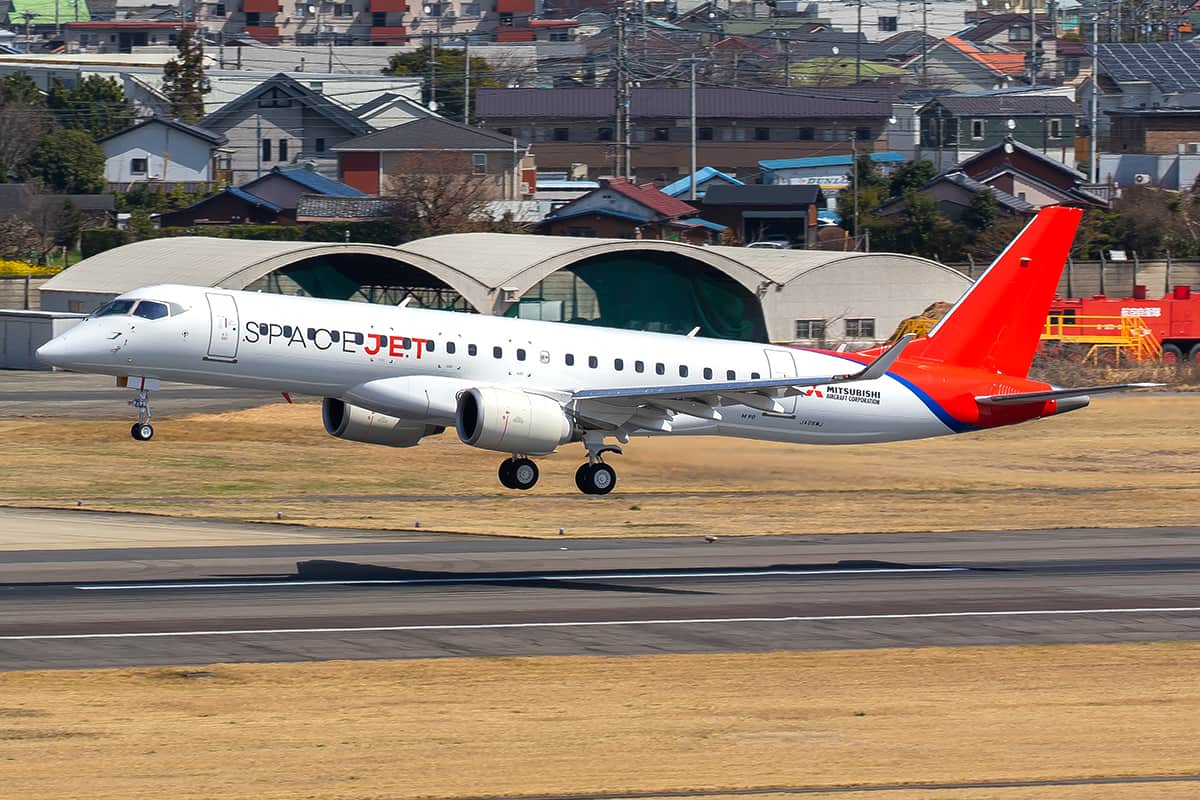
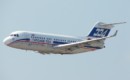
The Mitsubishi SpaceJet was a 92-seat regional jet built to make Japan a commercial aircraft manufacturer again for the first time since the NAMC YS-11. Launched in 2008 as the Mitsubishi Regional Jet and renamed in 2019, it first flew in November 2015 and logged thousands of test hours. It was never certified, never delivered, and was canceled in February 2023.
Live Fleet Activity (MRJ9)
Fetching live data…


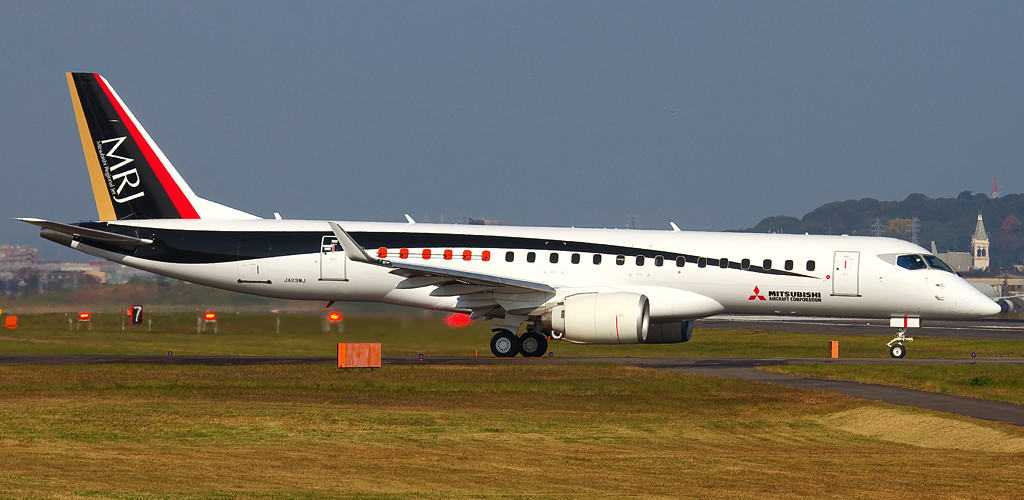


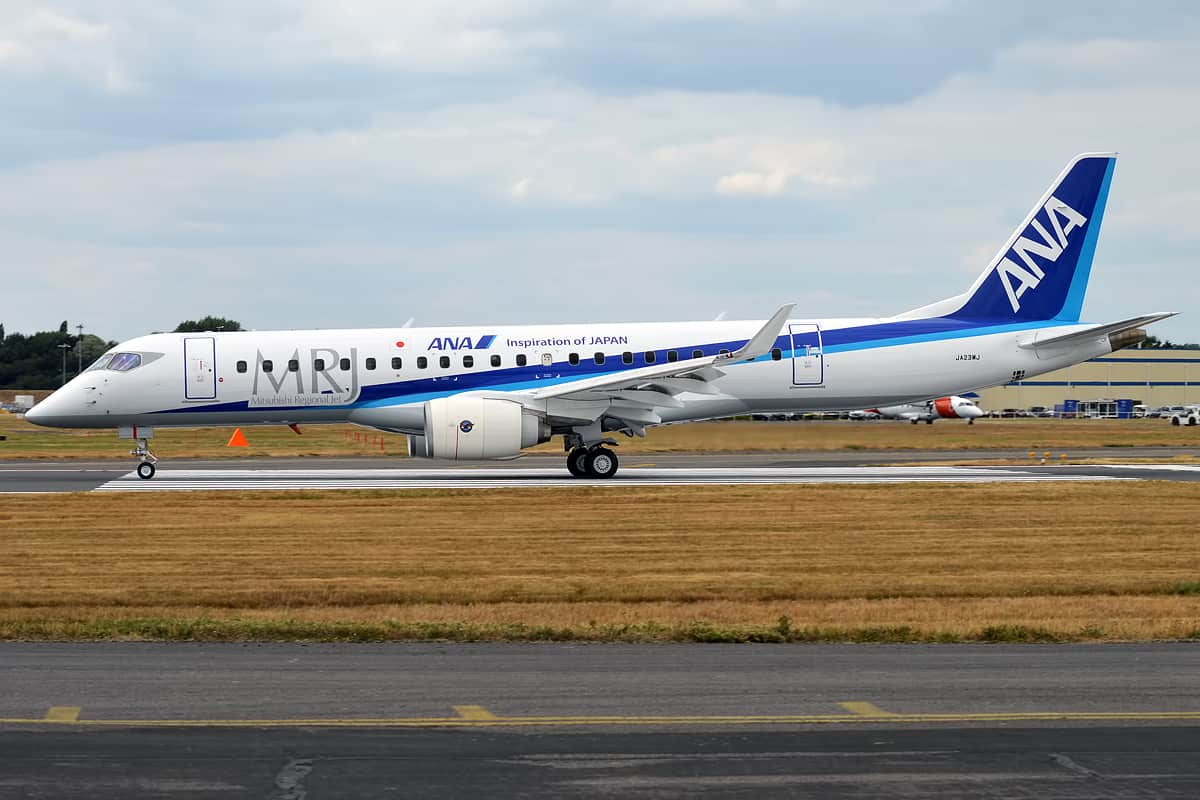

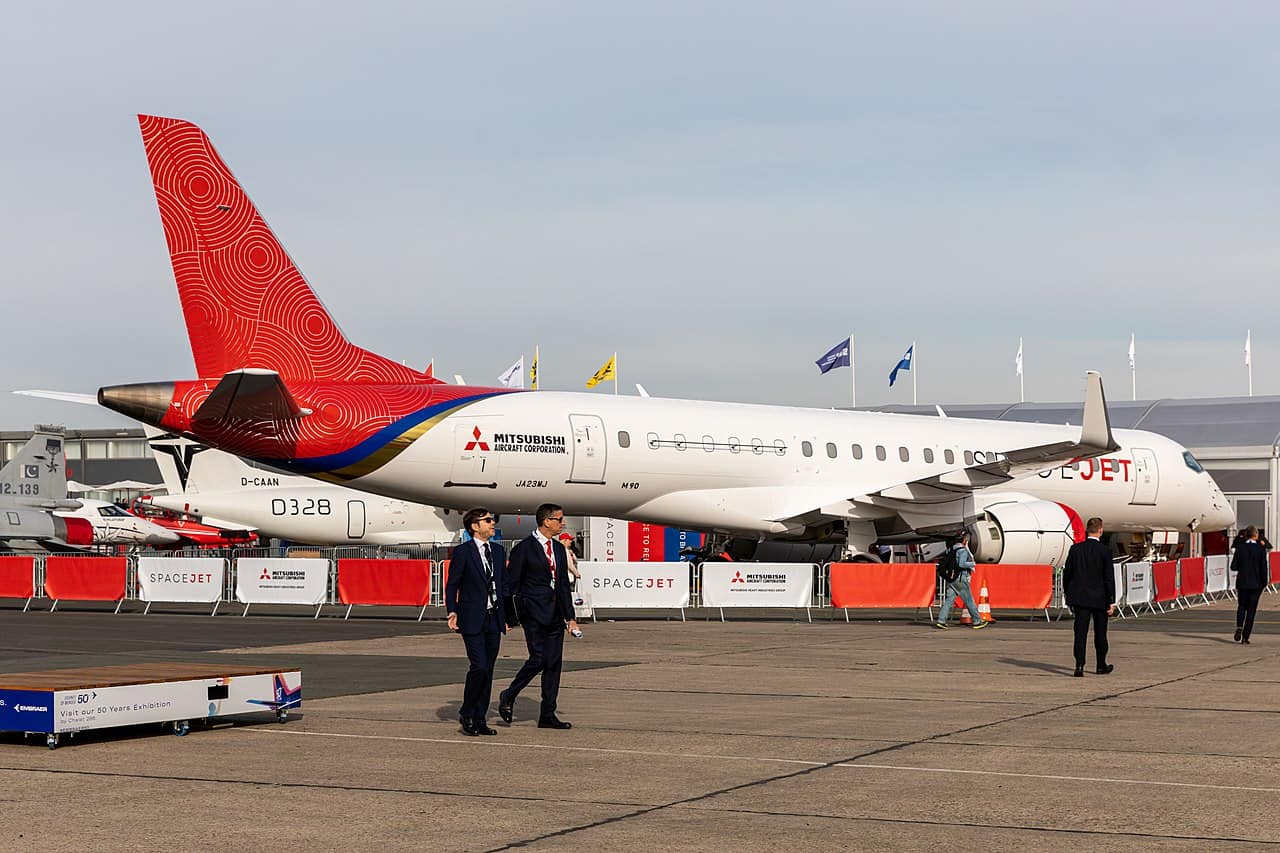
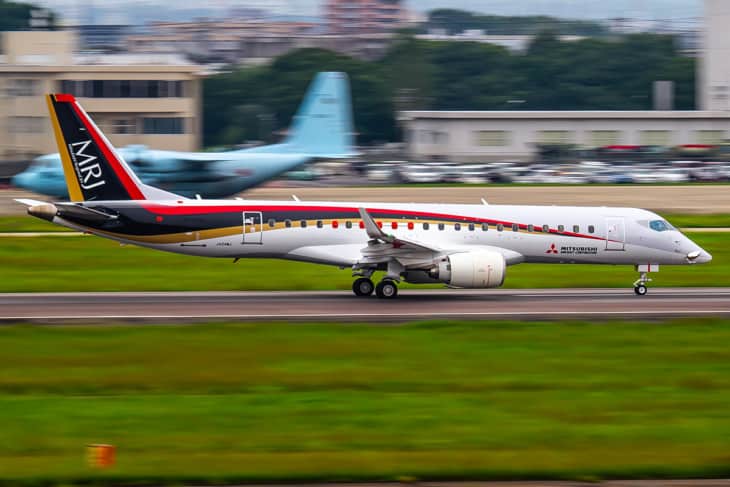
The Mitsubishi SpaceJet was a twin-engine regional jet built to put Japan back into commercial aircraft manufacturing for the first time since the NAMC YS-11 turboprop. It was launched as the Mitsubishi Regional Jet, or MRJ, and renamed in 2019.
It flew. It never carried a paying passenger. After roughly sixteen years of development, five schedule slips and a pandemic that gutted demand for small jets, Mitsubishi Heavy Industries announced on February 7, 2023 that it was discontinuing the program.
The aircraft on this page is the SpaceJet M90, the lead variant, known as the MRJ90 before the 2019 rebrand. Its ICAO type designator is MRJ9.

The program began in 2003 as a government-backed technology study for a 30 to 50 seat regional aircraft. By 2006 it had been refocused on the 70 to 90 seat class, and Mitsubishi showed a full-size cabin mock-up at the 2007 Paris Air Show.
In October 2007 Mitsubishi selected Pratt & Whitney’s new geared turbofan, now known as the PW1200G, over an improved General Electric CF34-10 and a scaled-up Rolls-Royce RB282. The program was formally launched in March 2008 with an All Nippon Airways order for 15 MRJ90s plus 10 options.
The plan at launch called for a first flight in 2011 and service entry in 2013. Neither happened.
A September 2009 redesign replaced the composite wing box with aluminum and widened the cabin, pushing first flight to 2012. Further delays followed in 2012 and 2013. The first flyable airframe was rolled out in October 2014 and flew on November 11, 2015.
Two more delays followed the first flight. In December 2015 delivery moved to mid-2018, and in January 2017 it moved again to mid-2020, this time because wire harnesses had to be rerouted and components in the avionics bay relocated to satisfy certification requirements.
Flight testing shifted to Grant County International Airport at Moses Lake, Washington, because crowded airspace in Japan was causing scheduling difficulties. The fleet had logged about 2,400 flight hours by December 2018 and roughly 2,600 by April 2019.

The MRJ family became the SpaceJet family in June 2019. The MRJ90 became the M90, and the smaller MRJ70 was dropped and redesigned into the M100.
In May 2020 Mitsubishi suspended M100 development and brought all overseas work, including the Moses Lake flight tests, home to Nagoya. That October it paused nearly everything except type certification paperwork. The formal cancellation came just over two years later.
The single most damaging constraint on the SpaceJet had nothing to do with engineering. It was a labor contract clause at three American airlines.
Scope clauses in the pilot contracts at the three US major carriers bar their regional partners from flying aircraft above 86,000 pounds (39,000 kg) maximum takeoff weight, or, with one minor exception, seating more than 76 passengers. The M90’s maximum takeoff weight is 94,358 pounds (42,800 kg), which puts it outside that limit no matter how few seats are fitted.
That mattered because SkyWest, which held the program’s largest order at 100 firm aircraft, is a scope-restricted US regional operator. Forecast International judged in 2021 that the M90 would have to find most of its market outside the United States.
The M100 was Mitsubishi’s answer. In a 76-seat, three-class layout its maximum takeoff weight was held to exactly 86,000 pounds (39,008 kg), making it scope compliant and a direct rival to the Embraer E175 and the Bombardier CRJ900. It never flew.
MRJ90 and SpaceJet M90. The lead variant and the only one built and flown. Mitsubishi originally marketed it in three weight versions: the MRJ90STD at 87,303 pounds (39,600 kg), the MRJ90ER at 90,378 pounds (40,995 kg) and the MRJ90LR at 94,358 pounds (42,800 kg). The heaviest of the three is the configuration the SpaceJet M90 was sold as.
MRJ70. A shorter model, listed by Mitsubishi at 78 seats in a typical single-class layout, also offered in standard, extended-range and long-range versions and powered by lower-rated 15,600 pound-force PW1215G engines. It was canceled in June 2019 and folded into the M100.
SpaceJet M100. The MRJ70 stretched by 3.6 feet (1.1 m), with smaller winglets, more seats and bigger overhead bins. It was designed around the US scope limit, and its development was suspended in May 2020 and never resumed.
SpaceJet M200. A proposed stretch seating up to 100 passengers, tentatively aimed at a 2026 service entry. It was never formally launched.
The M90 is powered by two Pratt & Whitney PW1200G geared turbofans rated at 17,600 pound-force (78.2 kN) each. The gearbox between fan and low-pressure turbine lets each run at its own best speed, which is where the family’s fuel burn and noise gains come from.
The airframe is a conventional swept-wing, low-wing design with underwing engines, a swept fin and tailplane, a circular fuselage and retractable tricycle landing gear with twin wheels on each unit. Compared with the earlier MRJ configuration, the SpaceJet made greater use of aluminum-lithium alloys and carbon composites, which on the MRJ had been concentrated in the tail.

Flight controls are fly-by-wire. The flight deck is built around Collins Aerospace Pro Line Fusion with four 15-inch landscape displays.
The cabin seats four abreast, with a single aft cargo compartment holding 18.2 cubic meters (643 cu ft). The forward and aft holds of the original design were combined into one during the 2009 redesign.
The full specification table for the aircraft is on this page. Three of its figures need context, because published sources quote them in ways that do not obviously line up.
Range. The 2,040 nautical mile figure is the SpaceJet-era number, quoted with 88 passengers aboard. Mitsubishi’s own earlier MRJ90 table gave 1,780 nautical miles for the same heaviest LR version at full passenger payload, and much shorter figures for the lighter STD and ER versions. The range you see quoted for this aircraft therefore depends entirely on which version and which loading the source had in mind.
Speed. Mitsubishi published a maximum operating Mach number of 0.78 and no separate higher top speed, so cruise and maximum are effectively the same figure here. ICAO’s type designator entry converts that to 447 knots, which is the number stored in the speed fields above.
Weight. The 42,800 kg maximum takeoff weight is the long-range version. Two lighter certified weights existed, and the difference is not academic: it is the gap between an aircraft that misses the US scope limit by 8,358 pounds and one that misses it by 1,303 pounds. Neither fits.
At its peak the program had attracted about 450 orders and commitments, with Japan Airlines and All Nippon Airways among the customers. Many were later canceled.
Forecast International counted 153 firm orders and 114 options and purchase rights for the M90 as of February 2021. SkyWest accounted for 100 firm orders and 100 options, Japan Airlines for 32, and All Nippon Airways for 15 firm and 10 options.

Not one aircraft was ever delivered. The type never received a type certificate from the Japan Civil Aviation Bureau, which is the document that would have allowed deliveries to begin.
Mitsubishi’s public explanation was commercial. The company said it had “failed to confirm sufficient business viability,” and MHI president Seiji Izumisawa told reporters the firm “lacked the know-how” to develop passenger jets.
The company also said it had found it “difficult to obtain understanding and necessary cooperation from global partners,” and that further extensive funding would have been needed to get the design approved.
Underneath that, four problems compounded. Certification experience was the first, and Izumisawa said so plainly: the 2017 rerouting of wire harnesses and relocation of avionics bay components was late work redone because the original design did not satisfy certification requirements.
The scope clause was the second, because it locked the only flying variant out of the US regional market. Time was the third, since a decade of delay gave the E175 a long run at the scope-limited US regionals that the M100 was eventually drawn up to win back.
The pandemic was the fourth. Demand for new regional jets collapsed in 2020, which is when Mitsubishi halved the budget, shelved the M100 and then paused the program.
Reported development spending had reached 350 billion yen, about 3.17 billion dollars, by 2017 and kept climbing afterward. MHI stated that the cancellation itself would have no material impact on its results, consolidated or non-consolidated.
The flight-test fleet was broken up after cancellation. All but one of the test airframes were dismantled.
One airframe survives. The tenth aircraft built was completed in January 2020 and made its first flight from Nagoya Airport on March 18, 2020, logging 48 flight hours before the program stopped.
It is being preserved at the Aichi Museum of Flight, which already displays a YS-11. As of September 2026 the museum’s announced plan was to close for about six months in the first half of 2026 to install the aircraft, with the exhibit opening to the public in the second half of the year.
Mitsubishi Aircraft Corporation, the subsidiary set up in April 2008 to run the program, was put into liquidation and renamed MSJ Asset Management in April 2023.
In March 2024 Japan’s Ministry of Economy, Trade and Industry unveiled a plan for a new domestically developed passenger aircraft, ready after 2035, backed by up to five trillion yen, about 33 billion dollars, of public and private investment in the industry over the following decade.
The structure is the deliberate opposite of the SpaceJet’s. Rather than one company carrying the program, it is framed as a public-private effort with multiple partners, explicitly to spread the risk.
The technologies named are hydrogen combustion, hydrogen fuel cells and hybrid-electric propulsion, which means the next Japanese airliner is not intended to be a conventional regional jet at all.
Mitsubishi Heavy Industries discontinued the program on February 7, 2023, saying it had failed to confirm sufficient business viability and that further extensive funding was needed to get the design certified. Sixteen years of development, five delivery delays, a type certificate that never arrived, a maximum takeoff weight that locked the aircraft out of the US regional market, and a pandemic collapse in demand all contributed.
Yes. The first aircraft flew on November 11, 2015, and the flight-test fleet accumulated roughly 2,600 hours by April 2019, much of it at Moses Lake, Washington. It never carried a paying passenger and no aircraft was ever delivered to a customer.
Reported development spending had reached 350 billion yen, around 3.17 billion dollars, by 2017, and it continued for another six years after that. MHI said the cancellation itself would have no material impact on its financial results.
They are the same aircraft. Mitsubishi rebranded the MRJ family as the SpaceJet family at the Paris Air Show in June 2019, and the MRJ90 became the SpaceJet M90 at that point.
The M90 is the longer aircraft, at 117 ft 5 in (35.8 m) with a 95 ft 10 in (29.2 m) wingspan, and it was the only variant that flew. The M100 was a shorter redesign of the dropped MRJ70, built specifically to meet the US 86,000 pound (39,000 kg) scope limit in a 76-seat layout. Its development was suspended in May 2020 and it was never built.
Bombardier designed, certified and built the CRJ900. Mitsubishi’s name attaches to it only because MHI agreed in June 2019 to buy the CRJ program’s maintenance, support and type certificate business from Bombardier, a deal that closed in 2020 and created MHI RJ Aviation. The aircraft itself is a Bombardier design.
Not complete commercial aircraft of its own. MHI lists its aviation business as supplying main components of commercial aircraft such as main wings and fuselages, civil aeroengines, and aftermarket maintenance services. In June 2026 it established Aero Breath, a maintenance joint venture with JAL Engineering in Aichi Prefecture, owned 51 percent by JAL Engineering and 49 percent by MHI, which plans to start regional aircraft maintenance within fiscal 2026.
Yes, though not many. A few dozen Mitsubishi A6M Zero airframes survive in museums around the world, and only a small number are airworthy. The Planes of Fame Air Museum in Chino, California, flies an A6M5 that it says is the only authentic A6M flying, still turning its original Nakajima Sakae engine.
Mitsubishi built the A6M Zero, designed by Jiro Horikoshi as a long-range carrier-capable fighter for the Imperial Japanese Navy. It was adapted for kamikaze operations in the final phase of World War II, which is not what it was built for. Mitsubishi’s modern aviation work has no connection to it beyond the company name.
The Embraer E175 above all. Mitsubishi drew up the scope-compliant M100 expressly to compete with the E175 and the Bombardier CRJ900 in that seat class, and the decade the SpaceJet spent in development was a decade the E175 spent winning those customers.
Sources and references used for research and fact-checking.


.jpg)
