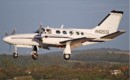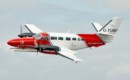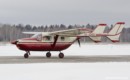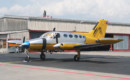
Twin Turboprops
Cessna 411
ICAO: C411
The Cessna 337 Super Skymaster is a push-pull twin with one engine in the nose and one behind the cabin, built from 1963 to 1982 so a failed engine never leaves the pilot fighting asymmetric thrust.
Updated: by Tim de Vries

The latest aviation news and stories sent to your inbox.
The Cessna 337 Super Skymaster is an American twin-engine civil utility aircraft with a push-pull layout: one engine pulls from the nose and one pushes from behind the cabin. More than 2,900 Skymasters of all models were built, including about 500 military O-2 versions, making it the most commercially successful push-pull aircraft ever sold.
Live Fleet Activity (C337)
Fetching live data…


The Cessna 337 Super Skymaster is a push-pull twin: one engine pulls from the nose and the other pushes from behind the cabin. Both sit on the fuselage centerline, so losing one engine does not twist the airplane toward the dead side.
That single design choice is why it exists, and also why it has such a loyal following and such a mixed reputation.
The story starts with the Model 336, which first flew on February 28, 1961, with fixed landing gear. Cessna built about 195 of them in 1963 and 1964.
The 337 Super Skymaster arrived in February 1965 as a bigger, stronger follow-up. It added retractable landing gear, more powerful 210 hp Continental IO-360 engines and a dorsal air scoop to feed the rear engine.
The turbocharged T337 followed in 1966, and a pressurized version, the P337G, in 1973. Production in the United States ended in 1982, with roughly 2,993 Skymasters of all types built, about 513 of them military O-2s, according to Jane’s.
A conventional piston twin is dangerous when an engine quits. The thrust on the working side yaws and rolls the airplane, and a slow pilot can lose control entirely.
The Skymaster removes that problem. With both engines on the centerline, an engine failure costs power but not directional control, so the airplane keeps flying straight.
The aircraft is so different that pilots need a separate centerline thrust rating rather than a standard multiengine rating. Insurers often require around 15 hours of dual instruction before a new owner flies solo.
Single-engine climb is modest, as in any light twin. Owners typically quote a few hundred feet per minute, and it is best on the rear engine with the gear up.
The gear is the catch. Leaving it down costs more than 100 feet per minute, and the transition itself adds drag from the gear doors. A heavy, slow approach on one engine with the gear cycling can sink the airplane onto the runway.
One rule is absolute: a single-engine takeoff is prohibited. FAA Airworthiness Directive 77-08-05 requires a placard reading “Do not initiate single engine takeoff.” Pilots who did not notice a dead rear engine and took off on the nose engine alone have crashed on short runways.
The full specification table for the aircraft is on this page. A few figures need context.
The published speeds come from Jane’s T337C figures, which list a top speed at sea level and a slower economy cruise at 10,000 feet. Normally aspirated owners report cruising well below the top speed, while turbocharged and pressurized models are noticeably faster at high altitude.
The range in the table is the normal-fuel economy figure. Auxiliary tanks raise the usable fuel load above the normal tank capacity, and owners report burning 15 to 22 gallons an hour in total.
The 337A through 337H were built in regular and turbocharged forms, and the pressurized P337G and P337H were the top of the line. Reims Aviation in France built the F337 series from 1970 to 1978 and later the FTB337 short-field version.
The US Air Force bought hundreds of military versions as the O-2A and O-2B. California’s forestry department flew O-2s for firefighting from 1976 until the mid-1990s.

The type also flew in combat for others. The Rhodesian Air Force used the Reims FTB337G “Lynx” as its main light attack aircraft in Fire Force operations from 1974, and Portugal operated 32 until July 2007.
The Skymaster has a reputation as a maintenance hog, though AVweb says it is not entirely deserved. Systems are packed tightly into the fuselage, which makes access slow and labor expensive.
Owners commonly report oil leaks around the rear engine, a weak 30-amp charging system and hydraulic leaks. Early models had a complicated multi-tank fuel system and a gear hydraulic setup that Cessna revised in 1973, and many accidents trace back to fuel mismanagement.
Rear-engine overheating is a common worry, especially on the ground in hot weather. It can usually be managed with the cowl flaps and mixture, and one Florida owner calls the overheating stories “just rumors” as long as the front engine is running.
The front propeller can also throw debris into the rear one, so the airplane is a poor choice for gravel strips. Cabin noise is high because passengers sit between the engines.
Used prices are low for a twin. AVweb reports a reasonably equipped Skymaster for under $100,000, with neglected airframes at $20,000 to $40,000 and well-kept ones with updated avionics passing $100,000.
The purchase price is the cheap part. Owners report parts and labor averaging several thousand dollars a year, an annual inspection one owner’s mechanic estimated at under $4,000, and insurance around $2,000 a year on a mid-value hull.
Check the wing spar inspections before buying. They fall due on a fixed schedule at high airframe hours and can, in the worst case, mean replacing spars.

For the right owner, yes. It offers twin-engine redundancy at a low purchase price, a roomy cabin, excellent visibility and stable IFR flying.
It is a poor fit for someone who cannot afford proper maintenance or fly regularly, since AVweb warns the airplanes can waste away on the ramp. Treat it as a roomy four-seater, not a true six-seater, because of weight and balance.

Used Cessna 337s commonly sell for under $100,000, according to AVweb. Neglected airframes can cost $20,000 to $40,000, while well-maintained ones with updated avionics can exceed $100,000.
Only some are. The P337G and P337H models are pressurized, and the basic and turbocharged versions are not. Pressurized models are limited to five occupants.
There is no official answer, and the Skymaster is not a candidate. It has a poor early reputation, which the Cessna Owner Organization attributes mostly to inadequate pilot training rather than design flaws.
It is a good plane for owners who can afford its maintenance. It combines twin-engine redundancy, centerline thrust and stable IFR handling at a low purchase price.
The push-pull layout keeps both engines on the centerline. If one fails, the airplane does not yaw and roll toward the dead side, which removes the biggest danger of a conventional light twin.
Sources and references used for research and fact-checking.