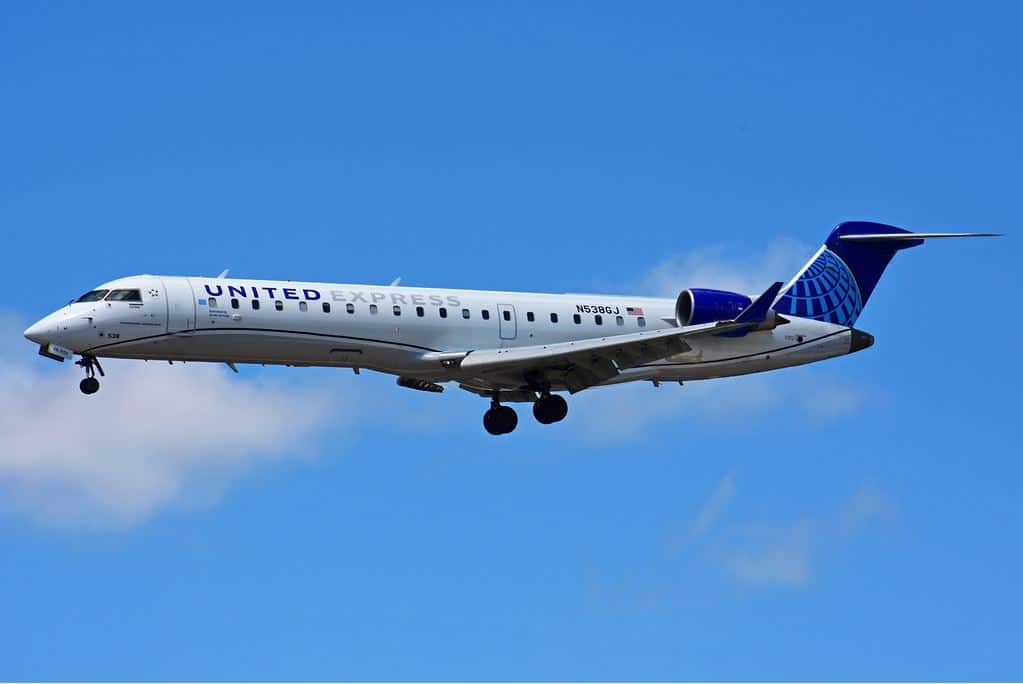
Bombardier CRJ 550 — a scope-compliant evolution of the CRJ700
The CRJ 550 is based on the CRJ700 airframe but is certified for a maximum of 50 passengers, allowing it to comply with restrictive pilot union scope clauses in the United States. Launched in 2019 and entering service with United Express in 2019, the aircraft was developed to give airlines a way to operate within contractual limits while improving onboard comfort.
Instead of adding seats, the CRJ 550 removes them. The aircraft features a three-class layout with first class, premium economy, and standard economy seating. The reduced passenger count allows for larger galleys, expanded storage space, and additional amenities not typically found on smaller regional jets. The cabin retains the narrow fuselage design common to the CRJ family but offers a more spacious feel through improved layout efficiency.
Performance remains largely consistent with the CRJ700 platform, including similar range and operational capability. The aircraft is powered by General Electric CF34 engines and maintains the strong short- to medium-range performance that defines the CRJ series.
The CRJ 550 represents a creative business solution rather than a technical redesign. By adapting an existing aircraft to meet contractual constraints, Bombardier extended the life of the CRJ platform and provided airlines with a way to deliver a more premium regional product without exceeding regulatory limits.
Development
The CRJ 550 concept originated from airlines seeking a regional jet that met contractual crew and aircraft size limits while offering a higher-yield product. Program intent emphasized cabin differentiation over airframe redesign, aiming to retain existing operational procedures and commonality where possible. Bombardier elected a cabin-centric approach to minimize development risk and time to market.
Prototypes underwent interior fit trials to validate galley placement, lavatory arrangements, and emergency egress with the reduced seating plan. These trials focused on human factors, including passenger flow during boarding and deplaning and service workflows for a multi-class cabin on a single-aisle regional jet. Structural changes were kept minimal to accelerate entry into service.
Certification work concentrated on ensuring compliance with airworthiness standards for interior arrangements, stowage, and evacuation with the altered cabin configuration. Modifications to interior fittings, placarding, and mass and balance documentation formed the bulk of the regulatory submissions. Production context relied on existing manufacturing lines and supplier relationships to introduce the revised interiors without establishing a new airframe production stream.
Program planning considered aftermarket support and parts commonality to simplify operator transition. Maintenance procedures and training syllabi for cabin crew were adapted to reflect the three-class service concept on a regional platform. Logistics adjustments emphasized continuity with preexisting service networks rather than creating separate supply chains.
Design
The cabin design centers on distinct zones arranged to provide varied levels of comfort and service. Seat pitch and widths are allocated to create a perceivable step between premium and standard sections. Galley and service equipment are scaled to support a higher level of onboard catering than typical regional single-class operations.
Interior architecture includes expanded stowage and dedicated closets for catering and service trolleys, along with upgraded lavatory provision envisaged to serve multiple cabin classes. Lighting and finish selections aim to enhance perceived space within the narrow single-aisle fuselage, employing cabin systems to deliver adjustable mood lighting and improved passenger amenities.
Structurally the aircraft retains the original pressure shell and primary airframe, with modifications largely limited to interior attachments and reinforced floor fittings for heavier galleys. Weight management required recalibration of load plans and cargo distribution to maintain center of gravity limits with a nonstandard passenger and baggage mix.
Avionics and cockpit arrangements reflect a philosophy of minimal change to flight systems, preserving common pilot type ratings and operational procedures. Flight deck ergonomics remain aligned with existing regional jet practice, while cabin systems integrate modern connectivity options and passenger service units consistent with contemporary expectations.
Reduced passenger load affects the aircraft’s mission flexibility by altering typical payload-range tradeoffs. With fewer seats and increased onboard service equipment the available payload for revenue cargo changes, influencing how operators plan stage lengths and payload mixes. Fuel consumption per flight hour remains governed by the airframe and engines used, but per-passenger fuel efficiency improves with lower seating density on many missions.
Climb and cruise performance are influenced principally by the unchanged propulsion installation and aerodynamics. Operators report that the aircraft performs within the normal regional-jet envelope for short- to medium-stage lengths, permitting operation into airports with steep procedures or field-length constraints typical of regional networks.
Operational limitations are principally administrative rather than aerodynamic. The aircraft is intended to be deployed on routes constrained by contractual or labor agreements, which shapes range and scheduling decisions. Weight and balance constraints for mixed-class cabins require careful load manifesting, especially on shorter sectors with high baggage volumes.
Endurance and ceiling are driven by the installed environmental control and fuel systems. Cabin environmental controls support sustained operations in typical regional climates while heating ventilation demands increase with higher-service galleys and amenities. Mission planning therefore accounts for service weight and potable water loads when assessing endurance margins.
Variants
This model is a cabin reconfiguration of an established regional jet rather than a distinct airframe family. No major structural or propulsion derivatives are part of the basic offering beyond optional interior packages tailored to airline requirements. Optional fitments include upgraded galley modules, additional or reconfigured lavatories, and alternate front-cabin layouts configured for first class or premium economy.
Special mission conversions have been explored by third parties for executive transport and corporate shuttle roles, leveraging the aircraft’s enhanced cabin volume and existing systems. These conversions focus on luxury fitments, secure communications, and flexible interior layouts while retaining the underlying airframe and flight systems.
Some operators select bespoke cabin finishes and seat manufacturers to align the interior with their brand standards. These options are managed as supplier-led packages to preserve commonality in maintenance and to avoid changes that would require additional certification.
Operational History
The type entered service with U.S. regional operations where contractual limitations on aircraft size and crew work rules are significant. Operators deploy it primarily on trunk and feed routes for major carriers, using the aircraft to provide a premium regional product between hub and spoke points. Scheduling emphasizes frequency and service level rather than maximum seat count.
Cabin crews adapt standard regional service flows to a three-class environment, with modified trolley sequences and boarding procedures developed to maintain on-time performance. Ground handling and catering suppliers adjusted provisioning and turnaround processes to support larger galleys and expanded amenity sets within typical regional turn times.
Fleet experience shows that the aircraft fits niche network requirements where passenger demand favors comfort and higher yields over seat density. Dispatch reliability aligns with the broader regional-jet fleet, and maintenance planning benefits from spares commonality with the donor airframe. Operators report favorable passenger feedback for comfort-related features compared with single-class regional jets.
Operational economics are influenced by yield management and route selection. Airlines using the type balance the higher per-seat cost against premium fares on specific markets. Deployment decisions factor in stage length, market willingness to pay for premium cabins, and the ability to maintain high load factors despite lower nominal seat counts.
Legacy
The program demonstrates a market approach that prioritizes interior differentiation to meet contractual constraints without major airframe redevelopment. Lessons include the viability of cabin-focused product strategies to access higher-yield passengers on regional routes and the operational value of maintaining systems and pilot commonality when modifying in-service types.
Technological influence is limited to interior systems integration and supplier coordination practices rather than airframe innovation. The program reinforced the importance of adaptable cabin architectures for regional fleets, informing how airlines specify interiors for both customer experience and operational compliance.
Program impact is observable in fleet planning philosophies that consider service level as a lever for revenue optimization in constrained markets. The model underscores the tradeoffs between seat count and service quality and provides a case study in leveraging existing platforms to achieve commercial objectives without large capital investment.
Successor planning for similar market needs emphasizes modular cabin designs and flexible supplier arrangements that can be introduced with minimal disruption to maintenance and training infrastructures.