

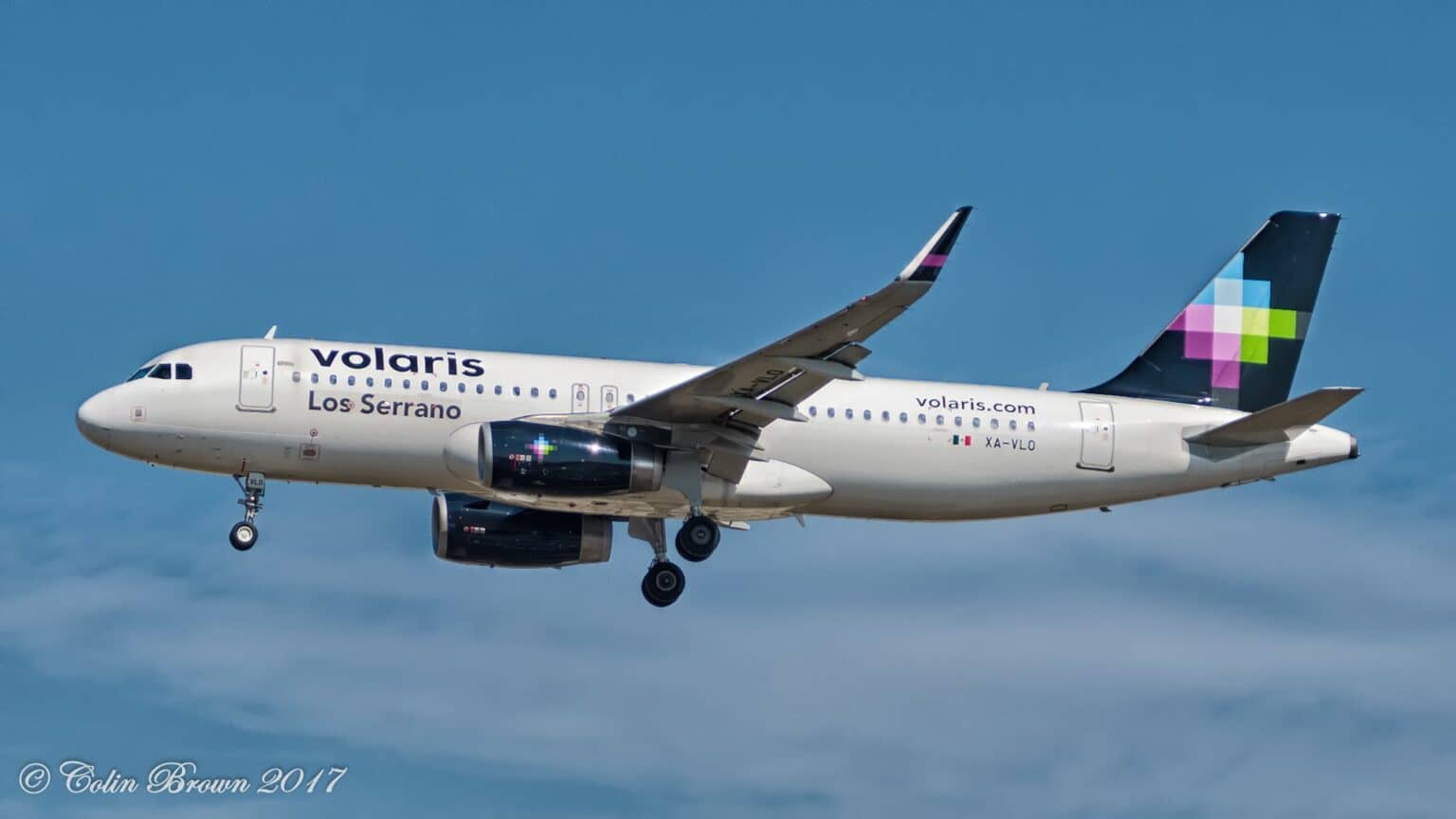
Volaris flight Y43120 from Tijuana to Puerto Vallarta hit clear air turbulence on Friday, October 30, 2026, injuring some passengers and crew members, the airline said. Volaris has not said how many people were hurt or how badly.
The jet continued to its destination, and those who needed it received attention on arrival. FlightAware’s tracking data adds another detail: the aircraft flew again about two hours after landing.
What Volaris has said
The airline’s statement, carried by Uniradio Informa, says the aircraft experienced clear air turbulence during the flight and that this caused injuries to some passengers and crew. It says those who needed it received additional attention on arrival in Puerto Vallarta.
Volaris added that it will follow the health of those involved and give them support. “We wish a speedy recovery to all those affected,” it said, in AeroCorner’s translation from Spanish.
TV Azteca Baja California reported that no further details were available on possible hospital transfers. AeroCorner found no public statement on the flight from AFAC, Mexico’s civil aviation agency, as of November 1.
The aircraft and the flight
Reports differ on the type. The Aviation Herald names an Airbus A320-200, registration XA-VLO, while Punto Norte says an A321.
Volaris’s statement, as quoted, names no type. FlightAware and FlightStats both list XA-VLO on this flight as an A320, which supports The Aviation Herald’s version.
FlightAware shows the jet taking off at 9:40 a.m. Pacific time and landing at Puerto Vallarta at 12:55 p.m. Central time, about two hours and 15 minutes later. FlightStats has it at the gate at 12:59 p.m., 18 minutes ahead of schedule.

Punto Norte’s times of 9:34 a.m. and 1:17 p.m. match the published schedule on FlightStats, not the actual movements.
The track does not reveal where the turbulence struck. It holds 31,000 feet from about 9:58 a.m. Pacific until the descent begins at about 12:31 p.m. Central, with no visible altitude change.
Those readings arrive roughly every 30 seconds, so a sharp jolt lasting seconds would not necessarily appear. Neither Volaris nor The Aviation Herald gives a time, position or altitude for the encounter.
A quick turnaround, and a 21-hour gap
The Aviation Herald says the aircraft stayed on the ground in Puerto Vallarta for about 21 hours. FlightAware’s data points to a different place for that pause.
It lists XA-VLO taking off from Puerto Vallarta as VOI3121 at 2:53 p.m. local time the same day, about two hours after landing, and reaching Tijuana at 4:20 p.m. Pacific. Its next listed flight left Tijuana at 1:16 p.m. on October 31, roughly 21 hours later.
Volaris’s statement, as carried by local outlets, does not mention the aircraft’s condition, any inspection or the reason for the pause. The tracking data shows only that the jet moved, not what was done to it on the ground.
What is still unknown
Volaris has not given the number of people injured, how serious the injuries are, whether anyone went to a hospital, where the flight was when it hit the turbulence, or whether the seat belt sign was on. The clear air description is the airline’s own, and AeroCorner found no investigator confirming it as of November 1.
What clear air turbulence means for a cabin
The term has a specific meaning. In its safety study of US airline turbulence accidents from 2009 through 2018, the NTSB tied convective encounters to strong radar returns or visible storm clouds, and clear air encounters typically to jet streams, the tropopause or upper-level fronts.
Clear air turbulence was present in 32 of the 111 accidents in that study, against 64 for convective turbulence. The figures cover US carriers, not Mexican ones.
Turbulence mostly hurts people, not airplanes: most of those accidents involved one or more serious injuries and no aircraft damage.
Flight attendants made up 97 of the 123 people seriously injured. Only one of the 123, a passenger, was documented as wearing a seat belt.
On October 9, Avianca flight AV42 diverted to Miami after severe turbulence on its way to New York.
How serious is serious?
ICAO’s Annex 13, as reproduced by SKYbrary, counts an injury as serious if it requires more than 48 hours in a hospital, breaks a bone other than a simple fracture of a finger, toe or nose, or damages an internal organ, among other tests. Nothing public yet says whether any injury on Y43120 meets that bar.
Volaris had a comparable event in 2018. On September 26 that year, its flight 423 from Guadalajara to Tijuana hit turbulence at 34,000 feet, and authorities counted 29 people hurt, Mexico News Daily reported.
The airline said it sent 12 people to hospitals and that all were released the next morning, well short of 48 hours. A long injury list and a serious injury count can be different numbers, and for Y43120 neither is public.
Sources and references used for research and fact-checking.
- Volaris, Statement on flight Y43120 (via Uniradio Informa Baja California)
- FlightAware, VOI3120 TIJ-PVR, October 30, 2026 flight history and track
- FlightAware, XA-VLO flight history
- FlightStats, Y4 3120 October 30, 2026 flight tracker
- NTSB, Preventing Turbulence-Related Injuries in Air Carrier Operations Conducted Under Title 14 CFR Part 121 (Safety Research Report NTSB/SS-21/01)
Get the Newsletter
The latest aviation news and stories sent to your inbox.
About the Author

AeroCorner News is the aviation news desk of AeroCorner.com. It covers accidents and incidents, safety rulings, airline and airport disruption, and new aircraft. It works from primary sources such as the NTSB, FAA, EASA and the manufacturers' own announcements.