

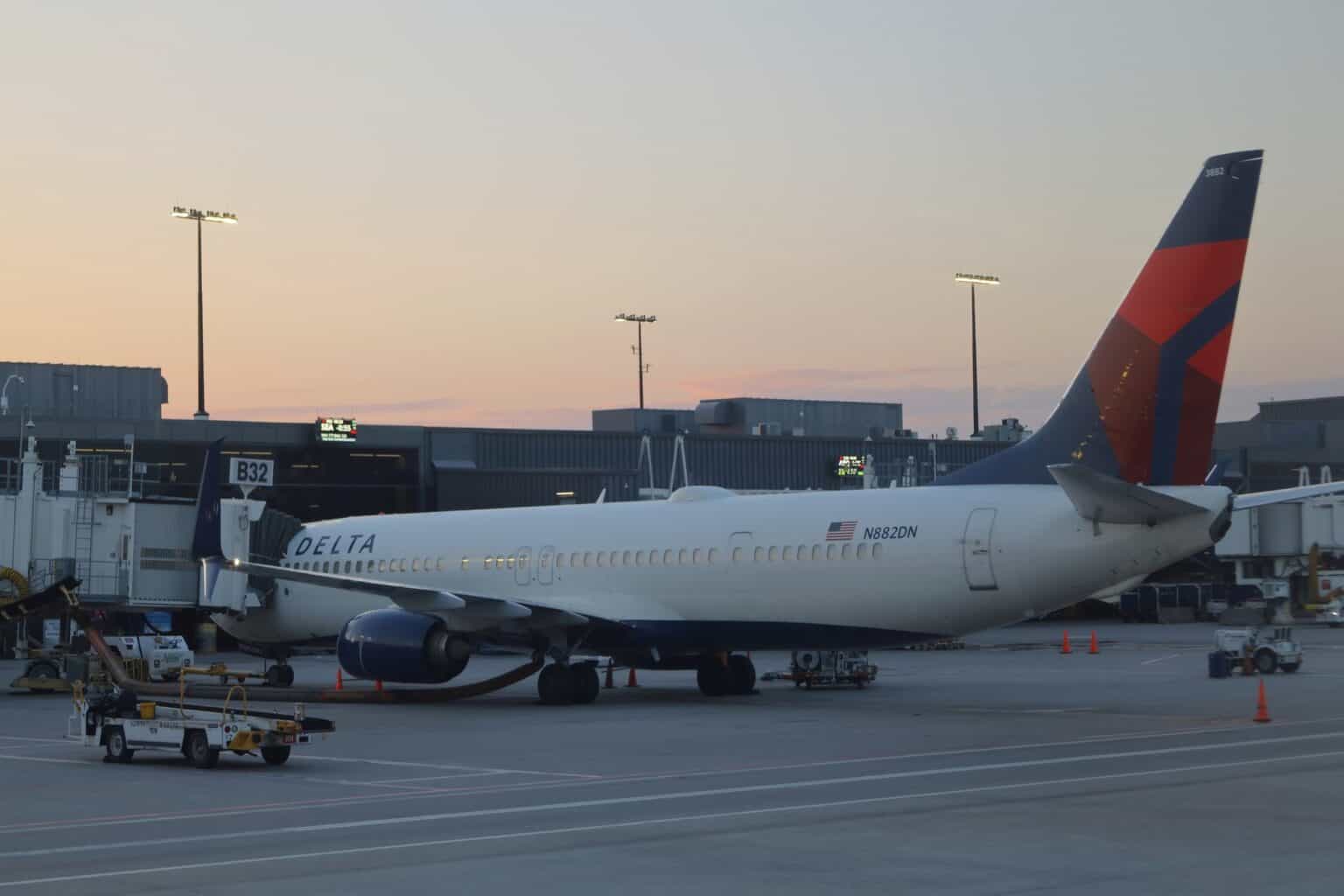
Delta Air Lines flight DL1264 from Chicago declared an emergency on Saturday, October 31, 2026, after a smoky odor was detected on board. The Boeing 737-900 landed safely at Hartsfield-Jackson Atlanta International Airport with 130 passengers and six crew.
The plane taxied to the gate under its own power, and Delta has not said what caused the smell.
What Delta and the tracking data show
Delta’s account was reported by WSB-TV in Atlanta. The airline said the crew “followed established procedures to land the aircraft safely without incident,” and the station said the emergency was declared as the plane approached Atlanta, to receive priority handling from air traffic control.
Atlanta News First reported that fire trucks met the plane on the tarmac before it went to the gate, and that no injuries were reported. The two reports do not say whether the odor was noticed in the cabin or the cockpit.

The timing differs by source. Atlanta News First put the landing just before 8 a.m., while FlightAware recorded it at 8:14 a.m. Eastern and the arrival at gate C36 at 8:33 a.m., four minutes behind schedule by FlightStats’ count.
FlightAware shows the jet took off from Chicago O’Hare at 5:49 a.m. Central and cruised at 37,000 feet, and neither tracker lists a diversion. Its track cannot show when the odor was detected.
Both trackers identify the aircraft as N882DN. FAA registry records list that tail as a Boeing 737-900ER built in 2017, with CFM engines.
FlightAware’s history for N882DN listed no completed flight after that landing when checked early on November 1, and still showed that evening’s trip to Louisville as scheduled. That does not establish why, and Delta has not said whether the jet was held for inspection.
As of early November 1, Delta’s news site carried no statement on the flight. The FAA’s incident statements page had no entry for it either; its newest listing was dated October 30.
Why a smell is treated as a possible fire
Declaring an emergency does not mean a crew has found something dangerous. The FAA’s Aeronautical Information Manual says an aircraft is in at least an urgency condition the moment the pilot becomes doubtful about any condition that could adversely affect flight safety.
Odor gets particular respect. The FAA’s advisory circular on in-flight fires says fumes may be one of the first indications of an impending fire, and tells crews: “Never ignore a strange odor.”
The reason is time. The same circular says a fire allowed to spread into the overhead area may become uncontrollable in as few as 8 to 10 minutes, and that a crew may have as few as 15 to 20 minutes to get on the ground if a hidden fire progresses without intervention.
That is why it says smoke, fire or fumes checklists should open with the pilots putting on oxygen masks. It also notes that the vast majority of cabin events are controlled and do not need an emergency landing, and no report says what DL1264’s crew did on the flight deck or that any fire was found.
A smell does not have to mean fire. On most large airliners, the FAA says, the ventilation mix is about half fresh or engine bleed air and half recirculated air, and in rare instances failures such as an engine oil seal or a recirculation fan bearing can let fumes into the cabin.
Airlines must file a Service Difficulty Report when smoke, vapor or noxious odors enter the cockpit or cabin. A 2015 FAA report put cabin air quality events at fewer than 33 per million departures.
Not Delta’s first smoke or odor report in recent months
At least two other Delta flights returned to Atlanta in August over smoke or a smell. On August 8, Flight 2204, a 757 bound for Orlando, came back with cockpit smoke and passengers left by the slides, and on August 13 Flight 1334 to Fort Lauderdale returned over a smoky odor.
FAA statements list three more within three days in September: smoke in the cabin of Flight 1035, a fuel smell on Flight 1390 and an electrical odor in the cockpit of Flight 958. On September 27, DL251 from Barcelona landed in Porto after smoke was reported in the cabin.
The flights with a published type span the 757, the 767, the A220 and the A330, and nothing published links any of them to DL1264. A list like this, with no count of Delta’s total departures beside it, says little by itself about risk.
Sources and references used for research and fact-checking.
Get the Newsletter
The latest aviation news and stories sent to your inbox.
About the Author

AeroCorner News is the aviation news desk of AeroCorner.com. It covers accidents and incidents, safety rulings, airline and airport disruption, and new aircraft. It works from primary sources such as the NTSB, FAA, EASA and the manufacturers' own announcements.