

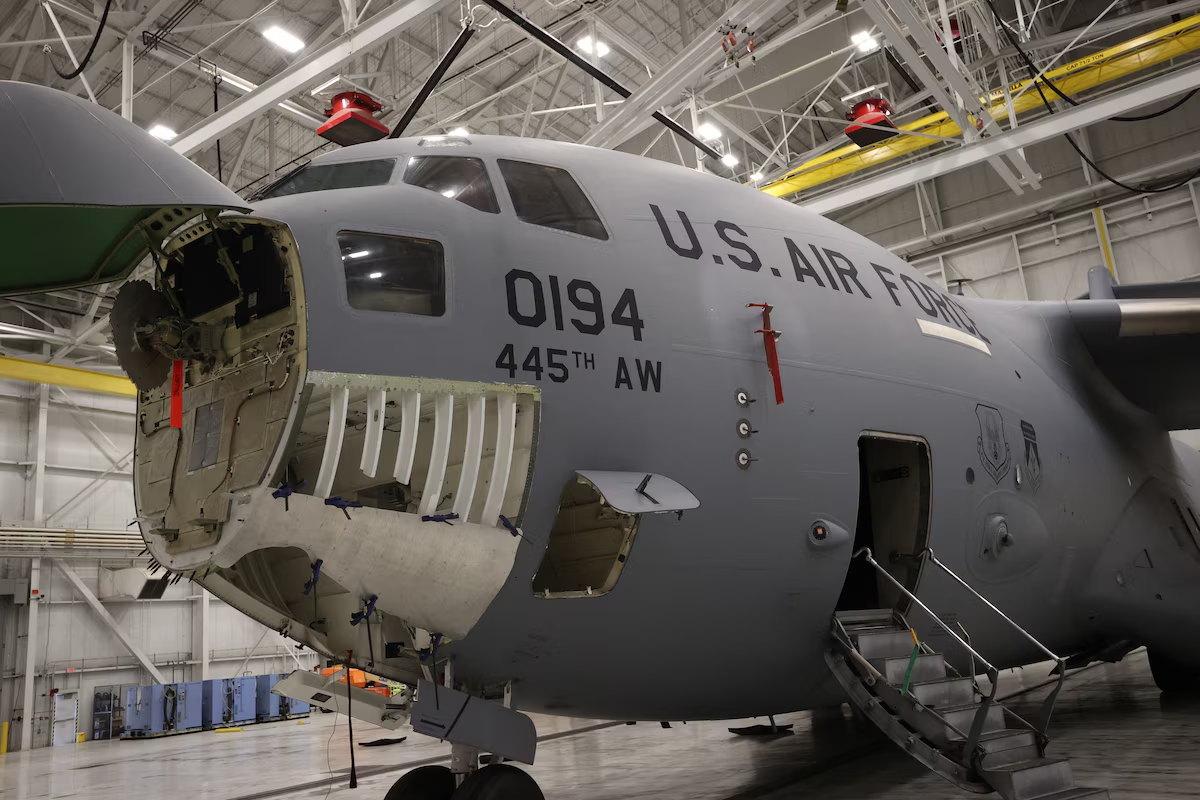
On July 30, 2026, a US Air Force C-17 Globemaster III flew again nearly 17 months after two private jets were blown into it during a storm. The holdup was not the damage itself but a single nose panel that no outside vendor would agree to build, so the Air Force had a robot make it instead.
The aircraft, tail number 01-0194, belongs to the Air Force Reserve’s 445th Airlift Wing at Wright-Patterson Air Force Base, Ohio. It had been sitting since March 4, 2025.
Two business jets, one storm
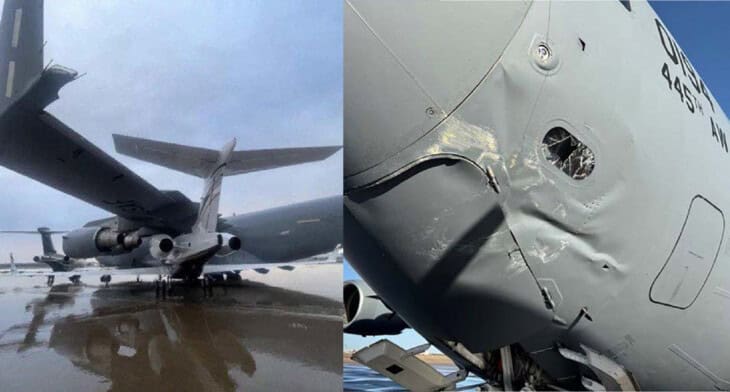
The C-17 was parked overnight at Perot Field Fort Worth Alliance Airport in Texas when microbursts estimated at up to 80 mph tore through the ramp. Two private Bombardier Challenger jets were blown into the parked Globemaster, damaging its left-side door, fuselage, and nose, according to Stars and Stripes.
Maintainers repaired the door and fuselage without much trouble. The nose panel was different: it needed replacing, and that is where the job stalled for months.
Why one panel grounded a $23.8 billion sustainment contract
Boeing built the last C-17 in 2015 and still holds a performance-based logistics contract worth up to $23.8 billion to keep the fleet flying, according to AeroTime. Even so, Boeing could not find a vendor willing to invest in the dies and tooling needed to press a single replacement panel.
That is the economics of an out-of-production aircraft: building the tooling for one part rarely pencils out for a supplier when there is no production run to spread the cost across. Left unresolved, the airframe faced roughly a year in storage and another year of repairs once a fix eventually appeared.
It is not an isolated problem. The Air Force is also seeking backup engine makers for its fighter fleet, driven by the same shrinking industrial base that struggles to support aircraft decades into service.
Key fact
The Air Force says incremental sheet forming cut an estimated two-year repair, including a year in storage, down to months. It is the first ISF part ever flown on a US Air Force aircraft.
How a robot replaced the tooling
The Air Force’s Rapid Sustainment Office, working with the University of Dayton Research Institute, turned to a process called incremental sheet forming. A robot presses a flat sheet of metal into its finished shape a little at a time, following a digital path instead of a physical die or mold.
Because no mold has to be built first, the process skips the exact step that had stalled the repair. Production began in January 2026, a fit-check panel was delivered that April, and Boeing and the wing’s maintenance group installed the finished piece in July.
March 4, 2025
Storm damage. Microbursts blow two Bombardier Challenger jets into the parked C-17 at Fort Worth Alliance Airport, damaging its door, fuselage, and nose.
January 2026
Robot production begins. The Rapid Sustainment Office and the University of Dayton Research Institute start forming the nose panel with incremental sheet forming.
April 20, 2026
Fit-check delivery. A test panel is delivered to confirm the robotically formed part fits the airframe.
July 2026
Installation. Boeing and the 445th Maintenance Group fit the finished panel to the aircraft.
July 30, 2026
Return to flight. The C-17 flies again, nearly 17 months after the storm.
Col. Karen Gharst, the 445th Maintenance Group commander, said using the technology “to rapidly produce an otherwise unobtainable part allowed us to avoid a prolonged work stoppage.”
Reality check
This is the first incremental-sheet-formed part to fly on a US Air Force aircraft, not a routine repair method yet. The Rapid Sustainment Office says parts for the KC-135 tanker and the F-15 are already in work using the same process.
If the approach holds up on those aircraft, it offers the Air Force a way to keep aging, out-of-production fleets flying without waiting on a commercial vendor to decide a single part is worth tooling up for.
Sources and references used for research and fact-checking.
Get the Newsletter
The latest aviation news and stories sent to your inbox.
About the Author

Tim is the owner and lead editor of AeroCorner since 2019, overseeing aviation content covering aircraft, airlines, airports, and the broader aviation industry. Through years of researching, writing, editing, and publishing aviation-focused content, he has developed extensive practical knowledge of commercial aviation and air travel. Based in Asia and a frequent traveler himself, Tim also brings firsthand passenger experience to AeroCorner’s coverage. Outside of publishing, he has also explored aviation firsthand through hands-on flight training in New Zealand.