

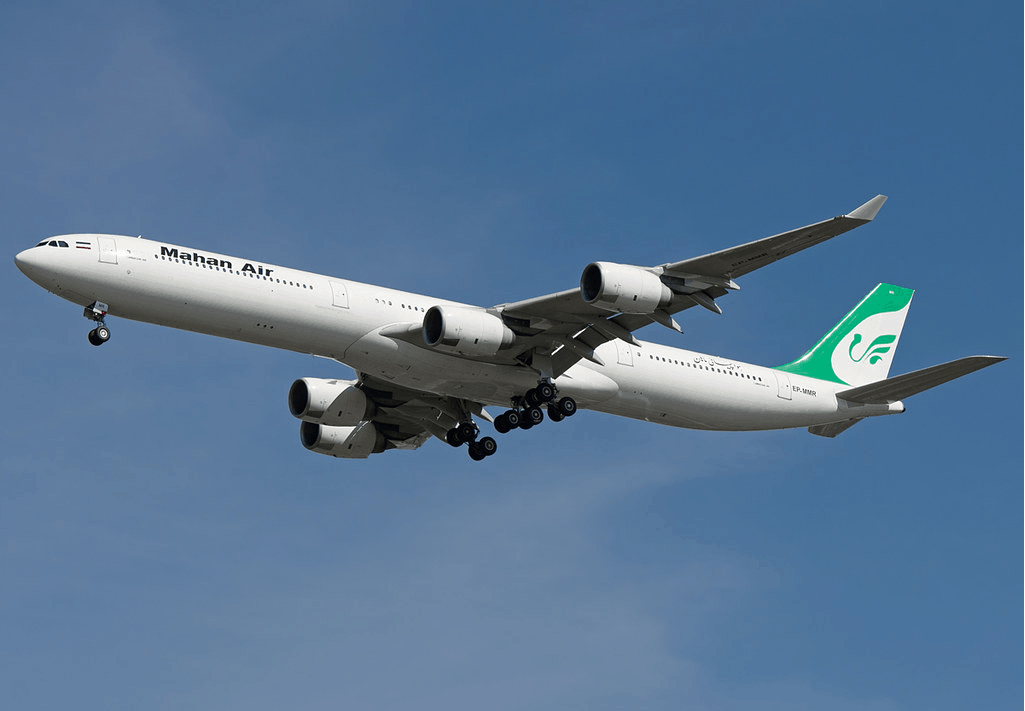
On July 30, 2026, the US Treasury Department’s Office of Foreign Assets Control designated six entities and individuals in China, India, Russia and Iran over their support for Mahan Air, the Iranian carrier the United States has treated as an arm of the Islamic Revolutionary Guard Corps since 2011. Most of those designated are not airlines or aircraft suppliers. They are the sales agencies that book Mahan Air’s passengers and freight in three of its most important overseas markets.
Treasury named Shanghai Wings International Logistics Co. and its managing director Tang Xin, along with Shanghai Elite International Travel Co., which Tang also part-owns. India-based Skiez Travels and Logistics Private Limited and Russia-based Air Cargo Pro Limited were designated as Mahan Air’s general sales agents in their respective countries.
“Those who provide financial services, logistics, or commercial support to the IRGC or Mahan Air are helping sustain a terrorist enterprise,” Treasury Secretary Scott Bessent said in the announcement. “Treasury will continue to identify them, expose them, and cut them off from the U.S. financial system.”
What a general sales agent actually does
The term sounds like corporate filler, but a general sales agent is one of the most consequential relationships an airline has in a foreign market. A GSA is an outside company paid to represent the airline where it has no local sales office of its own.
In practice the GSA sells the seats and the cargo space, holds the relationships with travel agents and freight forwarders, quotes rates, issues documentation, and collects the money. To a customer in Shanghai or Delhi, the GSA effectively is the airline.
Nearly every international carrier uses them, and there is nothing unusual or improper about the arrangement itself. It is standard commercial plumbing in the way airlines operate outside their home markets.
Why the GSA layer matters here
A sanctioned airline can keep flying without a single new aircraft, but it cannot keep selling without someone on the ground to take bookings and payments. Cutting the sales agents attacks the revenue side rather than the fleet.
A different lever than grounding an airline
Mahan Air has been under US sanctions for almost fifteen years. OFAC designated the carrier on October 12, 2011, under Executive Order 13224, saying it provided financial, material and technological support to the IRGC-Qods Force, which was itself designated in October 2007.
Those years of designation have not stopped the airline flying. Mahan Air still operates an ageing fleet built largely around Airbus widebodies, including A310s and A340s acquired through intermediaries rather than from Airbus directly, and it still runs scheduled and charter services across Asia and the Middle East.
That is the gap this action is aimed at. Sanctioning an airline restricts what it can legally buy; sanctioning the companies that sell on its behalf restricts what it can legally earn, and puts foreign firms on notice that the commission is not worth the exposure.
Treasury describes Mahan Air as a carrier that “masquerades as a civilian airline” while carrying IRGC-Qods Force personnel for military training and moving unmanned aerial vehicle systems and weapons in and out of Iran. Shanghai Wings, according to the release, also coordinated the transport of electronics from China to Iran.
A sixth designation in the same action is not an aviation target at all. Treasury named DadeNegar Startup Studio, which it describes as an IRGC-affiliated front company that ran a website soliciting the locations of American and Israeli equipment to support Iranian targeting.
What changes, and what does not
The designations block any US-held property of the named parties and generally bar US persons from dealing with them. They also expose foreign banks that knowingly process significant transactions for the designated companies to secondary sanctions on their US correspondent accounts.
That last point is usually the operative one. The Chinese, Indian and Russian firms named here are unlikely to hold US assets, so the practical pressure falls on the banks and partners that would otherwise handle their money.
Reality check
Designating sales agents rarely removes an airline from the sky. Networks of this kind have historically been rebuilt under new company names, which is why OFAC returns to the same airline repeatedly rather than acting once. Treat this as attrition, not a shutdown.
OFAC took the action under E.O. 13224 and in furtherance of National Security Presidential Memorandum 2, which directs the US government to deny the IRGC access to sustaining assets. Treasury tied the timing to Iran’s attacks on regional states and on commercial vessels in the Strait of Hormuz.
Sources and references used for research and fact-checking.
Get the Newsletter
The latest aviation news and stories sent to your inbox.
About the Author

Tim is the owner and lead editor of AeroCorner since 2019, overseeing aviation content covering aircraft, airlines, airports, and the broader aviation industry. Through years of researching, writing, editing, and publishing aviation-focused content, he has developed extensive practical knowledge of commercial aviation and air travel. Based in Asia and a frequent traveler himself, Tim also brings firsthand passenger experience to AeroCorner’s coverage. Outside of publishing, he has also explored aviation firsthand through hands-on flight training in New Zealand.