

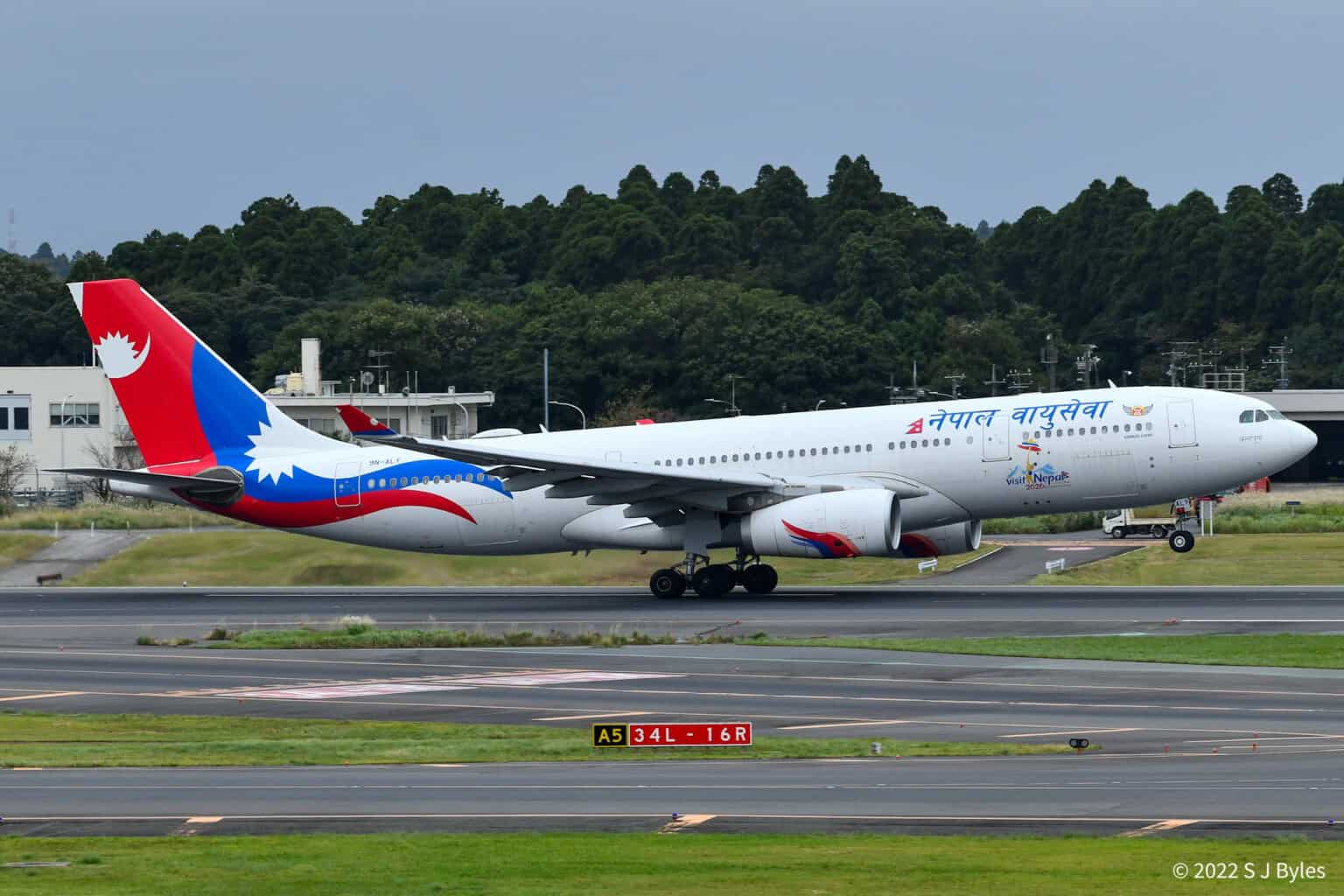
On September 14, 2026, Nepal Airlines began rescheduling its long-haul network after one of its two Airbus A330-200s was left sitting at Tokyo Narita with a damaged engine blade. Over the following three days the flag carrier issued three separate notices.
Together those notices move 10 flights on five international routes: Narita, Kuala Lumpur, Dubai, Doha and Guangzhou. Every one cites a technical problem with the aircraft rather than weather or crewing.
What Happened at Narita
The Kathmandu Post reported that engineers found damage to one of the 26 fan blades in the aircraft’s No. 2 engine, and that 226 passengers were waiting on the return sector.
Devendra Pun, the airline’s technical spokesperson, told the paper the carrier was weighing whether to obtain a replacement blade from Thai Airways at Narita or ship one from Kathmandu. Nepal Airlines has not published a repair completion date.
In its first notice, numbered 51, the airline moved RA-433 from Kathmandu to Narita from September 15 to September 17, and the return RA-434 from September 16 to September 18.
| Route | Flight | Original | Rescheduled |
|---|---|---|---|
| Narita | RA-433 KTM-NRT | Sep 15 | Sep 17, 22:30 |
| Narita | RA-434 NRT-KTM | Sep 16 | Sep 18, 10:30 |
| Kuala Lumpur | RA-415 KTM-KUL | Sep 15 | Sep 17, 21:35 |
| Kuala Lumpur | RA-416 KUL-KTM | Sep 16 | Sep 18, 05:30 |
| Dubai | RA-229 KTM-DXB | Sep 16 | Sep 17, 23:30 |
| Dubai | RA-230 DXB-KTM | Sep 17 | Sep 18, 03:55 |
| Doha | RA-253 KTM-DOH | Sep 17 | Sep 18, 09:00 |
| Doha | RA-254 DOH-KTM | Sep 18 | Sep 18, 12:15 |
| Guangzhou | RA-417 KTM-CAN | Sep 18 | Sep 20, 22:35 |
| Guangzhou | RA-418 CAN-KTM | Sep 19 | Sep 21, 06:25 |
Why One Blade Stops a Widebody
A fan blade is a rotating, life-limited part, and there is no version of dispatching a jet with a damaged one. An engine spinning an unbalanced fan at takeoff thrust is not a deferrable defect the way a cabin light or a coffee maker is.
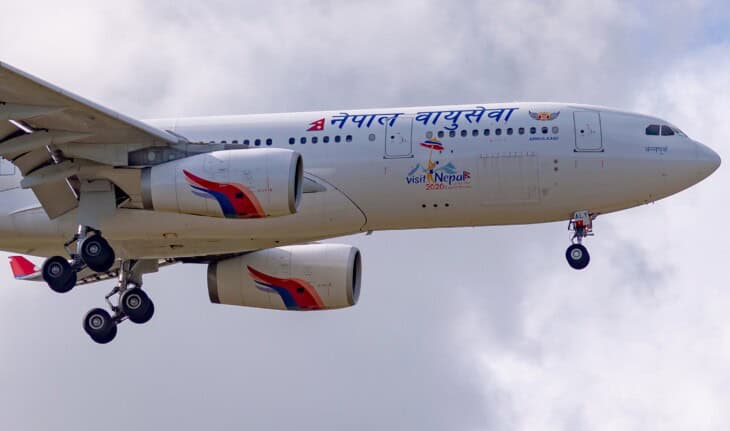
Nor can the part be improvised. A blade carries a specific part number, and a replacement has to be matched and the fan rebalanced, which is why the airline’s options came down to borrowing one from another carrier or flying one in from home.
That is the ordinary meaning of an aircraft on ground away from base. An airline with spare widebodies absorbs it by swapping aircraft. Nepal Airlines has no spare to swap.
A Two-Aircraft Fleet With No Margin
The state-owned carrier runs its entire long-haul operation on two Airbus A330-200s, alongside two A320s and two Twin Otters. Both widebodies arrived in 2018 and are named Annapurna and Makalu.
The second one was not available to cover. Nepalnews reported that Makalu went to Atitech in Italy on August 10 for a C-check, and the Kathmandu Post said its return had slipped well past the original late-August target.
So a single blade in Japan took out the only widebody the airline could actually fly, which is why the delays spread from Narita to four routes that have nothing to do with Japan.
The bigger constraint
Both A330s are approaching the 6,000 flight cycle threshold that triggers a major overhaul. Nepalnews reported in August that Annapurna had roughly 170 cycles left and Makalu about 400, with a tender worth around 5 billion Nepali rupees still to be arranged. The blade is this week’s problem; the overhaul schedule is next year’s.
Other carriers facing the same squeeze have simply stopped flying routes rather than keep rescheduling them, the way IndiGo paused its Heathrow service when it gave back its leased widebodies.
Nepal Airlines has kept its flights on the schedule and moved them instead. Passengers on the Guangzhou rotation are currently booked to leave three days later than they planned, and the airline has asked them to watch its notices page for further changes.
Sources and references used for research and fact-checking.
Get the Newsletter
The latest aviation news and stories sent to your inbox.
About the Author

Tim is the owner and lead editor of AeroCorner since 2019, overseeing aviation content covering aircraft, airlines, airports, and the broader aviation industry. Through years of researching, writing, editing, and publishing aviation-focused content, he has developed extensive practical knowledge of commercial aviation and air travel. Based in Asia and a frequent traveler himself, Tim also brings firsthand passenger experience to AeroCorner’s coverage. Outside of publishing, he has also explored aviation firsthand through hands-on flight training in New Zealand.