

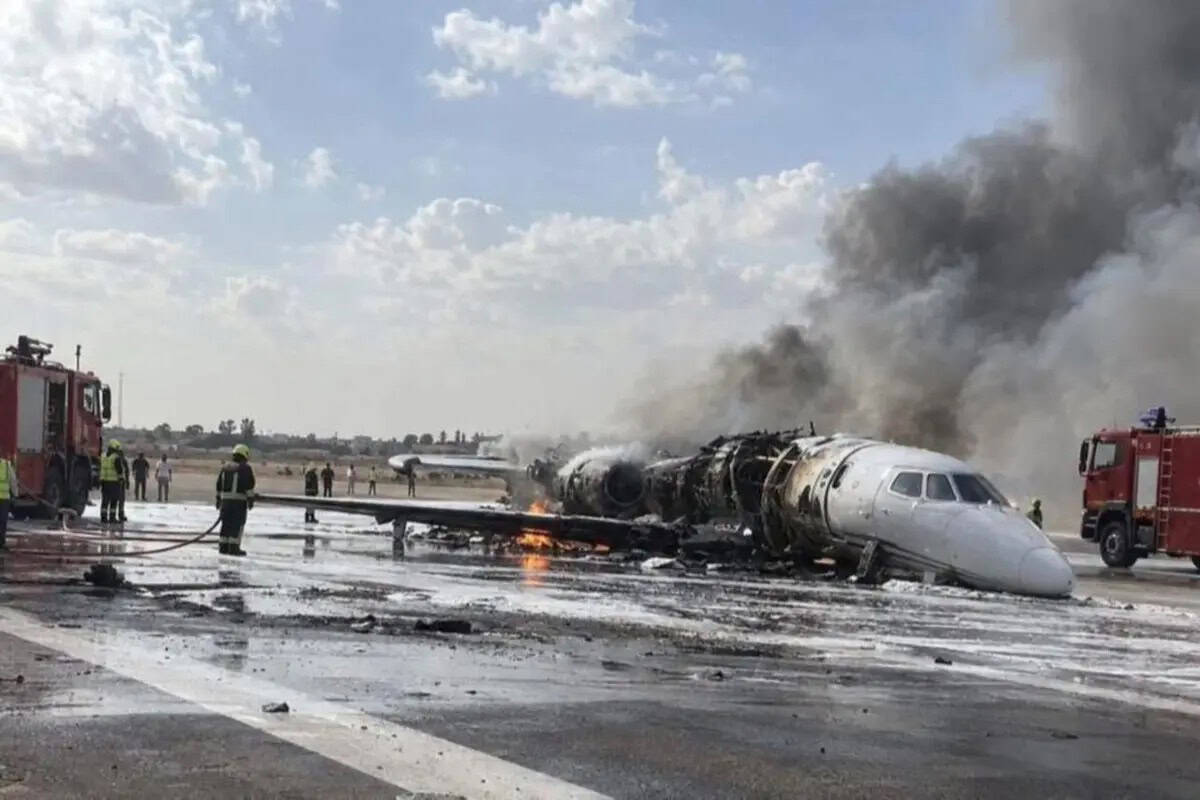
A Cessna Citation Latitude registered TC-AKF veered off runway 15 while landing at Misrata International Airport in Libya on September 14, 2026, and was destroyed by fire. All three people aboard, two pilots and a flight attendant, escaped without injury.
Two days later Libya’s Public Prosecution said it had confronted both pilots with evidence that they operated the aircraft while intoxicated, and ordered them held in pretrial detention. The Turkish operator says no such evidence has ever been shown to it.
Two Accounts That Cannot Both Be Complete
Libya’s Attorney General’s office said that “both the pilot and copilot of the private jet that crashed at Misrata Airport last Monday (14 September) have been found intoxicated,” according to the Libya Herald. Both men were placed in pretrial detention.
The statement did not describe the evidence, name the pilots, or say whether a blood or breath test was taken, and if so when. AeroTime dates the prosecution’s announcement through state news agency LANA to September 16.
Operator BKNJET pushed back directly. “No verified result or document indicating any such finding regarding alcohol has been received by us,” the company said in a statement reported by AeroTime. It also characterized the crew as being questioned rather than arrested.
The jet had flown in from Istanbul with three crew and no passengers, a positioning leg to collect a group of VIP passengers in Libya. Secondary reporting describes the captain as German and the co-pilot and flight attendant as Turkish, which neither the prosecution nor the operator has confirmed.
What is actually established
The aircraft, the date, the runway excursion and the fire are not in dispute, and neither is the fact that nobody was hurt. Everything about alcohol rests on one prosecution statement with no published test result, contradicted by the operator. Treat the intoxication finding as an allegation until a test result or a charging document is published.
What the Alcohol Rules Actually Say
Flight crew alcohol limits are far below road limits almost everywhere, and the numbers are worth knowing before reading any accusation of this kind. European rules under EASA cap blood alcohol at 0.2 grams per liter, or 0.1 milligrams per liter of breath.
The American rule in 14 CFR 91.17 works differently. It bars acting as a crewmember within eight hours of drinking anything alcoholic, the so-called bottle-to-throttle rule, or with an alcohol concentration of 0.04 or more.
That FAA threshold converts to 0.4 grams per liter, so the European limit is half of it. A single drink close to report time can put a crewmember over either line.
None of those frameworks is automatically the one that applies here. The flight was operated by a Turkish company into Libya, and it is Libyan criminal law, not EASA or the FAA, that governs the prosecution now underway.
Why a Prosecution Complicates the Safety Investigation
Two separate processes are now running over the same wreckage, and they want opposite things. ICAO’s Annex 13 sets the principle that “the sole objective of the investigation of an accident or incident is to prevent accidents and incidents and that the investigation is not to apportion blame or liability.”
A criminal prosecution exists to do precisely what Annex 13 rules out. That tension is old and well documented, and it has a practical cost: crew and engineers facing charges stop talking freely, and the safety investigation loses its best source.
Investigators have recovered both recorders from the Citation Latitude and say they will be sent to a specialist facility for readout. The wreckage has been moved into an enclosed hangar, and air traffic control audio, weather data and interviews with crew and airport staff have been gathered.
The cockpit voice recorder is the item to watch. It will capture the approach briefing and the crew’s speech, which is why it matters to both the safety investigators and the prosecutors, and why access to it is often fought over.
A Familiar Failure Mode, Whatever the Cause
Runway excursions remain one of business aviation’s most common serious events, and a Citation leaving the paved surface is not by itself evidence of anything exotic. A Citation Excel overran at Porterville on September 1, and a VistaJet Citation landed at the wrong airport on September 12.
What separates this one is the fire. The aircraft was destroyed, which means the physical evidence available to both investigations is degraded and the recorders carry more weight than usual.
September 14, 2026
Excursion and fire. TC-AKF, a Cessna Citation Latitude operated by BKNJET, arrives from Istanbul with three crew and no passengers, veers off runway 15 at Misrata and is destroyed by fire. Nobody is injured.
September 16 to 18, 2026
Prosecution statement. Libya’s Attorney General’s office says both pilots have been found intoxicated and orders pretrial detention. Reports differ on the exact announcement date, with AeroTime dating the LANA release to September 16 and the Libya Herald carrying it on September 18.
After September 16
Operator disputes it. BKNJET says it has received “no verified result or document” on alcohol, and describes the crew as questioned rather than arrested.
Ongoing
Recorders pulled. Both the cockpit voice recorder and flight data recorder are recovered for readout at a specialist facility. The wreckage is moved into an enclosed hangar.
Sources and references used for research and fact-checking.
Get the Newsletter
The latest aviation news and stories sent to your inbox.
About the Author

Tim is the owner and lead editor of AeroCorner since 2019, overseeing aviation content covering aircraft, airlines, airports, and the broader aviation industry. Through years of researching, writing, editing, and publishing aviation-focused content, he has developed extensive practical knowledge of commercial aviation and air travel. Based in Asia and a frequent traveler himself, Tim also brings firsthand passenger experience to AeroCorner’s coverage. Outside of publishing, he has also explored aviation firsthand through hands-on flight training in New Zealand.