

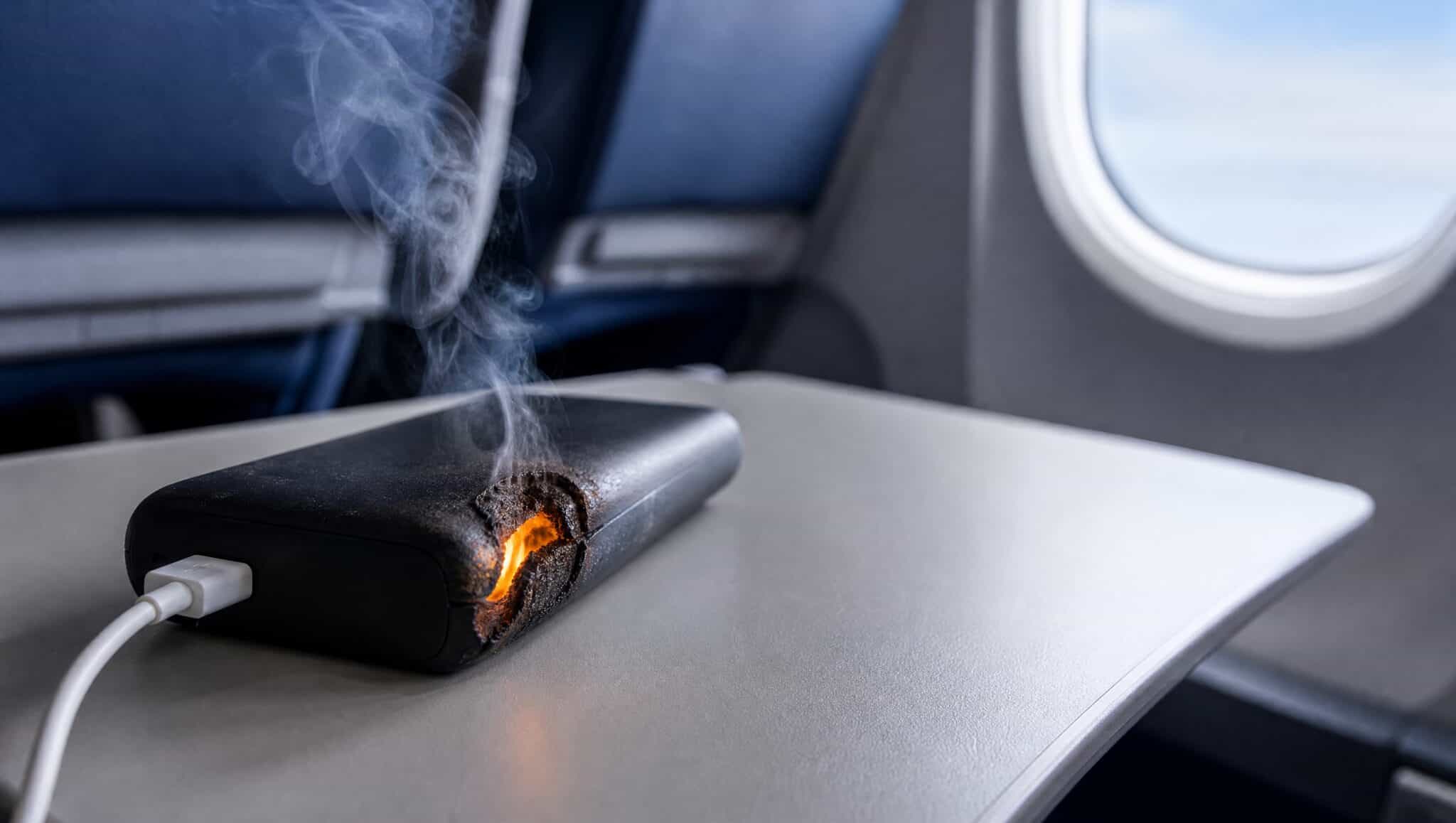
A passenger’s power bank overheated and caught fire in the business class cabin of KLM flight KL735 on September 17, 2026, roughly two and a half hours after the Boeing 777-300ER left Amsterdam for Curacao. Cabin crew put the fire out, and the flight deck turned the aircraft around rather than press on across the Atlantic.
What happened on KL735
The aircraft was PH-BVP, a 10-year-old Boeing 777-300ER. It had already left late, pushing back at 3:21 PM local time against a 1:25 PM schedule, according to One Mile at a Time.
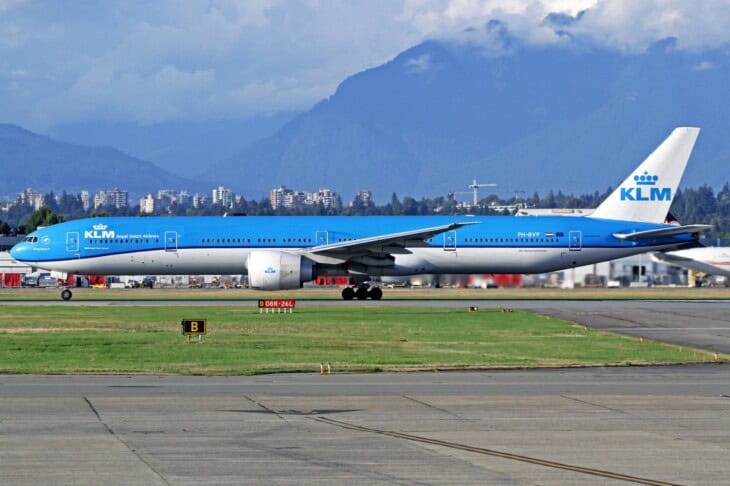
The device belonged to a passenger who had fallen asleep. It overheated, smoked and burst into flames at around 30,000 feet, scorching the seat console and leaving burn marks running up the window blind and the cabin sidewall.
Crew doused the power bank and then submerged it in water, which is the standard drill for a battery that has already ignited. Paddle Your Own Kanoo reported that one passenger suffered minor injuries.
With the fire out but the cabin damaged, the crew returned. KL735 landed back at Amsterdam Airport Schiphol at 8:42 PM, five hours and twenty minutes after departure, having gone nowhere.
3:21 PM, Sep 17
KL735 departs Amsterdam. The 777-300ER PH-BVP leaves nearly two hours behind a 1:25 PM schedule, bound for Curacao.
About 2.5 hours in
Fire in business class. A sleeping passenger’s power bank overheats and ignites at around 30,000 feet over the Atlantic, burning the seat console, window blind and sidewall.
Minutes later
Crew extinguish and isolate it. Cabin crew douse the device and submerge it in water, then the flight deck elects to return rather than continue.
8:42 PM, Sep 17
Back on the ground at Schiphol. The aircraft lands 5 hours 20 minutes after departure. One passenger is reported with minor injuries.
10:35 AM, Sep 18
Replacement aircraft goes. KLM hotels 322 passengers overnight and sends a 787-10, PH-BKG, to Curacao the next morning.
KLM accommodated 322 passengers in hotels and dispatched a Boeing 787-10, PH-BKG, the following morning at 10:35 AM, Simple Flying reported. The 777 had not returned to service.
The power bank’s owner was reported to be Camiel Eurlings, whom KLM announced as its president and CEO effective July 1, 2013, and who left the airline in October 2014. KLM declined to confirm the passenger’s identity, citing privacy rules.
A KLM spokesperson told Simple Flying that the airline does not intend to penalize him: “We give the message at the beginning of the flight that [power bank usage] is not allowed. We do not hand out any further fines.”
KLM already bans the exact thing that happened
KLM’s hand baggage rules are unusually blunt on this point. Passengers may bring up to two power banks, but the airline tells them to “always keep yours with you,” states that “it’s not allowed to put it in the overhead bin,” and adds that “using or charging it on board is also not allowed.”
That last clause is the one that matters here. Most carriers police where a power bank is stowed; a smaller group, KLM among them, bars switching it on at all once the doors close.
The rule in one line
KLM allows two power banks per passenger, kept on your person, never in the overhead bin, and never switched on or charging in flight. Batteries over 160 Wh are refused outright, and anything between 100 and 160 Wh needs prior permission.
The reasoning is thermal runaway. The FAA warns that any lithium ion battery can overheat and run away “without warning,” set off by damage, heat, water, overcharging or a plain manufacturing defect, and that spare batteries and power banks must ride in the cabin rather than the hold.
Cabin stowage is not a formality. A battery burning in the cabin is one a trained crew can reach in seconds, which is what happened here. The same battery in a closed bin, or in a cargo hold, is a fire nobody sees start.
That difference is why the rules tightened industry-wide. In January 2025 an Air Busan Airbus A321 was destroyed by fire at Gimhae in South Korea, a blaze the country’s National Forensic Service later attributed to a short circuit in a power bank, with crew placing its origin in an overhead bin. All 176 people aboard evacuated.
Asian carriers rewrote their power bank policies within weeks, and the change spread from there. The consistent thread is to keep the battery where somebody can see it.
KL735 is the third cabin battery fire AeroCorner has covered this year, after a Swiss flight that diverted to Dublin over a power bank and an American Airlines A321 laptop fire at Dallas Fort Worth. In each case the fire was contained by crew, and in each case the aircraft went somewhere it had not planned to go.
Sources and references used for research and fact-checking.
Get the Newsletter
The latest aviation news and stories sent to your inbox.
About the Author

Tim is the owner and lead editor of AeroCorner since 2019, overseeing aviation content covering aircraft, airlines, airports, and the broader aviation industry. Through years of researching, writing, editing, and publishing aviation-focused content, he has developed extensive practical knowledge of commercial aviation and air travel. Based in Asia and a frequent traveler himself, Tim also brings firsthand passenger experience to AeroCorner’s coverage. Outside of publishing, he has also explored aviation firsthand through hands-on flight training in New Zealand.