

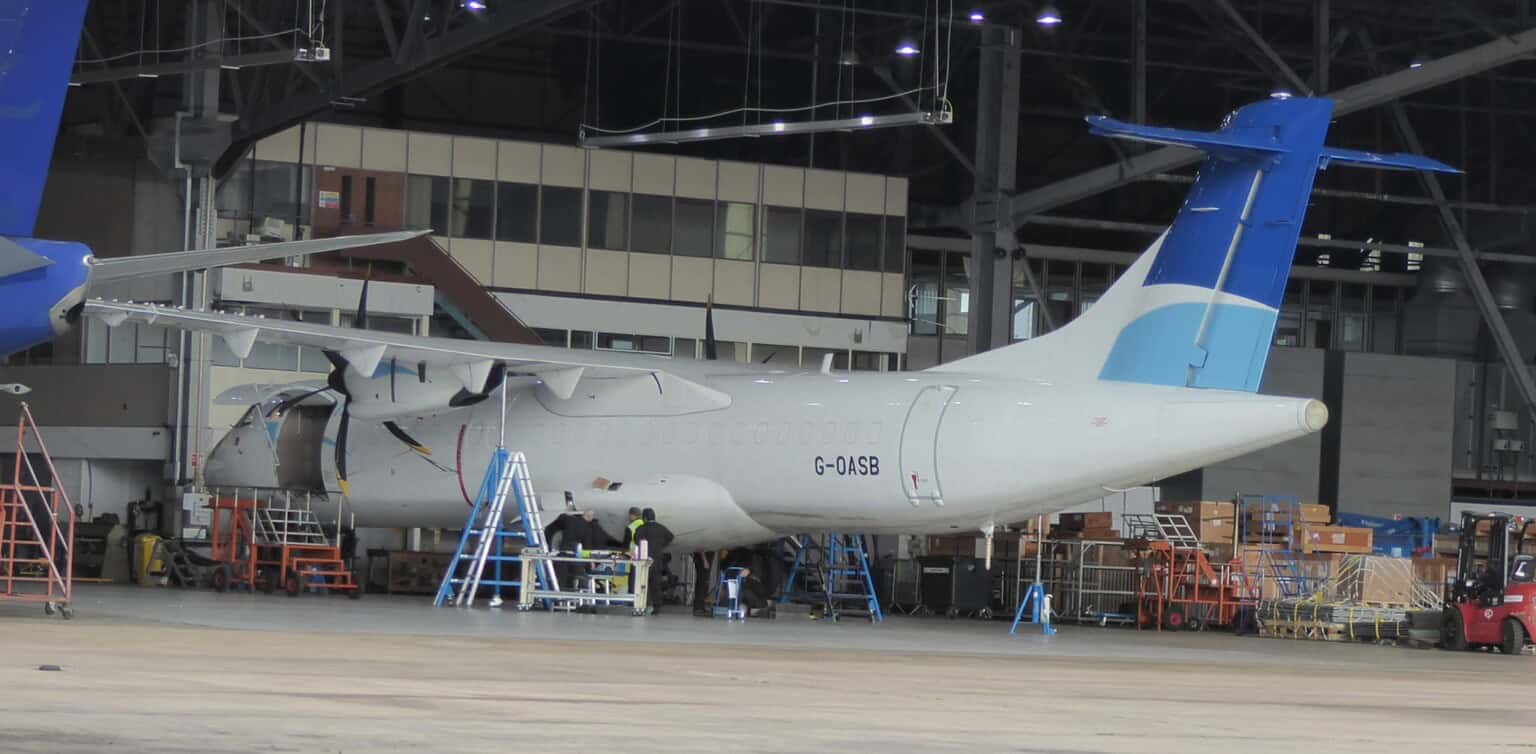
On September 17, 2026, the UK Air Accidents Investigation Branch published its field investigation into G-OASB, an ATR 72-500 freighter that landed nosewheel first at East Midlands Airport on November 14, 2025. Both nose landing gear wheels fractured and the aircraft had to be shut down on a taxiway.
The aircraft, operated by ASL Airlines UK, was flying a scheduled cargo service from Guernsey with two pilots and no passengers. Neither was injured.
Nothing in the setup was marginal. The AAIB records a takeoff weight of 42,838 pounds (19,432 kg) against a maximum of 50,265 pounds (22,800 kg), a center of gravity within limits, no outstanding technical defects, and a commander with 5,152 of his 5,554 flying hours on the type.
What the Flight Data Recorder Shows
The approach was stable. The co-pilot called “stable” at 1,000 feet and then read out radio altitudes of 80, 50, 20 and 10 feet, the last of which is this operator’s cue for the pilot flying to retard the power levers to flight idle.
The commander did so and flared. Both pilots described the aircraft floating in ground effect, and the recorder confirms it: roughly three seconds at about 10 feet of radio altitude.
Then the data diverges from what the crew felt. The crew recalled the aircraft suddenly dropping. The recorder shows a nose-down elevator deflection first, and the pitch attitude moving from plus 0.4 degrees to minus 4.4 degrees over the following two seconds.
The AAIB notes the conditions were turbulent and the sudden drop “may have been a result of a change of airflow over the aircraft,” while also recording the elevator input that preceded the pitch change. It does not resolve the two into a single cause.
The g figures, in order
First touchdown at minus 4.4 degrees of pitch and 2.04 g. Second bounce 2.6 g. Third 1.5 g. The aircraft finally settled with a 1.7 g touchdown. The whole sequence, from the start of the pitch-down to the last touchdown, took nine seconds.
Why the Go-Around Never Happened
The operator’s own manual is explicit about the recovery: on a significant bounce, hold a normal landing pitch attitude, advance the power levers, keep the gear and flaps where they are, and expect a second touchdown that will be soft enough to avoid damage.
That is not what happened, and the report spends a full section on why. The commander said he was taken completely by surprise and could not execute a go-around in the one or two seconds he had.
After the first bounce he deliberately chose not to add power, reasoning that with the nose down, thrust would drive the aircraft into the runway. The AAIB suggests he was “possibly still inhibited by a startle effect.”
Startle is not a figure of speech in an accident report. The AAIB defines it as an involuntary response that narrows attention, delays comprehension and pushes pilots toward automatic rather than analytical action, usually for under 30 seconds. This landing lasted nine.
One recorded detail shows how far that went. A pitch-force parameter captured the two pilots working against each other just before the second bounce, with the commander pushing nose-down and the co-pilot pulling nose-up.
What a Nosewheel Landing Actually Costs
Both nose wheels fractured, and examination found the failures were mechanical overload. Both tires deflated, which is why the commander could barely steer and had to stop on Taxiway S rather than reach a stand.
The nose gear axle was bent upward. ATR then assessed the loads and required the nose landing gear leg, the drag brace, and the right main landing gear leg and shock absorber to be replaced for exceeding their design load capacities, with the left main shock absorber removed for inspection.
The airframe itself was built in 2001 and converted from passenger to freighter configuration in 2022, so the loads landed on a 24-year-old aircraft in its second role.
The type has drawn separate regulatory attention this month: the FAA ordered a leaking valve tested on ATR 42 and 72 nose gear after uncommanded retractions. That is an unrelated defect, and the AAIB found no technical fault on G-OASB.
Sources and references used for research and fact-checking.
Get the Newsletter
The latest aviation news and stories sent to your inbox.
About the Author

Tim is the owner and lead editor of AeroCorner since 2019, overseeing aviation content covering aircraft, airlines, airports, and the broader aviation industry. Through years of researching, writing, editing, and publishing aviation-focused content, he has developed extensive practical knowledge of commercial aviation and air travel. Based in Asia and a frequent traveler himself, Tim also brings firsthand passenger experience to AeroCorner’s coverage. Outside of publishing, he has also explored aviation firsthand through hands-on flight training in New Zealand.