

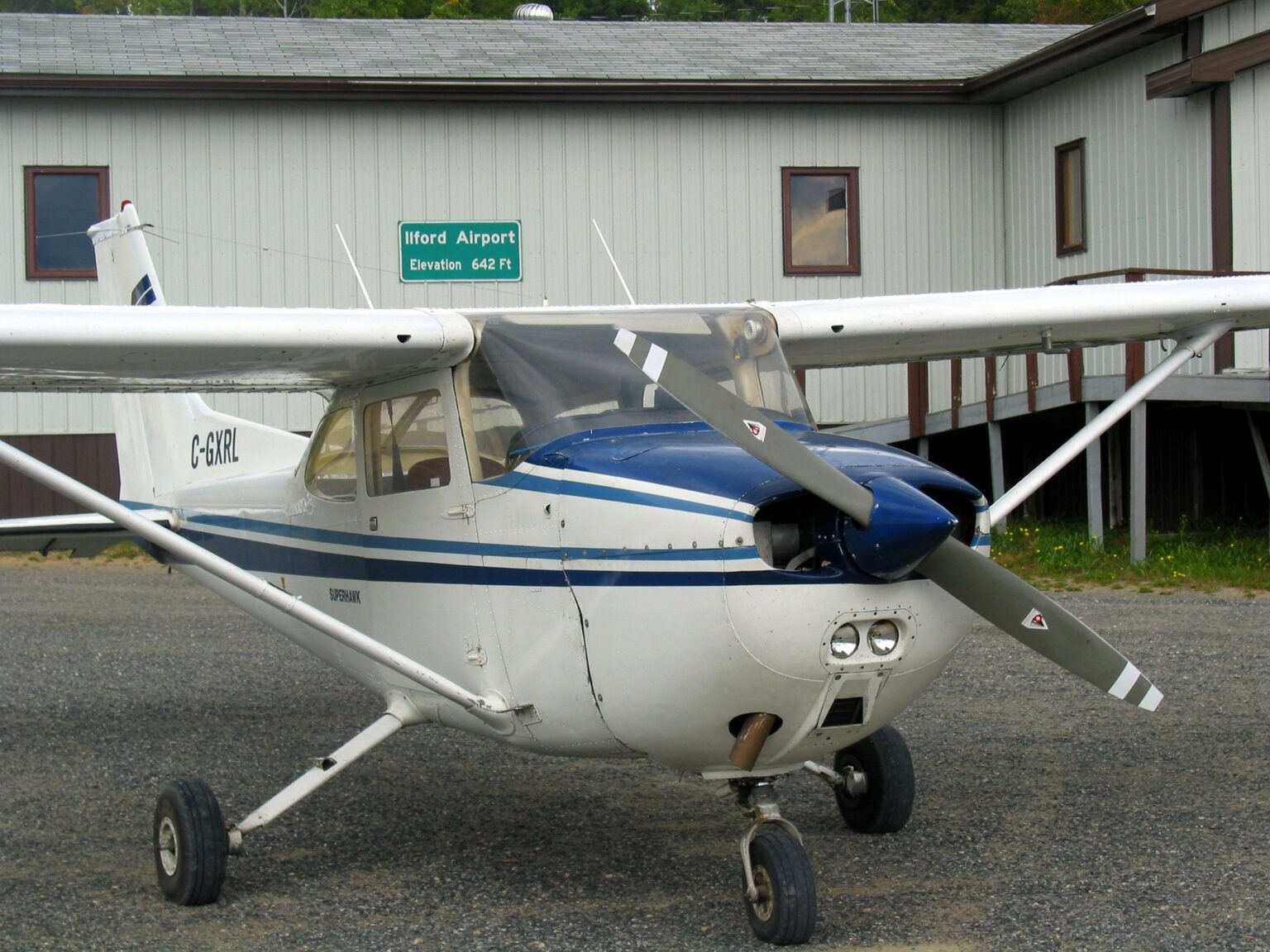
Canada’s Transportation Safety Board (TSB) released its report on October 21, 2026, into the July 8, 2025, midair collision of Cessna 172R C-GZKA and Cessna 152 C-GGPE near the Steinbach (South) Aerodrome in Manitoba. Both solo pilots, flying training circuits for Harv’s Air Service, were killed.
The report describes two aircraft converging on the same final approach in smoke haze and low morning sun, close enough to touch before either pilot reacted. The TSB says it shows the limits of see-and-avoid.
How the two circuits converged
Both aircraft took off from Runway 36 shortly after 8:10 a.m. local time, two minutes apart, to fly left-hand circuits, and for a while they were the only traffic. By about 8:36 a.m., four aircraft were in the circuit.
When another aircraft began its takeoff, the pilot of the Cessna 172 broke off his approach 0.8 miles (1.3 km) from the runway and went around. He rejoined behind it and twice extended his downwind leg by about a mile to make space.
At 8:41:33 a.m., the 172’s pilot called final for Runway 36. Eight seconds later, the pilot of the Cessna 152, flying a normal circuit, called turning final, with the two aircraft only half a mile (0.8 km) and about 200 feet (60 m) apart.
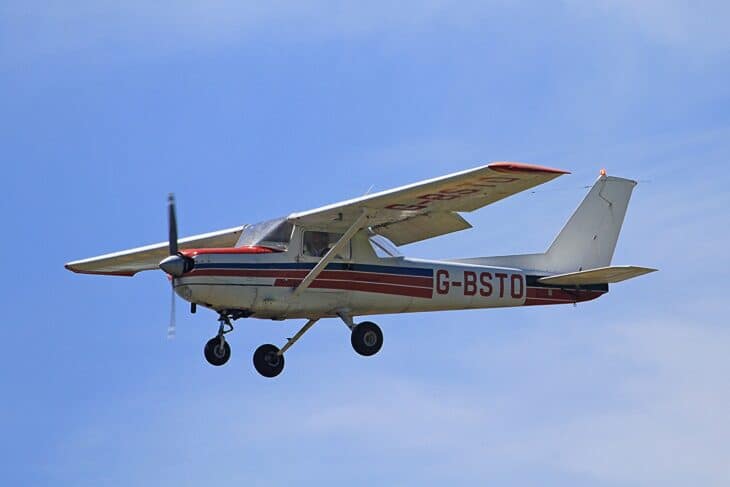

By 8:41:58 a.m., both were about a mile from the runway, the 172 roughly 100 feet (30 m) directly above the 152. They touched once at about 8:42 a.m., the 152’s pilot applied full power and pitched up, and the aircraft struck again and became entangled.
They came down a quarter mile (0.4 km) south of the runway threshold and were destroyed by a post-impact fire. The TSB’s regional manager, Eric Vermette, told CBC News that the two pilots made their final calls within seconds of each other but did not appear to be listening to one another.
The pilots were Savanna May Royes, 20, and Sreehari Sukesh, 23, identified by her family and by India’s consulate general respectively, CBC reported. According to the report, the 172’s pilot held a private pilot license with 169.4 hours and was working toward a commercial license, while the 152’s pilot held a student pilot permit with 59.3 hours, 14.4 of them solo.
Smoke, sun and a missing distance call
Wildfire smoke from northern Manitoba had drifted south that morning. Winnipeg’s airport, 33 nautical miles to the northwest, reported 5 miles (8 km) of visibility in smoke at 8:49 a.m., which the TSB says was still suitable for visual flight.
The sun was also a factor. It sat about 28 degrees above the horizon almost exactly on the heading of the base leg, so pilots flying that leg, the turn onto final, were heading nearly straight into it.
About six months earlier, two Harv’s aircraft had a close call on final for Runway 18. The school then required every call on final to include the distance from the runway, such as “1 mile final Runway 36,” but neither accident pilot gave a distance in any call that morning.
A cap on circuit traffic had also been discussed after the near miss, but no policy had been written by the time of the collision.
What Harv's Air has changed
Since the accident, the school limits its circuit at Steinbach to 3 aircraft at a time, makes the distance call on final mandatory, requires all lights on for the whole flight and a lookout and blind-spot briefing for every student and renter, and is adding LED lighting and ADS-B In and Out to more of its fleet, according to the TSB.
Why see-and-avoid breaks down in a busy circuit
Steinbach South sits in uncontrolled Class G airspace with no tower. Pilots share a single aerodrome traffic frequency, the Canadian counterpart of a CTAF, and keep themselves apart by announcing where they are and watching for each other.
The 172’s pilot did announce that he was extending his downwind leg, and then that he was on final. The TSB’s point is that a call only helps if the other pilot hears it, works out where that aircraft is and plans around it, and the 152 called final eight seconds later.
The eye is a weak backup. The report quotes the Australian Transport Safety Bureau’s point that an aircraft on a collision course holds a fixed spot in the windshield, and human vision is best at spotting movement, not a stationary dot that slowly grows.
Vertical stacking made it worse. With one aircraft directly above the other, visual awareness was nil, as CBC put it, and in a high-wing Cessna the wing and the cabin floor hide much of the airspace above and below.
The TSB says it has now investigated 13 midair collisions since 2011, and in several it has warned that the risk will not drop substantially until traffic awareness systems are widely adopted. Neither Cessna had a collision avoidance system or ADS-B In, and regulations required neither.
Airliners carry TCAS collision avoidance, but light trainers rarely do. Canada’s ADS-B Out mandate covers only Class A and B airspace, with Classes C, D and E to follow no sooner than 2028. At the time of the report there was no ADS-B In requirement at all.
The problem is not only Canadian: the Carlisle midair in Pennsylvania also happened at a non-towered field coordinated by radio.
The TSB ran this as a limited-scope class 4 investigation and does not assign fault. Its closing message: install equipment that shows nearby traffic, and actively listen to other pilots’ calls.
Sources and references used for research and fact-checking.
Get the Newsletter
The latest aviation news and stories sent to your inbox.
About the Author

AeroCorner News is the aviation news desk of AeroCorner.com. It covers accidents and incidents, safety rulings, airline and airport disruption, and new aircraft. It works from primary sources such as the NTSB, FAA, EASA and the manufacturers' own announcements.