

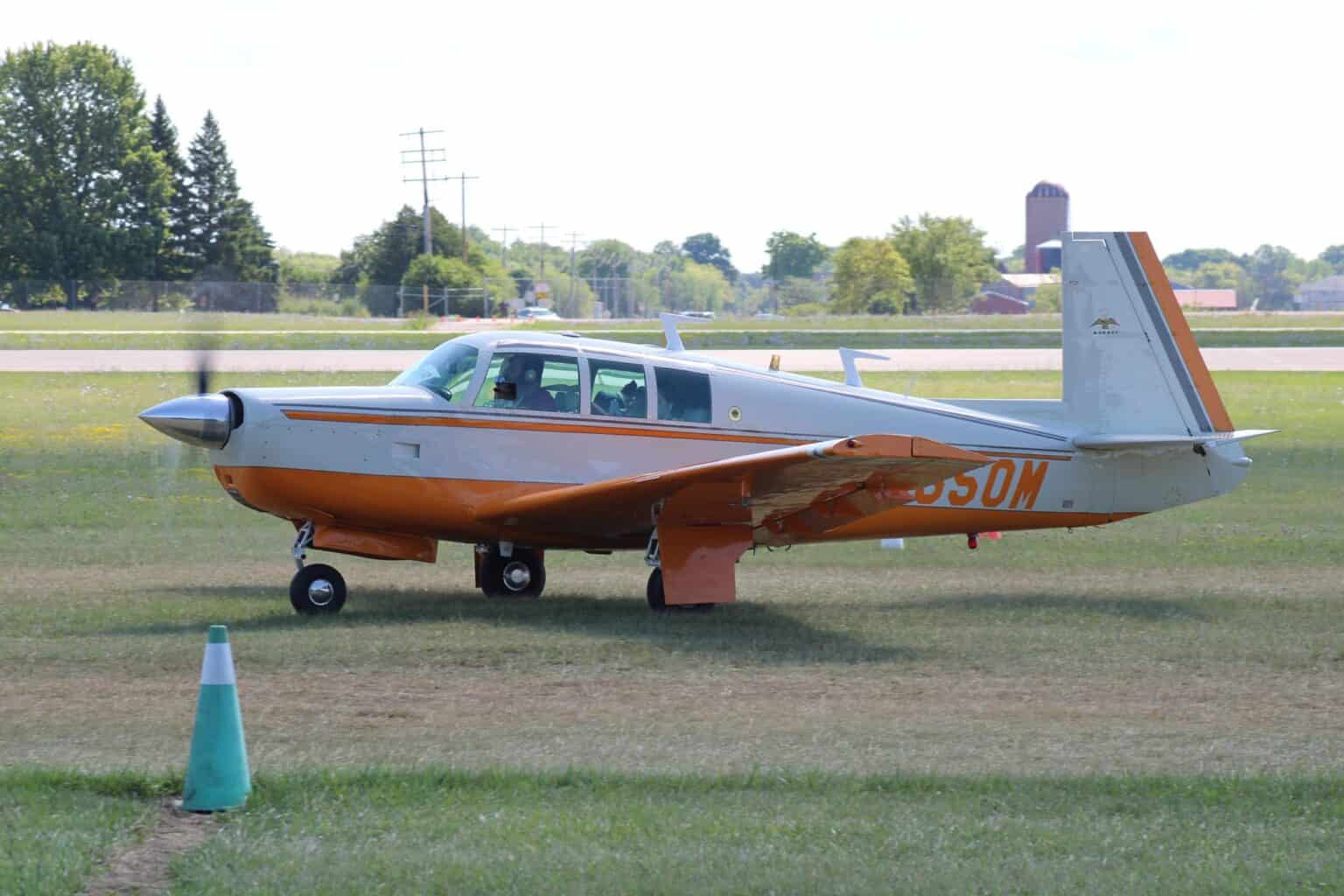
The Mooney M20F N9573M that crashed after takeoff from Beverly, Massachusetts, on June 19, 2025, stalled in a steep turn while its engine was still making close to full power, the National Transportation Safety Board said in its final report. The report, ERA25FA230, was published on October 16, 2026.
The board found that a spark plug left loose at the airplane’s last annual inspection made the engine backfire on takeoff. It ruled that the pilot’s loss of control while trying to return to the airport, not the engine problem itself, was the probable cause.
Both people on board died. The pilot, Geoffrey Andrews, 30, of Melrose, died at the scene, and his passenger died several days later, NBC Boston reported, citing the Essex County District Attorney’s Office.
About 30 seconds from takeoff to the last radar return
The 1966 Mooney was cleared for takeoff from runway 16 at Beverly Regional Airport at 8:45 a.m. on an IFR flight plan to upstate New York.
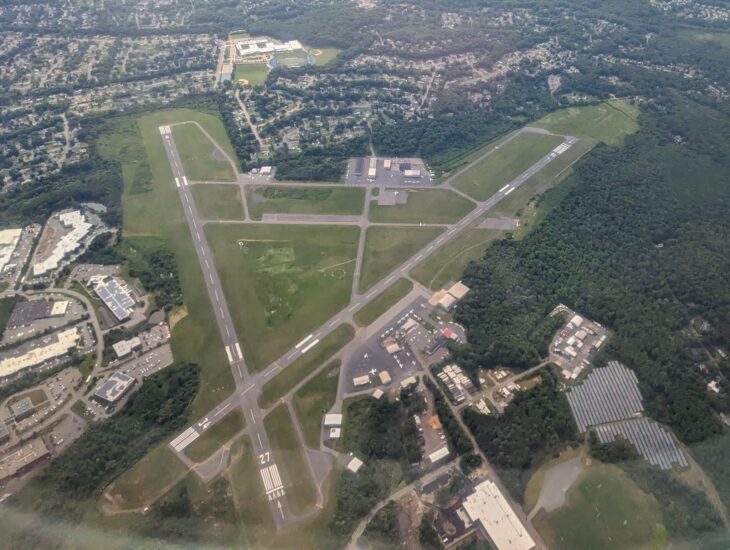

An airport surveillance camera recorded the sound of the takeoff at about 8:46:28, followed seconds later by the engine backfiring. Power dropped sharply and then came back.
Security video showed dark smoke trailing under the belly. The tower controller saw it too, asked whether everything was okay and cleared the pilot to land on any runway.
The pilot replied that he had engine trouble and would “head up and turn back,” and was cleared to land on runway 09. The Mooney first turned right toward that runway, then rolled into a steepening left turn and descended behind trees.
A flight instructor watching from the airport described a “significant reduction in power” at about 150 feet, a partial recovery, and then a wings-level descent in what looked like a “stalled” state. The last radar return, at 8:46:55, put the airplane 110 feet above the ground at a groundspeed of 65 knots.
The Mooney hit a grass berm beside a two-lane road with its left wing, crossed the road and stopped against a light pole, without a fire.
The engine was still running
The engine monitor recorded the rpm falling from 2,600 to 1,500 and then climbing back to 2,500, with fuel flow and manifold pressure tracking it, which the NTSB said fits a pilot pulling the throttle to idle and then pushing it back to full.
According to the same data, the engine was operating near full power as the airplane descended to the ground. The board said the pilot may have cut power to land, then changed his mind and decided to circle to another runway.
On the Lycoming IO-360, investigators found the No. 2 cylinder’s bottom spark plug loose, with exhaust staining and residue around its port consistent with it having been loose before the crash.
The engine logbook showed the plugs had been “cleaned, gapped, tested, and rotated” at the annual inspection on October 11, 2024, about 37 flight hours earlier, with no later entry for their removal. Lycoming’s Service Instruction 1042AH calls for spark plugs to be torqued to 420 inch-pounds (35 foot-pounds).
Water, corrosion and debris turned up in parts of the fuel system, but the components passed bench tests and nothing would have stopped fuel reaching the engine. An erratic exhaust temperature reading on the No. 1 cylinder, present since the same annual, came from a disconnected probe wire.
The electric boost pump, which the owner’s manual says should be on for takeoff, was found switched off. The report does not tie that to the backfire.
The probable cause reads: “The pilot’s failure to maintain control of the airplane while maneuvering to return to the airport which resulted in an aerodynamic stall. Contributing to the accident was the improperly installed No. 2 cylinder bottom spark plug by maintenance personnel, which came loose and resulted in an engine backfire on takeoff.”
Why a turn at 110 feet is so unforgiving
The M20F’s owner’s manual gives a stall speed of about 55 knots (64 mph) with takeoff flaps and wings level, rising to about 80 knots (93 mph) in a 60-degree bank.
That is the accelerated stall effect: banking steeply loads the wing and raises the speed at which it stops flying. The airplane’s last recorded groundspeed of 65 knots sat near its published stall speed, the NTSB noted, and the steep bank raised the speed at which it would stall.
The laminated emergency checklist found in the wreckage gave the first item for power loss right after takeoff as holding 100 mph, or 87 knots. The NTSB said the airplane most likely stalled from an altitude too low to recover.
The FAA’s safety training aid on engine failure after takeoff says research points to a higher chance of survival when a pilot continues straight ahead. A return to the runway takes more than 180 degrees of turn, it says, and turning at low altitude and low airspeed sets up a stall or spin.
A turn back after a faltering engine was also reported in the October 2026 crash of an RV-7A at Petaluma, where witnesses reported a sputtering engine and a turn back. The Beverly report differs in its engine data: the power came back, and the airplane was lost in the maneuver rather than to the engine.
The NTSB issued no safety recommendations with the report.
Sources and references used for research and fact-checking.
Get the Newsletter
The latest aviation news and stories sent to your inbox.
About the Author

AeroCorner News is the aviation news desk of AeroCorner.com. It covers accidents and incidents, safety rulings, airline and airport disruption, and new aircraft. It works from primary sources such as the NTSB, FAA, EASA and the manufacturers' own announcements.