

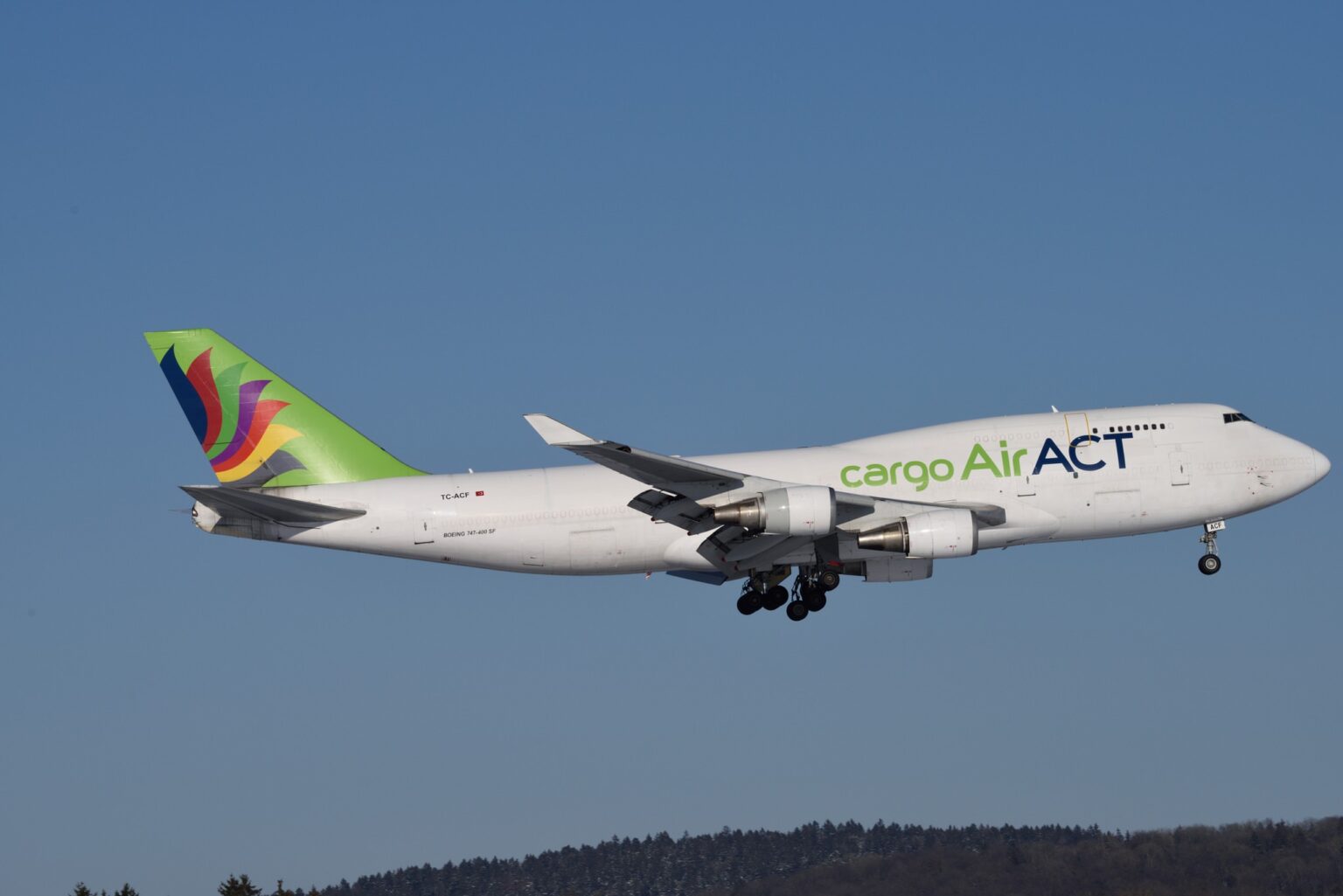
Emirates SkyCargo flight UAE9788, a Boeing 747-400 freighter registered TC-ACF, ran off Hong Kong’s north runway and into the sea on October 20, 2025, killing two aviation security staff in a stationary security vehicle. A year later, Hong Kong’s Air Accident Investigation Authority (AAIA) has not yet said why the jet’s No. 4 engine went to full forward thrust after landing.
In an interim statement dated October 13, 2026, the AAIA said the manufacturers’ examinations of the engine control units, the No. 4 engine’s speed card and the thrust control module found no faults relevant to the accident. The remaining tests, including an NTSB sound analysis of the cockpit voice recording, are planned to finish by the end of 2026.
What the AAIA has ruled out so far
The aircraft was a 747-481 converted to a Bedek Special Freighter (BDSF), operated by Turkey’s ACT Airlines on behalf of Emirates SkyCargo on a cargo run from Dubai World Central. All four crew survived uninjured, and the aircraft was destroyed.
The interim statement says flight data shows the 747 touched down on Runway 07L at 03:52:13 local time “with no anomalies.” BAE examined and downloaded the Electronic Engine Control units, and Boeing examined the thrust control module and its resolvers.
The No. 4 engine’s N2 speed card was tested too. Across the supervised examinations of the engine control units, the speed card, the thrust control module and the resolvers, the AAIA says no faults relevant to the accident were found.
Investigators have also downloaded memory from a Collins flight control computer and two central maintenance computers. The quick access recorder stopped at 03:51:33, with the jet 499 feet above the ground, which the AAIA believes happened because the crash came before the unit finished storing later data.
How the landing went wrong
The sequence comes from the AAIA’s preliminary report of November 18, 2025. The jet was dispatched under its Minimum Equipment List with the No. 4 engine’s thrust reverser inoperative, a provision that lets an aircraft fly with set items out of service under defined conditions.
The weather was suitable, visibility was about 6 miles (10 km) or more, and the wind was from 030 degrees at 18 knots. Air traffic control instructed the crew to keep their speed up until they vacated the runway, and the crew replied they would try their best.
The co-pilot was flying and the captain was monitoring. After touchdown, the crew selected reverse thrust on engines 2 and 3 and idle reverse on engine 1, then an AUTOBRAKES message appeared, the autobrake disarmed and the captain took control.
03:52:13
Touchdown on Runway 07L. Flight data shows no anomalies at landing, according to the AAIA’s interim statement.
03:52:30
No. 4 engine reaches 90% N1 forward thrust. This follows the autobrake disarming and the captain taking control.
03:52:35
All selected reversers stowed. The reversers on engines 1, 2 and 3 are put away.
03:52:36
No. 4 engine at about 106% N1. It ends up at 107% N1 at 03:52:42.
03:52:41
Reverse thrust selected again. The preliminary report says these selections came after the aircraft had already veered off the runway.
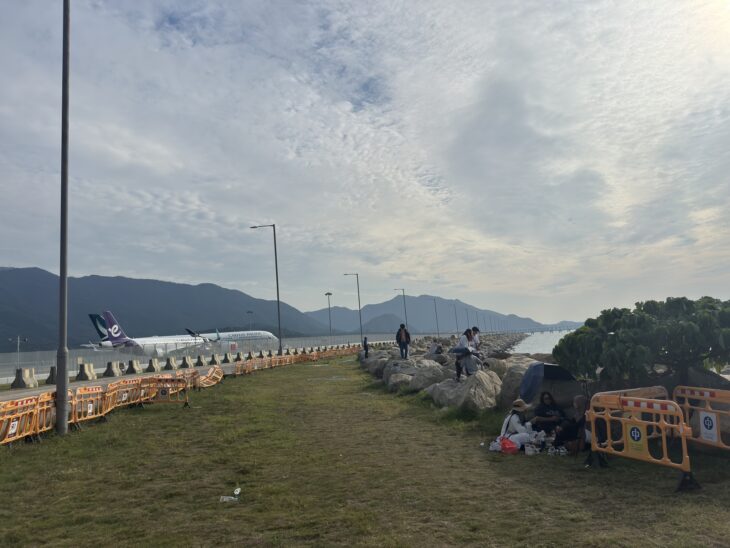
The 747 veered left off the runway abeam Taxiway C6, struck the security vehicle parked at an observation point on the perimeter road and pushed it into the sea. The jet went through the perimeter fence into the water, and its tail section separated.

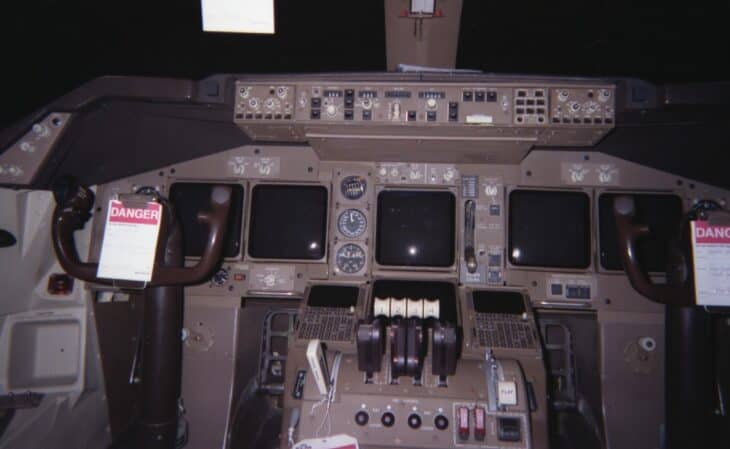
On the flight deck, investigators found the No. 4 thrust lever in the full forward position and its reverse lever fully forward, while the other three thrust levers were closed with their reverse levers at maximum. The autobrake selector read Disarmed and the fuel control switches were at Run.

What investigators are still testing
The central open question is how the No. 4 thrust lever got to full forward. On this jet, the autothrottle moves the thrust levers through an electromechanical servo motor, so a lever can travel either because the motor drove it or because something else pushed it.
That is why the NTSB, which represents the US as the 747’s state of design and manufacture, is running a sound spectrum analysis of the servo motor using the cockpit voice recording. The AAIA says the analysis aims to tell whether the motor drove the lever forward or it was “advanced by external forces.”
Boeing is still examining and testing what the statement calls the EEC/Thrust Management Computer card. Investigators are also recovering memory from two Honeywell flight management computers and the Crane brake system control unit, running flight simulator trials of the excursion and carrying out human factors work that includes earlier 747-400 accidents with similar characteristics.
Changes already made, and when the report could come
ACT Airlines added the accident scenario to its initial and recurrent simulator training from December 17, 2025. On April 3, 2026, Boeing used its WINGTips newsletter to remind every 747 operator of its manual guidance on crew callouts and on handling the thrust levers and reversers.
Not a finding of cause
The AAIA states that these safety actions do not mean the investigation has determined the causes or contributing factors. Its human factors and operational analyses are still under way.
An interim statement exists because international rules under ICAO Annex 13 require one on each anniversary when a final report is not out within 12 months. The AAIA attributes the timeline to complex technical work done abroad and checks with the Turkish and US representatives.
Once the work ends, Hong Kong law sends the report to the relevant parties for representations. Anyone who made representations can then serve a notice of review if the findings may affect their reputation, before the report goes to the Chief Executive for publication. The AAIA gave no date for the final report.
The preliminary report also found no report of foreign objects on Runway 07L at Hong Kong International Airport before the landing, and said air traffic control and navigation equipment were working normally.
Sources and references used for research and fact-checking.
- Air Accident Investigation Authority (Hong Kong), Interim Statement ITR-2026-09: Runway Excursion, Boeing 747-481 BDSF TC-ACF at Hong Kong International Airport on 20 October 2025
- Air Accident Investigation Authority (Hong Kong), Preliminary Report PLR-2025-04: Runway Excursion, Boeing 747-481 BDSF TC-ACF
Get the Newsletter
The latest aviation news and stories sent to your inbox.
About the Author

AeroCorner News is the aviation news desk of AeroCorner.com. It covers accidents and incidents, safety rulings, airline and airport disruption, and new aircraft. It works from primary sources such as the NTSB, FAA, EASA and the manufacturers' own announcements.