

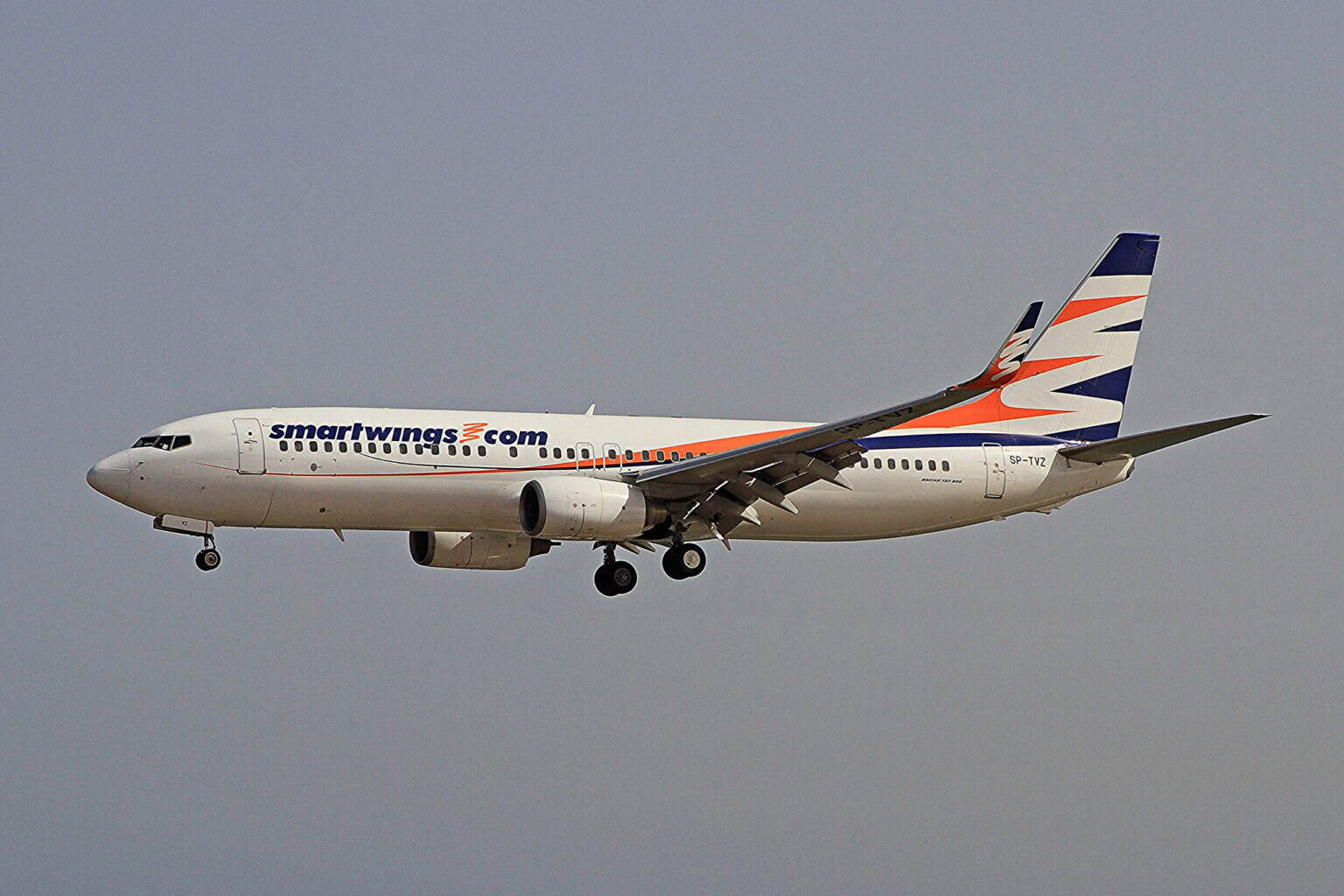
On August 18, 2026, a Smartwings Poland Boeing 737-800 flying from Prague to Almeria diverted to Valencia after the crew received a fire indication on one of the aircraft’s engines. The aircraft landed safely, but the diversion also stranded more than 200 passengers who were booked on the same aircraft’s return flight to Prague.
What happened over Spain
According to Aviation Herald, flight QS1158 (registration SP-TVZ) was cruising near Valencia when the crew received a fire indication for one of the aircraft’s CFM56 engines. The crew shut the engine down, declared an emergency, and diverted to Valencia rather than continuing to Almeria.
The aircraft landed safely on runway 12 about 20 minutes later. No injuries were reported. Valencia’s runway was briefly closed after the landing, forcing other arriving traffic to hold or divert while the aircraft was cleared.
The 737-800 is a twinjet, so it can fly, climb, and land safely on one engine, which is exactly the scenario every airline crew trains for in the simulator. Shutting an engine down after a fire warning is standard procedure, not a sign the aircraft was in danger of losing both engines.
A warning light, not necessarily a fire
Modern jet engines like the CFM56 carry dedicated fire-detection loops that can trigger on heat or smoke that never becomes an open flame. Crews are trained to treat every fire indication as real, shutting the engine down and diverting immediately, even when the underlying cause later turns out to be a faulty sensor.
Why a diverted plane stranded a second flight
The La Voz de Almeria reports that the same aircraft was scheduled to fly the return leg from Almeria back to Prague at 21:15 local time. Because it never arrived, Smartwings canceled that departure, leaving more than 200 passengers in Almeria without their flight.
This is the ordinary mechanics of an airline schedule, not a coincidence. A single aircraft typically flies several legs in a row, so a problem on one leg ripples forward into every leg that aircraft was due to fly next, as explained in AeroCorner’s guide to how one delay creates more. Passengers were bused roughly 4 hours from Almeria to Valencia overnight to board a substitute aircraft for Prague.
Low-cost and charter carriers like Smartwings tend to run leaner aircraft rotations than larger network airlines, with fewer spare jets sitting idle at any one base. That efficiency keeps fares down, but it also means a single mechanical event far from home, like an engine warning over Valencia, has fewer backup options to absorb it than it would at a hub airline with spare aircraft nearby.
Neither Smartwings nor Valencia Airport had issued a public statement on the cause of the fire indication as of publication. Spanish outlet Preferente corroborated the diversion and the passenger disruption.
Still developing
No aviation authority has published an official report on this incident. The cause of the engine fire indication, and how long the aircraft, a Boeing 737-800, will remain grounded in Valencia, are both unconfirmed.
Engine fire indications in flight are uncommon but not rare. In July 2026, a Ryanair Boeing 737-800 suffered an engine failure that shattered a cabin window over North Macedonia, a reminder that most in-flight engine problems on twinjets end the same way: a shutdown, a single-engine approach, and a safe landing, exactly as happened at Valencia Airport this time.
Get the Newsletter
The latest aviation news and stories sent to your inbox.
About the Author

Tim is the owner and lead editor of AeroCorner since 2019, overseeing aviation content covering aircraft, airlines, airports, and the broader aviation industry. Through years of researching, writing, editing, and publishing aviation-focused content, he has developed extensive practical knowledge of commercial aviation and air travel. Based in Asia and a frequent traveler himself, Tim also brings firsthand passenger experience to AeroCorner’s coverage. Outside of publishing, he has also explored aviation firsthand through hands-on flight training in New Zealand.