

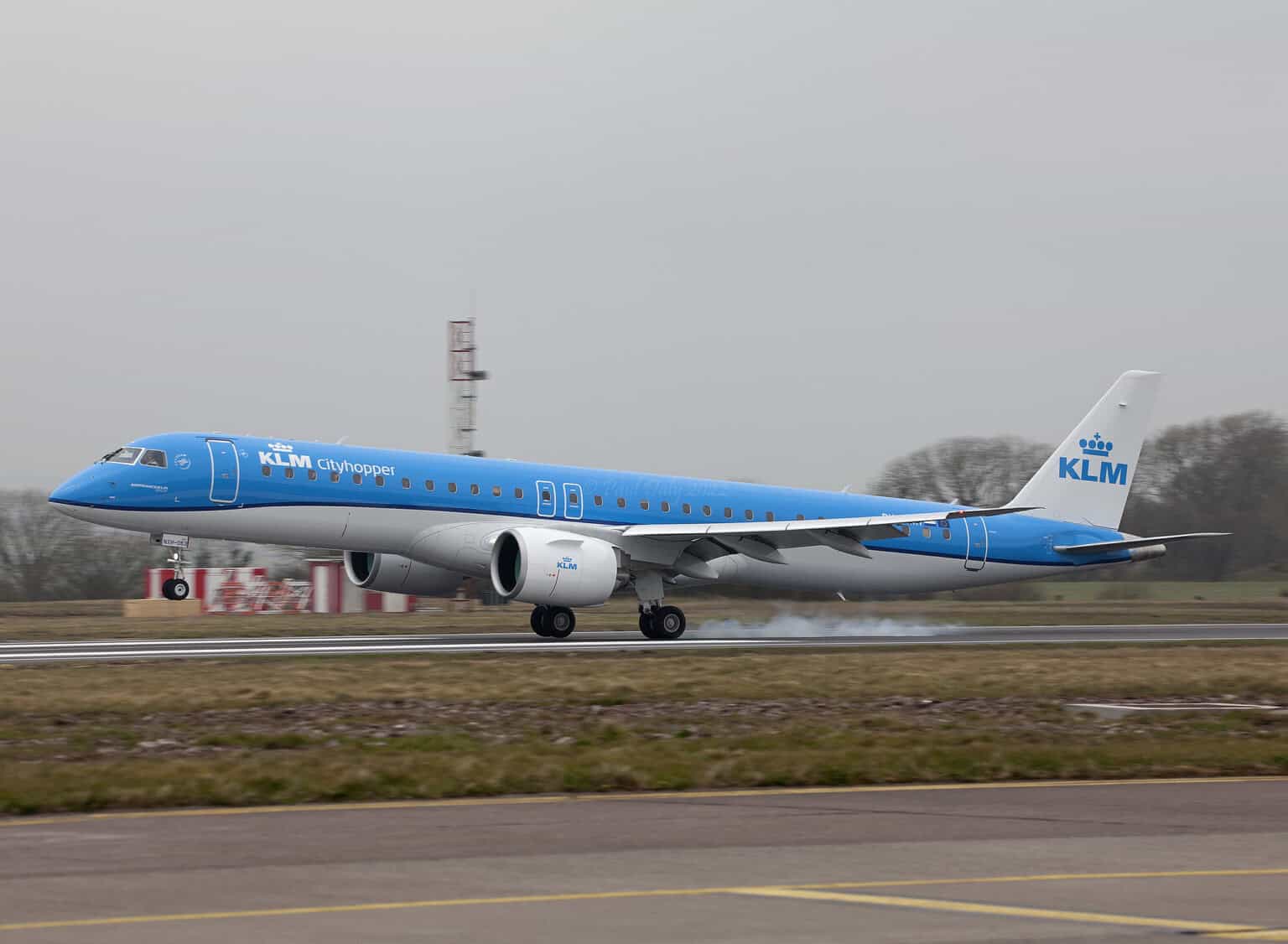
On September 15, 2026, KLM Cityhopper flight KL1531 stopped its climb out of Amsterdam and turned back after the crew reported a rudder failure. The aircraft, an Embraer E195-E2 registered PH-NXH and bound for Valencia, landed safely about 30 minutes after departure.
Nobody was hurt. The detail that makes the return unusual is the number the crew gave air traffic control on the way back: they could accept no more than 3 knots of crosswind.
The jet had departed from runway 18L and had leveled at FL130, roughly 13,000 feet, when the failure appeared. It came back to runway 24 instead, where the crosswind component was 2 knots. The occurrence was reported by The Aviation Herald and is logged as an incident, not an accident.
Why Three Knots of Crosswind Decided the Runway
A crosswind landing is not flown pointing at the runway. The aircraft flies the approach crabbed into the wind, nose angled off the centerline, so its track stays on the centerline even though its heading does not.
Straightening that out is the rudder’s job. In the last seconds before touchdown the pilot pushes downwind rudder to swing the nose onto the runway heading, with opposite aileron to keep the wings level. The maneuver is called a decrab, and it is the reason an airplane rudder matters far more on landing than most passengers assume.
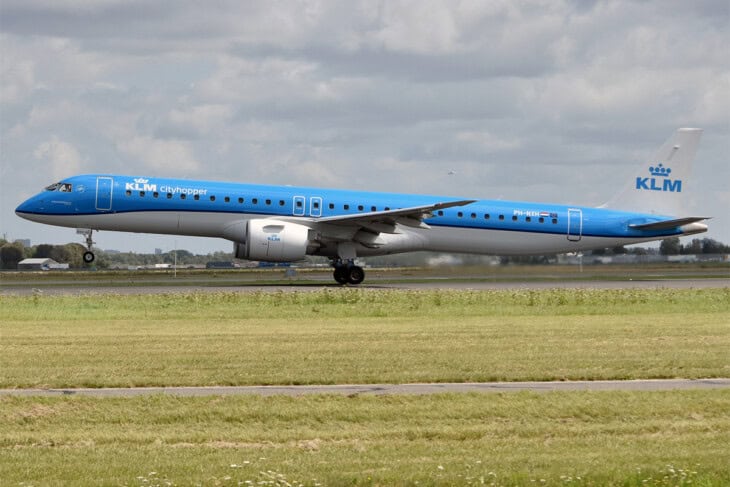
Take the rudder away and there is no way to do it. Touching down still crabbed loads the main gear sideways, in a direction it is not designed to absorb, and the aircraft then tries to weathervane into the wind during the rollout.
So the usable crosswind limit collapses from the type’s normal figure to almost nothing. The wind has to be blowing nearly straight down the runway, which is exactly what the crew asked for and what runway 24 gave them.
The 60-degree swap
Runway 18L at Amsterdam points due south. Runway 24 points southwest, 60 degrees away. Changing runways was not about length or approach aids, it was about turning a crosswind into a headwind.
What Is Known, and What Is Not
Neither KLM nor Embraer has said publicly what failed, and no safety investigation has been announced. On a fly-by-wire airliner a rudder fault can mean a lost control channel, a failed actuator, or a sensor disagreement that takes the system offline, and those are very different problems.
One data point hints at the milder end. PH-NXH was back in service roughly six hours after it landed, which is closer to a component swap or a fault reset than to anything structural.
The passengers reached Valencia on a replacement aircraft, PH-NXK, about three and a half hours behind schedule. Both jets are part of the 25-strong Embraer 195 family fleet KLM Cityhopper operates out of Amsterdam Schiphol.
Reality check
This is a turnback, not a near miss. The crew kept the aircraft inside a wind limit they set themselves and landed on a runway that met it. The open question is what the rudder system actually did, and that answer may never be published for an incident of this size.
Worth separating from the engine story that has followed this fleet. Four of KLM Cityhopper’s E195-E2s spent long periods parked at Twente while Pratt & Whitney worked through geared turbofan durability issues, and the carrier has been reactivating them through 2026. A rudder fault has nothing to do with that.
Turnbacks into Amsterdam are not rare, and they usually end this way. In July a KLM Boeing 787 came back with its flaps, slats and landing gear all misbehaving, and it also landed without incident.
Sources and references used for research and fact-checking.
Get the Newsletter
The latest aviation news and stories sent to your inbox.
About the Author

Tim is the owner and lead editor of AeroCorner since 2019, overseeing aviation content covering aircraft, airlines, airports, and the broader aviation industry. Through years of researching, writing, editing, and publishing aviation-focused content, he has developed extensive practical knowledge of commercial aviation and air travel. Based in Asia and a frequent traveler himself, Tim also brings firsthand passenger experience to AeroCorner’s coverage. Outside of publishing, he has also explored aviation firsthand through hands-on flight training in New Zealand.