

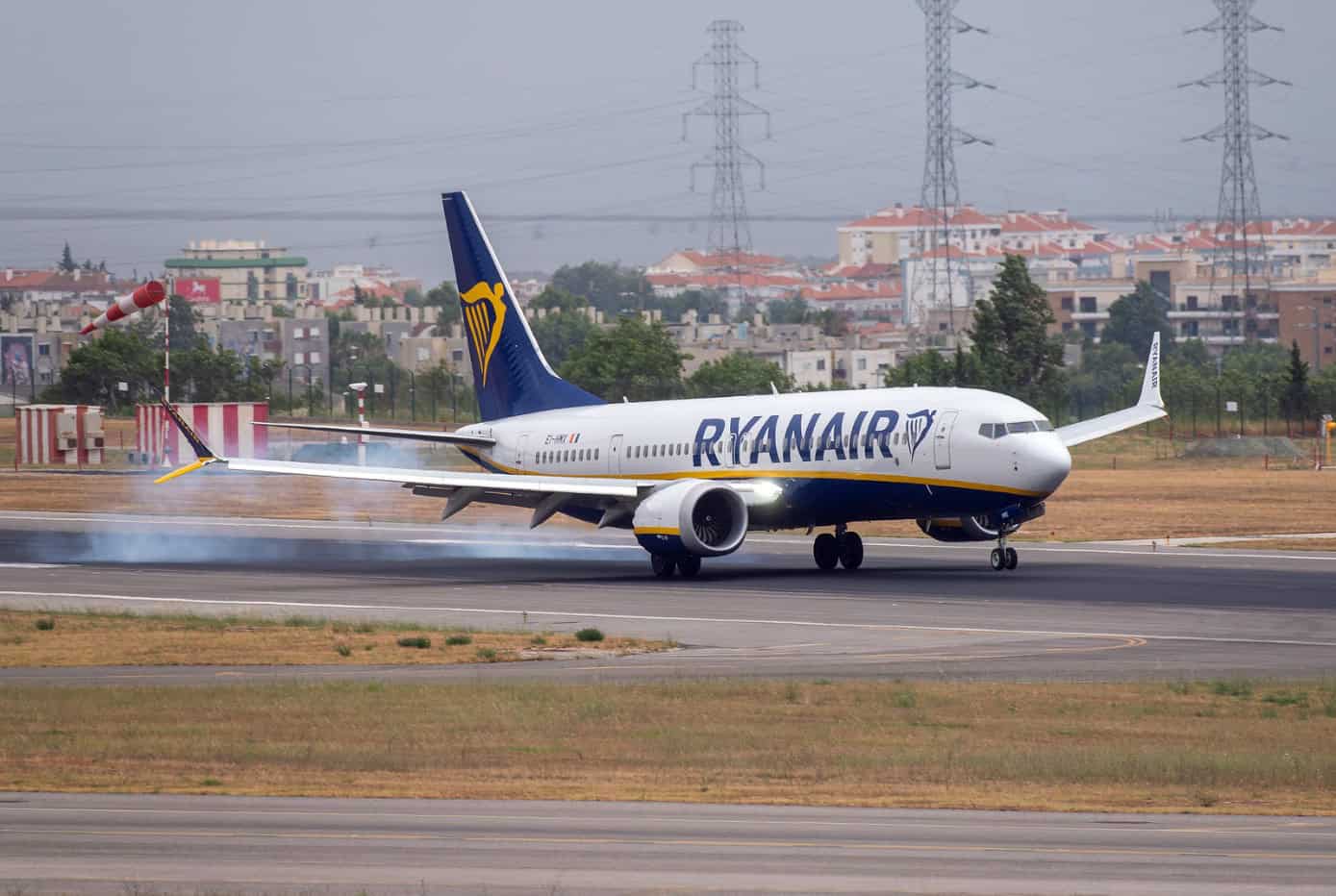
A Ryanair Boeing 737 MAX touched its right wingtip on the runway while landing at Dublin Airport on September 10, 2026, then climbed away and landed safely on its second approach. The jet, registered EI-ILA, was operating flight FR9457 from Bologna.
Ryanair described the contact as minor. “Ryanair flight FR9457 from Bologna suffered a minor wing tip impact,” the airline said, adding that the aircraft landed safely, all passengers got off normally, and its engineers repaired the wingtip before the jet went back into service.
What happened in the final seconds
The event became public when Simple Flying reported it on September 12, alongside a passenger’s video. According to that report, the jet rolled sharply to the right just before touchdown, the right wingtip met the runway, and the pilots added thrust to go around.
The same report, citing flight-tracking data, says EI-ILA spent about 10 hours on the ground in Dublin for inspection and repair. It left that night for Glasgow as flight FR5563.
The aircraft is one of Ryanair’s 737-8200s, a high-density version of the Boeing 737 MAX 8 that the airline calls the “Gamechanger.” Ryanair says each one seats 197 passengers, eight more than the 189 seats on its earlier 737s.
A wind that would not settle
Dublin’s routine weather reports from around the landing show why the approach was demanding. At 12:00 local time the wind was from 210 degrees at 11 knots, but swinging anywhere between 180 and 260 degrees.
Half an hour later it was blowing at 15 knots and still varying by 60 degrees. The report issued about an hour before the landing had recorded gusts of 26 knots, and gusts of 23 knots were back in the report at 13:30.
A wind that shifts direction by as much as 80 degrees keeps changing the crosswind a pilot is correcting for, right up to the moment the wheels touch.
Why a wingtip can reach the runway
Airliners normally fly a crosswind approach “crabbed,” pointing slightly into the wind so they track straight down the approach path, according to the safety knowledge base SKYbrary. In the flare, the pilot uses rudder to swing the nose into line with the runway and aileron to keep the wings level.
The margins are small. SKYbrary notes that near the crosswind limit, crews may accept a little leftover crab rather than bank more than about 5 degrees from wings level, because beyond that many jets with wing-mounted engines risk an engine pod touching the ground.
It also warns that the wind at the aircraft can differ considerably from the last wind check the crew received. A gust or shift in those final seconds can upset the balance between rudder and aileron just as the aircraft runs out of height.
Going around gave the crew a second, steadier attempt, but a go-around begun that close to the runway carries its own hazard. In a tail strike at Houston this year, an ANA 787’s nose rose after touchdown when the go-around mode was triggered by accident.
Dublin has its own example. Ireland’s Air Accident Investigation Unit found that an Airbus A321neo struck its tail there in October 2024 when it was over-rotated during a go-around started after its main wheels had already touched the runway.
Reportable, but probably not an accident
Under EU rules the strike had to be reported. Implementing Regulation 2015/1018 lists a “tail, blade/wingtip or nacelle strike during take-off or landing” among the occurrences that airlines and crews must report.
It is a different question whether it counts as an accident. If the damage was confined to the wingtip, as Ryanair’s statement suggests, the event falls outside the ICAO Annex 13 definition of an accident, which excludes damage limited to wing tips.
That would make it an incident, or a serious incident if investigators judge that an accident nearly occurred. Annex 13 says the difference between the two lies only in the result.
What is not known yet
Ryanair has not said how many passengers were on board, which runway was in use, or how extensive the wingtip damage was. Its statement did not mention injuries. Ireland’s Air Accident Investigation Unit had published nothing on the event as of September 12, so it is not yet known whether it will investigate.
Sources and references used for research and fact-checking.
- Iowa Environmental Mesonet, EIDW (Dublin) METAR archive, September 10, 2026, 09:00-12:30 UTC
- EUR-Lex, Commission Implementing Regulation (EU) 2015/1018, Annex I, section 1.3 (7)
- Bureau of Air Accident Investigation Malta, Important definitions taken from ICAO Annex 13
- Air Accident Investigation Unit (Ireland), Final Report 2026-004: Airbus A321-271NX TC-LTL, Dublin Airport, 18 October 2024
- Ryanair, Ryanair Takes Delivery Of 1st Boeing 737 'Gamechanger' Aircraft
Get the Newsletter
The latest aviation news and stories sent to your inbox.
About the Author

Tim is the owner and lead editor of AeroCorner since 2019, overseeing aviation content covering aircraft, airlines, airports, and the broader aviation industry. Through years of researching, writing, editing, and publishing aviation-focused content, he has developed extensive practical knowledge of commercial aviation and air travel. Based in Asia and a frequent traveler himself, Tim also brings firsthand passenger experience to AeroCorner’s coverage. Outside of publishing, he has also explored aviation firsthand through hands-on flight training in New Zealand.