

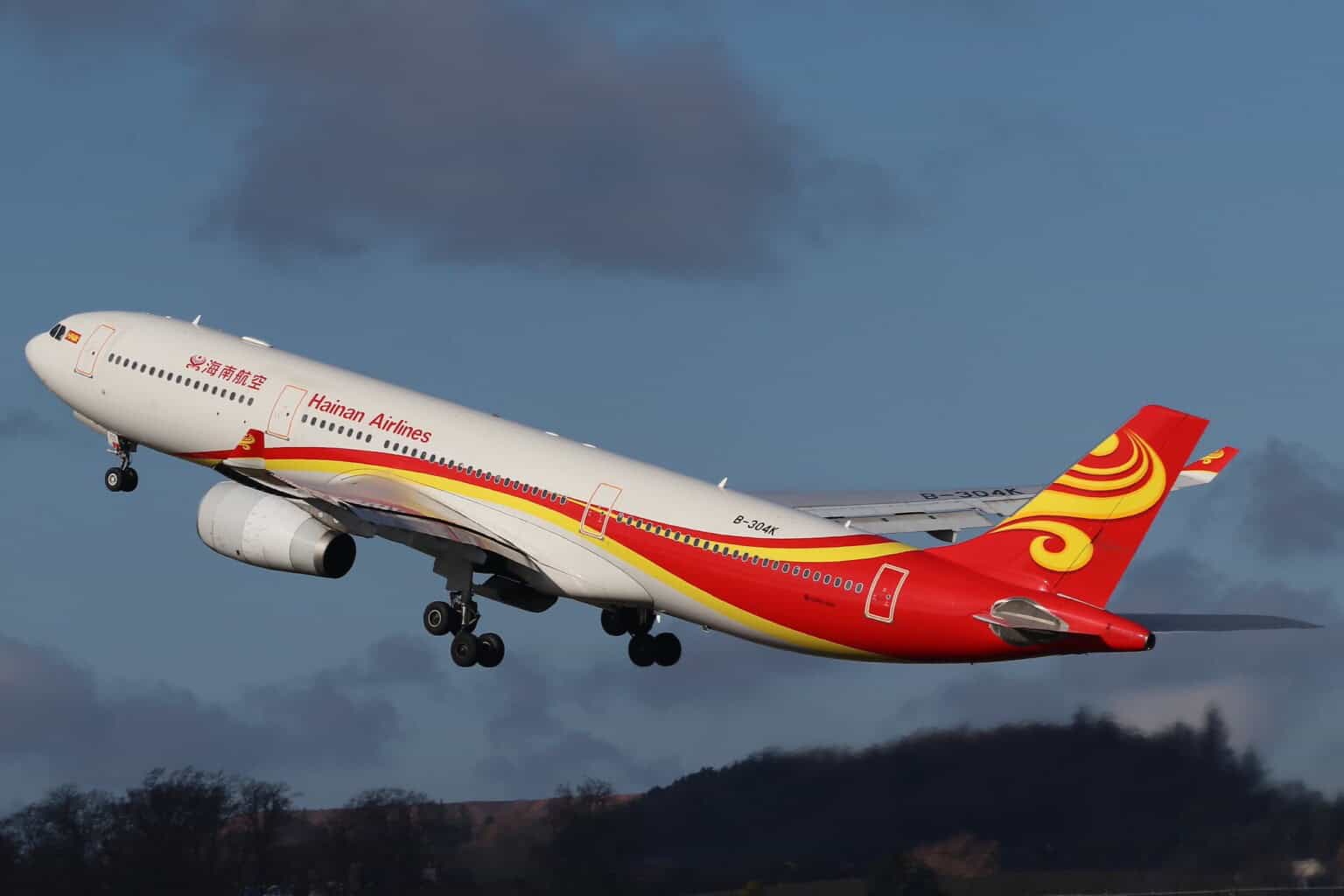
Hainan Airlines flight HU753, an Airbus A330-300 flying from Beijing to Manchester, diverted to Krasnoyarsk, Russia, in the early hours of August 15, 2026, after onboard sensors flagged a mechanical fault roughly four hours into the flight. All 230-plus passengers and crew landed safely, and Hainan Airlines said it is sending a replacement aircraft to complete the journey.
What happened on Flight HU753
The aircraft, registered B-304L, left Beijing Capital International Airport on a route that crosses Russian airspace for several hours on the way to the UK. About four hours in, while the jet was over central Russia, onboard sensors detected the fault and the crew requested a diversion.
The Airbus A330-300 landed at Krasnoyarsk International Airport in central Siberia at roughly 6:15 a.m. local time, according to Russia’s Emergencies Ministry. Krasnoyarsk sits more than 2,000 miles (3,200 km) east of Moscow.
Airport rescue crews met the aircraft as a precaution, and English- and Chinese-speaking staff helped coordinate with passengers and the airline, the ministry said. Neither the jet nor any airport infrastructure was damaged, and no injuries were reported.
Hainan Airlines confirmed the diversion in a statement reported by IBTimes UK, saying it plans to send a replacement aircraft to fly passengers on to Manchester. “We sincerely apologise for any inconvenience caused to passengers,” the airline said, without disclosing the specific nature of the fault.
That leaves passengers waiting out an unplanned stop in Siberia until the replacement jet arrives. Hainan has not said how long the wait to Manchester will be.
Why the flight was over Russia in the first place
A Beijing-Manchester service follows the great-circle route across Siberia, the shortest path between the two cities. Since 2022, Western governments have barred Russian airlines from their airspace, and Russia barred UK, EU, and US carriers in return, so most Western airlines now fly wide detours around Russian territory.
Chinese carriers were never part of that mutual ban, so Airbus and Boeing jets flying for airlines like Hainan still cross Russia directly on Asia-Europe routes. Airlines that instead reroute around Russian airspace typically add several hours of flying time and substantial fuel cost, a burden widely reported across the industry since the 2022 closures.
That routing advantage is also why HU753 had a Russian, rather than a European, airport within reach when the fault appeared. A similar split is playing out over Iran, where Gulf carriers have resumed overflights that European regulators still advise against.
A rare kind of diversion
Krasnoyarsk International Airport is not a typical emergency stop for a UK-bound flight. It was in reach here only because Hainan Airlines, unlike most European carriers, still overflies Russia on the Beijing-Manchester run.
The tradeoff behind the shortcut
The same routing that saves Chinese carriers time and fuel also means a diversion can land passengers somewhere the UK Foreign Office advises against travelling to. It is one more way Russia’s invasion of Ukraine still shapes ordinary passenger routings across Asia and Europe.
Sources and references used for research and fact-checking.
Get the Newsletter
The latest aviation news and stories sent to your inbox.
About the Author

Tim is the owner and lead editor of AeroCorner since 2019, overseeing aviation content covering aircraft, airlines, airports, and the broader aviation industry. Through years of researching, writing, editing, and publishing aviation-focused content, he has developed extensive practical knowledge of commercial aviation and air travel. Based in Asia and a frequent traveler himself, Tim also brings firsthand passenger experience to AeroCorner’s coverage. Outside of publishing, he has also explored aviation firsthand through hands-on flight training in New Zealand.