

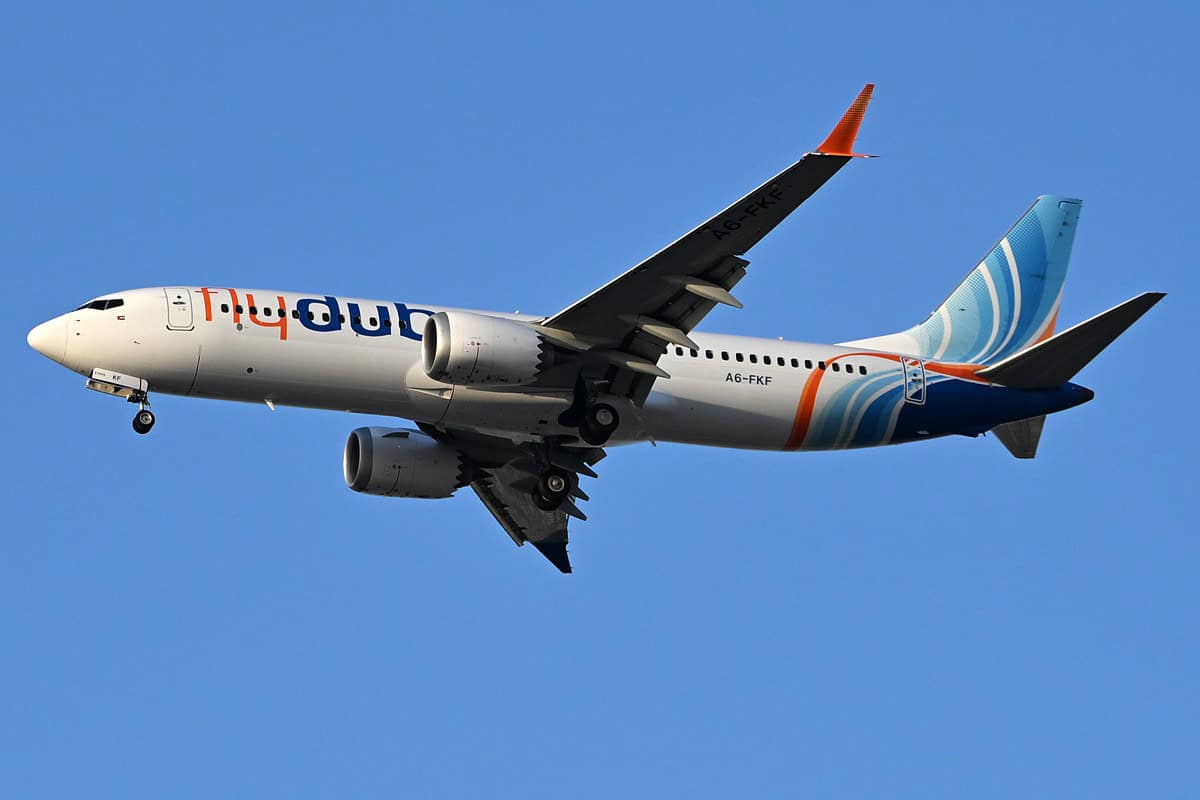
Both pilots of flydubai flight FZ1073 were taken to a hospital with injuries after the Dubai to Tel Aviv flight made an emergency landing at Tabuk, Saudi Arabia, on Wednesday, September 30, 2026, the airport’s operator said. Israeli officials, speaking anonymously to several news outlets, say they suspect the co-pilot stabbed the captain while trying to take over the aircraft.
That is a sharp change from the first hours after the flight squawked 7500 and diverted, when Israeli sources described an altercation between the pilots. In the statements reviewed for this article, neither flydubai nor the Saudi airport operator said who attacked whom, or why.
What the Airline and the Airport Have Confirmed
Flydubai said in a statement carried by Flightradar24 that FZ1073 “experienced an incident while en route” and landed safely at Tabuk, and that “all passengers are safe and accounted for.” The statement does not describe the incident or say what happened to the crew.
The fuller account comes from Cluster2 Airports, which runs Prince Sultan bin Abdulaziz International Airport in Tabuk. Its statement, reported by the Saudi Gazette, said the airport’s air traffic control center received a distress call from FZ1073 at 8:44 a.m. and that the aircraft landed safely at 9:45 a.m. local time.
Cluster2 said the captain and co-pilot were found to have sustained injuries and were taken to a hospital. It did not say how they were hurt, and added that authorities were continuing to investigate.
The aircraft was a Boeing 737 MAX 8. Ynetnews put the number on board at 174 passengers, including 27 children.
What the Flight Data Shows
Flightradar24’s own account of its data has the jet cruising at 34,000 feet when it began a steep descent, then a sharp climb, then a second sharp descent. It settled at about 15,000 feet roughly 12 minutes later, with its altitude and ground speed still varying for the rest of the flight.
The times below are Saudi local time, converted from Flightradar24’s UTC times, plus the two times the airport operator gave.
6:05 a.m.
Departure. FZ1073 leaves Dubai, where the clock reads 7:05 a.m., and climbs to 34,000 feet.
8:21 a.m.
Altitude swings. The aircraft begins a steep descent, followed by a sharp climb and another sharp descent.
8:28 a.m.
Squawk 7700. The transponder shows the general emergency code along the Saudi-Jordanian border.
8:35 a.m.
Squawk 7500. The code for unlawful interference appears. The jet turns west, briefly enters Jordanian airspace, then turns back toward Tabuk.
8:44 a.m.
Distress call. Tabuk’s air traffic control center receives a request for an emergency landing, according to Cluster2.
9:45 a.m.
Landing. FZ1073 lands at Tabuk, according to Cluster2. Flightradar24 says it had switched back to 7700 on the approach.
Outlets reading the same tracking data describe the first plunge differently. The Associated Press, in a report carried by The Tribune, said the jet went from 33,000 feet to 17,000 feet in about a minute, while CNN said it lost 17,400 feet in just under two minutes.
What Israeli Officials and Passengers Say
Two Israeli sources told CNN they suspect the co-pilot was trying to hijack the plane after stabbing the captain. They said it was not clear whether the aim was to crash the jet or to land it and take hostages.
The Associated Press quoted an Israeli official as saying a fight broke out between two pilots, one of whom was armed with a knife. A regional official told the agency that the crew had been questioned, without saying whether anyone was detained.
A passenger told The Jerusalem Post that one pilot stabbed the other and that passengers seated near the front rushed the cockpit and removed the attacker. According to that passenger, two other pilots who were seated at the back then went into the cockpit and one took the controls.
The pilots’ nationalities are not settled. Two Israeli officials told CNN that one of the pilots was Omani, and one of them said he was the co-pilot. An earlier report attributed to Israel’s N12 and relayed by the Ukrainian outlet Glavnoe described a captain of Russian origin and a Ukrainian co-pilot, with no official confirmation.
Even the direction of the attack differs between reports. CNN’s sources say the co-pilot stabbed the captain, while Ynetnews, citing Israeli officials, wrote that the co-pilot was stabbed during the struggle and that the captain was an Indian national.
Confirmed versus reported
On the record as of the afternoon of September 30: the flight had an incident en route and landed safely at Tabuk (flydubai), and the captain and co-pilot were injured and hospitalized (Cluster2 Airports). The stabbing, the claim that the co-pilot was the attacker, the hijacking motive and both pilots’ nationalities rest on unnamed officials and passenger accounts, and those accounts conflict.
Why the Transponder Read 7500
A transponder squawk code is a four-digit number set in the cockpit so radar can identify a flight. Code 7500 is reserved for unlawful interference, and it describes what is happening to the aircraft, not who is responsible.
That matters here. If the accounts given by Israeli officials hold up, the threat came from a crew member inside the cockpit, and the code does not distinguish that from a threat in the cabin. In the reports reviewed, no official said who set the code on FZ1073.
The FAA’s Aeronautical Information Manual, which sets out US procedure, says a controller who sees 7500 asks the pilot to verify it. If the pilot confirms or does not reply, the controller asks no further questions, keeps following the flight and notifies the appropriate authorities.
The sequence on FZ1073 was 7700, then 7500 about six minutes later, then 7700 again on the approach to Tabuk, according to Flightradar24. The data cannot show who was at the controls at each point.
What Happens Next
An Israeli official told CNN that agencies including Shin Bet, Mossad, the military and the transportation ministry are investigating. One question, the official said, is why the crew included a pilot from a country with which Israel has no diplomatic relations.
Cluster2 said it was coordinating with the airline on a replacement aircraft. The Jerusalem Post reported that a flydubai jet sent for the passengers landed in Saudi Arabia shortly before 4 p.m., and that eyewitnesses said most passengers refused to board it.
Flydubai said it is working with the relevant authorities and will issue further updates as details are confirmed. Until the airline or the Saudi authorities describe what happened in the cockpit, the account of an attack by the co-pilot remains an allegation.
Sources and references used for research and fact-checking.
Get the Newsletter
The latest aviation news and stories sent to your inbox.
About the Author

Tim is the owner and lead editor of AeroCorner since 2019, overseeing aviation content covering aircraft, airlines, airports, and the broader aviation industry. Through years of researching, writing, editing, and publishing aviation-focused content, he has developed extensive practical knowledge of commercial aviation and air travel. Based in Asia and a frequent traveler himself, Tim also brings firsthand passenger experience to AeroCorner’s coverage. Outside of publishing, he has also explored aviation firsthand through hands-on flight training in New Zealand.