

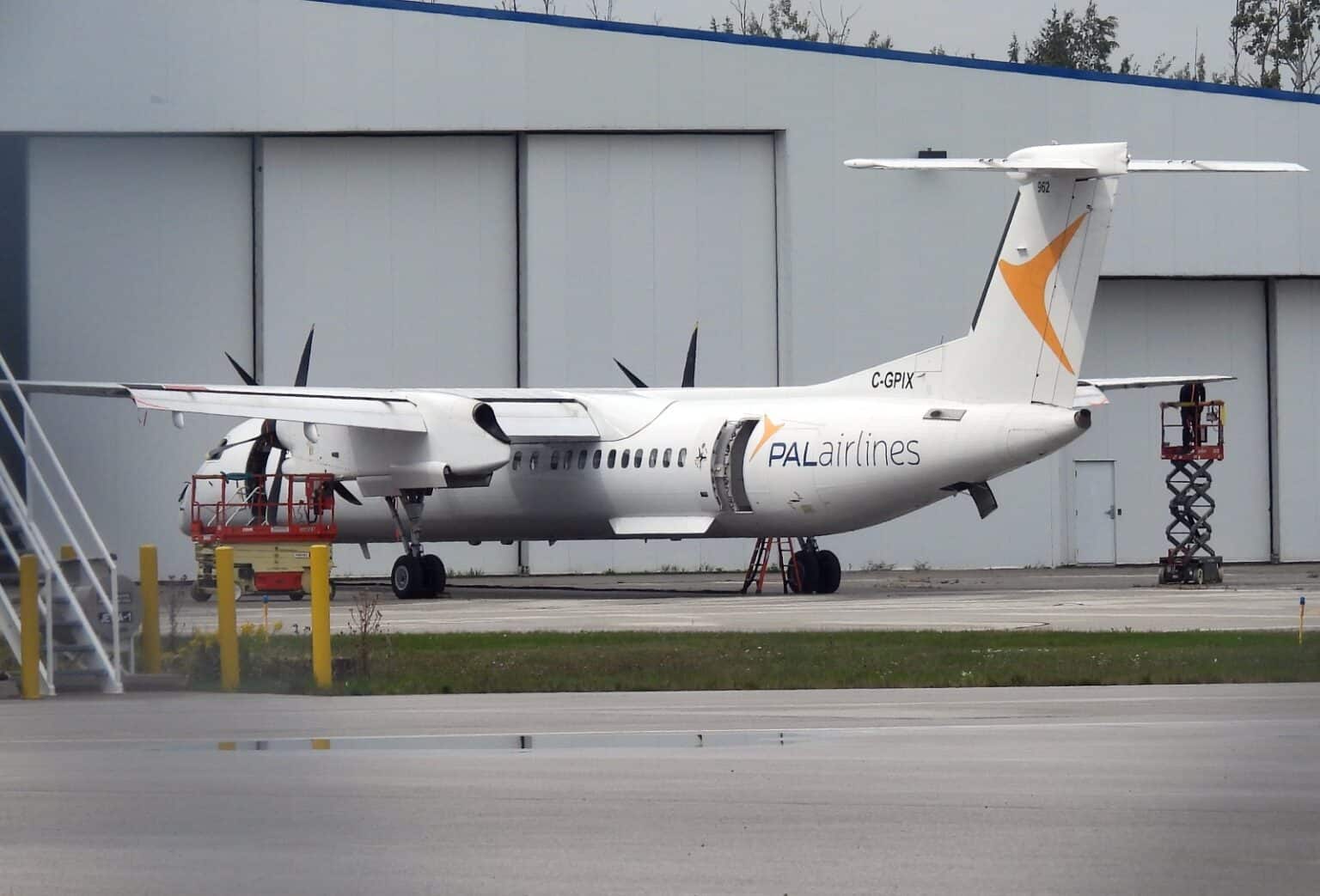
PAL Airlines flight PB411, a De Havilland Dash 8-400 registered C-GPIX, lost a main wheel as it departed Goose Bay, Labrador, on Thursday, November 12, 2026. The crew diverted to St. John’s instead of continuing to Deer Lake, and the aircraft landed safely.
It was the second wheel the same airframe had lost in 13 days. On October 30, C-GPIX was the aircraft operating flight PB901 when it lost a wheel at Wabush, an event a CBC producer on board caught on video.
What happened on PB411
Transport Canada’s occurrence database, CADORS, records that the flight lost a wheel during its departure from Goose Bay and that the crew asked to divert to St. John’s. The entry, number 2026U0057, was reported by NAV CANADA and says the aircraft landed safely at 1940 UTC, or 4:10 p.m. local time in St. John’s.
The same entry lists no injuries and logs the occurrence at 1730 UTC, with the aircraft en route 40 nautical miles south of Goose Bay. It identifies the aircraft as a DHC-8-402 built in 2001, owned by PAL Airlines and flown by Provincial Airlines under Canada’s commercial airline rules.
More detail came on November 19, when The Aviation Herald reported the Transportation Safety Board of Canada’s (TSB) information on the flight. By that account, the tower told the crew the left outboard wheel had come off as the aircraft climbed out from runway 08.
The crew kept climbing to flight level 250, about 25,000 feet, before deciding on St. John’s, according to the same report, then held at 7,000 feet on the approach and landed on runway 28 about two and a half hours after takeoff.

One airframe, two wheels
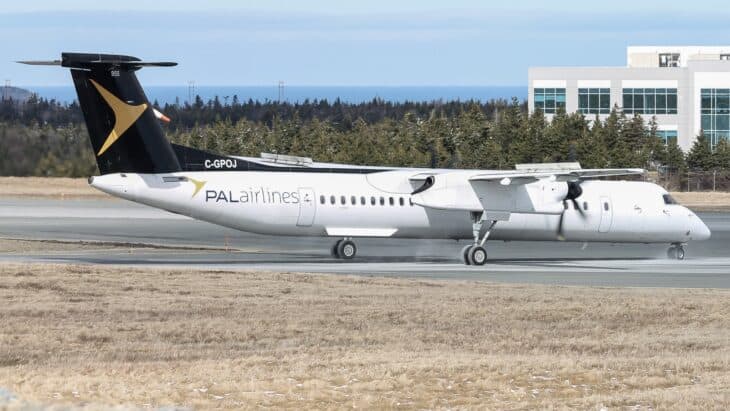
PAL confirmed the link on the day itself. Spokesperson Joseph Galimberti told The Canadian Press that the aircraft had also lost a wheel on October 30 and that PAL was pulling it from service.
According to that report, PAL had carried out extensive maintenance on the aircraft after the Wabush event, following guidance from De Havilland Aircraft of Canada. The airline said it was inspecting the wheel assemblies on the rest of its Dash 8-400 fleet as a precaution, and rebooking the PB411 passengers to Deer Lake.
The early reports on Wabush did not name the aircraft. The Aviation Herald reported that the TSB’s November 19 information identified it as C-GPIX, and said its left inboard main wheel came off during the landing rollout there. PAL has blamed that first event on a wheel bearing failure.
So the two events took different wheels from the same side of the aircraft: the inboard one at Wabush, then the outboard one at Goose Bay. Whether the two failures share a cause has not been said publicly.
The TSB also said, per The Aviation Herald, that PAL is working with the manufacturer and with Collins, which makes the main landing gear, to understand why the wheels detached. The aircraft was still on the ground in St. John’s on November 19, the outlet reported.
What a class 5 occurrence means
The TSB classed the Goose Bay event as a class 5 occurrence, The Aviation Herald reported. Under the board’s classification policy, that is the lightest of the classes the TSB uses for occurrences in Canada: a short data-gathering file, not a full inquiry.
The policy says a class 5 file is generally finished within 60 days and produces no formal investigation report. The data go into the TSB’s database, and the work can, in some cases, lead to a safety letter on an issue it uncovers.
The classification is not fixed. The policy lets the TSB upgrade an occurrence when new information justifies it, so a full investigation remains possible if the wheel findings point to something wider than one aircraft.
For now the answers sit with PAL, De Havilland and Collins. AeroCorner found no public statement from any of them on what failed on the second wheel, whether the October work touched it, or what the fleet inspections of PAL’s other Dash 8-400s found.
PAL, headquartered in St. John’s, describes itself as one of the largest independent airlines serving eastern Canada and Quebec, The Canadian Press noted. How many of its Dash 8-400s were checked, and whether any flights were affected, has not been reported.
Sources and references used for research and fact-checking.
Get the Newsletter
The latest aviation news and stories sent to your inbox.
About the Author

AeroCorner News is the aviation news desk of AeroCorner.com. It covers accidents and incidents, safety rulings, airline and airport disruption, and new aircraft. It works from primary sources such as the NTSB, FAA, EASA and the manufacturers' own announcements.