

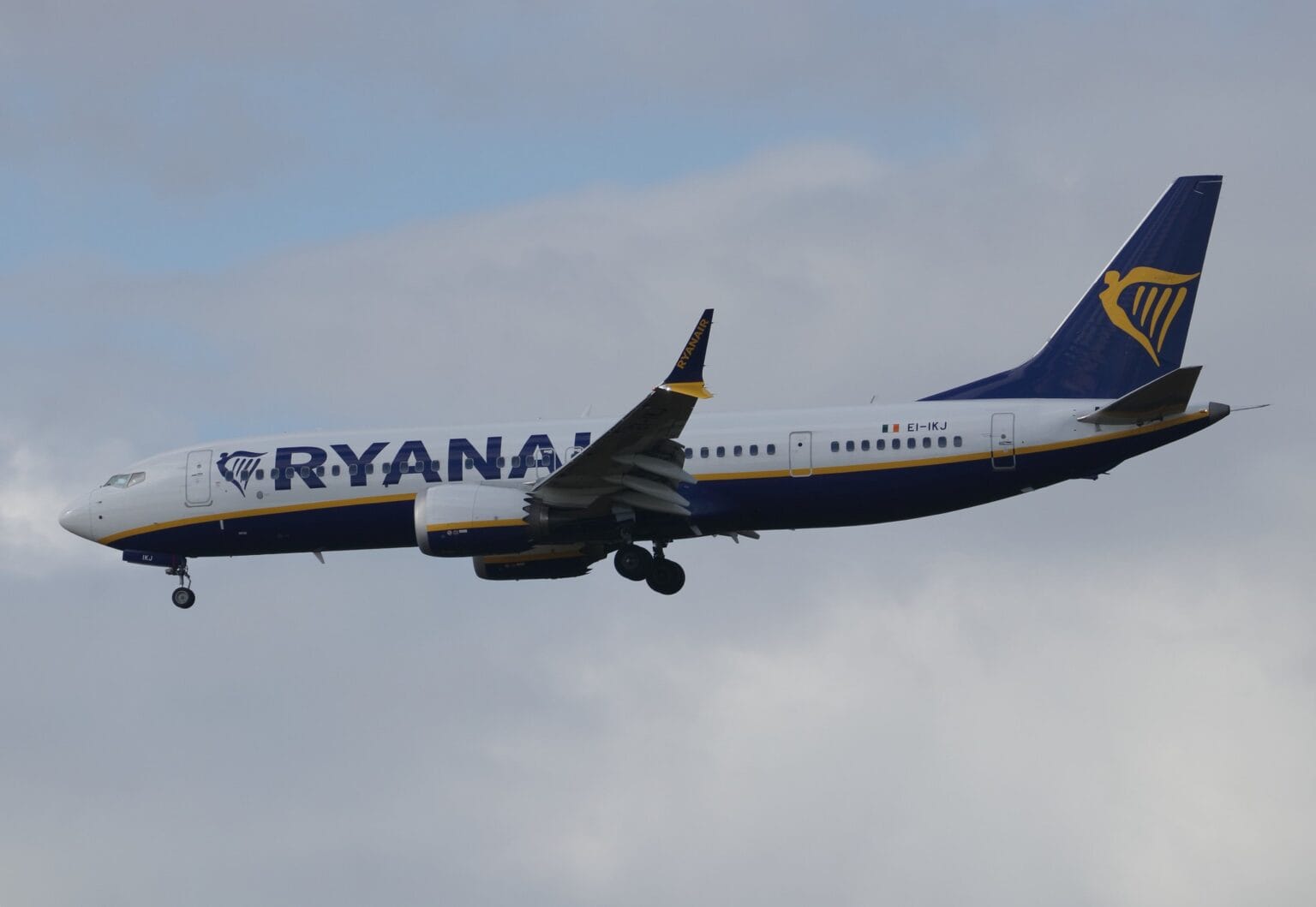
Ryanair flight FR7073 from Porto to Dublin returned to Porto Airport shortly after takeoff on the night of September 22, 2026, after a passenger handed the cabin crew written notes for the captain. The Boeing 737 MAX, registered EI-IKJ, reached Dublin in the early hours of September 23.
Several reports say the captain set 7500, the transponder code for a hijacking. Portuguese authorities told one newspaper that the code was not needed, and Ryanair has described the event only as a false security report.
Notes for the Captain
The flight took off at 21:55 UTC, or 10:55 p.m. in Porto, according to Flightradar24. Soon afterward, a 48-year-old Brazilian woman gave a flight attendant several sheets of paper to pass to the captain, according to police information reported by Correio da Manhã.
In them, the newspaper reported, she wrote that she was being pursued by three people. A source in Portugal’s Public Security Police (PSP) told Notícias ao Minuto that her speech was incoherent and that she disturbed the cabin, and that the captain then decided to return.
Police took her off the aircraft, identified her and informed the Public Prosecutor’s Office, the same source said, adding that there was no sign of any hijacking attempt. Police could not confirm anything she had written, Correio da Manhã reported.
Accounts of what happened next differ. Correio da Manhã reported that she went back on the aircraft, while Renascença reported that she was put out of the airport.
FR7073 left Porto again at 1:27 a.m. and landed in Dublin at 3:13 a.m. local time. Ryanair said in a statement quoted by Ireland Live that the flight “returned to Porto shortly after take-off due to a false security report,” with a delay of two hours and 33 minutes.
Where the 7500 Report Came From
In Portugal, the hijack-code claim traces to José Correia Guedes, a former TAP Air Portugal captain. He wrote on X that the pilot entered 7500 and that the crew asked for radar vectors back to Porto and for the authorities to be notified, as quoted by Notícias ao Minuto.
Portuguese outlets repeated his account, and AIRLIVE reported that the captain set the code while climbing through 12,000 feet. The Independent’s report then cited AIRLIVE.
Correio da Manhã reported the opposite: the authorities told it that activating 7500 had not been necessary. None of the reports we found pointed to flight-tracking data or an air traffic control recording that shows the code.
What is confirmed, and what is not
Ryanair confirms the return to Porto, a false security report and a delay of 2 hours 33 minutes. A police source confirms the passenger was removed, identified and reported to prosecutors, with no sign of a hijacking attempt. Whether the crew actually set 7500, and whether the passenger continued to Dublin, were unconfirmed at the time of writing.
What a 7500 Squawk Sets in Motion
Code 7500 is the transponder setting that tells air traffic control an aircraft is being hijacked. In the FAA’s wording, it means “I am being hijacked/forced to a new destination.”
A code is sometimes entered by mistake, as Guedes noted, so controllers first check it. Under the FAA’s published procedure, the controller asks the pilot to verify 7500, and a crew that is not under threat says so on the radio and resets the code.
If the pilot confirms the code or does not answer, the controller asks nothing more. The flight is followed, its requests are handled, and the authorities are notified.
That is why the dispute matters. A 7500 would mean the crew believed the aircraft was being hijacked, the threat that led to reinforced cockpit doors after September 11. A return for a disruptive passenger, which is what the police account and Ryanair’s statement describe, is not that.
Sources and references used for research and fact-checking.
Get the Newsletter
The latest aviation news and stories sent to your inbox.
About the Author
Tim is the owner and lead editor of AeroCorner since 2019, overseeing aviation content covering aircraft, airlines, airports, and the broader aviation industry. Through years of researching, writing, editing, and publishing aviation-focused content, he has developed extensive practical knowledge of commercial aviation and air travel. Based in Asia and a frequent traveler himself, Tim also brings firsthand passenger experience to AeroCorner’s coverage. Outside of publishing, he has also explored aviation firsthand through hands-on flight training in New Zealand.