

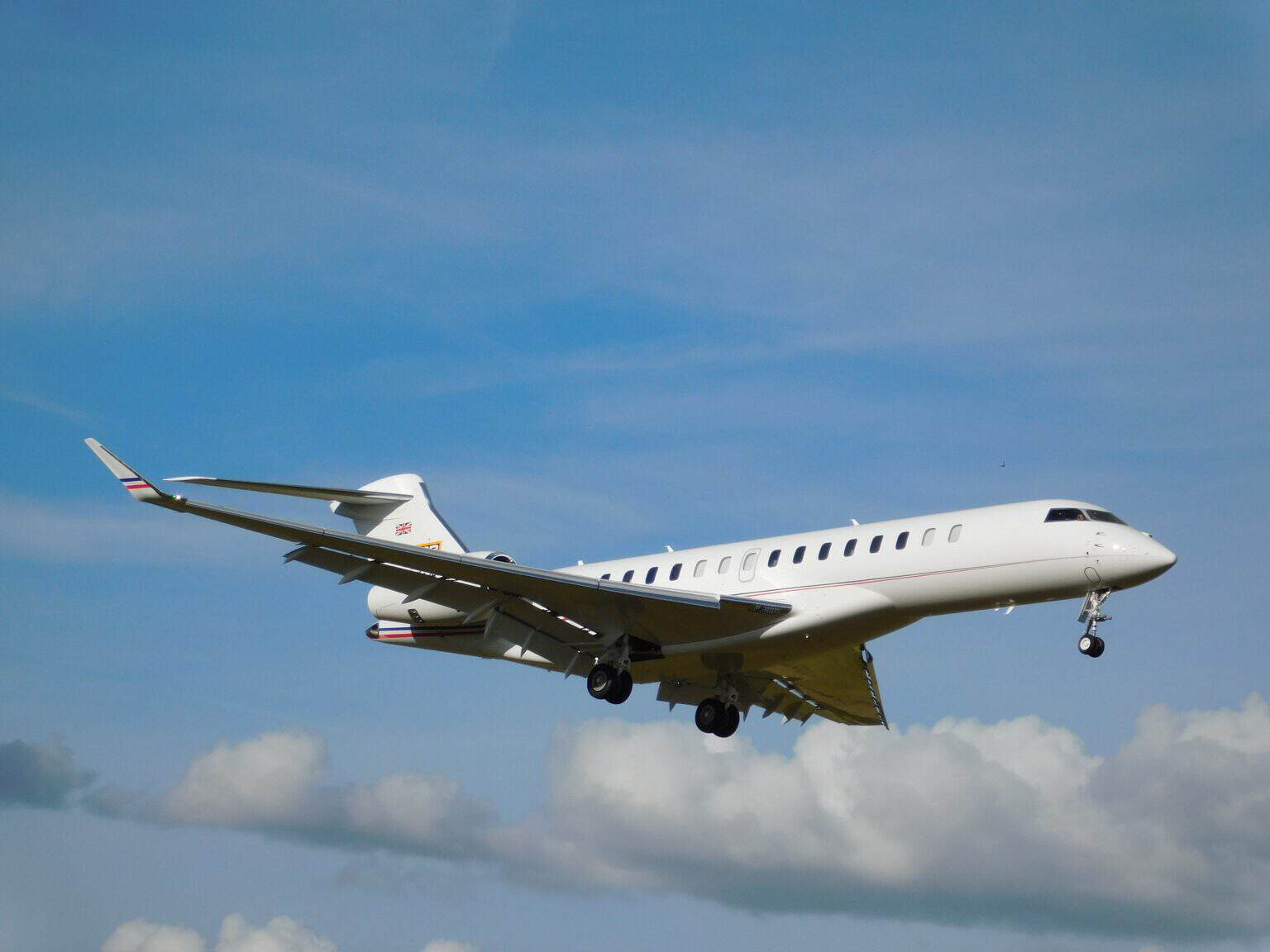
The FAA has made a right-wing fix mandatory on the Bombardier Global 7500, publishing airworthiness directive 2026-20-09 in the Federal Register on October 14, 2026. The rule takes effect on November 18, 2026.
It targets three spots in the right wing where a fuel line, hydraulic lines and the fuel vent tube sit too close to their neighbors. The FAA estimates that 60 US-registered jets are affected.
What the directive requires
According to the FAA, there have been reports of low clearance in three places. The first is between the fuel line flexible coupling and a clip-nut on a wiring harness support bracket in bay 3.
The second is between that fuel line coupling and a hydraulic system 3 line in bay 18. The third is between the hydraulic system 3 lines and the fuel vent tube in bay 20.
The stated risk is not a leak or chafing. In the FAA’s words, the low clearance “could result in an ignition source developing in the fuel tank in the event of a lightning strike.”
The fix comes from Bombardier service bulletin 700-57-7537. Mechanics replace the clip-nut on the harness bracket between ribs 3 and 4, and replace fuel tube assemblies between ribs 17 and 20.
They also inspect the clearance between the hydraulic lines and the fuel vent tube in bay 20. If the gap is too small, the hydraulic system support brackets between ribs 19 and 21 are replaced before further flight.
Which jets, and how long owners have
The FAA rule adopts Transport Canada AD CF-2025-49, because Canada is the type’s state of design. That order covers model BD-700-2A12 airplanes with serial numbers 70005 through 70179.
Owners must complete the work within 1,500 flight hours or 72 months of November 18, 2026, whichever comes first. Jets already fixed under the original September 2024 issue of the bulletin count as compliant.
The Global 8000 shares the BD-700-2A12 type designation, and an FAA draft Flight Standardization Board report lists both names under it. The directive is written by serial number, though, and the first Global 8000 delivered, C-FPJD, is msn 70240 according to ch-aviation, outside the covered range.
Neither the FAA nor Transport Canada names the Global 8000 in the order. Owners should check their own serial number against the range rather than the badge on the tail.
| Item | FAA estimate |
|---|---|
| Required work, labor | 9 work-hours at $85, or $765 |
| Required work, parts | $1,928 |
| Required work, per jet | $2,693 |
| Required work, US fleet of 60 | $161,580 |
| Bracket replacement if needed, per jet | $5,772 (14 work-hours plus $4,582 in parts) |
Why a few millimeters matter in a lightning strike
Jets get struck by lightning, so the FAA’s transport airplane rules cover lightning protection of fuel tanks and systems, including failures that could lead to a fuel tank explosion. Physical spacing between metal parts is one of the design features that does that job.
The FAA’s guidance on transport airplane fuel system lightning protection, Advisory Circular 25.954-1, explains the mechanism. A voltage spark can jump between a fuel tube and adjacent structure if the separation is insufficient, and if that spark meets fuel vapor, it can ignite it.
The same circular says lab tests put the minimum spark energy needed to ignite hydrocarbon fuel vapor at 200 microjoules, a tiny amount. That is why it lists “insufficient tube or wiring clearance to adjacent systems or structure” among the known causes of lost lightning protection.
Reality check
No in-service ignition or lightning event is cited in either directive. The orders respond to reports of low clearance found on the airplanes, and the FAA said the condition has no effect on fuel system operation.
A year from Canadian order to US rule
Transport Canada acted in October 2025, and the FAA proposed its version on March 4, 2026. Seven people commented, and five backed the rule without change.
One commenter asked why the FAA had not issued an emergency AD or a shorter deadline. The FAA replied that it had no data to justify cutting the Canadian compliance time, and that the low clearance “would not contribute to fuel starvation” because there is no potential for the vent line to be fouled.
A second commenter asked for the comment period to be reopened, arguing the public could not see the referenced material or the basis for the cost estimate. The FAA disagreed and adopted the rule as proposed, apart from minor editorial changes.
Sept. 30, 2024
Bombardier issues the fix. Service bulletin 700-57-7537, basic issue.
June 13, 2025
Bulletin revised. Revision 01 becomes the reference standard.
Oct. 15, 2025
Canada makes it mandatory. Transport Canada AD CF-2025-49 takes effect.
March 4, 2026
FAA proposal. The notice of proposed rulemaking is published.
Oct. 14, 2026
Final rule published. AD 2026-20-09 appears in the Federal Register.
Nov. 18, 2026
Effective date. The 1,500-hour and 72-month clocks start for US jets.
The directive lands as Bombardier’s US business draws political attention, weeks after President Trump said the company could not sell jets in the US unless it built them there. The AD itself follows the standard path for a Canadian-designed type: Transport Canada notified the FAA under the two countries’ bilateral agreement.
Sources and references used for research and fact-checking.
- FAA (Federal Register), Airworthiness Directives; Bombardier, Inc., Airplanes (AD 2026-20-09, Docket FAA-2026-2289)
- Transport Canada, AD CF-2025-49: Wings, Low Clearance Between Fuel Vent Tube Installation and Surrounding Systems and Structures in Right Wing
- FAA, Advisory Circular 25.954-1, Transport Airplane Fuel System Lightning Protection
Get the Newsletter
The latest aviation news and stories sent to your inbox.
About the Author

AeroCorner News is the aviation news desk of AeroCorner.com. It covers accidents and incidents, safety rulings, airline and airport disruption, and new aircraft. It works from primary sources such as the NTSB, FAA, EASA and the manufacturers' own announcements.