

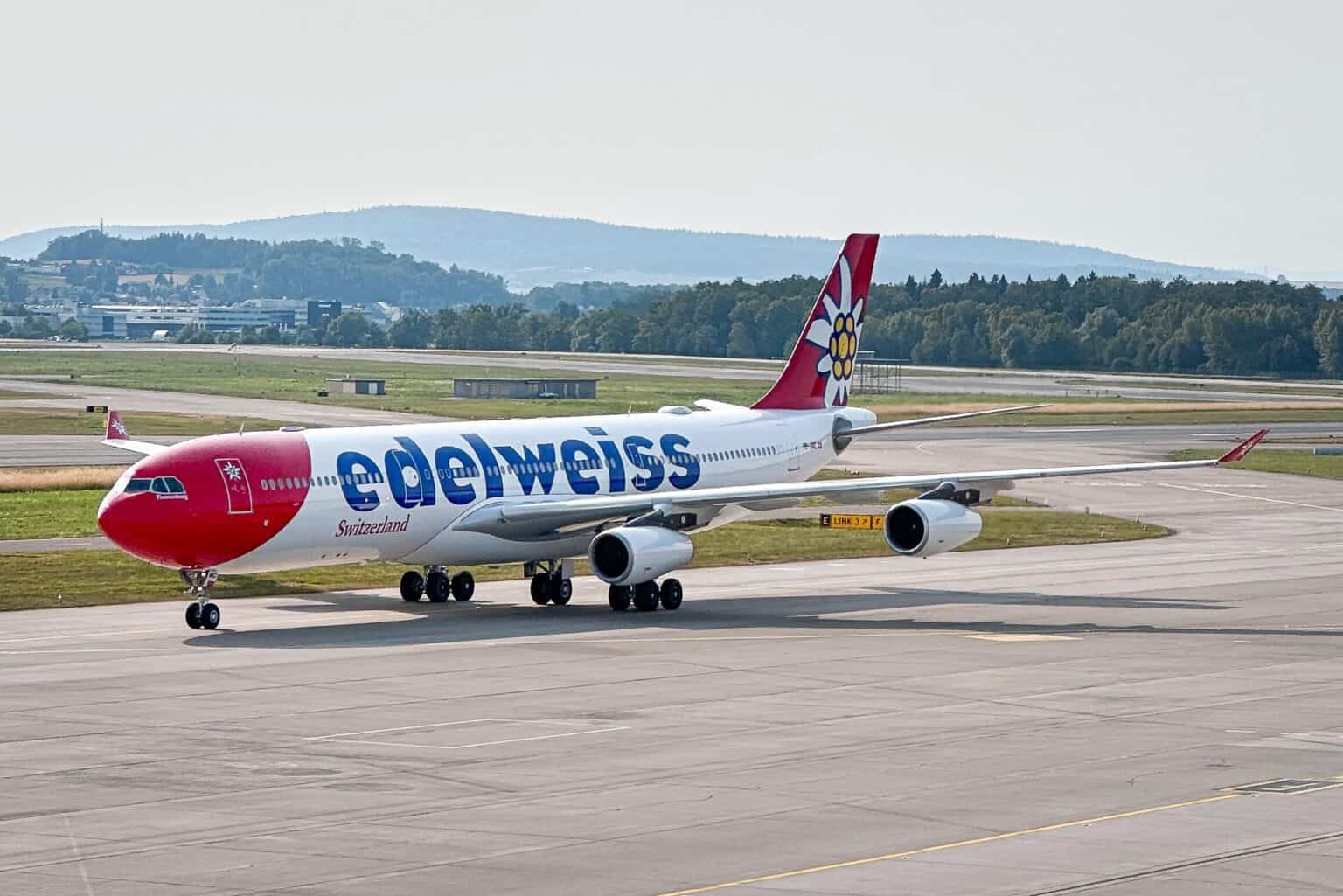
Edelweiss flight WK34 from Zurich to Punta Cana turned back on Saturday, October 17, 2026, because the center landing gear on its Airbus A340-300, registration HB-JMC, would not retract. The four-engine jet dumped fuel to bring its weight down for landing and was back on the ground in Zurich about 90 minutes after it left.
Edelweiss spokesperson Andreas Marti confirmed the gear fault to Swiss media. The airline told Blick that there had been no danger, and the same aircraft left for the Caribbean again that afternoon.
How the flight unfolded
The A340 took off from runway 16, according to The Aviation Herald. The crew stopped the climb at flight level 080, about 8,000 feet, and entered a hold to work the problem.
The jet later climbed to FL220 before turning back and landing on runway 34 at Zurich Airport at around 3 p.m. local time. Marti told 20 Minuten that the center gear, the extra landing gear under the middle of the fuselage, could not be raised.
Tages-Anzeiger described the fault as a problem with a gear door. Edelweiss said a part was replaced but did not name it in its statements to Swiss media.
Because the aircraft was too heavy to land, Marti said, fuel had to be dumped first. Tages-Anzeiger put the amount at about 99,000 pounds (45 tonnes), released over the area around the Jungfrau, the Titlis, Chur and Flims.
A reader filmed the fuel streaming from the jet’s dump nozzle, 20 Minuten reported.
Once the part was swapped, the airline said, the aircraft took off again for Punta Cana at 5:10 p.m. local time with a delay of 3 hours 40 minutes. The Aviation Herald, which also reported that the same jet continued, estimated the arrival delay at about 2 hours 40 minutes.
Early on October 18, the tracking site Plane Finder showed HB-JMC flying the return leg, WK35, from Punta Cana back to Zurich.
WK34 has turned back over its gear before. In October 2017, an Edelweiss A330-300 on the same route returned to Zurich when its landing gear would not retract, and the flight left that evening on a different aircraft, 20 Minuten reported at the time.
Why a stuck center gear ends a Caribbean flight
Besides the two four-wheel main gears under the wings, the A340-200 and -300 have a third, twin-wheel gear on the centerline of the belly. It retracts forward into its own bay in the fuselage, according to Airbus’s airport planning manual.
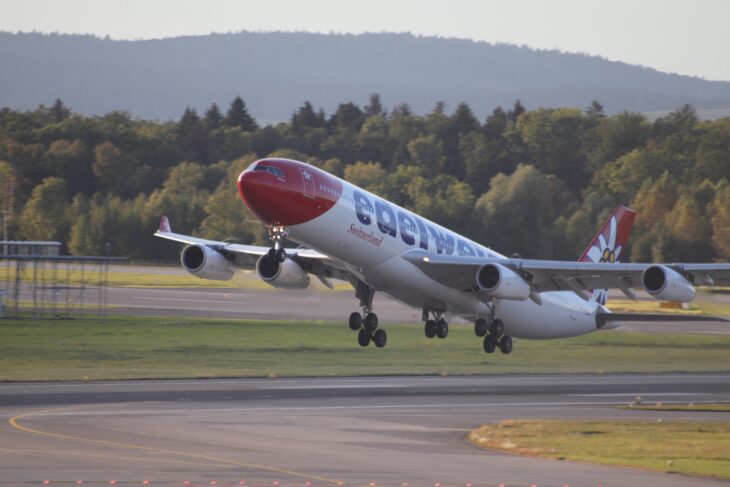

On the ground it takes about 15 to 16% of the aircraft’s weight at maximum ramp weight, according to the same document. Its bay is closed by a set of doors that shut once the gear is up.
A gear left hanging in the airflow is a heavy drag penalty. SKYbrary, the aviation safety reference, notes that fuel burn with the gear down and the flaps and slats out is significantly higher than in a clean configuration. It adds that flight management system fuel predictions are usually inaccurate whenever the aircraft is not in its normal configuration.
Zurich to Punta Cana is roughly 4,700 miles (7,500 km) in a straight line, which is a long way to fly on fuel figures the computers cannot predict. A Thai Airways 777 turned back to Frankfurt in August for the same kind of fault, and also dumped fuel first.
Turning back early creates the second problem, which is weight. Airbus lists the A340-300’s maximum takeoff weight at up to about 610,000 pounds (276.5 tonnes), but its maximum landing weight at 410,000 to 423,000 pounds (186 to 192 tonnes), depending on the weight variant.
Switzerland’s Federal Office of Civil Aviation (FOCA) says in a fact sheet that long-haul jets carry fuel for many hours, so a return soon after takeoff can leave them too heavy to land. Fuel may then be dumped only in an emergency, with air traffic control clearance and at least 6,000 feet above the ground, so that it evaporates before reaching the surface.
Every dump must be reported to the office. The fact sheet, dated 2016, counted an average of three cases a year in Swiss airspace over the previous decade, at about 26,000 pounds (12 tonnes) each, which makes the 45 tonnes Tages-Anzeiger reported nearly four times a typical event.
One of Edelweiss’s last three A340s
HB-JMC was delivered to SWISS in 2003 and moved to its sister airline Edelweiss in 2023, where it carries the name Flumserberg, aeroTELEGRAPH reported in September. It had returned to Zurich on September 18 from a 15-day C-check at HAECO in Hong Kong, which Edelweiss called the last one there for its A340s.
Edelweiss plans to retire all three of its remaining A340s, HB-JMC, HB-JMD and HB-JME, in January 2027, with HB-JMC’s last flight set for January 17. The airline has sold the jet, and it will be dismantled.
The Airbus A350 is taking over the long-haul network. Edelweiss said in April 2026 that it was flying four A350s and that the fleet would eventually reach six.
Elsewhere in the Lufthansa Group, the larger A340-600 is bowing out too: Lufthansa is due to fly its last A340-600 passenger service on October 18.
Sources and references used for research and fact-checking.
Get the Newsletter
The latest aviation news and stories sent to your inbox.
About the Author

AeroCorner News is the aviation news desk of AeroCorner.com. It covers accidents and incidents, safety rulings, airline and airport disruption, and new aircraft. It works from primary sources such as the NTSB, FAA, EASA and the manufacturers' own announcements.