

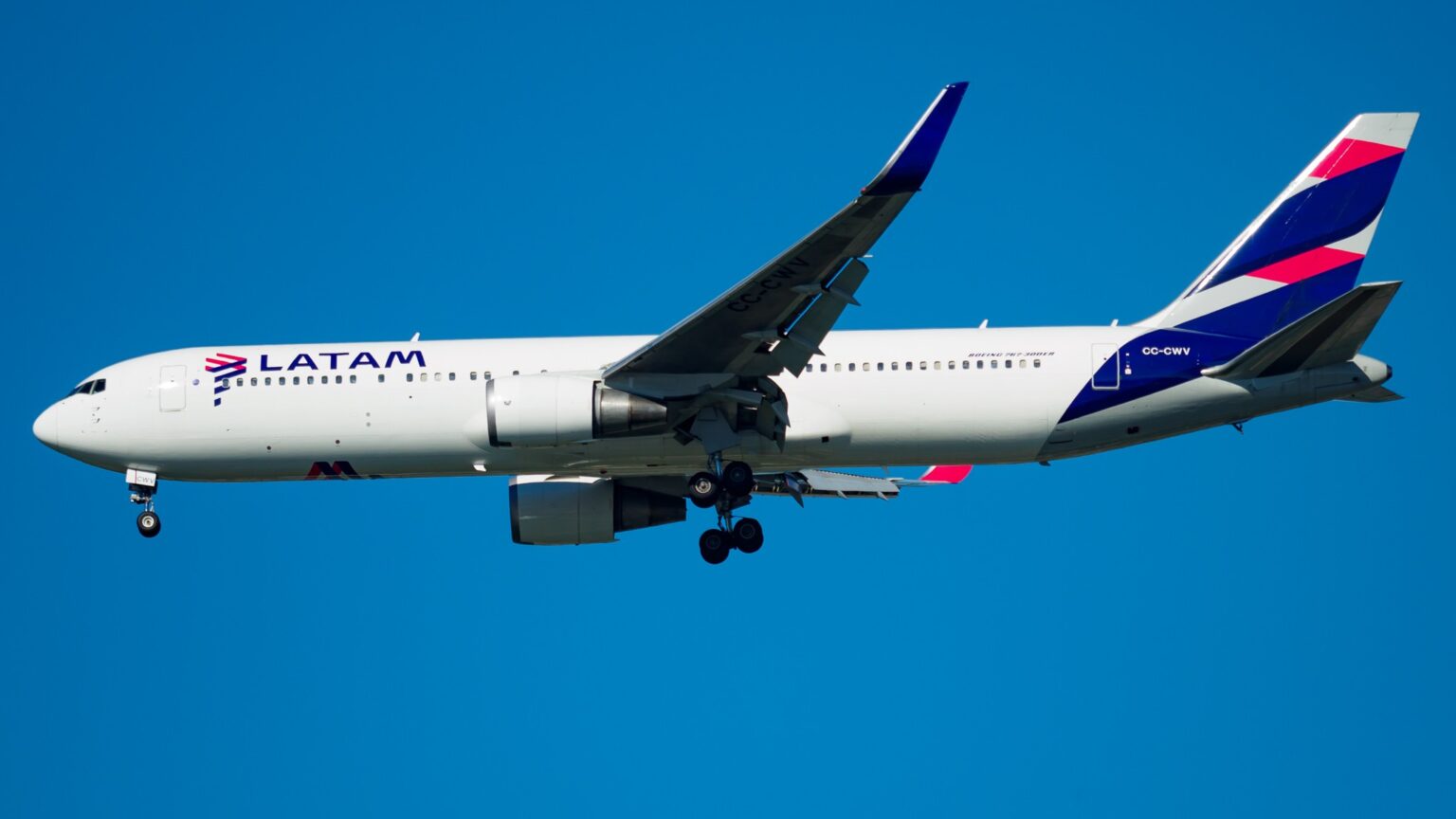
LATAM Airlines Perú flight LA2424 from Lima to São Paulo turned back on Friday, October 16, 2026, after the oxygen masks dropped in the cabin of its Boeing 767. The airline said a technical issue triggered its safety protocols, and the jet landed back at Jorge Chávez International without incident.
As of Sunday, October 18, LATAM has not said what the technical issue was. The Aviation Herald reported a loss of cabin pressure, but the airline has not confirmed that.
What happened on LA2424
Flight logs on Plane Finder show CC-CWV, a Chilean-registered Boeing 767-300ER, flying LA2424 that morning. The Aviation Herald names the same aircraft.
FlightAware times cited by APNoticias have the jet leaving Lima at 9:48 a.m. local time and landing back there at 11:31 a.m. The Aviation Herald put the landing about 105 minutes after departure, on runway 16R.


According to The Aviation Herald, the 767 was cruising at 33,000 feet about 300 nautical miles southeast of Lima when the crew began an emergency descent. The masks dropped, and the jet leveled off at 10,000 feet.
The APNoticias report says the flight declared a general emergency with the 7700 transponder code, which alerts air traffic control. It says the jet held at about 10,000 feet (3,060 m) and turned back near Ica, the region south of Lima.
In a statement quoted by Aviation Club Center, LATAM said the crew followed established procedures and chose to return to Lima to protect passengers and staff. Passengers received assistance after landing, the airline said.
LATAM said it swapped aircraft so passengers could reach São Paulo the same day. “LATAM Airlines Perú regrets any inconvenience this may have caused and reaffirms that the safety of its passengers and crews is the top priority in all of its operations,” the statement said.
Plane Finder’s log for a second 767, CC-CWF, shows it leaving Lima as LA2424 at 3:36 p.m. local time. The Aviation Herald said the replacement reached São Paulo Guarulhos about 6 hours and 15 minutes late.
CC-CWV was still on the ground in Lima about 26 hours after it landed, The Aviation Herald reported. Neither LATAM nor the reports AeroCorner reviewed give the number of people on board.
A passenger’s account
Peruvian businesswoman and TV personality Alejandra Baigorria described the flight in a TikTok video, Infobae reported. She did not name the airline; the outlet said the LA2424 identification came from another content creator.
Baigorria said she woke to a sharp descent and an announcement about an emergency landing, and the masks fell during a second descent. She said she kept hers on for 40 minutes to an hour, and told followers, “I thought these were the last minutes of my life.”
She described the event as a depressurization and praised the crew. She said she later boarded another aircraft and reached São Paulo.
Still unknown
LATAM has called the cause a technical issue and has not confirmed a loss of cabin pressure. It has not said what failed, how many people were on board, or whether the masks deployed automatically or were released by the crew.
Why a 767 heads for 10,000 feet when the masks drop
A pressurized airliner keeps the cabin far lower than the jet. The FAA’s design rules for airliners cap the normal cabin pressure altitude at 8,000 feet.
For jets certified above 30,000 feet, those rules require the passenger masks to be presented automatically before the cabin passes 15,000 feet. The crew must also have a manual way to release them if the automatic system fails.
Altitude is why speed matters. The FAA’s high-altitude training guidance gives an average time of useful consciousness of 1 to 2 minutes at 30,000 feet, and 30 seconds to a minute at 35,000 feet, with the times roughly halving after a rapid decompression.
The 10,000-foot figure lines up with the oxygen rules. US operating rules start requiring supplemental oxygen only once the cabin climbs above 10,000 feet, and require it for every passenger above 15,000 feet.
That is the altitude LA2424 leveled off at, according to The Aviation Herald. AeroCorner’s explainer on why planes carry oxygen masks covers how the cabin system works.
Earlier this month, British Airways BA295 ran the same drill over the Irish Sea, dropping from cruise altitude as its masks fell.
Sources and references used for research and fact-checking.
- eCFR (FAA), 14 CFR 25.841, Pressurized cabins
- eCFR (FAA), 14 CFR 25.1447, Equipment standards for oxygen dispensing units
- eCFR (FAA), 14 CFR 121.329, Supplemental oxygen for sustenance: Turbine engine powered airplanes
- FAA, Advisory Circular 61-107B CHG 1, Aircraft Operations at Altitudes Above 25,000 Feet MSL
Get the Newsletter
The latest aviation news and stories sent to your inbox.
About the Author

AeroCorner News is the aviation news desk of AeroCorner.com. It covers accidents and incidents, safety rulings, airline and airport disruption, and new aircraft. It works from primary sources such as the NTSB, FAA, EASA and the manufacturers' own announcements.