

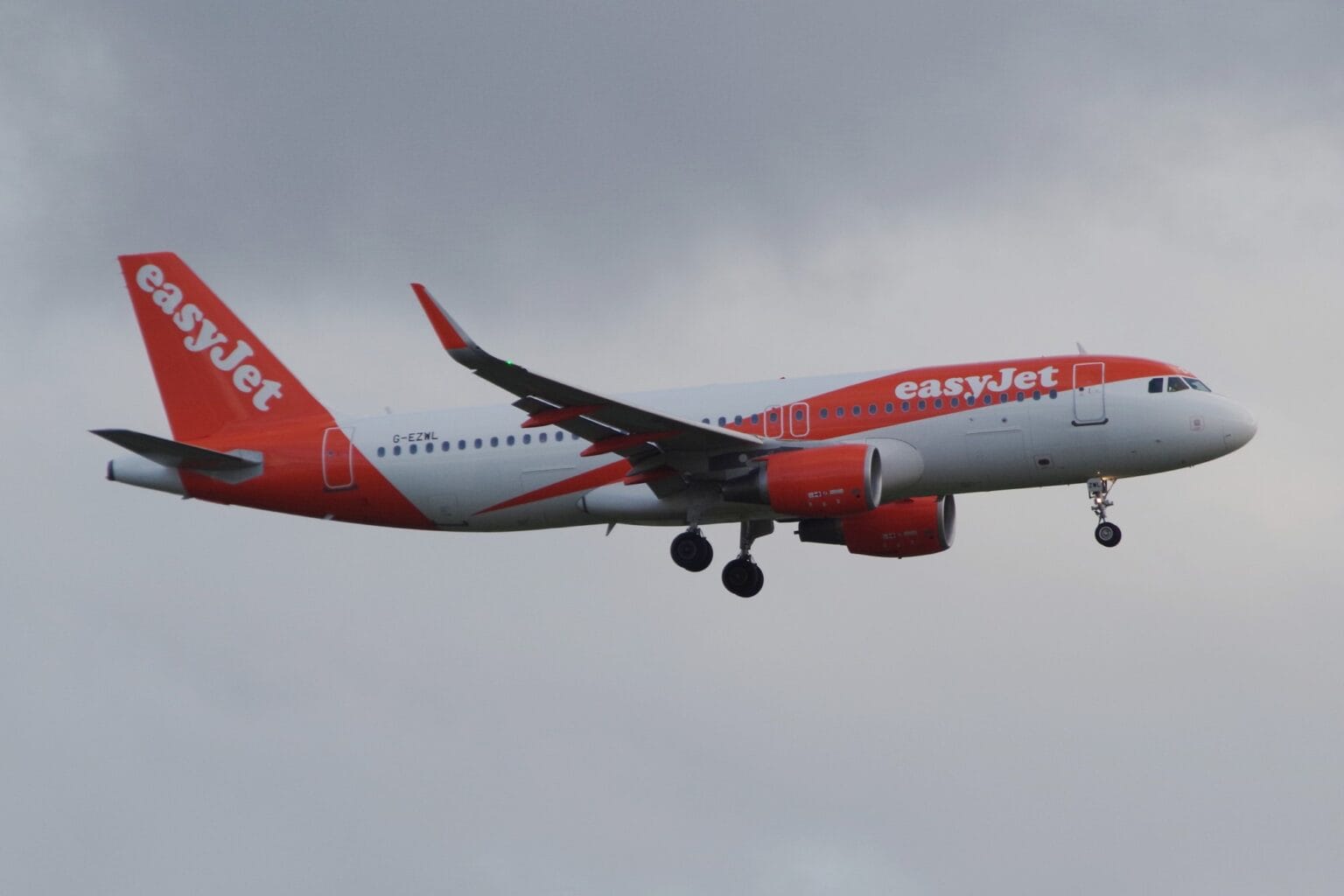
easyJet flight U23170 from Larnaca to Glasgow diverted to Amsterdam Schiphol overnight on October 6, 2026, after a passenger needed CPR in the cabin. The Airbus A320, registered G-EZWL, was cruising over the North Sea when the crew declared an emergency.
The diversion was first reported by AIRLIVE. At the time of writing, easyJet had not commented publicly, and the passenger’s condition was unknown.
What happened on U23170
The flight took off from Larnaca, Cyprus, at 10:16 p.m. local time, according to FlightAware data. Almost four hours after takeoff it was cruising at 38,000 feet over the North Sea, northwest of the Dutch coast and heading for Scotland.
AIRLIVE reported that a passenger then went into life-threatening distress and that people on board began CPR. The captain set the emergency transponder code 7700 and told air traffic control the aircraft needed to land immediately.
The tracking data shows the jet starting down from 38,000 feet at 23:10 UTC and turning back toward the Netherlands. At that point it was about 73 nautical miles (134 km) from Schiphol and more than 300 nautical miles from Glasgow.
Controllers cleared a direct descent, and the A320 landed on Runway 06 at Amsterdam Schiphol at 1:34 a.m. local time on October 7. AIRLIVE reported that this was 22 minutes after the distress call, and that medical teams boarded at gate D60 to take over care.
The same aircraft left Amsterdam for Glasgow at 12:28 p.m. local time on October 7, flying as EZY9170, FlightAware shows. easyJet has not said how many passengers were on board.
Why the crew turned back to Amsterdam
Passengers whose hearts go into ventricular fibrillation on board rarely survive, because emergency care and defibrillation are so far away, a 2000 study of airline cardiac cases noted. Getting the patient to paramedics quickly is the main thing a crew can do.
Schiphol was already behind the aircraft, but at about 73 nautical miles it was the closest major airport. Norwich, in eastern England, was about 86 nautical miles away, and Glasgow was more than 300.
Most medical calls on board do not end in a diversion. A 2013 New England Journal of Medicine study of 11,920 in-flight medical calls from five airlines found one emergency per 604 flights, but a diversion in only 7.3% of them.
A similar choice faced the crew of British Airways flight BA711 from Larnaca, which diverted to Luxembourg with a medical emergency on September 27.
The defibrillator question
EASA says automated external defibrillators, or AEDs, are essential to improving the chances of survival from heart rhythms such as ventricular fibrillation when used within the first 10 minutes. The rules on carrying them differ between the US and Europe.
In the US, federal rule 14 CFR 121.803 has required an AED on every airliner that needs a flight attendant and has a payload above 7,500 pounds (3,400 kg) since April 12, 2004.
In Europe, EASA changed its guidance in 2021 to say operators should carry an AED on every aircraft that has a first-aid kit and at least one cabin crew member. That is an acceptable means of compliance, the agency’s guidance layer, rather than a hard rule in the regulation itself.
The evidence for the devices goes back to the late 1990s. A US airline that fitted AEDs in 1997 recorded 14 cases of ventricular fibrillation in just over two years, and the survival rate to hospital discharge after a shock was 40%, that 2000 study in the same journal reported.
Whether an AED was used on U23170 has not been reported. What the flight data does show is a crew that went from cruise to the runway on an Airbus A320 in under half an hour.
Sources and references used for research and fact-checking.
- FlightAware, EZY3170 flight history and track log, October 6, 2026 (Larnaca to Amsterdam)
- eCFR (FAA), 14 CFR 121.803 Emergency medical equipment
- EASA, FAQ: Is there any regulatory statement by which it is required for all European aeroplanes to carry a defibrillator on board?
- New England Journal of Medicine (Peterson et al., 2013), Outcomes of medical emergencies on commercial airline flights
- New England Journal of Medicine (Page et al., 2000), Use of automated external defibrillators by a U.S. airline
Get the Newsletter
The latest aviation news and stories sent to your inbox.
About the Author

Tim is the owner and lead editor of AeroCorner since 2019, overseeing aviation content covering aircraft, airlines, airports, and the broader aviation industry. Through years of researching, writing, editing, and publishing aviation-focused content, he has developed extensive practical knowledge of commercial aviation and air travel. Based in Asia and a frequent traveler himself, Tim also brings firsthand passenger experience to AeroCorner’s coverage. Outside of publishing, he has also explored aviation firsthand through hands-on flight training in New Zealand.