

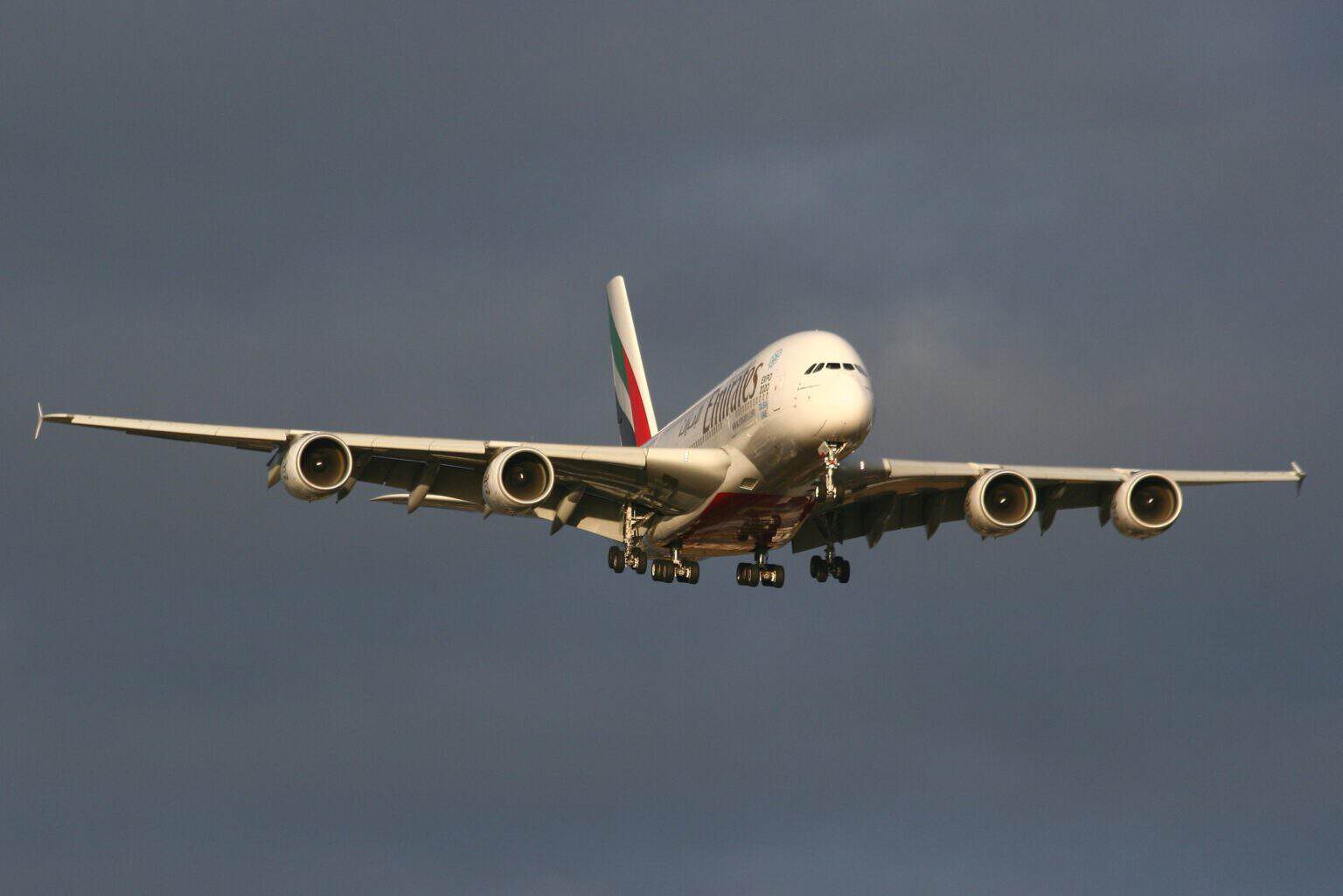
Emirates flight EK31, an Airbus A380-800 flying from Dubai to London Heathrow, diverted to Frankfurt on Thursday, October 1, 2026, after a passenger suffered a medical emergency. The airline said the jet landed safely and the passenger left the aircraft for further treatment.
The crew set the emergency transponder code 7700 while cruising at about 40,000 feet over Europe, according to flight-tracking reports. After about two hours on the ground in Frankfurt, the A380 continued to Heathrow.
What happened on EK31
Emirates confirmed the diversion in a statement to Gulf News. “Our cabin crew assisted the flight, and medical support was arranged on arrival,” the airline said, adding that “the health and safety of our passengers and crew is always our highest priority.”
The airline did not describe the passenger’s condition, and no update on it had been published at the time of writing. Emirates also apologized to customers for the delay.
The flight left Dubai at 07:30 UTC on its scheduled 7-hour, 20-minute trip, AIRLIVE reported. Roughly six hours in, the crew squawked 7700, began descending and turned for Frankfurt.
AIRLIVE identified the aircraft as A6-EDX. It reported that the A380 touched down on Frankfurt’s runway 25L at 16:09 local time and taxied to a remote stand.
The first explanation was vague. AIRLIVE said Emirates initially cited “operational reasons” before confirming that the diversion was medical.
AIRLIVE reported that it left Frankfurt at 18:10 local time with an arrival in London scheduled for 18:38, and Emirates said it was rebooking passengers who had missed connections.
Why a medical call triggers squawk 7700
Code 7700 is the general emergency setting on an aircraft’s transponder squawk codes. The FAA’s Aeronautical Information Manual tells pilots to use it for any “distress or urgency condition,” not only a mechanical failure.
Setting it does something practical. The manual says code 7700 normally triggers an alarm or special indicator at every control position, so the flight stands out on radar screens at once.
That is why a passenger illness on a widebody can look alarming on a flight-tracking map. The code tells the public that something is wrong, but not what, which is how a medical diversion briefly reads like a technical emergency.
It also differs from code 7500, which signals unlawful interference. That was the code another Dubai-based carrier’s jet set a day earlier, when Flydubai FZ1073 diverted to Tabuk after a violent incident in the cockpit.
How often a sick passenger turns a flight around
In-flight medical emergencies are common, but diversions for them are not. A study in the New England Journal of Medicine reviewed 11,920 such calls from five airlines to a ground-based physician service between 2008 and 2010.
It found one medical emergency for every 604 flights, and the aircraft diverted in 7.3% of them. Fainting or near-fainting was the most common problem, and a physician passenger helped in nearly half of the cases.
Of the patients followed up after landing, about a quarter went to a hospital, 8.6% were admitted and 0.3% died. Possible stroke, breathing problems and cardiac symptoms were the most common triggers for admission.
Six hours into a 7-hour, 20-minute trip, the crew faced a simple trade: continue for more than an hour to Heathrow or land sooner at a major hub. EK31’s crew chose Frankfurt, in line with what Emirates described as a priority on the passenger’s health.
Sources and references used for research and fact-checking.
Get the Newsletter
The latest aviation news and stories sent to your inbox.
About the Author

Tim is the owner and lead editor of AeroCorner since 2019, overseeing aviation content covering aircraft, airlines, airports, and the broader aviation industry. Through years of researching, writing, editing, and publishing aviation-focused content, he has developed extensive practical knowledge of commercial aviation and air travel. Based in Asia and a frequent traveler himself, Tim also brings firsthand passenger experience to AeroCorner’s coverage. Outside of publishing, he has also explored aviation firsthand through hands-on flight training in New Zealand.