

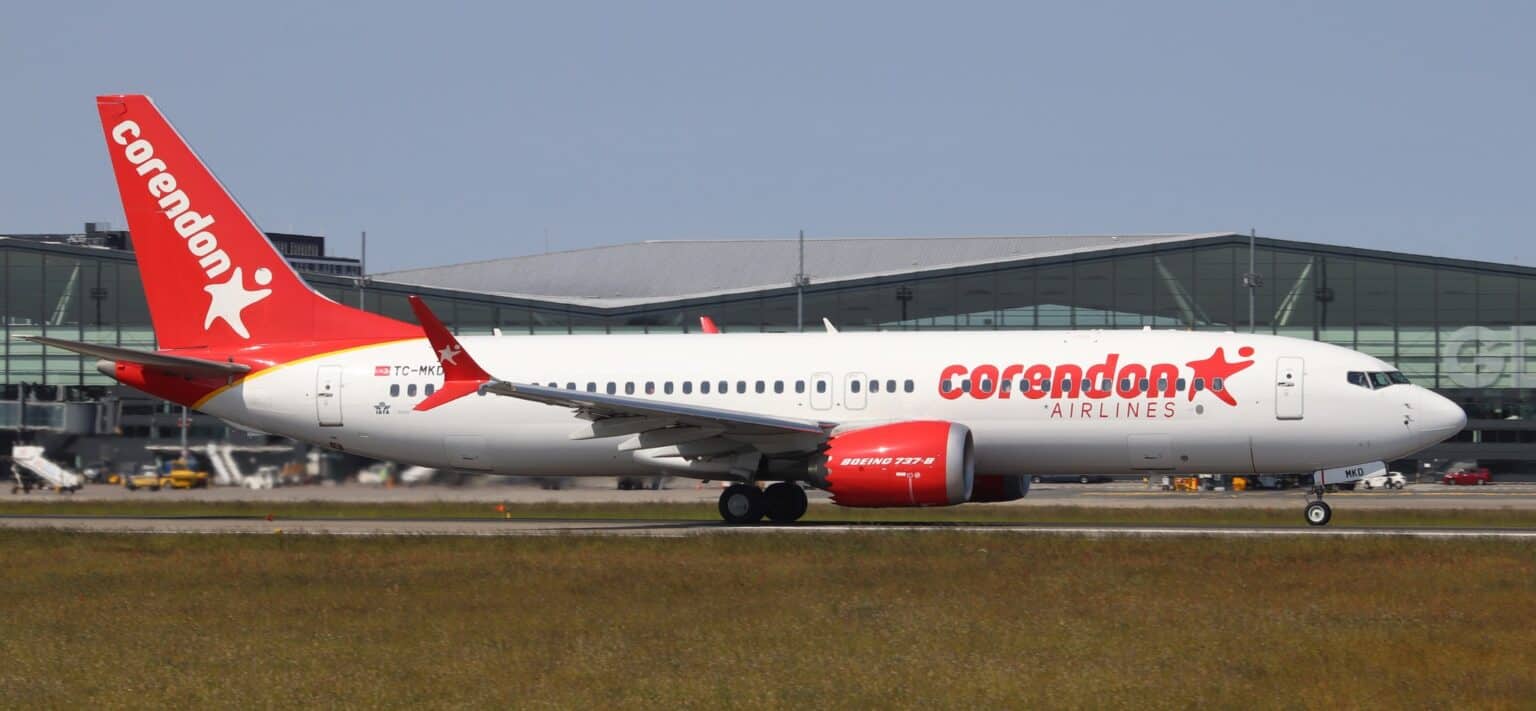
A Corendon Airlines Boeing 737 MAX 8 operating flight XC185 struck a stationary airport fire truck while taxiing for departure at Friedrichshafen, Germany, on the evening of Wednesday, September 30, 2026. The jet, registered TC-MKD, was bound for Antalya, Turkey, with 189 passengers and its crew on board.
The collision damaged the winglet on the left wing, according to the airport. Nobody on board was hurt, and the jet taxied back to its parking position under its own power.
What the airport and police have said
The truck belonged to the airport’s own fire service, Bodensee-Airport Friedrichshafen said in a statement on October 1. The aircraft was taxiing toward the runway when it hit the vehicle.
Police told the German news agency dpa that the wing struck the truck and put the damage at about 300,000 euros. The fire truck was standing still at the time, and the contact came during a turning maneuver, police said according to Feuerwehrmagazin.
Neither the airport nor the police has said why the truck was where it was, or how the turn brought the wingtip into it. Airport spokesperson Bernd Behrend said the authorities responsible are investigating, and that the airport could not yet comment on the sequence of events or the cause.
Corendon said in a statement, reported by the Turkish site Herdem Aviation, that inquiries into how the aircraft and the fire vehicle came into contact are ongoing. The airport’s statement does not name the agency leading the investigation.
A five-hour wait and a night-flight exception
Corendon sent a replacement aircraft, and the passengers reached Antalya about five hours late. The authorities granted an exception to Friedrichshafen’s night flight ban so the replacement could leave.
Reporting by Vorarlberg Online says the replacement jet came from Düsseldorf, landed around 9:40 p.m. and departed around 11 p.m. local time. XC185 had been scheduled to leave at 5:35 p.m.
“We quickly ordered huge amounts of pizza and delivered drinks to the waiting area,” Behrend said of the evening, in the airport’s statement. The damaged 737 MAX 8 will stay at Friedrichshafen until it is repaired.
Why wingtips and ground vehicles meet
A taxiing airliner is steered by its nose wheel, but its wings reach far beyond the path the crew is watching. The Boeing 737 MAX 8 spans 117 feet 10 inches (35.9 m), according to Boeing, which puts each wingtip about 59 feet (18 m) from the centerline.
That is why airports paint taxiway markings and clearance lines to keep vehicles and parked aircraft out of a moving jet’s way. When a vehicle or another aircraft sits inside that protected space, the margin the layout is meant to guarantee is gone.
The NTSB flagged the problem in a 2012 letter to Europe’s aviation regulator, EASA, after investigating 12 accidents since 1993 in which a large airplane’s wingtip hit another airplane or an object while taxiing. It asked for an anti-collision aid, such as a camera system, on airplanes whose wingtips are not easily visible from the cockpit.
The models it named were the 747, 757, 767 and 777, the A380, and the MD-10 and MD-11. The narrowbody 737 was not on that list.
The cost of these slow-speed contacts can still be high. At Charleston in July 2025, an ANA 787-10’s left wingtip hit the rudder of a parked Breeze Airways A220, and the NTSB found substantial damage to both jets. It blamed a mis-parked aircraft whose tail protruded into the taxiway, and the 787 crew’s failure to keep enough clearance.
At Friedrichshafen, the cause is still open at the time of writing, and the airport says the authorities are investigating.
Sources and references used for research and fact-checking.
Get the Newsletter
The latest aviation news and stories sent to your inbox.
About the Author

Tim is the owner and lead editor of AeroCorner since 2019, overseeing aviation content covering aircraft, airlines, airports, and the broader aviation industry. Through years of researching, writing, editing, and publishing aviation-focused content, he has developed extensive practical knowledge of commercial aviation and air travel. Based in Asia and a frequent traveler himself, Tim also brings firsthand passenger experience to AeroCorner’s coverage. Outside of publishing, he has also explored aviation firsthand through hands-on flight training in New Zealand.