

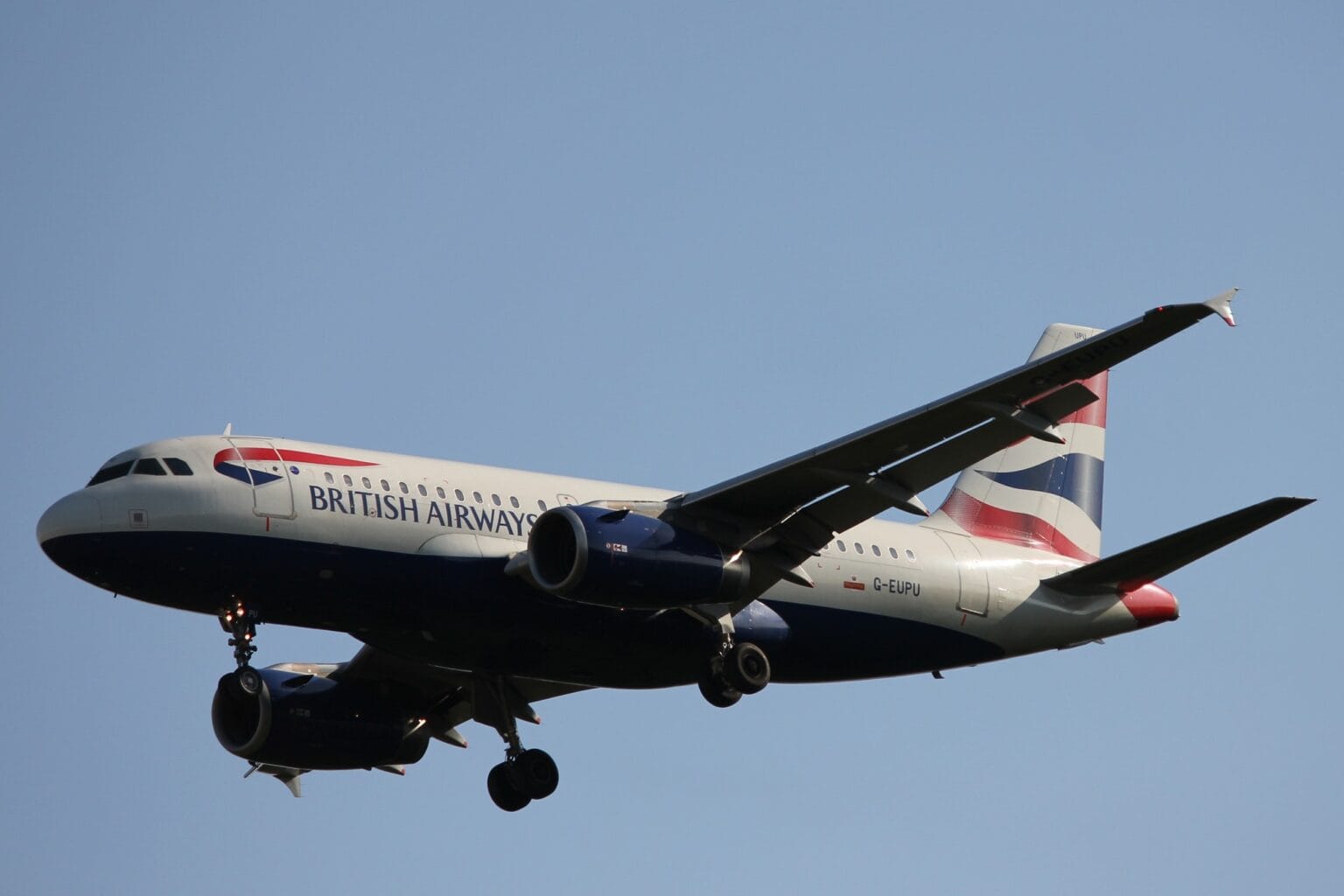
British Airways flight BA559 from Rome hit sudden turbulence as it approached London Heathrow on the evening of October 7, 2026, and a flight attendant was hurt. The cabin crew member lost her footing and injured her ankle, according to AIRLIVE, which reported the incident on October 8.
The Airbus A319, registered G-EUPU, left Rome Fiumicino at 6:44 p.m. local time and landed at Heathrow at 7:43 p.m. UK time, FlightAware data shows. At the time of writing, British Airways had not commented publicly.
A routine flight until the approach
Citing flight-tracking data, AIRLIVE said the A319 cruised at 36,000 feet over Italy and climbed to 38,000 feet over France. The flight was uneventful until the turbulence struck without warning on the approach to Heathrow, the outlet reported, describing it as clear-air turbulence.
During the descent, the pilots called British Airways operations to report the injury and ask for medical help on arrival. Ground staff and a medical team were alerted to meet the flight attendant at the gate after the jet landed safely.
She had been rostered on the aircraft’s next flight, BA1340 to Newcastle, and could not work it, so the airline had to find a replacement at short notice. Flightradar24 shows G-EUPU leaving Heathrow for Newcastle at 8:52 p.m., seven minutes after its scheduled time, and landing there at 9:40 p.m.
How badly the flight attendant was hurt has not been made public. Nor has it been reported whether the seatbelt sign was on, or whether any passengers were injured.
Why cabin crew take most turbulence injuries
Turbulence seldom damages the aircraft itself; the people at risk are the ones who are not strapped in. If you want the meteorology, our guide to what causes turbulence covers the different types.
The clearest numbers come from the US National Transportation Safety Board, whose 2021 safety research report found that turbulence was involved in 111 of the 295 accidents at US airlines from 2009 through 2018, or 37.6%, making it the most common kind of accident at those airlines. Not one of the 111 caused substantial damage to an airplane.
Flight attendants made up 97 of the 123 people seriously injured in those accidents, or 78.9%. Of those 97, 81 were documented as not wearing a seat belt, and no pilot was seriously hurt in the period.
Timing matters too: the NTSB found that about half of the turbulence accidents happened during descent or approach, the stage of a flight when cabin crew are often on their feet preparing the cabin for landing. Of the descent-phase accidents with a known altitude, about two-thirds happened below 20,000 feet.
In 28.7% of the accidents the NTSB studied, the flight crew had no advance warning of the turbulence, and clear-air turbulence was present in 32 of the 111.
A brief jolt can still break bones
A British Airways A380 flying from Los Angeles to Heathrow on December 6, 2024 met turbulence lasting about 10 to 15 seconds that the captain judged light to moderate. A flight attendant lowering her seat to strap in was lifted and fell, breaking her ankle, and a passenger also suffered a serious leg injury, the UK Air Accidents Investigation Branch found. The seatbelt signs had been on for about 20 minutes.
That case, published in AAIB Bulletin 1/2026, ended with a pointed conclusion: had the seatbelt signs been off, more people might have been hurt. It also credited the crew’s live weather app, which had flagged the forecast turbulence and let them secure the cabin early.
What happens next
Whether BA559 counts as an accident in law depends on the injury. Under UK law, an occurrence counts as an accident if someone is seriously injured, which includes a hospital stay of more than 48 hours or a fracture of any bone other than a simple fracture of a finger, toe or nose.
A minor sprain would normally fall short of that bar; a broken ankle would not. Until British Airways or the AAIB says more, the extent of the injury is unknown.
In July, two flight attendants on American Airlines flight AA174, a 777, were hurt when severe turbulence forced a diversion to JFK.
Sources and references used for research and fact-checking.
- NTSB, Preventing Turbulence-Related Injuries in Air Carrier Operations Conducted Under Title 14 CFR Part 121 (Safety Research Report NTSB/SS-21/01)
- UK Air Accidents Investigation Branch, AAIB Bulletin 1/2026: Airbus A380-841, G-XLEI
- legislation.gov.uk, Regulation (EU) No 996/2010 (UK retained), Article 2: Definitions
Get the Newsletter
The latest aviation news and stories sent to your inbox.
About the Author
Tim is the owner and lead editor of AeroCorner since 2019, overseeing aviation content covering aircraft, airlines, airports, and the broader aviation industry. Through years of researching, writing, editing, and publishing aviation-focused content, he has developed extensive practical knowledge of commercial aviation and air travel. Based in Asia and a frequent traveler himself, Tim also brings firsthand passenger experience to AeroCorner’s coverage. Outside of publishing, he has also explored aviation firsthand through hands-on flight training in New Zealand.