

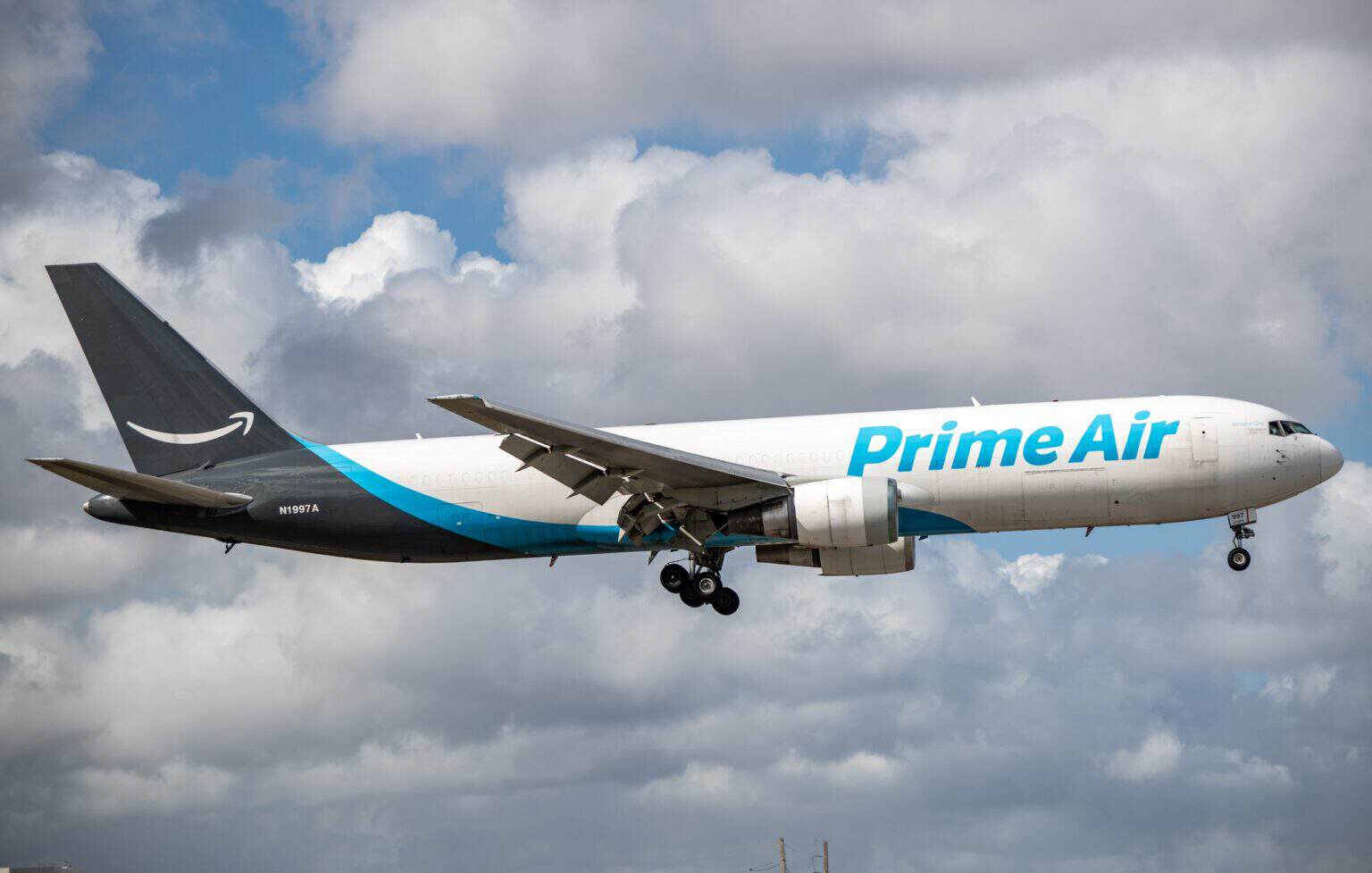
The Amazon cargo jet that overran a runway at Miami on September 6, 2026, 21 Air flight 7598, crossed the runway threshold at a groundspeed of 177 knots and did not touch down until about 3,750 feet along runway 30, according to the NTSB’s preliminary report on the Boeing 767 freighter, registration N1997A, released on October 1.
The report also finds that the tower controller cleared the flight to land without giving the crew any wind information. FAA air traffic rules require a controller to state the wind direction and speed when clearing an aircraft onto a runway with a tailwind component.
What happened on runway 30
Flight 7598 was a cargo flight from San Juan, Puerto Rico, operated by 21 Air on behalf of Amazon. It ran off the northwest end of runway 30 at Miami International Airport at about 1:53 p.m. and struck two vehicles.
Five of the seven people in a Ford Econoline van on the airport perimeter road were killed, and the other two were seriously injured. The jet then crossed NW 67th Avenue and hit a Toyota SUV, seriously injuring its sole occupant, before stopping about 1,200 feet beyond the end of the pavement. Both pilots had minor injuries.
The NTSB’s September 9 recorder update had already shown a go-around called after touchdown and no deployment of the speed brakes or thrust reversers. The preliminary report adds where on the runway each step happened, and how much pavement was left.
| Moment | Groundspeed | Runway remaining |
|---|---|---|
| Crosses the runway 30 threshold about 105 feet above the ground | 177 knots | Not stated |
| Main gear tire marks begin, about 3,750 feet past the threshold | About 160 knots | Not stated |
| Wheel brakes applied | 146 knots | Not stated |
| Weight-on-wheels sensor settles on “ground” | Not stated | About 2,730 feet |
| Brakes released, throttles advanced to go-around thrust | 120 knots | About 930 feet |
| Throttles back to idle, brakes reapplied | 117 knots | About 415 feet |
| Crosses the end of the runway | 113 knots | None |
| Hits the localizer antenna and approach lights | About 100 knots | Beyond the runway |
The wind the crew was not given
Thunderstorms were reported at the airport that afternoon. Its weather station recorded a wind shift at 1:37 p.m., and a peak wind of 26 knots from 180 degrees at 1:52 p.m., a minute before the crash.
The observation issued at 1:53 p.m. gave the wind from 190 degrees at 17 knots, gusting to 26. Runway 30 points roughly northwest, so a wind from that direction blows from behind the left side of a landing aircraft.
Part of that wind acts as a tailwind, which adds to groundspeed at any given airspeed. A jet landing with one covers more ground before the wheels touch, then has more speed to shed on the runway that is left.
About four minutes before clearing flight 7598, the same controller told another flight the wind was from 190 degrees at 19 knots, gusting to 22. Flight 7598 was not yet on that frequency, and its own landing clearance, issued about 12 nautical miles out, carried no wind at all.
The controller had 11 years of air traffic experience and had been on the position for about 17 minutes. The report does not say what wind information the crew had from other sources.
21 Air told the Associated Press it is reviewing the report alongside its own safety and operational protocols and “will take all appropriate action” as the facts are established.
The crew and what investigators found in the cockpit
The captain was flying. He had about 7,267 total hours, including about 2,700 on the Boeing 737, but only about 150 on the 767, having joined 21 Air in April 2026 and earned his 767 type rating on May 18.
The first officer had about 2,800 hours, 800 of them on the 767. The pair had flown together for the first time that morning, on the outbound leg from Miami to San Juan.
On the approach, the captain called for flaps 30, 41 seconds before the cockpit recording ended. In the wreckage, investigators found the flap lever in the 25-degree detent, and the flap and slat mechanisms measured consistent with flaps 25. The report does not reconcile the two.
The thrust reverser levers were in their first detent and the speed brake lever was stowed. The throttles were at idle, both fuel control switches at cutoff and both engine fire handles pulled and rotated, and the report does not say when any of these controls was moved.
Brake wear pins on all eight main wheels still showed remaining service life.
No arresting bed at the end of runway 30
Runway 12/30 is 9,360 feet long and 150 feet wide, a length that includes a displaced threshold at the runway 30 end. The report notes that no engineered materials arresting system (EMAS) was installed at the far end.
An EMAS is a bed of crushable material beyond the runway end that slows an overrunning aircraft far faster than open ground. The FAA says a standard bed will stop a runway’s critical aircraft that enters it at 70 knots or less, and flight 7598 crossed the end of the runway at 113 knots.
N1997A was built in June 1994 as a passenger jet and converted to a freighter in June 2016. It had logged about 110,077 flight hours and 24,505 cycles, and was powered by General Electric CF6 engines.
21 Air is based in Greensboro, North Carolina, with operations in Miami, and flew 22 Boeing 757s and 767s at the time. Amazon paused its flying with 21 Air after the crash.
The NTSB will feed the flight data into an airplane performance study to refine this sequence. No probable cause has been determined.
A preliminary report, not a finding of cause
Every figure in the NTSB preliminary report is labeled preliminary and subject to change. It does not say why the jet landed long and fast, why the speed brakes and reversers did not deploy, or whether the missing wind report played a part.
Sources and references used for research and fact-checking.
Get the Newsletter
The latest aviation news and stories sent to your inbox.
About the Author
Tim is the owner and lead editor of AeroCorner since 2019, overseeing aviation content covering aircraft, airlines, airports, and the broader aviation industry. Through years of researching, writing, editing, and publishing aviation-focused content, he has developed extensive practical knowledge of commercial aviation and air travel. Based in Asia and a frequent traveler himself, Tim also brings firsthand passenger experience to AeroCorner’s coverage. Outside of publishing, he has also explored aviation firsthand through hands-on flight training in New Zealand.